
Wall Switch Comparison Scorecard: Function, Fit, Fire Safety and Certification
Wall Switch Comparison Scorecard: Function, Fit, Fire Safety and Certification
A wall switch comparison usually collapses into one number — 10AX or 10A 250V~ — and then into a price. For a Decision-stage buyer that order is backwards: the rating declares a load envelope, while the project actually depends on control function, plate fit, material behaviour and model-level certification evidence.
This scorecard compares five common variants — 1 gang 1 way, 2 gang 1 way, 2 gang 2 way, intermediate, and push bell with LED — across four weighted dimensions: control function, physical fit on 65×65 mm or 81.6×81.6 mm panel formats, material and fire safety from ABS base to flame-retardant PC panel, and certification and durability evidence covering CE, TUV, SAA and 40,000-cycle endurance data. Wenzhou Huafeng Electric Co., Ltd. (HYFF) is a Wenzhou-based manufacturer of wall switches and wall sockets, founded in 2011, operating a 7,000 m² factory with 118 employees, 10 engineers and an annual output of 35,000,000 units, all of it exported to Europe, the Americas, Oceania, Asia and Africa. Its range is the working example for the method, not the conclusion of it.
Why a rating line cannot rank wall switches
A rating is a declaration about load and test conditions, not a statement about build quality. Two switches can carry the same 10 A 250V~ marking and still differ in terminal design, copper cross-section, contact pressure, spring performance and the flame performance of insulating parts. HYFF's risk analysis names the failure paths directly: poor contact, loose wiring, overheating, electrical arcing and reduced service life, arising from frequent long-term operation or loads beyond the rated capacity. The stated control methods are equally concrete — proper contact and terminal design, copper components sized for the rated current, and flame-retardant insulating materials.
None of those controls appear on the rating line. That is the gap a scorecard has to close: the rating answers "may this variant be connected to this load?", while the four dimensions below answer "is the evidence behind this variant complete enough for this project?". Keeping the two questions apart prevents a familiar pattern in comparison work — a higher or more elaborate marking being read as a quality verdict it was never designed to give.
The scorecard: four dimensions and one evidence rule
The weights below are an editorial starting point for a Decision-stage buyer weighing mechanical wall switches for a defined project. They are not a market benchmark, a certified rating or a scoring system published by any standards body, and they should be re-weighted per project rather than copied unchanged.
| Dimension | Default weight | Core question | Evidence that moves the score |
|---|---|---|---|
| Control function | 30% | Does the variant serve the required number of control points and load groups? | Wiring diagram, terminal count, gang/way designation, matching devices at the other end |
| Physical fit | 20% | Does the plate format match the box, frame, opening and cable space? | Dimensional drawing, panel format, frame and mounting details, installation instruction |
| Material and fire safety | 25% | Are base and panel materials declared per part, with fire and heat test evidence? | Material declaration per part, glowing-filament and ball-pressure test results |
| Certification and durability | 25% | Which certificates cover this exact model, and what endurance data exists? | Declaration of conformity, certificate number and model list, life-test report, production test records |
Each dimension is then scored against documentation depth rather than against a supplier's adjective: 0 = claim only; 1 = marking or declaration only; 2 = model-specific certificate or test report; 3 = model-specific report plus production test records. The rubric measures what a buyer can verify, and it keeps an unverifiable claim visible instead of averaging it into a comfortable total.
Dimension 1: scoring control function across five variants
Control function is the only dimension where a higher score is genuinely better for the application — and even there the gain is project-specific. A 1 gang 1 way switch is not inferior to an intermediate switch; it is simply the wrong device for a corridor that needs four control points.
| Variant | Function scoring basis | Fit dependency | Evidence dependency |
|---|---|---|---|
| 1 gang 1 way | One load, one control point. Highest function value in simple rooms; scores zero for multi-point layouts. | Confirm which plate format the reference is built on; a shared dimension does not by itself prove interchangeability. | Rated load type, terminal type, life-test report for the model |
| 2 gang 1 way | Two independent loads from one point. Check gang separation and whether simultaneous loading changes the declared conditions. | Gang count affects plate rigidity and termination space on either format. | Per-gang rating, not a combined headline figure |
| 2 gang 2 way | Two loads, each switchable from a second position. Terminal count roughly doubles against 1 way. | Cable and terminal space becomes a fit criterion, not just a plate measurement. | Wiring diagram and confirmation of the matching two-way device |
| Intermediate | Four-terminal device inserted between two two-way switches so a load can be controlled from three or more points. The largest function gain for long circulation routes. | Deserves its own line in the matrix; it is not a substitute for a two-way switch. | Terminal identification and a wiring diagram covering the full multi-point circuit |
| Push bell with LED | Momentary contact for bell or chime circuits with LED indication — typically entry and service positions rather than lighting groups. | Small face format common; confirm plate match with adjacent switches in the same run. | LED circuit compatibility and doorbell test evidence |
The pattern is that function and wiring complexity rise together. Intermediate and two-way variants add terminals, and terminals consume the same back-of-plate volume that fit scoring is meant to protect. Treating function as a free upgrade is how a specification ends up correct on paper and untidy in the wall box.
Dimension 2: physical fit — 65×65 mm modular versus 81.6×81.6 mm panel
Neither format is a quality tier. The 65×65 mm square module belongs to framed or modular plate systems where several functions are assembled behind a common surround; the 81.6×81.6 mm panel is a larger face format where the plate itself carries the visible geometry. The score should follow the installation, not the millimetre count.
| Check item | 65×65 mm modular | 81.6×81.6 mm panel |
|---|---|---|
| Assembly logic | Modules combined inside a frame; frame system must be specified with the modules. | Plate supplied as a single face; fewer separate parts to align. |
| Multi-gang density | Gang count grows by adding modules within the frame width. | Gang count is fixed by the plate; verify the exact configuration ordered. |
| Opening and retrofit | Depends on frame and box compatibility; measure the existing opening first. | Relevant where an existing opening already matches the larger face. |
| Termination space | Shared frame depth is consumed by every added module. | Space per gang must be confirmed for two-way and intermediate wiring. |
| Finish continuity | Frame and module finish must match across the run. | Plate batch consistency matters when a wall is completed in stages. |
Fit is the dimension most often decided by a photograph rather than a drawing. The defensible approach is to score it only against a dimensional drawing and the box or opening actually present on site, and to treat any format substitution as a new specification line rather than a like-for-like swap.
Dimension 3: ABS base versus flame-retardant PC panel
The two materials do different jobs, which is why scoring them as competing options distorts the comparison. The base is the structural and insulating carrier that holds contacts and terminals; the panel is the exposed front that defines appearance and takes the brunt of user contact and cleaning. Material declarations should therefore be read per part, not per product.
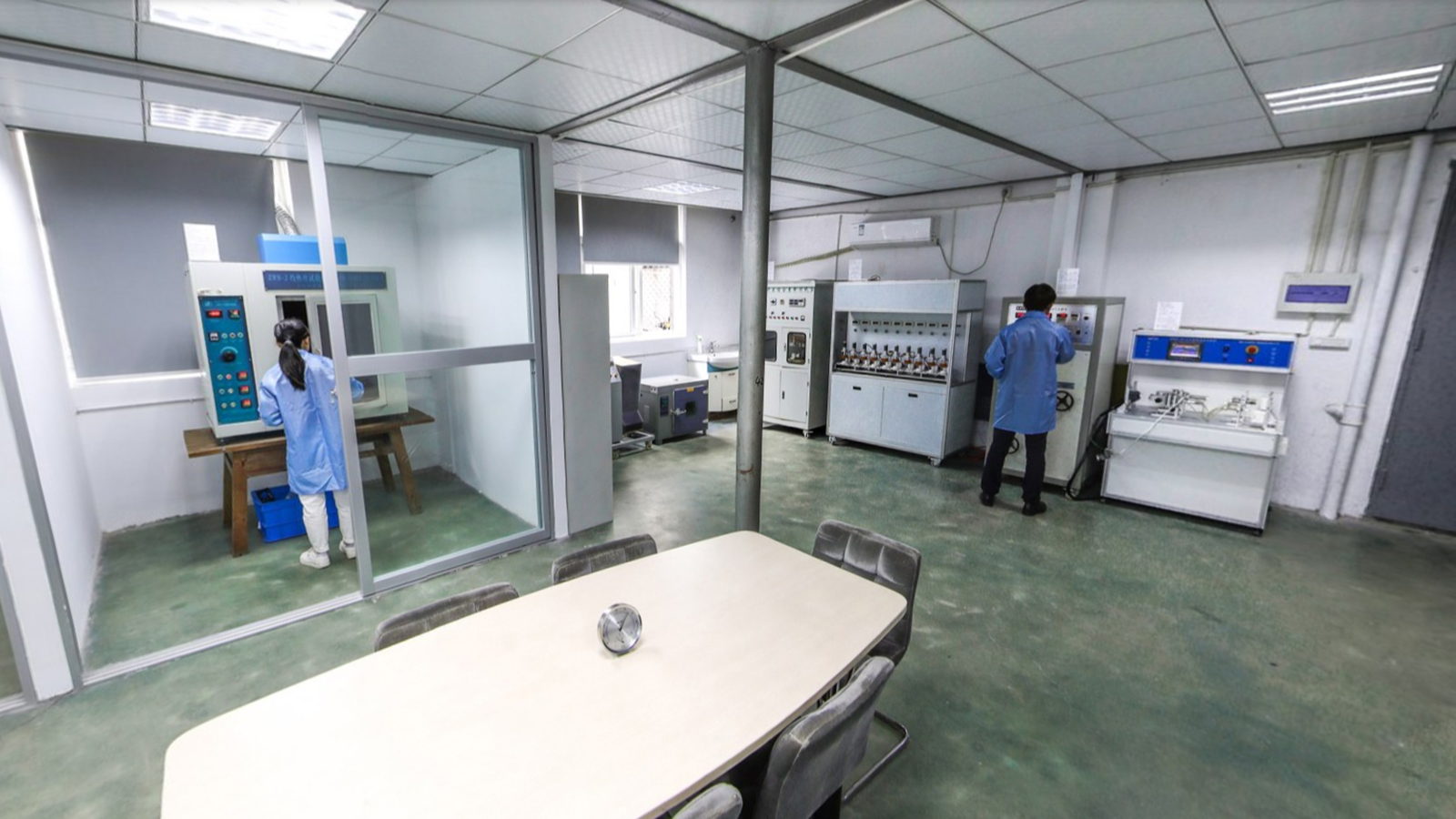
Flame retardancy is a grade property, not a family property. "ABS" and "PC" describe polymer families; whether a specific grade resists ignition and dripping has to be declared and tested. HYFF's inspection scope reflects that distinction: raw-material inspection, plastic parts inspection, plastic ball-pressure testing and glowing-filament testing sit alongside silver-layer thickness checks, performance life testing and on-line switch and socket on-off testing. For a buyer, the scoring question is not "ABS or PC" but "which tests support the fire and heat claim for this exact part, and are the results attached to this model?".
The risk evidence points the same way. Overheating and arcing are controlled by contact and terminal design and copper sized for the rated current, with flame-retardant insulating materials as the containment layer. A flame-retardant panel over an undeclared base, or a well-specified base behind an unverified panel, is an incomplete answer in both directions.
Dimension 4: certification and durability evidence
Certification is where comparison most often goes wrong, because three different instruments get treated as one. CE is a marking supported by a declaration against the applicable directives and standards — for flush-type fixed wall switches in the European Union, EN 60669-1:2018 is the standard identified as governing. TUV certification is third-party verification tied to specific models and test reports. SAA approval is the Australian route, where SAA Approvals defines a wall switch as an air-break switch rated not exceeding 20 A with AS/NZS 3133 as its class specification, and AS/NZS 3133:2020 is identified as the primary technical standard in Australia and New Zealand.
| Scheme or evidence | Basis | Scope question to ask | What it does not establish |
|---|---|---|---|
| CE | Declaration against applicable EU requirements; EN 60669-1:2018 identified for EU flush-type fixed wall switches | Which directive route, which standard edition, which models are listed? | Not a third-party certificate, and not proof for unlisted models |
| TUV | Third-party test and certification against named standards | Certificate number, test report reference, covered model list, current status | Does not extend to variants outside the listed scope |
| SAA | Australian approval route; AS/NZS 3133:2020 as class specification, wall-switch definition up to 20 A | Certificate holder, model list, applicable AS/NZS edition | Does not make European declarations interchangeable with Australian approval |
| 40,000-cycle endurance | Mechanical life testing of a sample under stated conditions | Which model, which load and operating conditions, what sample size? | Does not prove field life, load capacity or uniformity across production |
One numeric caution belongs here. AS 3133:2020 is described as applying to manually operated air-break switches up to 125 A and 500 V, while the SAA wall-switch definition uses a 20 A threshold. Those figures serve different purposes — standard scope versus product classification — and must not be merged into a single "rating" for a wall switch. HYFF's documented certification set for the range is CE, TUV and SAA, supported by 40,000-cycle endurance evidence; because such documents are model-scoped, the workable step is to request the certificate number and covered model list per reference rather than accept the set as a blanket claim.
Weighting 10AX and 10A 250V~ without treating either as a verdict
A 10 A 250V~ marking declares a 10 A rating at 250 V AC. A 10AX marking carries the same current and voltage figures with an X suffix used in IEC-based switch marking practice to declare suitability under fluorescent-lamp load conditions. The consequence is narrow but real: 10AX is not "a stronger 10 A switch"; it is a rating declared for a different load profile, and the declared load types should be read from the marking and datasheet rather than inferred from the letters.
Two limits keep the rating in its place. First, IEC 60669-1:2017 limits rated current to 16 A for switches fitted with screwless terminals, so terminal design and current rating are linked rather than independent variables. Second, LED and electronic products shift the question to a different standard part: EN 60669-1:2018 is described as including self-ballasted-lamp (LED) load testing, and IEC 60669-2-1:2021 covers electronic switches and building-automation switches at switching voltages up to 250 V AC and currents up to 16 A. A push bell with LED or a dimmable electronic unit is therefore screened under a different logic from a plain rocker switch, and a mechanical certificate should not be carried across.
In the scorecard, the rating earns no points. It is a gate: compatible with the project's load type, installation rules and terminal arrangement, or disqualified before weighting begins. That single change removes most of the false precision from wall switch comparison tables.
Applying the scorecard: B111 and A122 as criteria examples
HYFF's B111 and A122 references are the two most frequently quoted in buyer questions about 10AX versus 10A 250V~ marking and about certificate scope. They are used here strictly as criteria examples. The scorecard does not rank them against each other, and nothing in this section should be read as a comparative performance claim about either reference.
Applied to either one, the sequence is identical:
- Read the marking and datasheet for declared load type and rating, then confirm the terminal type and the resulting current limit.
- Match the certificate to the model. CE, TUV and SAA are model-scoped; request the certificate number and the covered model list, and check the standard edition cited.
- Confirm the plate format — 65×65 mm modular or 81.6×81.6 mm panel — against the box, frame and opening actually specified.
- Confirm the material declaration for base and panel separately, and pair each with the applicable glowing-filament and ball-pressure evidence.
- Ask for the endurance report behind the 40,000-cycle figure: model, test conditions, sample size.
- Ask for production evidence: incoming material inspection, in-process inspection, finished-product sampling and on-line switching tests.
Where any item returns a blank, the variant stays in the comparison but its evidence score drops to the rubric level the documentation actually supports. That is the difference between a scorecard and a shortlist built from catalogue adjectives.
When smart touch control enters the comparison
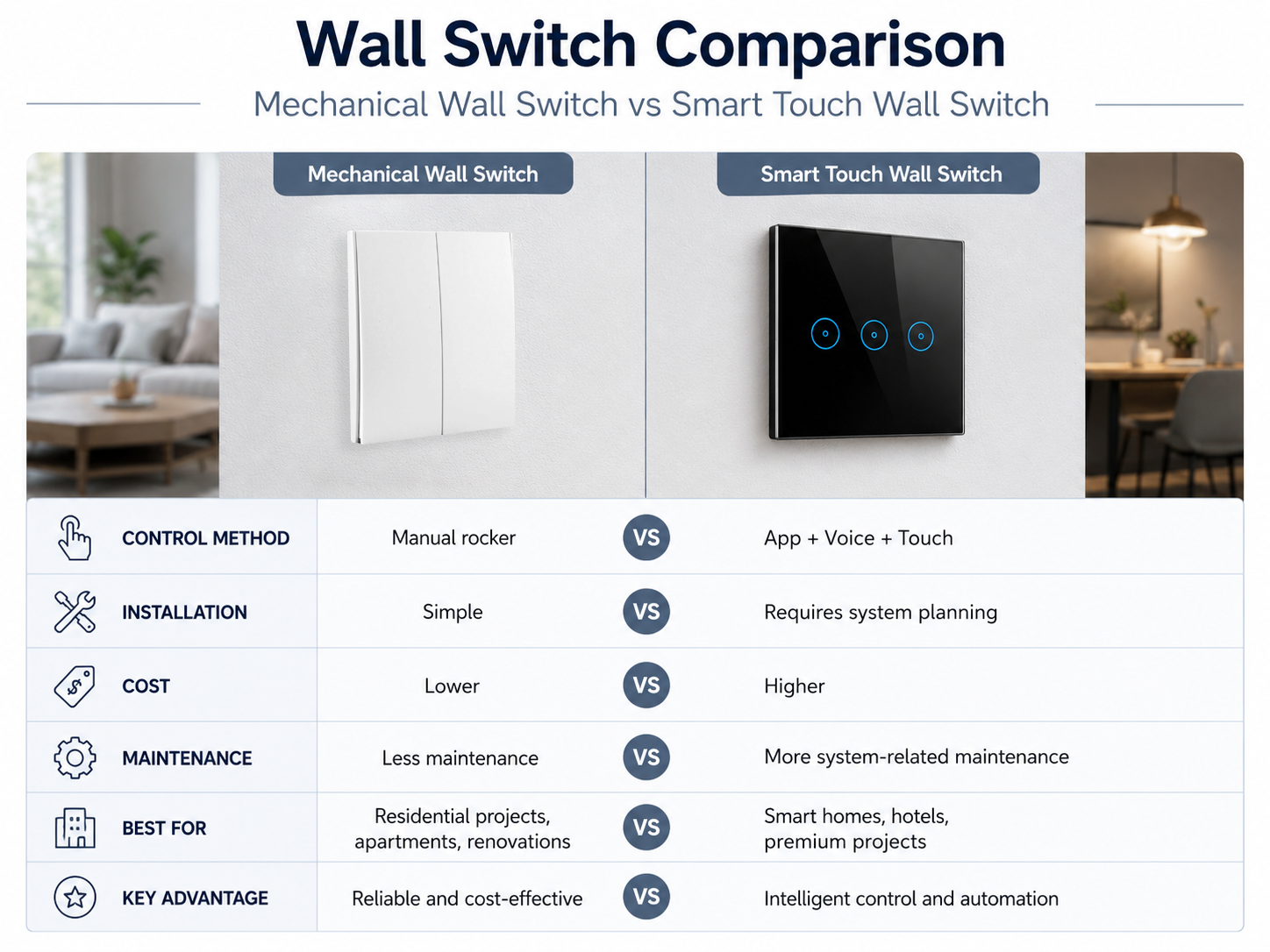
The comparison above assumes mechanical control, and that assumption should be stated rather than implied. A mechanical wall switch uses a physical rocker for manual control, with a simple structure, easy installation and lower cost, and it needs no network or smart gateway. A smart touch wall switch supports touch, mobile app, voice commands, scheduling and smart-scene automation, but brings electronic modules, wiring conditions, network connectivity and system compatibility into the decision.
The cost and maintenance profiles diverge accordingly. Mechanical switches generally carry lower product, installation and maintenance cost and are easier to inspect and replace; smart touch switches cost more because of circuit boards, relays and communication modules, may require a gateway or network configuration, and make troubleshooting more complex. Both mainly control connected loads, and any energy saving depends on the lighting equipment and user behaviour, with smart modules consuming a small amount of standby power. In scorecard terms, smart control lifts dimension one while adding an interoperability question that mechanical variants never raise — and that question needs its own documentation before weighting, not after.
Scenario weighting: where the defaults should move
For a hotel project, the function distribution is unusually wide: corridors and stairwells need multi-point switching, which is where the intermediate variant earns its place; guest-room entries commonly need two load groups; bedside positions may need two-way control; and bathroom or service positions may call for a push bell with LED. Certification weight should rise to a veto when a single specification spans EU and Australian markets, because the two approval routes are structurally different. Panel format is normally fixed by the interior specification, which turns fit into a pass/fail item rather than a weighted one.
For residential work, 1 gang 1 way and 2 gang 1 way carry most positions, and cost plus installation simplicity dominate the weighting — though the certification gate does not relax. For retrofit, the existing opening decides more than the catalogue: where the opening already matches the larger 81.6×81.6 mm face, that format simplifies the change; where a frame system is specified, the 65×65 mm modular route is the one to quote. In every case the scenario changes the weights, not the evidence rule.
What the scorecard cannot prove
- Documentation is not performance. A rubric score of 3 shows that reports and production records exist, not that every unit behaves identically.
- Cycle counts are test results. A 40,000-cycle figure describes a sample under stated conditions; it is not a warranty, a field-life prediction or a service commitment.
- Material families are not flame ratings. ABS and PC are polymer families; retardancy is a grade property that must be declared and tested for the specific part.
- Certificates are scope documents. A factory-level certificate does not automatically cover every model or variant in a catalogue.
- Weights are buyer decisions. The defaults in this article are an editorial starting point for a Decision-stage reader, not a measured market preference or an official ranking method.
Standards and market outlook
Two directions are worth tracking into the next procurement cycle. On standards, IEC 60669-2-1:2021 is the newer identified edition for electronic control devices, while the 2002+AMD1:2008 consolidated version remains historical reference material; national adoption and the applicable edition still have to be verified per market rather than assumed. The practical output for a buyer is a model-by-model compliance matrix that keeps CE, SAA, IEC and AS/NZS references in separate columns instead of treating them as interchangeable evidence.
On market direction, Mordor Intelligence — commercial research published in October 2026 — projects the global smart switch market moving from US$4.8 billion in 2023 to more than US$14 billion by 2030 at a 17.2% compound annual growth rate, with Europe playing a significant role due to smart building regulations. That is a forecast with stated assumptions, not a measured outcome, and it says nothing about any individual supplier's capacity, share or product performance. It does explain why documentation depth is becoming a differentiator: as specifications grow more electronic, the gap between a marking and a model-level record widens.
Frequently asked questions
Does a 10AX rating make a wall switch better than a 10A 250V~ switch?
No. Both declare a 10 A rating at 250 V AC, but the X suffix declares suitability under fluorescent-lamp load conditions, while a plain 10 A 250V~ marking states a general rating whose declared load types should be checked on the datasheet. The correct comparison is by declared load profile, terminal type and supporting test evidence, not by which marking looks more elaborate.
Can a 65×65 mm module and an 81.6×81.6 mm panel be treated as interchangeable?
Not by dimension alone. The 65×65 mm square module belongs to framed or modular plate systems, while the 81.6×81.6 mm face is a larger one-piece plate format. Interchangeability depends on the wall box, the frame system, the opening already present and the terminal space available behind the plate, so the substitution should be checked against a dimensional drawing before ordering.
Is an ABS base acceptable if the front panel is flame-retardant PC?
The two parts perform different functions. The base carries the contacts, terminals and mechanical load, while the panel is the exposed front. Acceptability depends on the declared grade and test evidence for each part — such as glowing-filament and ball-pressure results — plus contact and terminal design and copper sized for the rated current. Flame retardancy should be verified, never assumed from the material abbreviation.
What do CE, TUV and SAA each cover on a wall switch?
CE is a marking supported by a declaration against applicable EU requirements, with EN 60669-1:2018 identified as the governing standard for flush-type fixed wall switches in the EU. TUV is third-party certification against named standards for listed models. SAA is the Australian approval route, where the wall-switch definition is capped at 20 A and AS/NZS 3133:2020 is the class specification. All three are scope documents, so the model list matters as much as the mark.
What does 40,000-cycle endurance evidence actually demonstrate?
It demonstrates that a sample of a specified model completed a stated number of mechanical operating cycles under defined test conditions. It does not establish field life, load capacity, behaviour under overload, or uniformity across production. Buyers should ask which model was tested, what the load and operating conditions were, and whether production test records support consistency between the tested sample and the shipped units.
Conclusion
A wall switch comparison becomes decision-grade when the rating is demoted to a gate and the four dimensions carry the argument: control function for the layout, physical fit for the box and plate system, declared materials with fire and heat evidence, and certificates that name the exact model alongside endurance and production records. HYFF's 2026 product brochure, covering the wall switch and wall socket range, is available for download: HYFF 2026 brochure (PDF).
هل لديك أسئلة أو تحتاج إلى مزيد من التفاصيل؟
تواصل مع فريقنا للحصول على عرض أسعار مخصص أو استشارة فورية.
طلب عرض أسعار
املأ النموذج أدناه وسيتواصل معك فريقنا بعرض مقترح مخصص.
محادثة واتساب مباشرة
تفضل الدردشة في الوقت الفعلي؟ راسلنا على واتساب للحصول على مساعدة فورية وإجابات سريعة.
- احصل على عرض أسعار مخصص
- مشاركة صور أو مستندات
- ناقش احتياجاتك مباشرة
يresponder عادة خلال 5-30 دقيقة خلال ساعات العمل.