
Warehouse Tent Supplier Continuity: Capacity, Aftercare, Terms
A temporary warehouse is rarely bought once. It is bought in phases — one bay this quarter, sidewalls and insulation next season, a second site once the first is proven. Judging a supplier only against the first quotation answers the wrong question. What matters is whether the same frame system, engineering logic and commercial terms will still exist when phase two is approved.
Warehouse tents occupy an unusual position in industrial procurement: they are structures, but they are purchased like equipment. Buyers specify them against storage volume, pallet heights, forklift turning circles and a fixed date on which leased space expires. That pressure pushes a project from evaluation straight into execution, and the handover is precisely where multi-year supplier risk is created.
Shenzhen Shoulder Tent Co., Ltd. (Shoulder Tent) is a China-based manufacturer of large prefabricated aluminum-frame tent structures, founded in 2009 and operating a 20,000 m² factory with approximately 200 staff. Its range covers A-Shape, Arc/Curved, APS hybrid, Dome/geodesic, Mixed/polygon/high-peak and Pagoda/Gazebo tents, along with warehouse storage, sports, wedding and event solutions. This reference looks specifically at how a buyer should audit a supplier of that profile for a multi-year warehouse tent programme — and where the limits of the model sit.
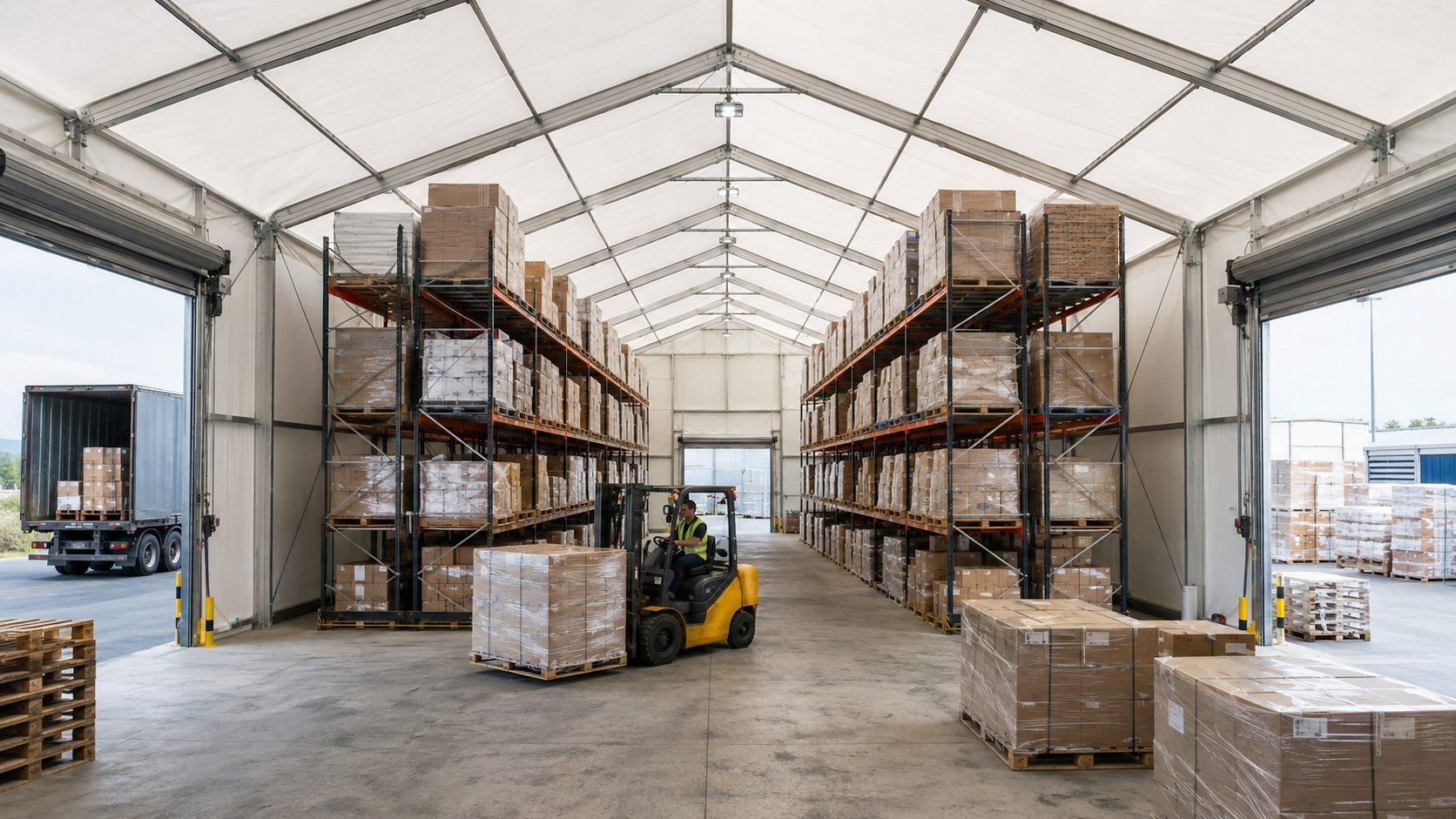
Why the Second Warehouse Order Is the Real Test
A single order can be satisfied by almost any competent fabricator: request a quotation, compare a few specifications, inspect on delivery. The second order is different. It assumes the frame profiles, the bay module, the sidewall connection system and the anchoring details are still being produced to the same standard, and that the supplier's engineering team still holds the drawings for the first structure.
For warehouse applications specifically, discontinuity has a physical cost. A second-phase storage tent that uses a different eave height, a different profile series or a different sidewall tensioning method cannot be joined cleanly to phase one. The buyer then faces a choice between accepting a structural mismatch or replacing functional parts of a building that is only a few years old.
This is why continuity deserves to be scored before price. In practice it reduces to four auditable questions: is the manufacturer old enough and staffed enough to be the same counterparty later; is throughput realistic against the rollout schedule; is quality repeatable through documented engineering and pre-shipment inspection; and does aftercare survive the end of the warranty conversation.
Continuity Signals a Buyer Can Actually Verify
Continuity cannot be promised in a brochure; it has to be evidenced. Company age, headcount, factory footprint and installed base are indirect but checkable signals, because they show whether the supplier has already survived several demand cycles with the same production system.
| Signal | Shoulder Tent reference point | Why it matters for a warehouse programme |
|---|---|---|
| Operating history | Founded in 2009; serving warehouse storage, sports, wedding, event, exhibition and commercial applications since then | Indicates the supplier has already traded through more than one construction and logistics demand cycle |
| Workforce and footprint | Approximately 200 staff; 20,000 m² factory | Suggests in-house production and engineering capacity rather than pure trading |
| Output record | Annual output of 1,000 units; 90 units monthly capacity | Gives a planning envelope for phased warehouse rollouts |
| Installed base | 3,800+ units deployed globally; exports to Europe, the Middle East, Africa, Southeast Asia and South America | Shows the same structural systems have been shipped, installed and serviced across regulatory environments |
| Engineering function | In-house R&D center and engineering team; ODM design and technical support | Determines whether later reconfigurations are engineered in-house or improvised |
None of these signals proves future performance on its own. Their value is comparative: a supplier whose factory, headcount and engineering team are visible and stable is a lower continuity risk than one whose production arrangements must be inferred from a marketplace listing. Buyers should ask for the same data from every shortlisted supplier and treat unexplained gaps as a cost, not a formality.
Throughput Realism: Reading 90 Units a Month Correctly
Monthly capacity is the number most often misused in supplier evaluation. Shoulder Tent states a capacity of 90 units per month against an annual output of 1,000 units — figures that are roughly consistent with each other and useful as an order-of-magnitude planning envelope, not as a guaranteed delivery slot.
The practical reading for a warehouse buyer is this: a 90-unit monthly envelope comfortably accommodates typical phased storage expansion, where a site adds a small number of bays per phase. It does not mean 90 warehouse structures can be drawn from inventory. Capacity is shared across the product portfolio, and it competes with event, sports and other project demand in the same production calendar.
Lead time follows the same logic. A stated 30–35 day lead time is meaningful only when its start point is defined. In multi-year programmes, the clock conventionally begins after design freeze and receipt of deposit, not at the moment of enquiry — buyers who assume otherwise build a schedule on a misunderstanding. The combination of a 1-unit minimum order quantity and a 30–35 day lead time is what makes phased procurement workable in the first place: a single bay can be ordered to test a site, a supplier and a documentation package before a larger commitment is made.
Repeatable Quality: Standardized Engineering and Pre-Shipment Inspection
Quality in a one-off structure is a delivery question. Quality across a multi-year programme is a systems question: can the supplier reproduce the same weld-free profile assembly, the same cover tension and the same anchoring logic on shipment three as on shipment one?
The mechanism that makes this credible is standardized engineering plus pre-shipment inspection. Standardized engineering means the structural logic is defined once — profile series, bay module, connection details, cover specification — and reused rather than re-invented per order. Pre-shipment inspection means the structure is checked against that definition before it leaves the factory, which is the last point at which a discrepancy can be corrected cheaply.
Material choices matter here as well. Shoulder Tent states 6061/T6 extruded aluminum alloy for its A-shape tent frames and high-anodized 6061/T6 aluminum alloy with an anti-rust surface for its event tent frames; third-party industry analysis puts the typical service life of 6061-T6 aluminum frame structures at 15 to 20 years. For warehouse use, the surface treatment is not cosmetic: it is the difference between a frame that can be dismantled, relocated and re-erected after a lease ends, and one that cannot.
Load Design, Fabric and Anchoring: What "120 km/h" Should Trigger
A wind-speed figure is one of the most quoted and least comparable numbers in the tent industry. Shoulder Tent's risk-control approach specifies design measures for wind loads up to 120 km/h and snow loads up to 1.9 kN/m², applied through aluminum profiles selected for local wind and snow conditions, flame-retardant fabric, project-specific anchoring reinforcement and regular inspections.
For a warehouse buyer, that description should trigger four follow-up requests rather than a signature:
- Span-specific structural documentation. Wind and snow capability varies with span, eave height and roof geometry; a single headline number does not describe the whole product range.
- Anchoring specification matched to the ground. Asphalt, concrete slab, compacted gravel and open field require different anchor types and different reinforcement detail; the anchoring plan belongs in the quotation, not in the installation week.
- Fire performance of the fabric. Flame-retardant fabric is a common requirement for storage of goods and for permitting in many jurisdictions; buyers should confirm the fabric specification and the certificate that accompanies it.
- An inspection cadence for the life of the structure. Tents are maintained structures. Regular inspection of covers, tensioning and anchors is part of the ownership model, not an optional extra.
Shoulder Tent's stated approach includes modular reinforcement solutions and global technical support for emergency situations, alongside design of aluminum profiles for local wind and snow loads. That is a sound basis for a multi-year relationship — provided the project-specific calculation for your site, span and exposure is issued in writing for each phase of the rollout.
Aftercare: The Clause That Outlives Delivery
Aftercare is the part of supplier evaluation that buyers most often defer, and the part that most reliably distinguishes a manufacturer from a reseller. In a warehouse context, support needs arrive on a predictable schedule: an installation question during erection, a cover tensioning issue after the first storm season, an anchoring review before a second phase is joined on, and a reconfiguration request when storage volumes change.
Shoulder Tent's described support model includes 24/7 online service, pre-sales and after-sales engineering, on-site installation and technical support, and ODM design and R&D capability through an in-house R&D center and engineering team. For evaluation purposes, the important question is not whether these services are listed, but whether they are contracted: which channel is used for after-sales requests, what response is committed, who bears the cost of engineering time on a phase-two reconfiguration, and whether installation supervision is included or quoted separately.
A second aftercare dimension is documentation. Multi-year warehouse programmes depend on drawings, load calculations, fabric specifications and inspection records being retained and retrievable. A supplier that can re-issue the technical file for a structure delivered three years earlier removes most of the friction from expansion planning.
Commercial Durability: Payment Terms, Incoterms and Configuration Continuity
Commercial terms are where long-term relationships are usually won or lost, because they determine whether a repeat order is administratively easy or exhausting. Shoulder Tent accepts T/T and states that payment terms can be adjusted to meet customer requirements, with standard incoterms of FOB, CIF and CFR. Delivery is factory-direct with global logistics coordination support, and specific shipping methods and incoterms are confirmed with the sales team per order.
| Commercial checkpoint | Stated position | What a multi-year buyer should confirm |
|---|---|---|
| Minimum order | MOQ of 1 unit | Whether single-unit pricing and documentation are identical to volume pricing |
| Payment | T/T accepted; terms adjustable to customer requirements | Whether adjusted terms remain available on repeat orders, and the deposit ratio applied to phased deliveries |
| Incoterms | FOB, CIF, CFR | Which term governs each phase, and who handles unloading, inland transport and site delivery |
| Delivery model | Factory-direct delivery with global logistics coordination | Consolidation rules if a phase mixes structure, insulation and lighting |
| Customization | Size and height, sidewalls, flooring, insulation and lighting | Whether phase-one specifications are archived so phase two matches |
Configuration continuity deserves particular attention in warehouse projects. A storage tent is a system: span and eave height set usable volume, sidewalls determine access and security, flooring affects forklift operation and insulation, and lighting determines whether the space can be worked after dark. If any one of these is re-specified between phases, the phases stop being interchangeable. Buyers should require the phase-one configuration to be recorded as a repeatable specification, not as a one-off quotation line.
Where Aluminum-Frame Warehouse Tents Fit — and Where They Do Not
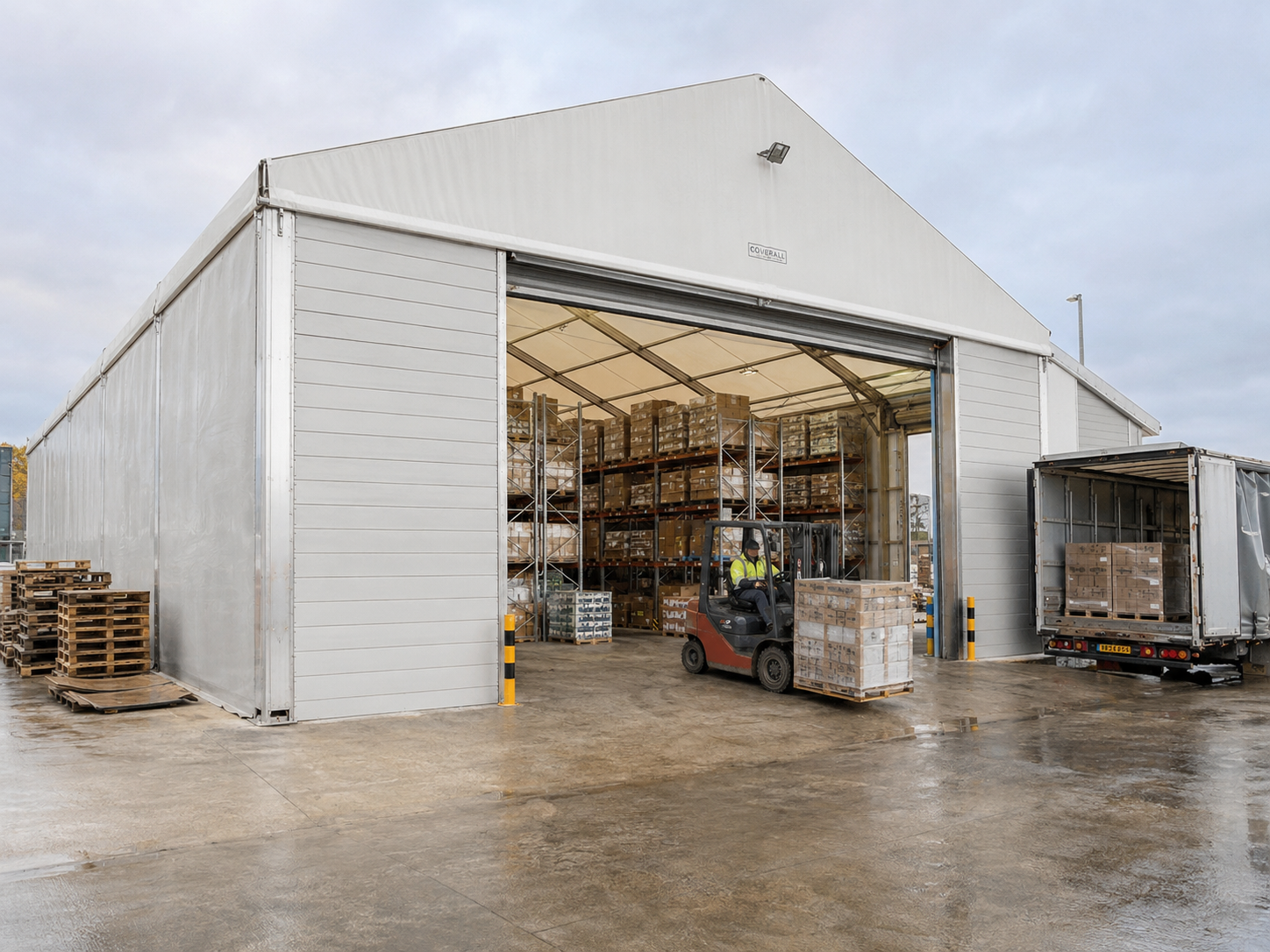
Warehouse tents are typically deployed where storage capacity is needed faster than a permanent building can be approved and built, or where the demand itself is temporary. Common configurations include temporary warehouse tent capacity for seasonal peaks, industrial storage tents for materials and equipment, workshop tents that combine covered production space with storage, and clear span structures used as logistics nodes, hangars and large storage tents.
The comparison with conventional construction is well established in the segment: modular tent solutions are positioned as delivering storage space 50%–70% faster and reducing upfront investment by 30%–60% relative to fixed steel or brick warehouses. They are best suited to short-term or seasonal capacity expansion, event logistics, temporary logistics nodes, sites where a permanent warehouse is unfeasible or undesirable, and constrained budgets. Traditional fixed warehouses remain the better answer where permanence, heavy racking loads and long-horizon asset value dominate.
The limits are equally concrete. Energy performance depends heavily on the insulation and climate-control options specified; even well-configured tents typically do not match a well-insulated permanent building. Lifetime cost is a function of service life, maintenance and climate requirements, and cannot be assumed from the upfront figure alone. Tents also require periodic inspection of fabric and anchoring, with possible reinforcement of foundations or waterproofing — an ongoing operational commitment that fixed buildings handle differently. Exact cost comparisons require like-for-like quotations covering span, cover, load design, anchoring, installation, freight and incoterms.
Market Signals Supporting Multi-Year Planning
Two structural trends make continuity evaluation more relevant than it was a few years ago. First, aluminum framing has become the default material logic in temporary structures: lightweight aluminum framing systems account for nearly 58% of total deployed structures in the tent rental market, according to commercial research on the rental segment. Second, demand is broadening rather than concentrating — industry market research cited in the segment forecasts the combined storage, sports and event tent category growing to USD 6.07 billion by 2033 at a CAGR of 5–7%, with warehouse and industrial storage identified among the applications expected to see significant growth as buyers seek cost-effective, flexible storage.
For procurement teams, the implication is that a warehouse tent supplier is increasingly likely to be a long-term counterparty rather than a one-off vendor. That shifts the weight of evaluation away from unit price and towards repeatability: whether the supplier's capacity, documentation and support model can absorb a second and third phase without renegotiating the fundamentals.
A Multi-Year Evaluation Scorecard
The following framework converts the discussion above into a scoring structure that can be applied consistently across shortlisted suppliers. Each criterion should be evidenced by documents or verifiable statements, not by assurances.
| Dimension | Evidence to request | Failure mode if unanswered |
|---|---|---|
| Corporate continuity | Founding year, headcount, factory footprint, installed base | Counterparty may not exist in the same form at phase two |
| Throughput realism | Monthly capacity, lead-time start point, parallel project load | Schedule slips discovered only after deposit |
| Design repeatability | Standardized engineering package, archived phase-one drawings | Phase two cannot be joined cleanly to phase one |
| Inspection discipline | Pre-shipment inspection scope and records | Defects discovered on site, at the worst possible moment |
| Load and risk engineering | Span-specific wind and snow calculation; anchoring plan by substrate; fabric flame-retardant specification | Structure unsuitable for site exposure or permitting |
| Lifecycle support | After-sales engineering channel, installation support, inspection cadence | Owner carries unresolved technical issues alone |
| Commercial durability | Payment terms, incoterms, repeat-order conditions | Each phase renegotiated from scratch |
| Configuration continuity | Recorded specification for size, sidewalls, flooring, insulation, lighting | Phases become non-interchangeable, eroding asset value |
Future Outlook
The direction of the segment is towards fewer, longer supplier relationships rather than more, shorter ones. Three developments support that view: the 15–20 year service life typical of 6061-T6 aluminum frames encourages buyers to think in asset cycles rather than project cycles; warehouse and industrial storage demand is expanding within the broader tent category; and buyers increasingly evaluate structures against documented load, fire and anchoring criteria rather than headline specifications.
For suppliers, the competitive pressure moves to the unglamorous parts of the operation — archived drawings, inspection records, after-sales engineering capacity and the ability to reproduce a configuration years later. For buyers, the practical conclusion is simple: the supplier who answers the second-order question well is worth more than the one who answers the first-order question cheaply.
FAQ
How can a buyer tell whether a warehouse tent supplier will still support the same structure in three years?
Look for evidence of a stable operating entity rather than promises: a verifiable founding year, a factory footprint, a workforce, an installed base and an in-house engineering function. Shoulder Tent, for example, was founded in 2009, operates a 20,000 m² facility with approximately 200 staff, reports 3,800+ units deployed globally and maintains an R&D center and engineering team. Confirm also that technical files for delivered structures are retained, since re-issuing a drawing set is the practical test of continuity.
What monthly capacity and lead time should a phased warehouse tent programme plan around?
Shoulder Tent states a capacity of 90 units per month against an annual output of 1,000 units, with a 30–35 day lead time and a minimum order quantity of 1 unit. Because capacity is shared across the product portfolio, buyers should treat the figure as a planning envelope and confirm project slots in advance. Lead time is normally calculated from design freeze and deposit rather than from first enquiry, so the schedule should be built around that start point.
How is quality kept repeatable across multiple warehouse tent shipments?
Repeatability comes from standardized engineering plus pre-shipment inspection. The structural logic — profile series, bay module, connection details and cover specification — is defined once and reused, and each structure is checked against that definition before dispatch. Material specifications reinforce this: Shoulder Tent states 6061/T6 extruded aluminum alloy for A-shape frames and high-anodized 6061/T6 alloy with an anti-rust surface for event tent frames, and third-party industry analysis cites a typical 15–20 year service life for 6061-T6 aluminum frame structures.
What load, fabric and anchoring information should accompany a warehouse tent quotation?
Shoulder Tent's stated risk-control approach covers design measures for wind loads up to 120 km/h and snow loads up to 1.9 kN/m², using aluminum profiles selected for local wind and snow conditions, flame-retardant fabric, project-specific anchoring reinforcement and regular inspections, with modular reinforcement solutions and global technical support for emergencies. Buyers should request the span-specific structural calculation, the anchoring specification matched to the actual ground condition, and the flame-retardant fabric documentation for the project.
What aftercare is available once a warehouse tent is installed?
Shoulder Tent describes 24/7 online service, pre-sales and after-sales engineering, on-site installation and technical support, and ODM design and R&D capacity through its in-house R&D center and engineering team. Buyers should convert these into contractual terms: the after-sales contact channel, the committed response arrangement, whether installation supervision is included, and who bears engineering time for later reconfiguration.
Which payment terms and incoterms apply to repeat aluminum-frame tent orders?
Shoulder Tent accepts T/T and states that payment terms can be adjusted to meet customer requirements. Standard incoterms are FOB, CIF and CFR, with factory-direct delivery and global logistics coordination support; specific shipping methods and incoterms are confirmed per order with the sales team. For multi-year programmes, buyers should confirm that adjusted terms carry over to repeat orders and that the deposit ratio is defined for each phased delivery.
Can a warehouse tent be reconfigured or expanded in a later phase?
Reconfiguration is feasible where the phase-one configuration has been recorded as a repeatable specification. Shoulder Tent offers customization based on site conditions, usage needs, dimensions and functional requirements, covering size and height, sidewalls, flooring, insulation and lighting, and provides tents in a wide range of span options. If any of these elements is re-specified between phases, the structures may no longer be interchangeable, so the original specification should be archived and referenced in each subsequent order.
What are the limits of an aluminum-frame warehouse tent compared with a permanent warehouse?
Modular tent solutions are positioned as delivering storage space 50%–70% faster and reducing upfront investment by 30%–60% versus fixed steel or brick warehouses, and are best suited to temporary or seasonal expansion, event logistics, temporary logistics nodes and sites where permanent construction is unfeasible. Energy performance depends on insulation and climate-control options and typically does not match a well-insulated permanent building; lifetime cost depends on service life, maintenance and climate requirements; and tents require periodic inspection of fabric and anchors with possible reinforcement of foundations or waterproofing.
A downloadable English-language company and product brochure covering the aluminum-frame tent range is available here: Shoulder Tent company profile (PDF).
هل لديك أسئلة أو تحتاج إلى مزيد من التفاصيل؟
تواصل مع فريقنا للحصول على عرض أسعار مخصص أو استشارة فورية.
طلب عرض أسعار
املأ النموذج أدناه وسيتواصل معك فريقنا بعرض مقترح مخصص.
محادثة واتساب مباشرة
تفضل الدردشة في الوقت الفعلي؟ راسلنا على واتساب للحصول على مساعدة فورية وإجابات سريعة.
- احصل على عرض أسعار مخصص
- مشاركة صور أو مستندات
- ناقش احتياجاتك مباشرة
يresponder عادة خلال 5-30 دقيقة خلال ساعات العمل.