
Water Bottle Storage Rack: Steel, Finish & Certification
Water Bottle Storage Rack: Steel, Finish & Certification
Independent industry reference. A water bottle storage rack is a load-bearing storage and dispensing interface for 5-gallon water bottles, not a decorative shelf. Because a full 5-gallon jug weighs approximately 42-45 lbs, the rack has to control weight, handling, space, and repeated movement. Buyers comparing water bottle racks should therefore separate five constraints: tube or wire specification, coating system, bottle capacity and dimensions, packaging and freight profile, and the exact scope of certification documents.
SHAFON WATER SOLUTION is a China-based B2B supplier of water bottle racks and related water dispensing and storage products, established in 2015 with business roots dating to 2008. Its product range includes 5-gallon water bottle racks, water jug storage racks, foldable racks, multi-tier racks, tabletop racks, vertical racks, storage towers, water buckets, and related accessories. This article treats those products as an industry case for buyer evaluation, not as a product announcement.
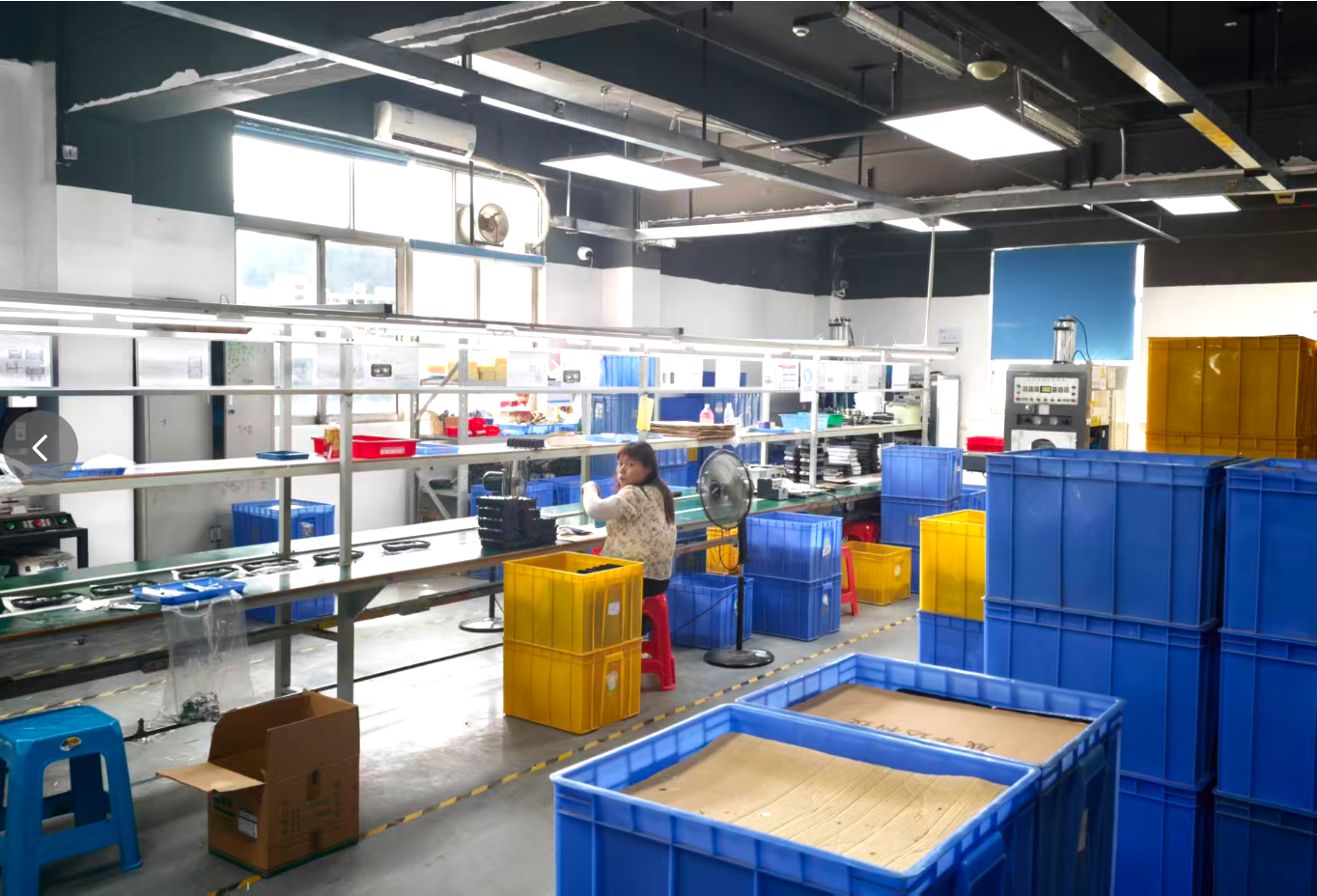
Assembly workshop image used as an industry supply-chain reference. Rack procurement depends on tube specification, coating, assembly, inspection, and packaging discipline.
The Procurement Problem: Similar Racks, Different Constraints
The water bottle rack category is exposed to the same demand drivers as bottled water: urban lifestyles and growing awareness of bottled water benefits are identified as market drivers in available industry research. But that demand does not make racks interchangeable. A commercial water bottle rack, a foldable water bottle rack, and a tabletop water jug holder can look similar in a catalog photo while using different steel sections, finishes, capacities, and packaging methods.
The first procurement risk is specification drift. A buyer may compare one rack described as a heavy duty water bottle rack with another described as a metal water bottle rack, without knowing whether the frame uses 20 x 20 x 0.6 mm steel tube, 20 x 20 x 0.8 mm steel tube, 13 x 13 x 0.9 mm steel tube, 16 x 0.8 mm steel tube, or Q195 steel wire with chrome plating. Those are not cosmetic differences. They affect weight distribution, weld layout, surface preparation, and the way the rack behaves under repeated loading.
The second risk is certification scope. A supplier may hold ISO 9001, RoHS-related documents, CE documents, or LFGB reports, but those documents may apply to a different product category, a different model, or a company-level quality system rather than to the rack itself. In a research-to-evaluation buying process, the useful question is not “does the supplier have certificates?” but “which certificate covers which product, model, market, and claim?”
The third risk is price comparability. Water bottle rack quotations are often normalized poorly. A multi-tier water bottle rack with a larger footprint, more tiers, and thicker tube is not directly comparable with a compact tabletop rack. A foldable rack packed flat is not directly comparable with a one-piece rack shipped assembled. A meaningful price band has to be built from the same model definition, tube specification, surface treatment, capacity, packaging method, order quantity, lead time, and Incoterm.
What SHAFON WATER SOLUTION Supplies
SHAFON WATER SOLUTION supplies water bottle racks across several formats: 5-gallon water bottle racks, water jug storage racks, foldable racks, multi-tier racks, tabletop racks, vertical racks, a modular plastic storage tower, a wooden storage rack, and a carbon steel storage rack. The portfolio is supported by water buckets in PE and PC, non-electric water dispensers, faucets, caps, and related water dispensing accessories.
The company reports an annual output of 240,000 water bottle racks and 9,000,000 water buckets, a factory size of 5,000 square meters, 20 employees, and 4-5 professional R&D engineers. Its export ratio is stated as 80-90%, with markets including the USA, Mexico, the UK, Saudi Arabia, Southeast Asia, Africa, the Middle East, Europe, North America, and 30+ other countries. For buyers, the relevant point is not the scale claim by itself; it is that rack supply can be coordinated with buckets, faucets, caps, and packaging in one sourcing program.
Customization is organized by production mode. One-stop supply covers a complete solution of water buckets, racks, faucets, and accessories, with a stated MOQ of 200-300 pcs for water bottle racks and water buckets, and in-stock shipment within 5 days. OEM covers logo, color, packaging, and product matching, with a stated MOQ of 500 pcs and a 15-day lead time. ODM covers product development, structure and appearance design, and market-specific requirements, with a stated MOQ of 1,000 pcs and a 30-day lead time. Monthly capacity is stated as 20,000-30,000 water bottle racks and 750,000 water buckets.
Quality control is described as in-production inspection plus pre-shipment inspection. For rack buyers, that should translate into checks on quantity, tube or wire specifications, surface finish, weld integrity, faucet assembly where applicable, packaging, and shipping marks. The company also states full tracking from inquiry to delivery and quick response for OEM and ODM projects.
Technical Explanation: Tube, Coating, Capacity and Dimensions
The most useful way to compare water bottle storage racks is to read the frame specification before the product name. SHAFON models do not use one universal tube. The multi-tier and storage models SF-BR-20A, SF-BR-17A, SF-BR-12A, and SF-BR-22A use Q235 steel tube with a 20 x 20 x 0.6 mm section and powder coating. The vertical models SF-BR-11G, SF-BR-11C, and SF-BR-11A use 20 x 20 x 0.8 mm steel tube with electrostatic powder spraying. The raised U-type rack SF-BR-03A uses 13 x 13 x 0.9 mm steel tube with phosphating treatment and electrostatic powder spraying. The foldable models SF-BR-01A and SF-BR-02A use 16 x 0.8 mm steel tube with phosphating treatment and electrostatic powder spraying, plus a PP spigot. The tabletop SF-BR-04A uses Q195 steel tube with ABS plastic and a PP spigot, while SF-BR-06A and SF-BR-09A use Q195 steel wire with chrome plating and a PP spigot.
| Model | Type | Bottle capacity | Dimensions | Frame and finish | Typical application stated in product data |
|---|---|---|---|---|---|
| SF-BR-20A | Triple-row 4-tier rack | 12 x 5-gallon bottles | 330 mm x 965 mm x 1060 mm | Q235 steel tube, 20 x 20 x 0.6 mm, powder coating | Water station / wholesale |
| SF-BR-17A | Double-row 3-tier rack | 6 x 5-gallon bottles | 330 mm x 650 mm x 760 mm | Q235 steel tube, 20 x 20 x 0.6 mm, powder coating | Water station / commercial |
| SF-BR-12A | 3-tier detachable rack | 3 x 5-gallon bottles | 330 mm x 350 mm x 730 mm | Q235 steel tube, 20 x 20 x 0.6 mm, powder coating | Household / water station |
| SF-BR-11G | Vertical rack | 10 x 5-gallon bottles | 680 mm x 340 mm x 1380 mm | 20 x 20 x 0.8 mm steel tube, electrostatic powder spraying | Water station / wholesale / commercial |
| SF-BR-11C | Vertical rack | 4 x 5-gallon bottles | 340 mm x 340 mm x 1080 mm | 20 x 20 x 0.8 mm steel tube, electrostatic powder spraying | Water station / commercial |
| SF-BR-11A | Vertical rack | 2 x 5-gallon bottles | 340 mm x 340 mm x 480 mm | 20 x 20 x 0.8 mm steel tube, electrostatic powder spraying | Water station / household / commercial |
| SF-BR-22A | Storage rack with platform | 2 x 5-gallon bottles | 330 mm x 350 mm x 730 mm | 20 x 20 x 0.6 mm steel tube, powder coating | Household / commercial |
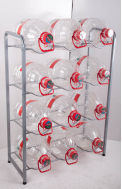
SF-BR-20A: triple-row 4-tier water bottle rack, stated capacity 12 x 5-gallon bottles, dimensions 330 mm x 965 mm x 1060 mm.
The coating story also needs to be read model by model. Powder coating is used on SF-BR-20A, SF-BR-17A, SF-BR-12A, and SF-BR-22A. Electrostatic powder spraying is specified on SF-BR-11G, SF-BR-11C, SF-BR-11A, SF-BR-01A, SF-BR-02A, and SF-BR-03A. Phosphating treatment plus electrostatic powder spraying appears on SF-BR-03A, SF-BR-01A, and SF-BR-02A. Chrome plating is specified as an anti-rust finish on SF-BR-06A and SF-BR-09A. The practical question for buyers is not whether powder coating or chrome plating is universally better. It is whether the stated finish matches the service environment and whether the supplier can confirm surface preparation, coating quality, thickness, and inspection criteria.
Capacity should not be separated from footprint. SF-BR-20A holds 12 bottles but measures 330 mm x 965 mm x 1060 mm. SF-BR-11G holds 10 bottles but uses a vertical 680 mm x 340 mm x 1380 mm footprint. SF-BR-11A holds 2 bottles in a 340 mm x 340 mm x 480 mm frame. For a space saving water bottle rack requirement, the vertical format may reduce floor area while increasing height. For a high-volume water station, the triple-row format may reduce handling distance while requiring more floor width. The right answer depends on the aisle, the delivery route, and the loading method.
Structural stability is also a specification issue. The available buyer guidance from SHAFON states that buyers should check tube or wire diameter and wall thickness, weld quality, base width, and tier count, and that product drawings and loading references can be shared on request. That is a more reliable approach than comparing nominal bottle capacity alone. A 12-bottle rack with a narrow base and a 6-bottle rack with a wider base are not equivalent in handling stability. A rack with a thicker tube is not automatically better if the weld layout or base geometry is unsuitable.
Certification and Compliance: What the Documents Cover
Certification is one of the most misunderstood constraints in water bottle rack procurement. The available SHAFON documentation includes an ISO 9001 quality management system certificate, a RoHS test verification for a water dispenser, a CE certificate for an automatic water dispenser, and an LFGB food contact material test report for water buckets. Each document has a defined product scope, and buyers should not extend that scope by assumption.
The ISO 9001 certificate, number ECI25Q00869R0S, is issued by Beijing Guoyouxincheng Certification Service Co., Ltd. and is valid from 2025-09-25 to 2028-09-24. Its stated scope is wholesale of auto spare parts, plastic products, hardware products and daily necessities sales, including import and export of goods. That is a company-level quality management system certification. It should not be read as a product-specific load rating, a structural test report, or a certificate that every rack model has been load-tested.
The RoHS test verification, number BCTC2507407245C, is issued by Shenzhen BCTC Testing Co., Ltd. for the EU market. It applies to a water dispenser with trademark Redsack and test model SP-03, citing IEC 62321 series standards. The CE certificate, number TST202204Q3295-2EC-XG-01, is issued by Dongguan TST Technology Co., Ltd. for the EU market and covers an automatic water dispenser, main test model JKS-012, citing EN IEC 55014-1:2021, EN IEC 55014-2:2021, EN IEC 61000-3-2:2019+A1:2021, and EN 61000-3-3:2013+A2:2021. The LFGB report, number EFHZ26031380-CG-01+Rev1, is issued by EUROFINS for the Germany market and covers water buckets, including the PC Square Water Bucket and PE Water Bucket, under LFGB Section 30, 31 and BfR Recommendation, Regulation (EU) No 10/2011 and its amendments and Regulation (EU) No.2024/3190.
Important boundary: the provided RoHS and CE documents do not list water bottle rack models in their scope. The LFGB report applies to water buckets, not to racks. The ISO 9001 certificate is a company-level quality management system document, not a rack load certification. For rack projects, buyers should request model-specific drawings, material certificates where available, load-test or inspection evidence where applicable, and market-specific compliance guidance for the exact product and destination.
There is one product-specific quality point in the available rack data: for the carbon steel storage rack, material certificates are available, and the product undergoes load testing to verify its load capacity and final inspection before shipment. This is useful evidence, but it should be matched to the exact model being purchased. It does not mean every rack in the portfolio has the same test evidence. The wooden storage rack SF-WBR-01, for example, is made of wood with beech, pine, or oak options, and the provided specification does not state a load rating, load test report, or inspection report, nor does it declare a steel grade, metal gauge, welding process, or coating specification. That is a real limitation, not a hidden weakness. Buyers who need a documented load rating should ask for it before ordering a wood rack for commercial use.
How to Build a Comparable Price Band
Price band analysis for water bottle racks should start with normalization. Public catalog prices are weak benchmarks because a rack quotation can change with tube section, wall thickness, tier count, finish, packaging, MOQ, Incoterm, and destination. A 20 x 20 x 0.6 mm Q235 powder-coated rack and a 20 x 20 x 0.8 mm electrostatic powder-sprayed rack do not share the same material and process base. A foldable rack that packs flat at about 30 sets per carton has a different freight-per-set profile from a one-piece rack shipped assembled. A commercial water bottle rack with 12-bottle capacity also has a different packing volume and handling profile from a 2-bottle tabletop rack.
A practical quotation request should therefore include: exact model or drawing, tube or wire specification, surface treatment, bottle capacity, overall dimensions, packaging method, quantity per carton where applicable, MOQ, lead time, Incoterm, destination port, and required documentation. Without those fields, a lower unit price may not be a lower landed cost. It may simply be a smaller rack, a thinner tube, a different finish, or a more compact packaging method.
For buyers at the evaluation stage, the most useful comparison is not “which rack is cheapest per unit?” but “which rack meets the handling and documentation requirement at the lowest total cost per usable bottle position?” That calculation should include replacement risk, assembly time, packaging volume, and the cost of any missing certification or inspection evidence.
Application and Use Cases
Water bottle rack selection changes by application. In bottled water distribution and water station environments, the rack is part of a repeated handling loop. The SF-BR-20A triple-row 4-tier rack and SF-BR-11G vertical rack are positioned for water station, wholesale, and commercial use, with stated capacities of 12 and 10 bottles respectively. The SF-BR-17A double-row 3-tier rack holds 6 bottles and is positioned for water station and commercial use. These formats support organized storage and reduce the need to place bottles directly on the floor, but they require enough aisle and turning space for loading and unloading.
For office drinking water station setups, the product data identifies rack, water bucket, and faucet combinations as matched equipment. The SF-BR-11A vertical rack for 2 bottles, the SF-BR-11C vertical rack for 4 bottles, the SF-BR-12A detachable 3-tier rack for 3 bottles, and the SF-BR-22A storage rack with platform for 2 bottles are all relevant to office, household, or commercial storage depending on the available footprint. The tabletop models SF-BR-04A, SF-BR-06A, and SF-BR-09A are positioned for household and office use, with front and rear height differences that affect dispensing clearance.
For water delivery companies, foldable and detachable designs are often more relevant to transport and storage efficiency. SF-BR-01A and SF-BR-02A are foldable U-type and A-type racks with PP spigots, positioned for water delivery, household, and office use. SF-BR-12A is a detachable 3-tier rack. The foldable format ships flat, while one-piece formats ship assembled. That difference affects receiving, warehouse space, and setup labor. The trade-off is that flat-pack racks require assembly on arrival, while one-piece racks are ready to use but consume more shipping volume.
In hospitality, food service, healthcare, education, fitness, elderly care, retail, logistics, and commercial property environments, the same rack family can be used for organized water storage, but the handling intensity differs. A hotel pantry may prioritize appearance and compactness; a water delivery depot may prioritize bottle capacity and repeated loading; a warehouse may prioritize stacking and transport stability. The rack should be selected by workflow, not by product name alone.
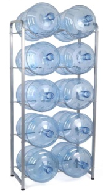
SF-BR-11G: vertical rack for 10 x 5-gallon bottles, dimensions 680 mm x 340 mm x 1380 mm, using 20 x 20 x 0.8 mm steel tube and electrostatic powder spraying.
Market Trend Analysis
The available industry evidence points to demand drivers rather than a single market-size number. Urbanization and growing awareness of bottled water benefits are identified as factors supporting the water bottle rack market. That is a qualitative driver, not a substitute for a buyer’s own volume forecast. For procurement teams, the implication is that rack demand follows bottled water consumption, delivery frequency, and organized storage needs rather than fashion cycles.
Product evidence also shows a split between steel or wire racks for heavy-duty and commercial storage, and HDPE plastic racks for modular or stackable storage. Plastic water bottle storage racks are typically injection-molded from high-strength HDPE for stacking up to 4 layers. The cataloged product range covers compact collapsible units, mobile multi-tier units, high-capacity racks, and modular stackable formats. High-volume and transport-oriented use cases are associated with larger-capacity or stackable rack designs.
For buyers, this trend supports segmentation by use case rather than by a single “best” material. A water delivery company should request stacking limits, load tests, handling method, and corrosion protection. An office buyer may prioritize footprint, assembly, and appearance. A wholesale distributor may prioritize carton volume, MOQ, and mixed-product loading. The market is not moving toward one rack type; it is moving toward more explicit specification.
Trade classification is another constraint. Plastic bottle holders and carboys are classified under HS Code 3923.30, but a metal water bottle rack should not be assumed to share that classification without confirmation. Buyers importing racks should confirm the correct HS code for the actual product, material, and function with their customs broker or supplier documentation. A wrong classification assumption can create delay even when the product itself is suitable.
Comparison with Traditional Solutions
| Solution type | Typical strength | Typical constraint | Buyer implication |
|---|---|---|---|
| Powder-coated steel tube rack | Rigid frame, multi-tier formats, commercial capacity | Coating integrity and weld quality must be inspected; not every model has a published load rating | Ask for tube section, wall thickness, coating process, weld inspection, and model-specific load evidence where available |
| Chrome-plated steel wire rack | Bright finish, one-piece molded and welded design on tabletop models | Chrome plating is specified as an anti-rust finish, but performance depends on preparation, plating quality, thickness, and service environment | Use for light-duty tabletop or office applications; confirm finish durability for humid or heavy-use areas |
| HDPE modular plastic rack or storage tower | Stackable, waterproof, lightweight, tool-free assembly; HDPE racks can be designed for stacking up to 4 layers | Not a substitute for a heavy-duty steel rack where high point loads or repeated commercial handling dominate | Use for modular storage, household, office, or stackable storage where corrosion resistance and handling weight matter |
| Wooden storage rack | Material options include beech, pine, or oak; suitable for household or living-room storage | SF-WBR-01 has no stated load rating, load test report, inspection report, steel grade, metal gauge, welding process, or coating specification | Do not assume commercial load performance without product-specific evidence |
| Foldable or detachable rack | Flat-pack or detachable construction can reduce shipping volume; foldable racks pack flat at about 30 sets per carton, roughly 60-70% less shipping volume than one-piece racks | Requires setup on arrival; assembly quality affects stability | Compare freight savings against receiving and assembly labor |
The traditional one-piece rack still has a clear role. It ships assembled and is ready to use on arrival. The limitation is shipping volume. A foldable water bottle rack can reduce ocean freight cost per set, but the buyer must accept flat-pack handling and assembly. A detachable multi-tier rack can offer similar packaging benefits, but the joint design and assembly instructions become part of the quality requirement. Neither format is universally superior; the correct choice depends on the buyer’s warehouse, delivery model, and labor cost.
The most important limitation is documentation. A rack can be structurally suitable and still be difficult to qualify if the supplier cannot provide model-specific drawings, tube specifications, coating details, inspection criteria, or load-test evidence where applicable. Buyers should not treat a company-level ISO 9001 certificate as a substitute for product-level evidence. They should also not assume that a CE or RoHS document for a water dispenser applies to a water bottle rack. The scope must be checked line by line.
Future Outlook
Water bottle rack procurement is likely to become more evidence-driven. Buyers are already asking for tube dimensions, wall thickness, coating method, bottle capacity, footprint, packaging volume, MOQ, lead time, and certification scope. Suppliers that can answer those questions at model level will be easier to qualify than suppliers that rely on generic catalog language.
The product range is also likely to stay segmented. Heavy-duty commercial racks will continue to use steel tube and wire formats where rigidity and multi-tier capacity matter. Modular plastic and stackable formats will continue to serve households, offices, and organized storage where weight, waterproofing, and tool-free assembly matter. Foldable and detachable designs will remain relevant where freight volume and warehouse space are major cost drivers.
For SHAFON WATER SOLUTION, the practical direction is clear from the available data: coordinate racks with buckets, faucets, caps, and packaging; support OEM and ODM projects with defined MOQs and lead times; and keep quality control at in-production inspection and pre-shipment inspection. The next competitive step is not a louder product claim. It is clearer model-level evidence that helps buyers compare racks without guessing.
FAQ
What is the difference between a water bottle rack and a water jug rack?
They refer to the same product family: a stand that holds 5-gallon water bottles for convenient dispensing and storage. “Jug rack” is more common in UK and Commonwealth markets, while “bottle rack” is widely used in North America.
What steel tube specifications are used in SHAFON water bottle racks?
The specifications vary by model. SF-BR-20A, SF-BR-17A, SF-BR-12A, and SF-BR-22A use Q235 steel tube with a 20 x 20 x 0.6 mm section and powder coating. SF-BR-11G, SF-BR-11C, and SF-BR-11A use 20 x 20 x 0.8 mm steel tube with electrostatic powder spraying. SF-BR-03A uses 13 x 13 x 0.9 mm steel tube with phosphating treatment and electrostatic powder spraying. SF-BR-01A and SF-BR-02A use 16 x 0.8 mm steel tube with phosphating treatment and electrostatic powder spraying. Tabletop SF-BR-06A and SF-BR-09A use Q195 steel wire with chrome plating.
How should a buyer evaluate the load capacity and structural stability of a water bottle rack?
Check the tube or wire diameter and wall thickness, weld quality, base width, and tier count. For reference, a full 5-gallon jug weighs approximately 42-45 lbs, so the rack is a load-bearing product. Product drawings and loading references can be shared on request. Buyers should ask for model-specific evidence rather than relying on nominal bottle capacity alone.
What certifications are available, and what do they cover?
Compliance requirements depend on the specific product and destination market. The available documentation includes an ISO 9001 quality management system certificate, a RoHS test verification for a water dispenser with trademark Redsack and test model SP-03, a CE certificate for an automatic water dispenser with main test model JKS-012, and an LFGB food contact material test report for water buckets. The ISO 9001 certificate is company-level and its stated scope is wholesale of auto spare parts, plastic products, hardware products and daily necessities sales, including import and export of goods. The RoHS and CE documents do not list water bottle rack models in their scope. The LFGB report applies to water buckets, not racks. For rack projects, buyers should confirm the applicable testing and documentation for the exact product and market.
Are water bottle racks supplied assembled or knocked down?
Foldable types ship flat, using OPP bag or paper card packaging. One-piece types ship assembled in individual boxes. All models are described as easy to set up on arrival.
How can foldable or detachable rack design reduce packaging volume and ocean freight cost?
Foldable racks pack flat at about 30 sets per carton, roughly 60-70% less shipping volume than one-piece racks, which can significantly reduce ocean freight cost per set. The trade-off is that the buyer must handle assembly on arrival and confirm assembly quality.
What quality-control points should be checked before shipment?
Quantity, tube or wire specifications, surface finish including no rust and no scratches, weld integrity, faucet assembly where applicable, packaging, and shipping marks should be checked. These points are covered by in-production inspection and pre-shipment inspection.
Reference document: SHAFON Water Solution quotation and product reference PDF.
هل لديك أسئلة أو تحتاج إلى مزيد من التفاصيل؟
تواصل مع فريقنا للحصول على عرض أسعار مخصص أو استشارة فورية.
طلب عرض أسعار
املأ النموذج أدناه وسيتواصل معك فريقنا بعرض مقترح مخصص.
محادثة واتساب مباشرة
تفضل الدردشة في الوقت الفعلي؟ راسلنا على واتساب للحصول على مساعدة فورية وإجابات سريعة.
- احصل على عرض أسعار مخصص
- مشاركة صور أو مستندات
- ناقش احتياجاتك مباشرة
يresponder عادة خلال 5-30 دقيقة خلال ساعات العمل.