
Water Chestnut Cake Use Cases: Frozen Cantonese Dim Sum Fit
Water Chestnut Cake Use Cases: Frozen Cantonese Dim Sum Fit
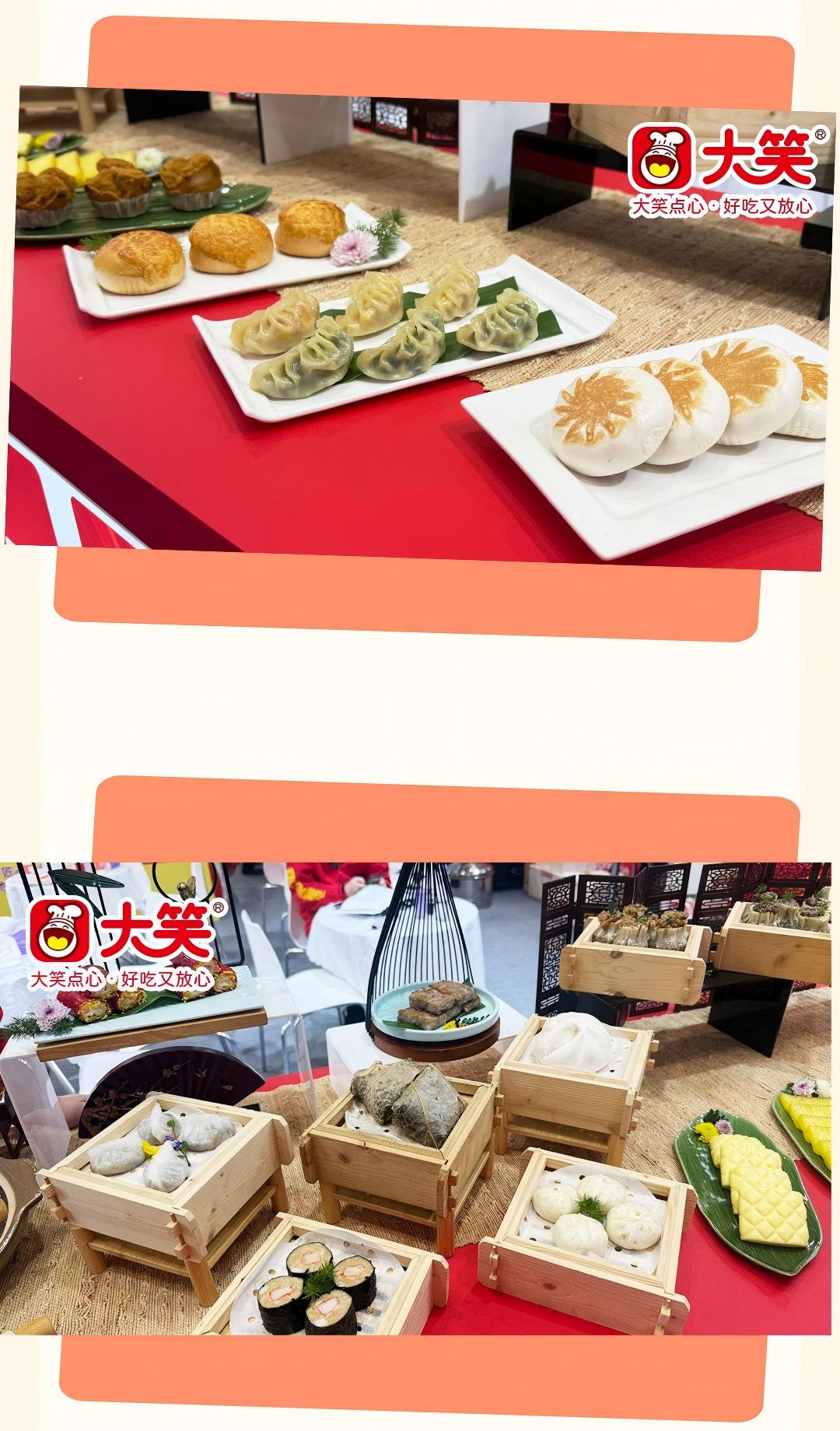
Dim sum service in a restaurant setting. Scenario fit, not menu ambition, decides whether a frozen cake line works at a given venue.
A frozen water chestnut cake earns menu space only where its format fits the service moment. For Foshan Shunde Yuexiang Food Manufacturing Co.,Ltd., that format is fixed: a 500 g bag of coconut-and-water-chestnut cake, packed 12 bags to a box, steamed from frozen in 6–8 minutes with no thawing step, and held at or below -18 °C through the cold chain. Those details decide which venues can serve it well — and, just as usefully, which should not order it at all.
Yuexiang Food is a Shunde-based dim sum manufacturer founded in 1981, producing more than 300 items across five series, with this water chestnut cake listed in its Traditional Dim Sum range. The Shunde setting matters for context rather than decoration: the district is recognised under UNESCO's City of Gastronomy programme, and the company presents its range as authentic Cantonese dim sum built on that base. Capability claims are only useful to a buyer when they are attached to a scenario, so this guide maps one product to four venue groups — restaurants, hotels and tourism venues, retail formats, and catering canteens — and states the operating condition that decides fit in each.
What the 500 g Bag Commits an Operator To
A box holds twelve 500 g bags, which is 6 kg of product per box. The bag, not the box, is the working unit: one bag is one 500 g service batch, and the box is what a buyer orders. That structure suits operators adding cake as a second or third sweet line rather than as a volume staple, because the smallest sensible production run is set by how quickly one bag moves through service.
Cold chain, shelf life and the equipment actually required
The product is stored frozen at or below -18 °C for the entire chain. Under the supplier's stated storage terms, steamed cakes — water chestnut cake among them — carry a six-month frozen shelf life, while steamed buns carry twelve months. Production date and shelf life are printed on the outer packaging of every product, which lets a receiving team check rotation at goods-in instead of discovering it at the freezer door.
The stated equipment list is short: freezers, steamers and refrigerated transport vehicles. None of it is specialised, but all of it is mandatory. A venue without reliable freezing capacity, or without a steamer on the line where the cake will be plated, cannot convert the format into service no matter how good the product is. The stated materials are coconut milk and water chestnuts, which is worth flagging early for venues that must communicate ingredients to guests with dietary restrictions.
The six-to-eight-minute window
The pack instruction is steaming without thawing, in a water pan, for 6–8 minutes. There is no overnight thaw, no proofing and no pastry section involved. For a kitchen that schedules its whole morning around steamer rotation, that is the single most important number in the specification, because it determines whether the cake can be produced inside an existing cycle or needs one of its own.
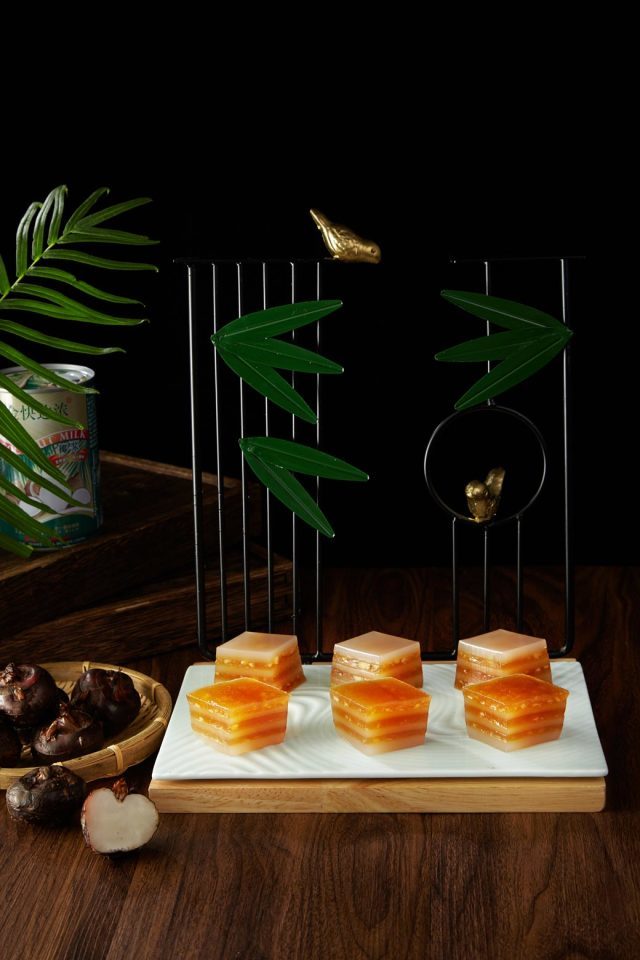
The cake's translucent layering is a post-steaming quality, which is why plated presentation, not the frozen pack, carries the sales argument.
Set against the supplier's other items, the cake sits at the fast end of the preparation range:
| Item | Stated pack format | Stated preparation |
|---|---|---|
| Water Chestnut Cake | 500 g × 12 bags/box | Steam from frozen in a water pan, 6–8 minutes |
| Shrimp dumplings | 270 g / 9 pieces × 15 packs/box | Steam from frozen 7–8 minutes; or pan-fry from frozen |
| Walnut Bun | 480 g (12 pieces) × 18 bags/box | Steam from frozen 8 minutes |
| Barbecued pork big bun (char siu bao) | 720 g (6 pieces) or 480 g (4 pieces) × 18 bags/box | Steam from frozen 10 minutes |
The product description also notes a second service style: steamed for a soft, chewy finish, or pan-fried for a crisp exterior. The pack instruction itself specifies steaming, so an operator switching to pan-frying should treat it as a kitchen decision to be tested on site rather than as a documented preparation method.
Order mechanics and quality gates
Commercial terms are straightforward. The stated minimum order is 50 boxes or more, lead time is 7–14 days, and monthly capacity is given as 50 million units. OEM and ODM work covers logos and product details to customer requirements. Pre-shipment control is described as a 100% test: weighing and verifying product weight, checking packaging seals and label completeness for leaks or bulging bags, plus microbiological safety testing using the plate count method for colony and coliform bacteria. Quality inspection reports, production qualifications and export customs declaration documents are provided with each order.
Restaurant Formats: Breakfast Counters, Tourist Windows, Late-Night Stalls
Three restaurant formats turn the cake's specification into revenue most directly: fast-food breakfast shops, tourist-area snack counters and late-night food stalls. All three sell small portions at high frequency, all three typically already run a steamer, and none of them can justify a dedicated pastry station.
Fast-food breakfast shops
A breakfast shop buys speed. With no thawing step, a bag moves from freezer to steamer and is servable inside the same 6–8 minutes that the pack specifies, which means the sweet item does not need to be pre-produced before the morning peak. The supplier's case material frames the headline operational gain in the same terms: saving kitchen labour costs, shortening food preparation time and improving table turnover efficiency, with consistent taste and appearance that reduces human error relative to hand-made batches.
The commercial logic is positioning rather than volume. A sweet cake placed beside savoury buns, siu mai and dumplings captures the guest who wants one sweet item with breakfast or mid-morning tea, without adding a second production line. The counterweight is shelf life: steamed cakes run six months frozen against twelve months for buns, so a breakfast shop should size its cake drops to actual sweet-item velocity rather than ordering on the same rhythm as its bun lines.
Tourist-area snack counters
At a tourist counter the product sells on appearance as much as flavour. The stated presentation is a translucent, layered milky-white cake, described by the supplier as attractive on a dim sum stall; the flavour is sweet coconut with a refreshing water chestnut note, and the texture combines a soft, smooth, chewy body with crunchy water chestnut pieces. The stated positioning is low-fat and less oily than heavy desserts, which suits visitors buying a light snack in warm weather rather than a dense pastry.
Operationally, a snack window needs portion control and a fast serve. A 500 g bag sets a clear batch boundary, and the short steam cycle keeps serve-time variation low during a rush. Because the visual advantage only exists after steaming, the counter itself — not the freezer — has to carry the cue, which is a display and menu-board decision rather than a purchasing one.
Late-night stalls
Late-night operators work with limited space, a steamer and a freezer. The supplier's scenario material makes the relevant point directly: a diverse menu can be achieved even with limited kitchen resources. Late-night menus tend to be savoury-heavy, and a warm sweet cake broadens the offer without a second cooking line or additional staff hours.
This is also where the fit boundary should be stated plainly. The cake is a complement, not a volume driver; a stall that sells it as a side rather than as a signature item will see it cycle through slowly, and a six-month frozen window punishes slow rotation more than a twelve-month bun line would.
Hotels, Resorts and Tourism Venues: Tea Service and Banquet Breaks
Hotels, guesthouses, resorts and camping sites appear in the supplier's stated industry coverage, and the cake's natural slots in that group are afternoon tea, banquet tea breaks and dessert service where a light Cantonese sweet is expected. The milder qualities the supplier lists — a mild, non-sticky texture described as suitable for both elderly guests and children — make the item easy to place across a mixed-age guest profile, while the layered appearance supports a tea-service presentation rather than a buffet filler.
For banquet use, the constraint is scheduling rather than cooking skill. A 6–8 minute steam cycle has to be sequenced against steamer availability alongside the savoury dim sum already in the banquet plan, so the sweet course should be built into the production timetable rather than added as an afterthought. A hotel kitchen that treats the cake as a last-minute item will end up serving it late.
Camping sites and outdoor venues need a more careful reading. The format depends on storage at or below -18 °C plus a steaming capability; where freezer volume is limited or no heat source is available on site, fit weakens regardless of guest demand. That is a specification boundary, not a product criticism.
Retail: Freezer Space, Rotation and the Six-Month Shelf Life
Supermarkets, community fresh food stores and convenience stores are the three retail formats the supplier lists, and each one treats the 12-bag box differently. A supermarket buys the box as a case and breaks it into consumer units; a convenience store with limited freezer facings buys the same box but may hold it longer, which turns shelf-life discipline into the deciding factor.
The relevant numbers are already in the packaging: frozen storage at -18 °C, production date and shelf life printed on the outer pack, six months for steamed cakes against twelve for buns. For a retailer, that six-month window is a merchandising constraint. Reorder cadence, facing allocation and markdown rules should be set on the shorter cycle rather than copied from the bun category, and stores with weak frozen turnover are better served by smaller, more frequent drops than by a full-case commitment.
Consumer preparation mirrors foodservice: steam from frozen for 6–8 minutes. That is a realistic home method for a shopper already buying frozen dim sum, and the low-fat, all-ages positioning the supplier describes gives the item a place in family baskets alongside savoury lines. One retail caveat is worth repeating: the cake's translucent layering appears after steaming, so in the freezer case the purchase decision rests on pack information and category placement rather than on the product's own appearance.
Catering Canteens: Volume, Mildness and Predictable Batches
Schools, factories, office buildings, hospitals, nursing homes and government canteens form the fourth group, and they buy on different criteria from restaurants: predictability, portion consistency and a dessert that does not create service risk. Standardised production gives a uniform taste and size, which is exactly what a canteen needs when the same item appears on a rotating menu week after week, and the reduction in on-site preparation removes labour from a kitchen that is usually staffed to a fixed headcount rather than to demand peaks.
The product qualities that matter here are the quiet ones. A mild, non-sticky texture is easier to serve to elderly residents and children than a sticky or crumbly dessert, and the stated low-fat, less oily profile fits canteens that are under pressure to lighten dessert menus. The flavour — sweet coconut balanced by water chestnut, described as sweet but not cloying — travels well across age groups.
Two checks belong before any canteen order. First, the cake is a dessert or tea item, not a staple, so it should be costed as a menu extra rather than as a replacement for buns or rice. Second, institutions serving guests with dietary restrictions should confirm ingredient and allergen documentation for the stated coconut milk and water chestnut materials against their own market's labeling requirements, and keep the specification sheet on file for kitchen and nursing staff.
Frozen Versus Made In-House: Where Each Format Actually Fits
Frozen and in-house water chestnut cake solve different problems, and neither is universally the better choice. The honest comparison is about what each one costs the venue in labour, space and planning certainty.
- Labour and skill. The frozen format requires no preparation or kneading — it is heated and served. A cake made on site has to be mixed, steamed and cooled in the venue's own kitchen, which consumes staff time and a measure of technical skill on every batch.
- Consistency. Standardised production is presented by the supplier as delivering uniform taste and size, avoiding the inconsistent textures that can occur in handmade products. In-house production gives the kitchen direct control over each batch, which some venues value and others find hard to sustain at volume.
- Equipment and space. The frozen route needs a freezer, a steamer and a refrigerated supply chain. The in-house route needs preparation space, cooking equipment and cooling capacity — usually the scarcer resource in a small outlet.
- Planning horizon. Frozen product allows flexible inventory through long-term low-temperature storage, used as needed, which the supplier links to reduced food waste. The trade-off is a fixed six-month window on steamed cakes and a minimum order of 50 boxes, so the flexibility is real but bounded.
- Menu agility. In-house production can be adjusted batch by batch in a way a frozen specification cannot, which matters for venues whose menu changes weekly rather than seasonally.
The decision rule that follows is simple enough to apply: if the venue already runs a steamer, has freezer capacity, and cannot spare skilled labour for pastry work, the frozen format fits. If the kitchen is built around on-site production and treats provenance as part of its offer, in-house fits. Neither conclusion requires a claim about which tastes better, because the supplier's documentation does not support one.
Labeling Transparency: What the 2026 Guangzhou Rule Changes
Provenance has become a menu question in at least one major Cantonese dim sum market. According to reporting attributed to Guangzhou local government sources, restaurants in Guangzhou have been required since 1 May 2026 to clearly indicate whether their dim sum is handmade on site or produced by central kitchens or as pre-made product. For a venue inside that jurisdiction, serving a frozen cake is a declarable choice rather than an invisible one, and front-of-house staff need a consistent answer ready.
The practical preparation is documentary. Keep the specification sheet, the ingredient list and the production qualifications where service staff can reach them, and decide in advance how the item will be described on the menu. The supplier states that quality inspection reports, production qualifications and export customs declaration documents are provided with each order, which covers most of what a provenance question requires.
For buyers outside Guangzhou, the rule is best read as an interpretation signal rather than a requirement: it shows that disclosure of pre-made dim sum is being formalised in a market that takes the category seriously. Operators in other regions should check their own local rules rather than assume the Guangzhou position applies to them.
Verification note: frozen dim sum shipments are commonly declared under HS Code 1902200000 or 1902309000 according to customs records cited in trade sources. Classification for a specific product line should be confirmed with the exporter and the destination customs broker rather than assumed from the category.
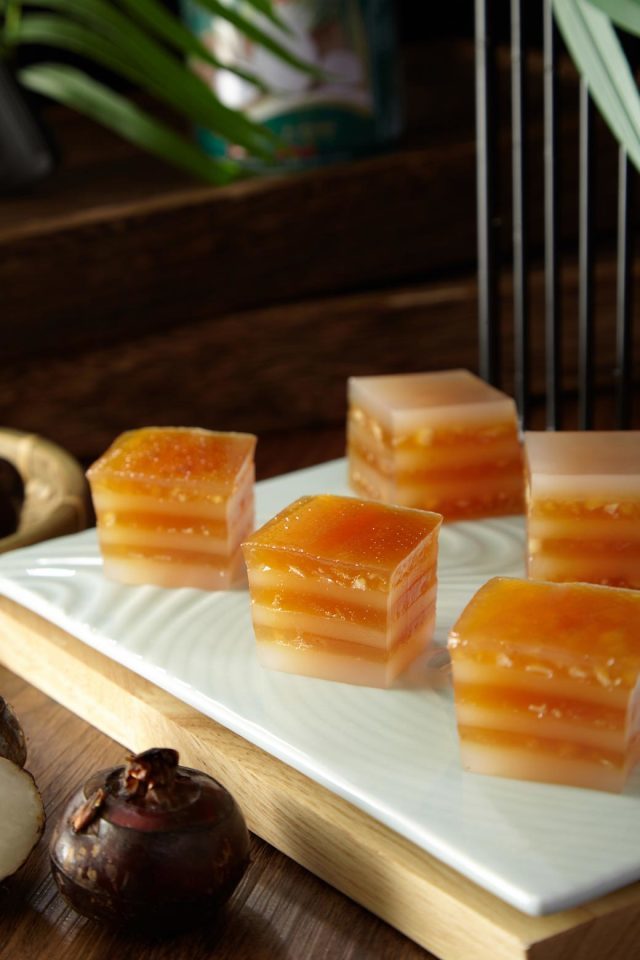
Portioning after steaming is the operator's decision; the 500 g bag sets the batch boundary, not the plate.
Scenario-to-Specification Table
The table below condenses the fit logic into one view. Each row states the service moment, why the format works there, and what a buyer should verify before committing to a first order.
| Venue type | Service moment | Why the format fits | Verify before ordering |
|---|---|---|---|
| Fast-food breakfast shop | Morning peak, sweet add-on to a savoury order | No thaw, 6–8 minute steam; no pastry station required | Steamer availability at peak; sweet-item velocity against a six-month cake shelf life |
| Tourist-area snack counter | Walk-up snack, light dessert | Layered translucent presentation; low-fat positioning | Display and menu-board space; portion format for takeaway |
| Late-night stall | Extended sweet offering | Steamer and freezer only; broadens a savoury-led menu | Actual rotation speed; freezer reliability overnight |
| Hotel, resort, tourism venue | Afternoon tea, banquet tea break | Mild, non-sticky texture for mixed-age guests | Steamer scheduling against banquet savoury lines |
| Supermarket, fresh store, convenience store | Frozen retail case | 12-bag box as case unit; printed production date and shelf life | Freezer facings and reorder cadence set on the shorter cake cycle |
| School, hospital, factory, government canteen | Dessert or tea item on a rotating menu | Uniform taste and size; reduced on-site preparation | Ingredient and allergen documentation for coconut milk; labour saving vs. menu role |
What Comes Next for Frozen Water Chestnut Cake
Third-party sizing puts the global frozen Cantonese-style dim sum market at USD 7.04 billion in 2025, with a projection of USD 11.99 billion by 2033, according to Data Insights Reports. That figure should be read with its definition attached: dim sum is a subset of the broader frozen dumpling category, and published market values for related categories vary considerably with how the product scope is drawn. A buyer should treat such estimates as context for category direction, not as a demand forecast for one SKU.
Supply concentration is the more immediately useful signal. Business Research Insights attributes 46% of global frozen dumpling production volume in 2025 to China, with Japan at 11% and South Korea at 9%. For a buyer, that concentration means the frozen dim sum category is deep and competitive at origin, which places more weight on specification and cold-chain evidence than on the mere availability of product.
The conditional outlook for this specific format runs along three lines. First, venues that cannot staff a pastry section will keep looking for items that fit an existing steamer cycle, and a 6–8 minute cake does that better than a 10-minute bun line for a sweet course. Second, labelling expectations around pre-made dim sum are tightening in at least one major market, which may push operators to state provenance on the menu rather than leave it implicit. Third, retail rotation pressure will stay tied to the six-month frozen window on steamed cakes, so range reviews should treat shelf life as a category design question rather than a storage footnote.
Yuexiang Food provides a company brochure covering its dim sum range as a downloadable PDF for buyers who want the wider specification context: Yuexiang Food product brochure (PDF).
FAQ: Frozen Water Chestnut Cake in Foodservice and Retail
Which foodservice venues are the strongest fit for frozen water chestnut cake?
The clearest fits are fast-food breakfast shops, tourist-area snack counters and late-night food stalls, because all three sell small sweet portions at high frequency and already operate a steamer; hotels, guesthouses, resorts and camping sites fit where afternoon tea or banquet tea breaks are served; retail suits supermarkets, community fresh food stores and convenience stores; and catering canteens in schools, factories, offices, hospitals, nursing homes and government buildings fit where a uniform dessert is needed. The common condition is a freezer at or below -18 °C and a steaming capability on site.
How is the 500 g bag prepared, and how long does it take?
The stated method is steaming without thawing, in a water pan, for 6–8 minutes. There is no thawing or proofing step, so the bag moves directly from frozen storage to the steamer. The product description also mentions a pan-fried style for a crisp exterior, while the formal pack instruction specifies steaming.
What storage conditions and shelf life apply to the 12-bag box?
Storage is frozen at or below -18 °C throughout the chain, including transport, which requires refrigerated vehicles. Under the supplier's stated terms, steamed cakes including water chestnut cake carry a six-month frozen shelf life, while steamed buns carry twelve months. Production date and shelf life are printed on the outer packaging of every product.
How does the frozen format compare with making water chestnut cake in-house?
The frozen format requires no preparation or kneading and is simply heated and served, which removes pastry labour and produces a uniform taste and size, avoiding the inconsistent textures associated with handmade batches. In-house production allows batch-level adjustment and on-site provenance, but consumes kitchen time, skilled labour, preparation space and cooling capacity. The frozen route also carries its own boundaries: a minimum order of 50 boxes, a six-month window on steamed cakes and dependence on freezer capacity.
What does the Guangzhou dim sum labelling rule mean for venues serving frozen dim sum?
Reporting attributed to Guangzhou local government sources states that, from 1 May 2026, restaurants in Guangzhou must clearly indicate whether their dim sum is handmade on site or produced by central kitchens or as pre-made product. A venue in that jurisdiction serving a frozen cake should therefore expect to describe it as a pre-made or central-kitchen item and keep specification and production documentation available for staff. Operators in other markets should check their own local requirements rather than assume the Guangzhou rule applies.
What are the minimum order, lead time and customisation options?
The stated minimum order is 50 boxes or more, with a lead time of 7–14 days and monthly capacity given as 50 million units. OEM and ODM services cover logo and product-detail customisation to customer requirements, and the supplier lists flavour adjustment, customised packaging and new product samples among its value-added services. Each order is stated to include quality inspection reports, production qualifications and export customs declaration documents.
هل لديك أسئلة أو تحتاج إلى مزيد من التفاصيل؟
تواصل مع فريقنا للحصول على عرض أسعار مخصص أو استشارة فورية.
طلب عرض أسعار
املأ النموذج أدناه وسيتواصل معك فريقنا بعرض مقترح مخصص.
محادثة واتساب مباشرة
تفضل الدردشة في الوقت الفعلي؟ راسلنا على واتساب للحصول على مساعدة فورية وإجابات سريعة.
- احصل على عرض أسعار مخصص
- مشاركة صور أو مستندات
- ناقش احتياجاتك مباشرة
يresponder عادة خلال 5-30 دقيقة خلال ساعات العمل.