
Water Chestnut Cake vs. Crispy Taro Pastry: A Buyer Comparison
Frozen Cantonese dim sum buyers rarely compare two products in the abstract. They compare them against a venue: a teahouse that needs a cake to serve with tea, a canteen that needs a filling item at breakfast, an airport outlet that needs something plated within minutes. Water Chestnut Cake and Crispy Taro Pastry look similar on a specification sheet — both are frozen cakes, both ship in 500 g bags with 12 bags to a carton, and both move from freezer to steamer without thawing — yet they occupy two different menu positions and demand two different kitchen setups.
Both items belong to the Traditional Dim Sum line of Foshan Shunde Yuexiang Food Manufacturing Co., Ltd., a Cantonese dim sum manufacturer founded in 1981 in Jun'an Town, Shunde District, Foshan, and marketed under the "Da Xiao" (Laughing) brand. Shunde is recognised by UNESCO as a City of Gastronomy, and the company operates a 20,000 m² automated production facility holding ISO9001, HACCP and FDA certification. Its catalogue covers more than 300 products across five series, with exports reported at approximately 40% of output and a sales network reaching markets that include the United States, Canada, Australia, New Zealand, Mexico, Malaysia and Vietnam.
Why Buyers Compare These Two Items at All
Frozen dim sum ranges are usually built around dayparts rather than around individual products. Tea service peaks in the late morning; canteen service peaks at breakfast and lunch; transport catering runs across the full operating day; retail demand clusters in the evening and at weekends. Water Chestnut Cake and Crispy Taro Pastry sit on opposite sides of that schedule.
Water Chestnut Cake is made from coconut milk and water chestnuts and is positioned as a tea-time steamed cake — the kind of item that anchors an afternoon tea service or a banquet tea-break tray, where a light, tea-friendly cake is expected alongside savoury dim sum. Crispy Taro Pastry (Taro Cake) is made from taro and is positioned as a savoury, filling snack with a strong sense of satiety, documented for breakfast, morning tea and late-night service.
A buyer who stocks only one of the two accepts a coverage gap: either no tea-pairing cake, or no savoury cake that carries a meal on its own. A buyer who stocks both obtains two menu positions and two price tiers from a single carton format and a single core preparation method.
Regulation is making that choice more visible. From 1 May 2026, restaurants in Guangzhou must clearly indicate whether dim sum is handmade on site or produced by central kitchens or as pre-made items (Tridge / Guangzhou local government). The rule converts product documentation into a menu-labelling question: operators need to know precisely what they are serving, and suppliers need to be able to state it.
SKU Snapshot: Two Cakes, Two Menu Roles
| Comparison point | Water Chestnut Cake | Crispy Taro Pastry (Taro Cake) |
|---|---|---|
| Product line | Traditional Dim Sum | Traditional Dim Sum |
| Core ingredients | Coconut milk, water chestnuts | Taro |
| Pack format | 500 g/bag, 12 bags/carton | 500 g (12)/bag, 12 bags/carton |
| Preparation from frozen | Steaming only: water-pan steam for 6–8 minutes, no thawing | Steaming for 6–8 minutes, or pan-frying until golden on both sides, no thawing |
| Flavour direction | Coconut-forward steamed cake built for tea pairing | Savoury taro, not too sweet, with real taro chunks and no artificial flavourings |
| Eating experience | Served warm from the steamer for tea and dessert service | Soft, chewy and springy cake paired with large taro chunks |
| Satiety and menu role | Tea-time and dessert slot; afternoon tea and banquet tea breaks | Filling snack with strong satiety; breakfast, morning tea, late-night |
| Documented frozen storage | ≤ -18 °C | ≤ -18 °C |
| Main operational constraint | Requires a working steamer; no alternative cooking method is documented | Requires a steamer, or a frying station with oil management for the crisp version |
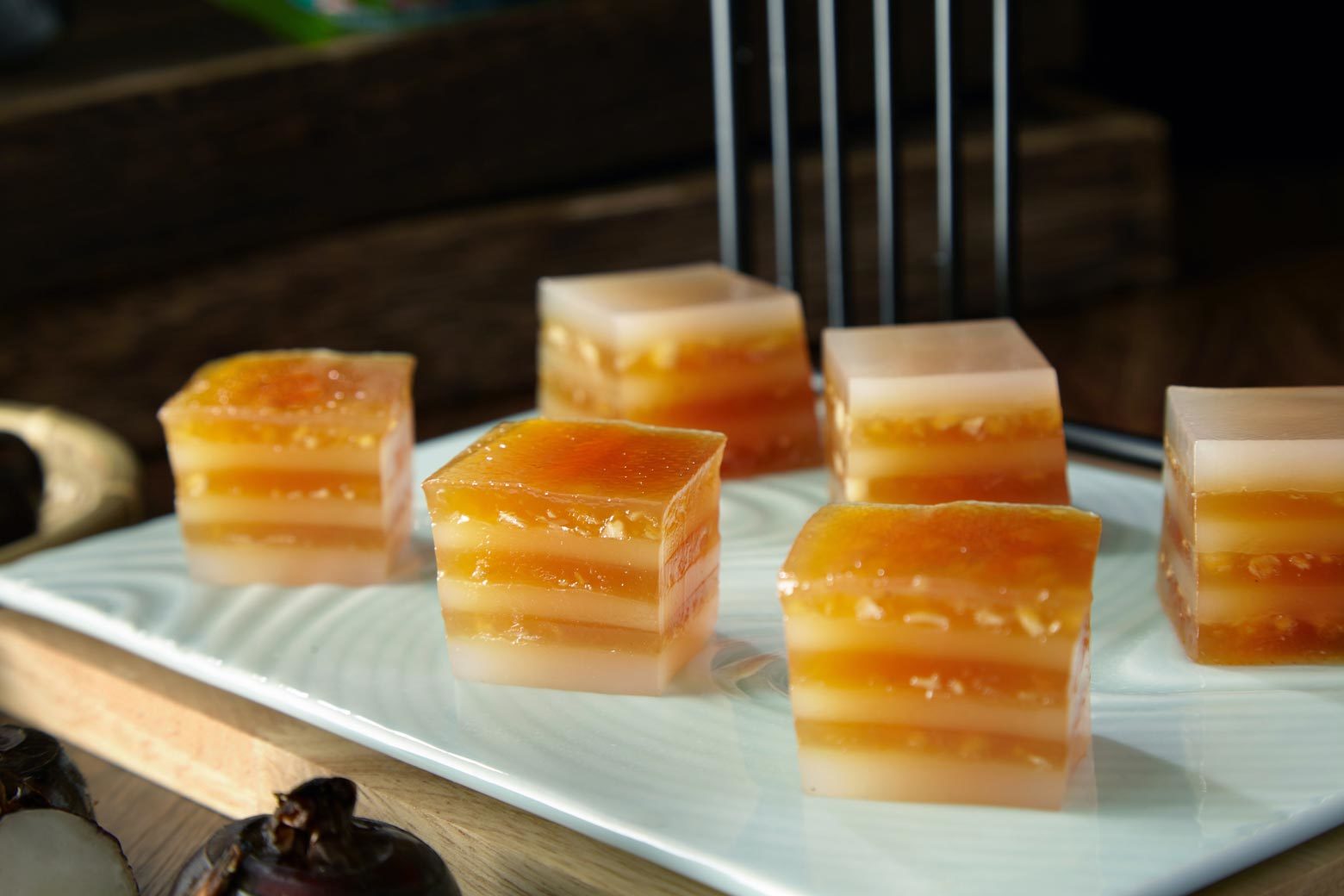
Water Chestnut Cake: a coconut milk and water chestnut steamed cake, prepared from frozen in 6–8 minutes.
Preparation and Packing Specifications: What the Kitchen Actually Has to Do
No thawing step
Both SKUs are documented for preparation without thawing: Water Chestnut Cake is steamed in a water pan for 6–8 minutes, and Crispy Taro Pastry is steamed for 6–8 minutes or pan-fried until golden on both sides. Removing the thawing step matters in high-turnover operations, because it eliminates overnight planning, shortens the interval between order and service, and reduces the time product spends at ambient temperature. In practice, this is the reason frozen dim sum is used as a quick-cooking ingredient for banquets, tea breaks and takeout meals.
One carton format, two portioning philosophies
Both items ship as 500 g bags with 12 bags per carton. This is a bulk kitchen format rather than a consumer-portioned format: cakes are sliced or portioned on site, and trays are assembled per service. That is an advantage for teahouses, hotels and canteens that already run a prep station; it is a constraint for outlets that plate directly from the pack, and for buyers who need fixed, individually portioned units.
Two presentations from the taro item
Crispy Taro Pastry documents both steaming and pan-frying. One SKU therefore covers two menu positions: a lighter steamed version for breakfast and canteen service, and a crisp pan-fried version for late-night, snack and bar menus. The trade-off is operational rather than product-related — pan-frying requires a frying station, oil management and a ventilation setup that a steamer-only kitchen may not have.
Cold chain and shelf-life discipline
Frozen dim sum in this range is designed for storage at ≤ -18 °C throughout the entire process, supported by freezers, steamers and refrigerated transport vehicles. Steamed cake items — including Water Chestnut Cake — carry a six-month frozen shelf life, while steamed buns carry twelve months. Cakes therefore require tighter rotation discipline in the warehouse. Production date and shelf life are printed on the outer packaging of all products, which supports both stock control and the labelling transparency now required on Guangzhou menus.
Ordering and quality-control parameters
The documented minimum order is 50 boxes with a lead time of 7–14 days. Quality control includes 100% pre-shipment testing: weight verification, packaging seal and label completeness checks, and microbiological safety testing using the plate count method for colony and coliform bacteria.
Venue-by-Venue Fit: Matching Each Cake to the Outlet
The two products are sold into the same seven channel types — restaurants, hotels and tourism, retail, catering services, transportation, trade and foreign trade, and gifts — but they do not fit those channels equally. The following allocation reflects the documented product positioning rather than preference.
Teahouses, Cantonese restaurants and hotel banquets
Water Chestnut Cake is the natural fit here: a coconut milk and water chestnut steamed cake served warm for tea service, afternoon tea and banquet tea breaks, where it adds a differentiated, visually distinct item to a menu that is otherwise dominated by buns and dumplings. Crispy Taro Pastry works alongside it as the savoury counterweight — one cake for the tea tray, one for the savoury platter.
Breakfast shops, fast-food outlets, tourist-area snack stands and late-night stalls
Crispy Taro Pastry fits this group more directly. It can be steamed quickly for a light morning item or pan-fried to a crisp finish for late-night service, and it is documented as a filling, savoury snack with strong satiety — a useful characteristic when customers are buying a meal replacement rather than a dessert.
Institutional catering: schools, factories, offices, hospitals, nursing homes and government canteens
Both items support a diverse menu even with limited kitchen resources, because neither requires preparation or kneading. Taro Pastry tends to suit canteen demand for savoury, filling items; Water Chestnut Cake suits dessert rotation and tea-break service in the same facility without adding new equipment beyond a steamer.
Retail: supermarkets, community fresh-food stores and convenience stores
Retail shoppers buy frozen dim sum for convenient breakfasts and afternoon teas. Taro Pastry answers evening snacking and meal top-up demand; Water Chestnut Cake answers tea-time and dessert demand. Both are stored, not prepared, by the retailer until the customer heats them at home.
Transportation: airports, high-speed rail stations, motorway service areas, vehicle and ship catering
For transport catering, the 6–8 minute preparation window is the deciding specification. Water Chestnut Cake fits tea-break and dessert trolleys; Taro Pastry fits hot counters where a pan-fried item can be held briefly and served as a filling snack.
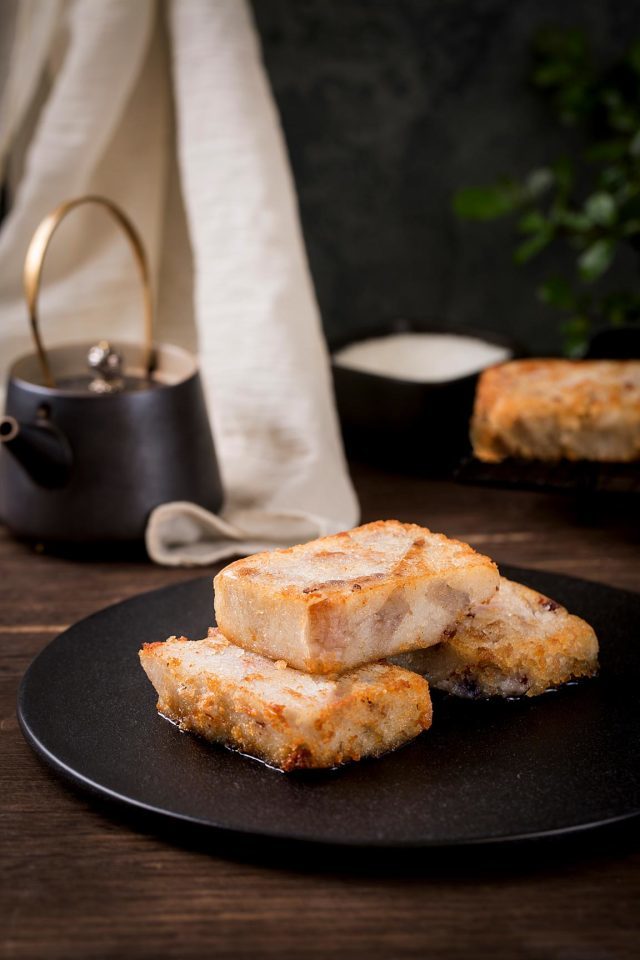
Crispy Taro Pastry: documented for both steaming and pan-frying, which lets one SKU serve two menu positions.
Trade and foreign trade, and gift programmes
Wholesalers, overseas Chinese restaurants and Chinese supermarkets buy at carton level, where the shared 500 g × 12 format simplifies range planning. Food OEM manufacturers, gift-box vendors and banquet organisers use both items in re-portioned trays. Application scenarios for this range are commonly cited in the United States, Malaysia, Canada, Australia, Vietnam, New Zealand, Mexico and Germany, which is consistent with the company's 40% export ratio.
Market Context: What Is Driving Frozen Dim Sum Demand
The global frozen Cantonese-style dim sum market was valued at USD 7.04 billion in 2025 and is projected to reach USD 11.99 billion by 2033, with a reported CAGR of 6.87%, according to Data Insights Reports / Research Insights. That growth is being supplied largely from Asia: China accounted for 46% of global frozen dumpling production volume in 2025, ahead of Japan at 11% and South Korea at 9%, per Business Research Insights.
Two structural factors shape how buyers source within that market. The first is regulation. The Guangzhou labelling requirement effective 1 May 2026 pushes operators to state whether dim sum is handmade on site or centrally produced, which raises the value of suppliers who can document specifications, production dates and cold-chain handling rather than simply supply product.
The second is documentation at the border. Frozen dim sum is commonly exported under HS Code 1902200000 (stuffed pasta) and 1902309000 (other pasta), based on China customs records cited by Zauba. Buyers comparing suppliers should treat classification consistency as part of the comparison, because it determines how a shipment is cleared and how it is described in import paperwork.
Shunde's advantage is not only heritage. The district hosts specialised upstream processors — for example, Foshan Shunde Meichengmei Food Co., Ltd., founded in 1976, is a professional manufacturer of egg products including salted egg yolk for dim sum applications, according to the company's official site. A dense ingredient and processing cluster of this kind is one reason a Shunde-based manufacturer such as Yuexiang can maintain more than 300 SKUs across five series, including the two cakes compared here.
Where These Two Items Stop: Practical Limits of the Frozen Format
A credible comparison has to include what the format gives up. Freshly made taro cake, prepared on site with hand-cut taro and served straight from the pan, still delivers a level of freshness and craft narrative that a frozen product cannot fully match, and venues that market in-store handmade preparation will continue to pay for that labour. Frozen production trades a degree of that immediacy for standardised appearance, uniform taste and size, and the labour saving of heating rather than preparing.
Beyond that general trade-off, four specific boundaries apply to this pair.
- Water Chestnut Cake is steam-only. Its documented method is steaming from frozen in a water pan for 6–8 minutes. A venue without a steamer cannot serve this SKU, and unlike the taro item it cannot be rescued by pan-frying.
- The packs are bulk, not portioned. Both items ship as 500 g bags. Whoever assembles the plate — kitchen or retailer-facing consumer — has to slice and portion, so buyers without prep capability get less benefit from the format.
- Cakes rotate faster than buns. Steamed cakes carry a six-month frozen shelf life against twelve months for steamed buns, so a warehouse ordering both must run tighter FIFO discipline on the cake lines.
- Neither item substitutes for the other. One is a coconut-forward steamed cake for tea service; the other is a savoury, not-too-sweet taro cake with strong satiety. A menu built on a single cake SKU will show either a savoury gap or a dessert gap.
Both also depend on an unbroken cold chain at ≤ -18 °C. Where storage temperature fluctuates, the format's advantages — stable texture, clean taste, consistent portion size — degrade, which is a logistics question for the buyer as much as a production question for the supplier.
Future Outlook
If the projected market expansion to USD 11.99 billion by 2033 materialises, competition among frozen dim sum suppliers will shift from availability toward documentation and operational support. Two signals already point that way. First, labelling rules such as Guangzhou's make transparent product origin a compliance requirement rather than a marketing claim, which favours suppliers with complete certification packs — quality inspection reports, production qualifications and export customs declaration documents — issued per order. Second, cold-chain integrity and after-sales handling increasingly influence supplier selection: documented -18 °C transportation, 24-hour complaint response, and support such as steaming parameters and menu matching reduce the risk of a frozen-pastry line failing in the outlet.
For recipe-level flexibility, OEM and ODM capability remains the other lever. Documented options include customised logos and product details according to customer requirements, plus flavour adjustment, customised packaging and new-product samples — relevant to buyers planning their own branded cake line rather than reselling a standard SKU.
For most buyers, the practical conclusion is not which of the two cakes is better, but which daypart each one covers. Water Chestnut Cake protects the tea and dessert position; Crispy Taro Pastry protects the savoury and filling position. Stocked together, they cover a full day of Cantonese dim sum demand from one carton format and one steamer.
FAQ: Water Chestnut Cake and Crispy Taro Pastry for Buyers
Steamed buns cover the staple position with high volume and repeat purchase. Water Chestnut Cake adds a differentiated tea-pairing cake that most competing ranges under-serve, and Crispy Taro Pastry adds a savoury snack position. Buyers tightening inventory rotation typically add one cake line first — the tea-time item for teahouse and hotel accounts, the savoury item for canteen and late-night accounts.
The documented preparation method for Water Chestnut Cake is steaming: no thawing, water-pan steam for 6–8 minutes. No pan-fry or fry method is specified for this SKU. Crispy Taro Pastry is the item in this pair documented for both steaming (6–8 minutes) and pan-frying until golden on both sides. A venue without steaming capability should plan its cake range around the taro item.
Both items are stored frozen at ≤ -18 °C. For steamed cake items in this range — Water Chestnut Cake, red bean cake and sesame cake among them — the documented frozen shelf life is six months, while steamed buns carry twelve months. Production date and shelf life are printed on the outer packaging of all products, so the operative limit is always the date printed on the carton in hand.
The documented minimum order quantity is 50 boxes, with a lead time of 7–14 days. Transportation is at -18 °C, and certification documents — quality inspection reports, production qualifications and export customs declaration documents — are provided with each order. These figures apply to the range as documented and should be confirmed against the specific carton configuration being ordered.
Crispy Taro Pastry. It is documented as savoury and not too sweet, built on real taro chunks with no artificial flavourings, and positioned as a filling item with strong satiety that is generally well received by older and younger diners alike. Water Chestnut Cake, by contrast, is a coconut milk and water chestnut cake intended for tea and dessert service, where a sweeter profile is expected.
Sourcing Reference
Sourcing enquiries for Water Chestnut Cake and Crispy Taro Pastry, and for the wider Traditional Dim Sum range, can be directed to Kyle@dimsum-daxiao.com or +86 13726399586. The company's export brochure is available for download: Foshan Shunde Yuexiang Food product brochure (PDF).
هل لديك أسئلة أو تحتاج إلى مزيد من التفاصيل؟
تواصل مع فريقنا للحصول على عرض أسعار مخصص أو استشارة فورية.
طلب عرض أسعار
املأ النموذج أدناه وسيتواصل معك فريقنا بعرض مقترح مخصص.
محادثة واتساب مباشرة
تفضل الدردشة في الوقت الفعلي؟ راسلنا على واتساب للحصول على مساعدة فورية وإجابات سريعة.
- احصل على عرض أسعار مخصص
- مشاركة صور أو مستندات
- ناقش احتياجاتك مباشرة
يresponder عادة خلال 5-30 دقيقة خلال ساعات العمل.