
Water-Circulation vs. Fan-Cooled Vests: A Data-Driven Look
Industry Reference · Personal Cooling Systems
Two cooling architectures now compete for the same outdoor job sites. One moves chilled water across the torso; the other moves air. The specification sheet — not the marketing copy — is where the real trade-offs become visible.
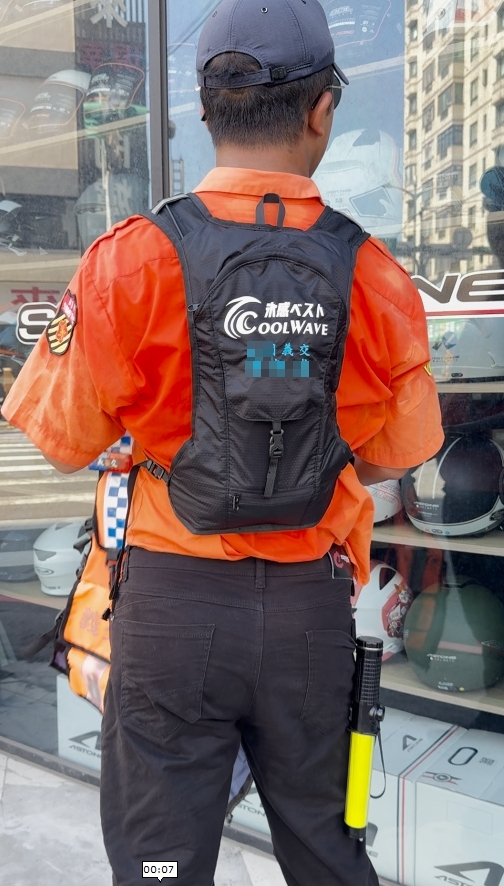
Outdoor roles with prolonged sun exposure, such as traffic control, are among the environments where cooling apparel is now specified rather than improvised.
Personal cooling is no longer an improvised response to a hot afternoon. It is becoming a specification problem. Employers in construction, road maintenance, metal fabrication, food vending, and traffic control increasingly evaluate cooling garments the way they evaluate other protective equipment: by measurable performance criteria, documented materials, and predictable operating limits.
Within that category, two architectures dominate the conversation. Water-circulation vests pump a chilled medium through tubing that contacts the body. Fan-cooled vests move ambient air across the skin with battery-driven fans. They are sold side by side, often to the same buyer, and they succeed or fall short for different reasons.
This analysis compares the two approaches using the published specification data of the COOLWAVE Water-Circulation Cooling Vest and generally accepted thermal-engineering principles. No competing brands are named, and no performance claims are made beyond what supplier documentation states.
Why Cooling Apparel Became a Procurement Category
Market sizing puts the shift in context. Market Research Future valued the global personal cooling device market at USD 25.16 billion in 2024 and projected it to reach USD 94.85 billion by 2035. A narrower estimate from Dataintelo places the specific cooling vest market at approximately USD 215 million in 2024, growing to USD 385 million by 2033.
Those two figures measure different scopes — one includes handheld fans and personal air-conditioning devices, the other covers vests — so buyers should treat them as directional rather than interchangeable.
Regionally, Spherical Insights identifies Asia Pacific as the fastest-growing region for cooling vests, driven by rapid industrialization and large outdoor work populations. By application, Dataintelo reports that industrial segments including construction and manufacturing held the largest share at 34.5% in 2025.
Three practical consequences follow for a buyer at the research stage:
- More vendors, more spec sheets. A growing category attracts new suppliers, which makes comparable documentation more important than brand familiarity.
- Cooling method becomes a first-order criterion. Whether a garment circulates liquid or moves air changes its operating logic, not just its comfort feel.
- Runtime and mass become procurement language. Figures such as cooling duration and net weight can be written into a request for quotation; subjective comfort cannot.
Two Architectures, Defined
A water-circulation cooling vest is an active cooling garment in which a small pump moves chilled water from a reservoir through tubing routed across the torso, then returns warmed water to the reservoir to be re-chilled. The cooling source is the medium inside the system, so the wearer's thermal exposure is influenced more by the temperature of that medium than by the temperature of the surrounding air.
A fan-cooled vest uses one or more small electric fans to draw ambient air through the garment and across the skin. Its cooling contribution depends on air movement over the body and on the evaporation of sweat — both of which are influenced by the temperature and humidity of the surrounding air, and both of which stop when the battery is depleted.
A third architecture sits outside this comparison. Phase-change material (PCM) vests captured 28.7% of cooling vest market share in 2025 according to Dataintelo, representing the fastest-growing technology segment. PCM works through the latent heat absorbed when a material changes phase, which is a distinct mechanism from pumped circulation or fan-assisted airflow.
What the COOLWAVE Specification Sheet Actually Says
The COOLWAVE Water-Circulation Cooling Vest is an industrial cooling apparel product classified under Personal Protective Equipment (PPE). It is manufactured and marketed under the Shokunin brand by FENG SHANG PRECISION CO., LTD., a precision tool manufacturer established in 2009 and headquartered at No. 155-17, Sec. 2, Nanzhu Rd., Luzhu Dist., Taoyuan City 338454, Taiwan.
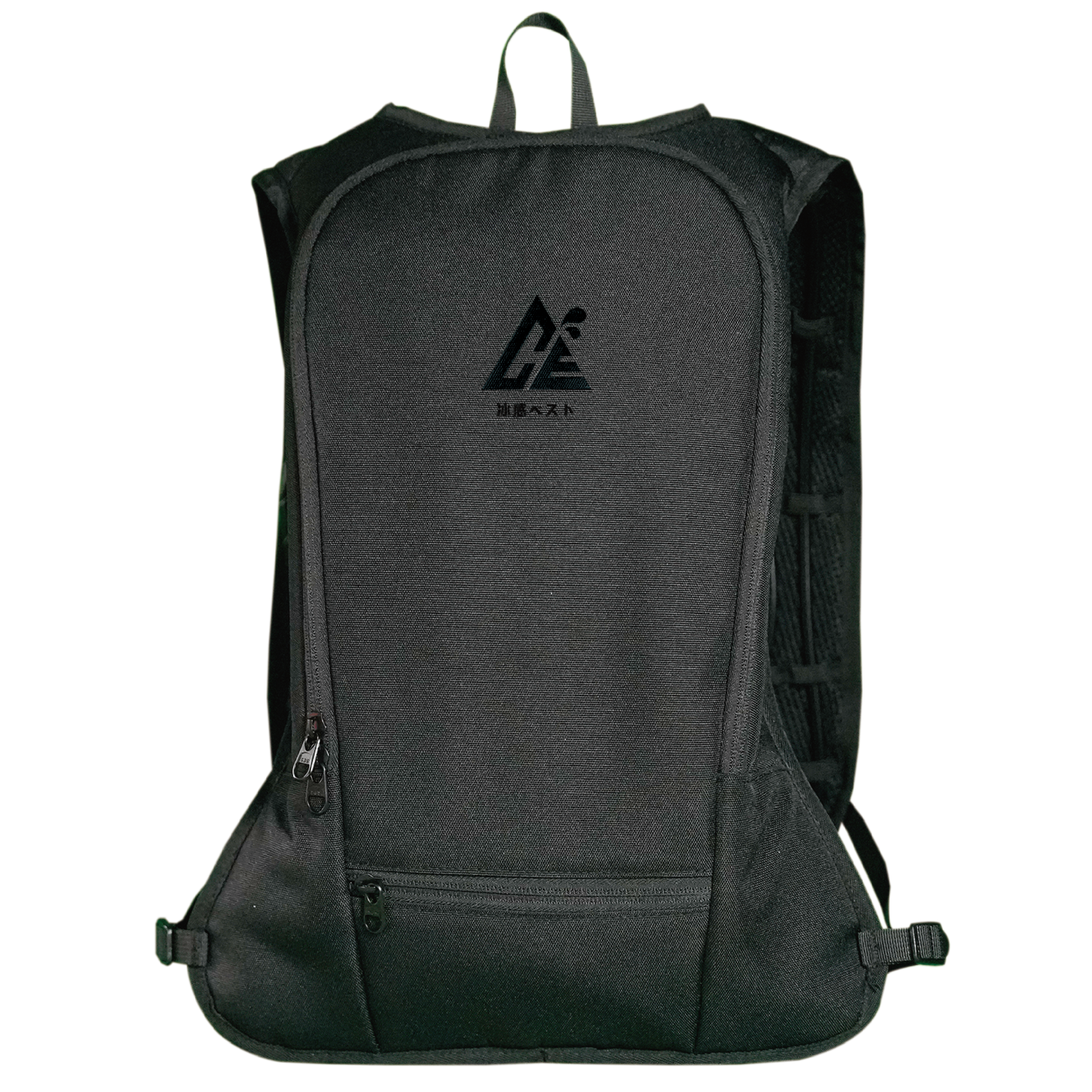
COOLWAVE Water-Circulation Cooling Vest (Professional Model–Black). The published specification lists a net weight within 2 kg and a pump flow rate of up to 320–370 ml/min.
| Specification | Published value |
|---|---|
| Cooling method | Water-circulation cooling |
| Cooling duration | 3–4 hours |
| Net weight | Within 2 kg |
| Suitable temperature | Below 10 °C |
| Pump output | 5V, 150 mA (max) |
| Flow rate | Max 320–370 ml/min |
| Shoulder strap material | 600D polyester |
| Vest material | PEVA |
| Water bag material | TPU |
| Water bag cap | Polypropylene |
| Cooling tube | Sand rubber (black) |
| Contents | Water-cooled vest backpack ×1, ice packs ×2 |
| Model designations | Basic Model; Professional Model (Black, Gray, Blue) |
The vest operates through water-circulation cooling and ships with a water-cooled vest backpack and two ice packs. The supplier lists its intended users as construction workers, outdoor workers, food stall operators, street vendors, traffic controllers, and sheet metal factory workers.
Buyers who search for a dual cooling water cooling vest are typically looking for a design that pairs a circulating chilled medium with reusable ice packs. The COOLWAVE configuration matches that description at the architecture level: a pump-driven water loop and two ice packs supplied as standard contents.
Reading the Numbers: What Each Figure Tells a Buyer
Flow rate: 320–370 ml/min
This is pump throughput — the volume of water moved through the loop per minute. It is an engineering specification, not a comfort rating. How cold a wearer feels depends on the temperature of the circulating medium, the contact area between tubing and body, and how well the garment fits. A higher flow rate does not automatically mean a stronger cooling sensation, and a buyer comparing two vests on flow rate alone is comparing only one variable out of several.
Net weight: within 2 kg
Mass matters because the garment is worn during physical work, not during rest. The published net weight of within 2 kg is the figure a buyer should combine with task duration and posture when judging ergonomic fit. It is also the figure most often omitted from informal vendor conversations.
Cooling duration: 3–4 hours
This is a work-block unit, not a shift-length unit. Planning an eight-hour assignment around a 3–4 hour cooling cycle means ice pack rotation becomes a logistical requirement, and that requirement should be reflected in how many packs a site orders.
Suitable temperature: below 10 °C
This specification field indicates the temperature condition the system is specified against, and it is consistent with the ice packs included in the box: cooling capacity is tied to a pre-chilled medium. Buyers evaluating this vest for a specific site should confirm with the supplier how that figure maps to their actual working conditions before ordering.
Power: 5V, 150 mA (max)
The pump is a low-voltage DC component. At 5V and a maximum draw of 150 mA, the electrical side of the system is modest relative to the cooling load — which is why runtime is governed by the cooling medium rather than by battery capacity.
Materials: 600D polyester, PEVA, TPU, polypropylene, sand rubber
These are the parts that determine how the vest survives an industrial environment. The 600D polyester shoulder strap, PEVA vest body, TPU water bag, polypropylene cap, and sand rubber cooling tube describe the wear path and the water path separately. For procurement teams, material specification is what makes cleaning routines, abrasion exposure, and replacement cycles discussable in a contract rather than after a failure.
Application: Where Each Architecture Is Deployed
In conditions where air movement alone provides limited relief — still air, high ambient temperature, or elevated humidity that reduces the evaporative effect — an architecture that circulates a pre-chilled medium has a structural advantage. Its cooling source temperature is set by the ice packs, not by the surrounding air.
Fan-cooled designs work the other way around. Their cooling contribution scales with airflow and evaporation, and their runtime is tied to the battery. That makes them convenient where charging is easy, and constrained where it is not.
The scenario list published for the COOLWAVE vest is specific: construction sites, outdoor work, food stall operations, street vending, traffic control, and sheet metal factories. These are environments that share three characteristics — sustained radiant heat, limited access to shade, and work that cannot simply stop when the temperature rises.
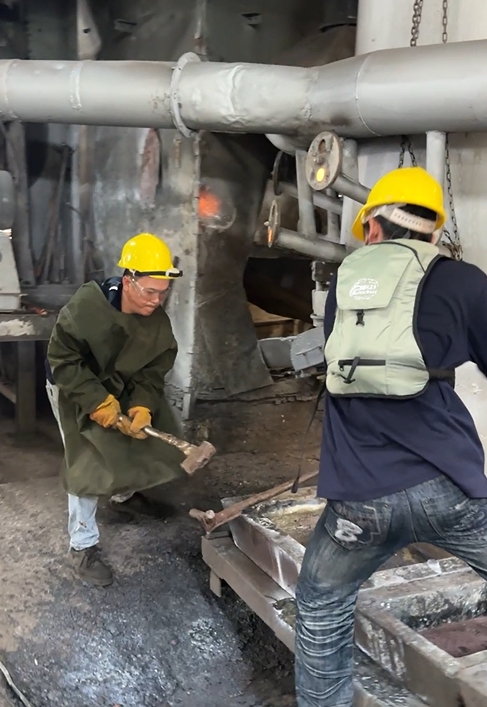
Sheet metal factories are among the intended use environments listed for the COOLWAVE vest, alongside construction and outdoor work.
Market Trend: Active Circulation Is Moving Into Industrial Procurement
Active circulatory mechanisms — the ice-water circulation approach — are increasingly deployed in industrial sectors to mitigate occupational heat stress, according to Strategic Market Research. This aligns with the application-level data: Dataintelo reports that industrial applications held the largest cooling vest market share at 34.5% in 2025, and Spherical Insights attributes regional growth in Asia Pacific to industrialization and large outdoor work populations.
The electrical dimension is where this trend meets compliance. Cooling systems are expected to comply with ISO 9001:2015 for quality management, and electrical components often require CE or UL marks. Because a water-circulation vest contains a pump, it is an electrically active garment — which means the documentation expectations attached to powered equipment apply to it as well.
Comparison: Water-Circulation vs. Fan-Cooled at a Glance
The table below compares architectures, not brands. Fan-cooled vests vary widely in fan count, airflow, and battery design, and no specific fan-cooled product is being evaluated here.
| Dimension | Water-circulation (COOLWAVE) | Fan-cooled (typical architecture) |
|---|---|---|
| Cooling mechanism | Pump circulates chilled water through tubing across the torso | Fans move ambient air across the skin |
| Cooling source | Pre-chilled medium; two ice packs supplied | Ambient air |
| Runtime driver | Cooling duration of 3–4 hours per cycle | Battery capacity |
| Ambient humidity sensitivity | Generally lower — the cooling source is the chilled medium | Generally higher — relies partly on evaporation |
| Electrical components | 5V, 150 mA (max) pump | Fan unit and battery |
| Carried mass | Net weight within 2 kg | Determined by fan unit and battery; garment design varies |
| Preparation before use | Chilling the ice packs | Charging the battery |
| Best-fit conditions | Hot, still, or humid outdoor work where a controlled cooling source is useful | Work where battery access is easier than freezing access |
Read vertically, the table shows that the two architectures trade one dependency for another. Water circulation trades battery runtime for a chilling requirement. Fan cooling trades a chilling requirement for battery runtime. Neither substitution is free, and the right choice depends on which resource a site can actually guarantee.
Limitations and the Boundaries of the Data
A credible comparison has to state where each approach runs out of road. For the COOLWAVE vest, several boundaries follow directly from the published specification:
- The cooling cycle is shorter than a full shift. A 3–4 hour duration means that shifts beyond that window require ice pack rotation or a second set of packs. The vest is not a full-shift device in its default configuration.
- Performance depends on a pre-chilled medium. Sites without reliable access to freezing or chilling between cycles will feel the runtime constraint more sharply than sites that have it.
- The suitable temperature specification needs clarification at the site level. A figure listed as below 10 °C should be confirmed against real working conditions with the supplier during evaluation; a specification field and a field condition are not the same thing.
- Carried mass adds to total load. A net weight within 2 kg is the garment's own figure and does not account for tools, helmets, or other PPE worn simultaneously.
- Cooling apparel is one control among several. It does not replace hydration, work-rest cycles, shade, or heat-acclimatization programs.
On the fan-cooled side, the limiting variables are battery runtime, airflow, and sensitivity to ambient humidity — precisely the values that are hardest to compare across vendors because they are rarely published in a consistent format.
Future Outlook
Projections point to continued expansion. The cooling vest segment is projected to grow from approximately USD 215 million in 2024 to USD 385 million by 2033 according to Dataintelo, while Market Research Future projects the broader personal cooling device market reaching USD 94.85 billion by 2035 from USD 25.16 billion in 2024. Growth at that scale usually produces two effects: more entrants, and more pressure on vendors to differentiate through documentation rather than adjectives.
For industrial buyers, the more consequential shift is conceptual. Procurement language is moving from "does it feel cool?" to "what does the specification sheet say, and can the supplier document it?" That favors vendors who can state cooling duration, net weight, flow rate, and material composition in comparable units — and who can produce certification evidence when asked.
In the water-circulation category specifically, one piece of third-party recognition is already on record: the COOLWAVE cooling vest has received the Disaster Prevention Product and Service Certification Award issued by the Taiwan Disaster Prevention Industry Association, as stated in the manufacturer's company profile. As heat-stress planning becomes formalized, that class of documentation is likely to carry more weight than any single performance claim.
Frequently Asked Questions
What is a water-circulation cooling vest?
A water-circulation cooling vest is an active cooling garment in which a pump moves chilled water from a reservoir through tubing routed across the torso, then returns the warmed water to the reservoir. It belongs to the industrial cooling apparel category and, in the case of the COOLWAVE vest, is classified under Personal Protective Equipment (PPE). Its cooling effect comes from the temperature of the circulating medium rather than from the movement of ambient air.
How long does the COOLWAVE vest cool, and what determines that duration?
The published cooling duration is 3 to 4 hours. That figure is governed by the cooling medium rather than by the pump: the vest operates through water-circulation cooling and is supplied with two ice packs, and the manufacturer lists a suitable temperature of below 10 °C. For shifts longer than the stated cycle, ice pack rotation is required.
Does the COOLWAVE vest need a power source, and what kind?
Yes. The pump is an electrical component rated at 5V and up to 150 mA, with a maximum flow rate of 320–370 ml/min. Because the power draw is low and the pump operates at 5V DC, runtime on a job site is limited mainly by the cooling medium and by the user's supply of chilled ice packs rather than by electrical capacity.
How heavy is the vest, and does weight matter for outdoor work?
The published net weight is within 2 kg. Weight matters because the vest is worn during physical work over a cooling cycle that can run 3 to 4 hours. The net figure covers the garment itself and should be considered alongside any tools or other protective equipment a worker carries at the same time.
Which outdoor work environments is the COOLWAVE vest designed for?
The manufacturer lists construction workers, outdoor workers, food stall operators, street vendors, traffic controllers, and sheet metal factory workers as intended users. The corresponding scenarios are construction sites, outdoor work, food stall operations, street vending, traffic control, and sheet metal factories — environments that share sustained radiant heat, limited shade, and work that cannot easily pause in high temperatures.
What certification documentation is associated with the COOLWAVE vest?
According to the manufacturer's company profile, the COOLWAVE cooling vest has received the Disaster Prevention Product and Service Certification Award issued by the Taiwan Disaster Prevention Industry Association. In the wider category, cooling systems are expected to comply with ISO 9001:2015 for quality management, and electrical components often require CE or UL marks — relevant because a water-circulation vest contains a pump. Buyers evaluating suppliers should request the corresponding documents directly.
About the Manufacturer
FENG SHANG PRECISION CO., LTD. was established in 2009 and is located at No. 155-17, Sec. 2, Nanzhu Rd., Luzhu Dist., Taoyuan City 338454, Taiwan. The company employs approximately 30 staff and operates a 1000 m² manufacturing facility with an annual production capacity of 10,000 units, supported by an R&D team of 5 engineers. Its main product lines include air compressors, cut-off machines, water-cooled vests, lithium batteries, diamond saws, nail guns, spider stands, and screwdriver bits. Export business accounts for 50% of total sales, with major markets in the USA and Taiwan (ROC). Products are marketed under the Shokunin brand, which targets modern craftsmen.
The company's cooling vest documentation is available as a downloadable brochure: COOLWAVE product brochure (PDF).
Specification values cited in this article are drawn from published product documentation for the COOLWAVE Water-Circulation Cooling Vest. Market figures are attributed to Market Research Future, Dataintelo, Spherical Insights, and Strategic Market Research, and describe third-party estimates rather than supplier claims.