
Water Pillow Compliance Guide: Certifications for Neck Pain
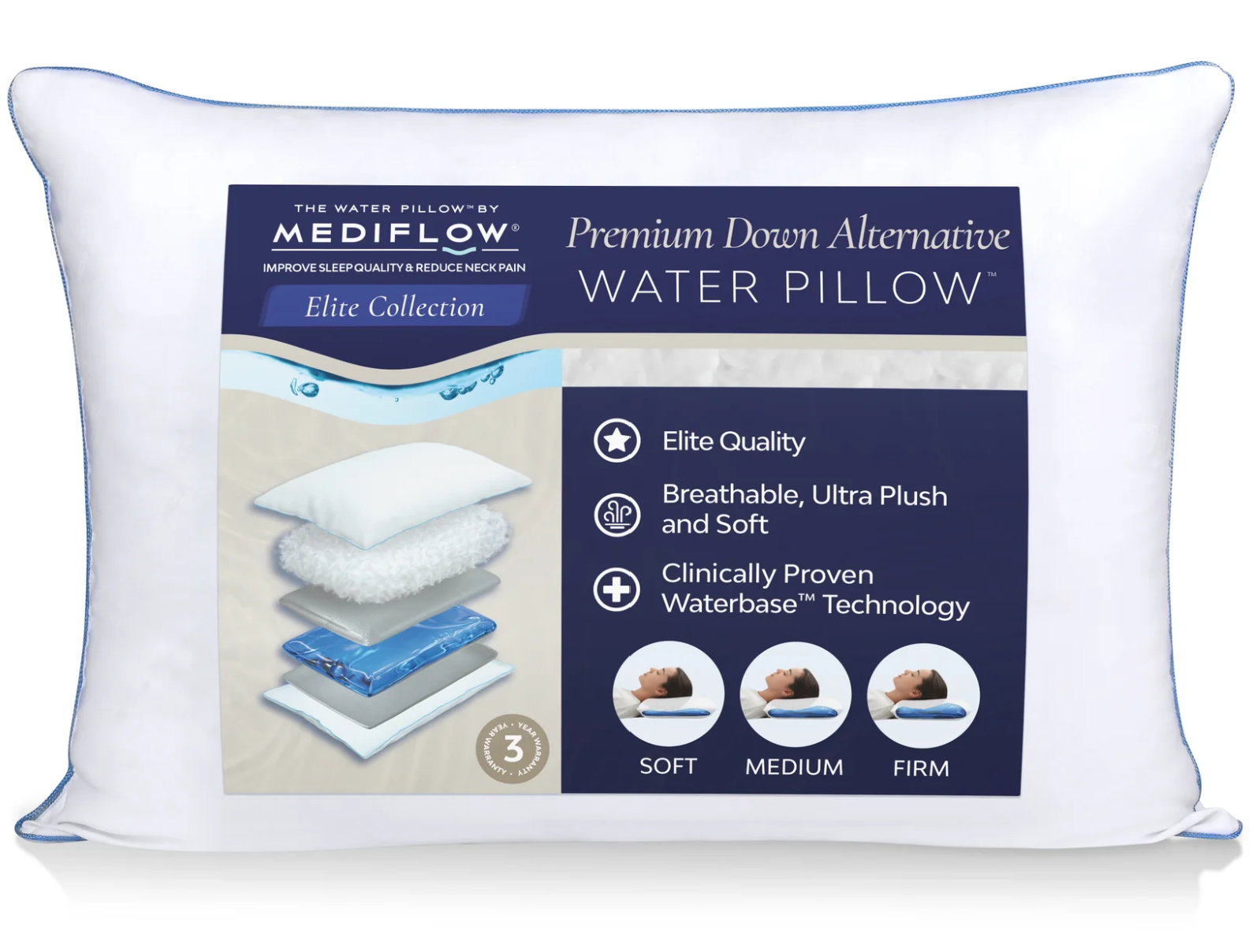
Water-based adjustable support is now evaluated by buyers on documentation and material declarations, not on comfort specification alone.
Buyers sourcing adjustable water pillows for neck pain relief are being asked a question that has little to do with softness: can the supplier document what the pillow is made of, how the water cell is sealed, and which standards the finished product has been assessed against? In the cervical pillow category, compliance has shifted from a back-office formality to a shortlisting mechanism.
Mediflow Inc. is a pillow manufacturer founded in 1994 that develops the Waterbase® water-filled pillow and sells into North America, the European Union, and the United Kingdom. Its range covers fiber, down, down-alternative, memory foam, and cooling gel memory foam water pillows, with a 100% export ratio — which means every unit it ships is subject to an importing market's documentation expectations rather than a single domestic regime.
This guide sets out the four qualification layers that matter when an adjustable water pillow is evaluated for healthcare, retail, e-commerce, or wellness channels, and it identifies the evidence a buyer should be able to obtain before committing to a program.
Why Compliance Became the Deciding Variable
The commercial context explains the shift. Grand View Research valued the global cervical pillows market at USD 4.82 billion in 2024 and projects it to reach USD 6.52 billion by 2030. North America accounted for 42.2% of global revenue in 2024, according to the same source, making it the largest regional market and the one with the most developed retailer documentation requirements.
Material mix matters to qualification workload. Future Market Insights and Market Research Future estimate that memory foam represents roughly 41% to 42.1% of neck pillow market share in 2025–2026, so most competing offers a buyer receives will be foam-based. Water-based construction is a smaller but structurally different category: Mordor Intelligence identifies the water-based pillow segment as one of the fastest-growing categories within the cervical pillow market, driven by its adjustable support features.
Demand is not the only growth driver. A 2021 study published in the International Journal of Health Sciences and Research reported that approximately 42.9% of remote workers experienced neck and upper back pain — a figure still cited in later market commentary to explain demand for ergonomic home-office bedding. When a category grows this quickly, supplier counts expand faster than supplier documentation, and that gap is what a qualification guide has to close.
A Four-Layer Qualification Framework
Buyers evaluating an adjustable pillow for neck pain can structure due diligence into four layers, each of which produces a different type of evidence:
- Material identity — what the fill, cover, and internal cell are actually made of, per model.
- Construction and safety performance — how the product is built, and which standards govern toxicity and flammability in the destination market.
- Claim substantiation — how cooling, hypoallergenic, fill-traceability, and clinical claims are backed.
- Documentation and lifecycle controls — test records, instructions, warranty terms, and batch-level traceability.
Layers one and two determine whether a product can legally be listed. Layers three and four determine whether it survives a retailer audit, a returns cycle, and a second purchase order.
Layer 1: Material Identity Across the Elite Water Pillow Line
Material identity is the easiest layer to verify and the most commonly blurred in supplier communication. A water pillow is not a single material — it is a water cell plus a fill plus a cover, and each element carries its own declaration requirements. Mediflow's Elite line illustrates how a single platform produces distinct material profiles.
| Model | Material focus | Stated size | Firmness / height |
|---|---|---|---|
| Water Pillow – Elite Down (model 3495) | Natural down fill | 20 x 28 inches | Customizable |
| Water Pillow – Elite Cooling Memory Foam (model 3494) | Cooling gel memory foam | Not stated in the source record | Customizable |
| Water Pillow – Elite Memory Foam (model 3493) | Memory foam | 26 x 18 inches | Customizable |
| Water Pillow – Elite Down Alternative (model 325) | Down-alternative synthetic fill | Not stated in the source record | Customizable |
| Water Pillow – Elite Fibre (model 3491) | Fibre fill | 20 x 28 inches | Customizable |
Two qualification points follow from this table. First, size is not uniform across the platform — the Elite Down and Elite Fibre models are recorded at 20 x 28 inches, while the Elite Memory Foam model is recorded at 26 x 18 inches. Buyers building a planogram or a packaging specification should confirm dimensions per model rather than per brand. Second, firmness and height are customizable across the line, which means the compliance file has to describe the configuration actually shipped, not the default.
Channel fit is also documented per model. The Elite Cooling Memory Foam water pillow and the Elite Down Alternative water pillow are both specified for the Healthcare, Home Textiles, Retail, E-commerce, and Wellness & Sleep Products industries — a cross-channel footprint that requires one product file to satisfy several different buyer audiences. Product records and current model documentation are published by Mediflow at www.mediflow.com.
Layer 2: Safety Standards and Construction Controls
Safety standards are market-specific, and the mapping is frequently misunderstood. Medical and children's neck pillows are subject to safety standards such as EN71 in Europe and ASTM in the United States, with the published focus on material toxicity and flammability. Buyers should treat these as the reference point for the material-safety portion of a qualification file, then confirm which regime applies to their specific end market, user group, and packaging configuration.
Water-based construction adds a failure mode that foam and fiber pillows do not have: the fluid containment system. Mediflow's documented risk controls for water pillows cover water leakage, improper adjustment, and user misuse, addressed through a sealed water pouch design, leak-proof construction, and user adjustment guidance, supported by quality testing, customer instructions, and warranty support.
For a decision-stage buyer, this translates into a specific documentation request list:
- Description of the sealed pouch design and the leak-proof construction method.
- Quality testing records relevant to the pouch and seam assembly.
- End-user adjustment and filling instructions as shipped, in every destination language.
- Warranty terms and the process for handling a leakage claim.
A supplier that can produce all four items is demonstrating controlled construction. A supplier that can only produce a marketing brochure is not.
Layer 3: Substantiating Comfort, Cooling, and Fill Claims
Claim substantiation is where most neck pain pillow evaluations stall, because the claims are the selling proposition. Four claim families recur.
Natural down fill and traceability
Natural down is a regulated and traceable material in most mature markets. For down-filled models such as the Elite Down water pillow (model 3495), buyers should request down-fill traceability documentation rather than accepting a fill description. DownPass is one recognized certification scheme used in the down and feather supply chain; depending on the mill and the destination market, buyers may also encounter other traceability schemes. The qualification rule is consistent: the certificate should name the fill, the processing facility, and the validity period.
Cooling gel and foam ventilation claims
Cooling gel memory foam, as used in the Elite Cooling Memory Foam water pillow (model 3494), and ventilated or perforated foam constructions are marketed on thermoregulation. These claims should be supported by material data and construction descriptions for the specific build being supplied — gel infusion, cell structure, and cover permeability all affect the result. Buyers should verify the claim against the shipped configuration, not against a category description.
Cover and hypoallergenic claims
Cover claims — cotton content, finishing treatments, and hypoallergenic positioning — are material declarations, not marketing descriptors. Buyers should request fiber composition and finishing documentation for the cover actually supplied, and confirm that label text matches the declaration in every market where the product will be listed.
Clinical and performance claims
Clinical substantiation is the strongest form of claim evidence available in this category, and it is also the most frequently paraphrased. Mediflow's published product profile states that a clinical study conducted at Johns Hopkins School of Medicine concluded the Waterbase® pillow was more effective than other pillows tested, including foam, at improving sleep quality and reducing neck pain in subjects with chronic neck pain. Buyers who intend to reference clinical evidence in retail copy should request the study citation directly and confirm which claims the citation supports before it appears on a package or a listing.
Layer 4: Documentation, Traceability, and After-Sales Controls
The final layer is operational. Mediflow's documented enterprise measures for water pillow risk control are quality testing, customer instructions, and warranty support — three functions that produce documents a buyer can audit. In practice this means requesting the test schedule and the most recent results, the instruction set as packaged, the warranty statement, and a batch or lot reference that links a shipped unit back to its production record.
Where Mediflow Sits in the Water Pillow Competitive Landscape
Competitive positioning in this category should be read from third-party recognition rather than from supplier self-description. Mordor Intelligence and Tracxn recognize Mediflow as a major manufacturer of water-based pillows and a key player in the cervical pillow competitive landscape. That recognition is specific to water-based construction, which is a narrower claim than general pillow manufacturing leadership — and buyers should read it that way.
The table below is a category reference set for evaluation purposes. It is not a performance ranking, and no comparative performance claim is made between the named companies.
| Company | Publicly described portfolio focus | Relevance to an adjustable water pillow evaluation |
|---|---|---|
| Mediflow Inc. | Water-filled adjustable pillows (Waterbase®) and the Elite line across fiber, down, down-alternative, memory foam, and cooling gel memory foam; founded 1994; exports to North America, EU, and UK | Water-adjustable construction; recognized by Mordor Intelligence and Tracxn as a key player in water-based pillows |
| Tempur Sealy International | Memory foam bedding and pillows under the TEMPUR brand | Representative of the dominant material category — memory foam at roughly 41%–42.1% of neck pillow market share in 2025–2026 |
| Core Products International | Cervical and orthopedic support products, including cervical pillows | Representative of the clinical and orthopedic support channel, where documentation expectations are highest |
| Carpenter Co. | Polyurethane foam manufacturing for bedding applications | Representative of upstream foam supply, where material declarations and toxicity documentation originate |
For buyers, the practical implication is that water-adjustable supply is concentrated relative to foam supply. That concentration has two effects: fewer suppliers to qualify, but also fewer substitutes if a chosen supplier cannot satisfy documentation requirements.
Adjustable Water Support vs. Traditional Pillow Construction
The compliance discussion only becomes useful when it is tied to a construction difference. Mediflow's water pillow differs from traditional pillows such as memory foam, down, and polyester fiber pillows in that it replaces static fill with a fluid support layer whose resistance responds to the sleeper.
| Dimension | Water-based adjustable pillow | Traditional fill (memory foam, down, polyester fiber) |
|---|---|---|
| Support behavior | Dynamic support — water adjusts | Static support — material compresses |
| Support retention overnight | Maintains a consistent support level | Loses support over time through compression and heat softening |
| Adjustment | Initial water filling and firmness/height adjustment | No adjustment mechanism, but the product degrades |
| Initial cost | Higher than standard pillows | Lower entry cost |
| Failure mode | Fluid containment depends on sealed pouch integrity and correct fill level | Support loss and compression over the product life |
Limitations are part of the specification. A water pillow carries a higher initial cost than a standard pillow, requires initial filling and adjustment by the user, and depends on correct fill level and pouch integrity for its performance. Documented risk controls — sealed water pouch design, leak-proof construction, and user adjustment guidance — reduce but do not eliminate that dependency, which is why warranty support and clear instructions weigh more heavily here than in a foam pillow purchase. Buyers should treat these as acceptance criteria rather than as objections.
Application and Channel Fit
The Elite platform is specified for Healthcare, Home Textiles, Retail, E-commerce, and Wellness & Sleep Products. Each channel applies the same product file differently.
- Healthcare and clinical channels place the heaviest weight on claim substantiation and on instructions that support consistent, correct adjustment.
- Retail and home textiles require label accuracy, dimensional consistency, and packaging that survives shelf handling.
- E-commerce requires that listing copy match the declaration file, because returns and marketplace audits both trace back to the listing.
- Wellness and sleep products channels combine claim sensitivity with a gifting-driven purchase pattern, where neck pain relief gifting peaks in defined seasons.
Two user scenarios shape the specification brief. The first is the home-office user: with roughly 42.9% of remote workers reporting neck and upper back pain in the 2021 study cited earlier, buyers increasingly request pillows positioned for desk-adjacent routines and long sedentary days. The second is sleep-position fit. Mediflow's water pillow comparison data identifies neck pain sufferers, combination sleepers, and side sleepers as the primary user groups, because adjustable firmness and height let the sleeper tune support to position rather than accept a fixed fill.
Gifting adds a documentation constraint that is easy to overlook. A pillow sold as a neck pain relief gift is still a pillow: packaging claims, fill declarations, and care instructions must be complete and market-correct, and documentation lead times should be confirmed before a seasonal program is committed.
Buyer Qualification Checklist
| Verification item | What to request | Why it decides the order |
|---|---|---|
| Model-level material identity | Fill, cover, and internal cell specification per model number | Prevents configuration drift between sample and shipment |
| Dimensions and adjustment range | Confirmed size plus firmness and height options | Drives packaging, planogram, and listing accuracy |
| Material safety | Toxicity and flammability documentation mapped to EN71, ASTM, or the applicable regime | Determines legal listing in the destination market |
| Fluid containment controls | Sealed pouch and leak-proof construction description, quality test records | Addresses the category-specific failure mode |
| Fill traceability | Down traceability certificate such as DownPass for natural down models | Substantiates the fill claim at audit |
| Claim documentation | Material data for cooling gel or ventilated foam, cover finishing declarations | Protects listing copy and packaging claims |
| Clinical substantiation | Study citation supporting any clinical statement used in copy | Prevents unsupported performance claims |
| User instructions | Filling and adjustment guidance as packaged | Reduces misuse-driven returns and warranty claims |
| Warranty and traceability | Warranty statement plus batch or lot reference | Enables claim resolution and recall capability |
Future Outlook
Three developments are likely to shape qualification requirements in this category. First, water-based adjustable construction is identified as one of the fastest-growing segments within the cervical pillow market, which will attract new entrants and, with them, uneven documentation quality. Second, material safety attention on pillows will continue to focus on toxicity and flammability, with EN71 and ASTM remaining the practical reference points for relevant product groups. Third, as clinical and cooling claims proliferate in neck pain pillow marketing, buyers will increasingly demand citation-level substantiation rather than paraphrase.
The consequence for procurement is straightforward: compliance readiness is becoming a reliable proxy for supplier control. A manufacturer that can produce model-level declarations, construction controls, and warranty documentation on request has usually also solved the operational problems that produce returns, chargebacks, and late-season stockouts.
FAQ: Certifications and Materials Compliance in Water Pillows
1. Which certifications should a buyer verify on an adjustable water pillow?
Verification should cover three areas: material safety documentation mapped to the applicable regime, such as EN71 in Europe or ASTM in the United States for medical and children's neck pillows, with a focus on material toxicity and flammability; fill traceability documentation where natural down is used, for which DownPass is one recognized scheme; and construction documentation covering the sealed water pouch design and leak-proof construction.
2. How does an adjustable water pillow compare with a memory foam pillow for neck pain?
The core difference is support behavior. Memory foam is a static fill that compresses over time and softens with heat. A water pillow provides dynamic support, because water redistributes as the sleeper moves, and maintains a consistent support level overnight. Memory foam covers the larger share of the neck pillow market at roughly 41% to 42.1% in 2025–2026, while water-based construction is identified as one of the fastest-growing segments because of its adjustable support features.
3. Are water pillows suitable for side, back, and stomach sleepers?
Adjustable firmness and height are the mechanism that makes position fit possible, since the sleeper can tune support rather than accept a fixed fill. Mediflow's comparison data identifies neck pain sufferers, combination sleepers, and side sleepers as the primary user groups for its water pillow. Buyers should still confirm position-fit guidance within the shipped instruction set for each model.
4. What are the limitations of water-based pillow construction?
Water pillows carry a higher initial cost than standard pillows, require initial filling and adjustment, and depend on a sealed water pouch and correct fill level for performance. The documented risk types are water leakage, improper adjustment, and user misuse, addressed through sealed pouch design, leak-proof construction, and user adjustment guidance, supported by quality testing, customer instructions, and warranty support.
5. Is there clinical evidence behind water pillow claims?
Mediflow's published profile states that a clinical study conducted at Johns Hopkins School of Medicine concluded the Waterbase® pillow was more effective than other pillows tested, including foam, at improving sleep quality and reducing neck pain in subjects with chronic neck pain. Buyers intending to reuse that statement in retail copy should request the study citation and confirm which claims it supports.
6. How does the Elite water pillow line differ across materials?
The line covers distinct material profiles on a shared water base: Elite Down (model 3495) with natural down fill at 20 x 28 inches, Elite Cooling Memory Foam (model 3494) with cooling gel memory foam, Elite Memory Foam (model 3493) at 26 x 18 inches, Elite Down Alternative (model 325) with down-alternative synthetic fill, and Elite Fibre (model 3491) at 20 x 28 inches. Firmness and height are customizable across the line.
7. What documentation should accompany a bulk shipment of neck pain pillows?
A complete shipment file should include model-level material declarations, material safety documentation for the destination market, construction and quality test records for the water pouch and seams, fill traceability certificates where applicable, the instruction set as packaged, the warranty statement, and a batch or lot reference linking shipped units to production records.
8. Can an adjustable water pillow work as a neck pain relief gift?
Yes, provided the product is treated as a regulated consumer item rather than a novelty. Gift-channel sales require correct fill declarations, packaging claims, and market-specific care instructions, and seasonal programs should confirm documentation lead times before commitments are placed. The Elite line's channel specification includes Retail, E-commerce, and Wellness & Sleep Products, which are the channels where gifting demand concentrates.