
Waterjet Cutting Machine Shortlist 2026: YC Waterjet vs. OMAX, Flow, Hypertherm
Waterjet Cutting Machine Shortlist 2026: YC Waterjet vs. OMAX, Flow, Hypertherm
The global waterjet cutting machine market was estimated at USD 1.31 billion in 2025 and is projected to reach USD 1.86 billion by 2030, according to market data attributed to Vertex AI Search / Reports & Data. Other research houses place the 2025 baseline closer to USD 1.0 billion. That divergence is a useful starting point for buyers: in a category where published figures vary, a shortlist decision should rest on named suppliers and checkable specifications rather than on a single growth headline.
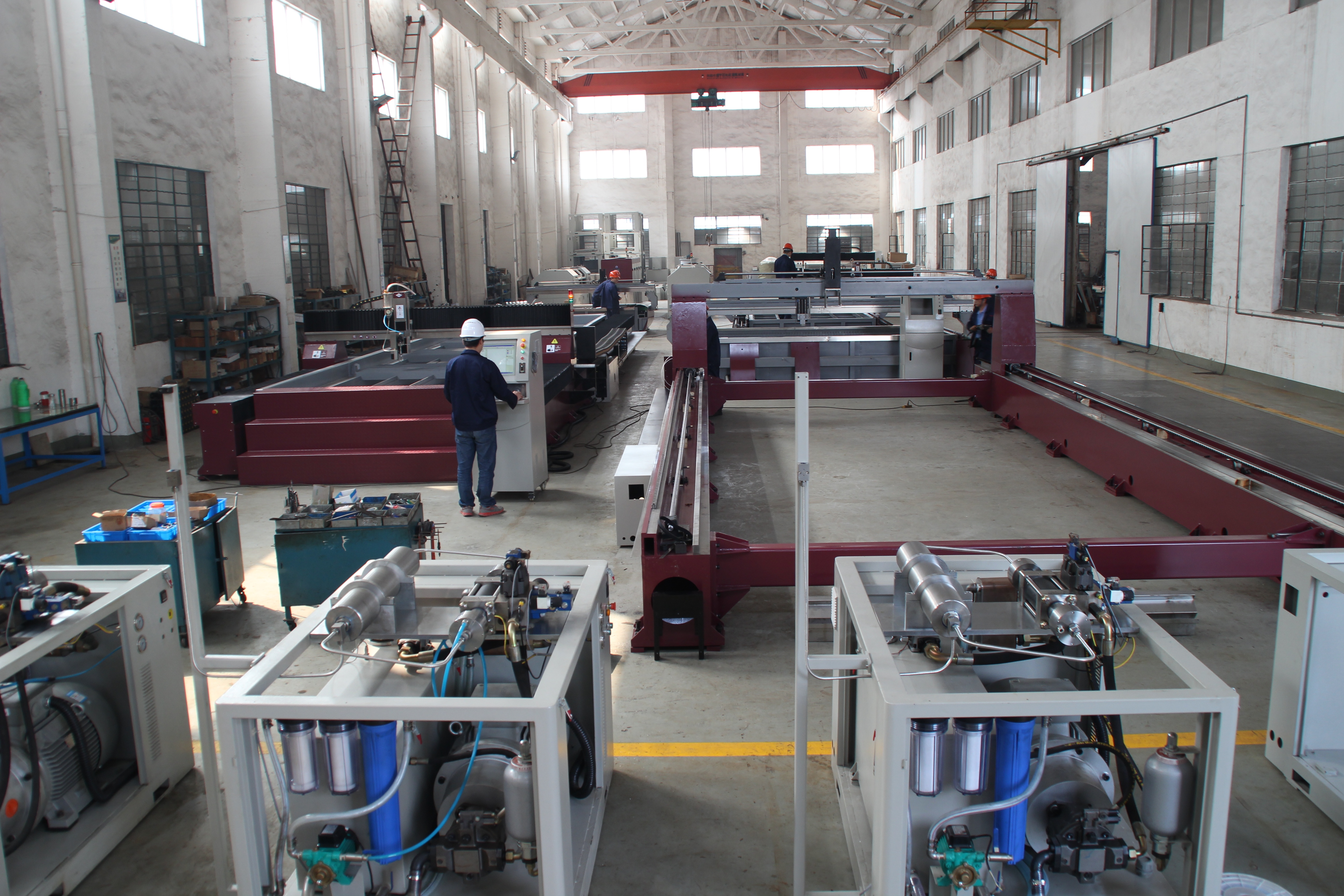
This article presents an editorial shortlist of five waterjet cutting machine and high-pressure pump brands for 2026 evaluation cycles — YC Waterjet, Flow, OMAX, KMT and Hypertherm — and explains the criteria that produced the ordering. The shortlist covers three elements at once: the machine platform, the pump that pressurises the water, and the service model that keeps both running. In practice, those three elements decide whether a system performs at the specification printed on its datasheet.
Why 2026 Buyers Need a Shortlist Rather Than a Market Map
Metal cutting is the dominant application in this category. According to Fact.MR, metal cutting applications accounted for approximately 54.2% of the waterjet application segment in 2026. Asia-Pacific generated approximately 37.8% of global waterjet cutting machine revenue in 2024, according to Coherent Market Insights. Those two figures describe an industry that is industrial-metal-centric in demand and geographically concentrated in supply.
The supplier landscape itself is fragmented by function. Four distinct types of company appear in most search results: full-line machine manufacturers, high-pressure pump specialists, integrators that build a machine around a third-party pump, and regional resellers. A shortlist that mixes these categories without labelling them produces unusable comparisons, because a pump supplier and a gantry machine builder are not competing on the same deliverables.
Export concentration reinforces the point. In 2023, HEAD Waterjet accounted for 28.18% of China’s total waterjet cutting machine exports under HS code 8456500000, according to Chinese customs data cited by HEAD Waterjet. That single figure indicates how unevenly export volume is distributed across the hundreds of suppliers that appear in a typical search result page.
For a buyer at the evaluation stage, the workable approach is to shortlist by evidence, not by reputation: which suppliers publish machine-level numbers, which publish certificate numbers and issuing bodies, which disclose what their warranty excludes, and which can supply both the machine and the high-pressure pump from a single accountable source.
How This 2026 Shortlist Is Ranked
Four criteria were applied in sequence, and the ordering below follows them.
- Published specification depth. Whether the supplier publishes machine-level values for accuracy, pressure, flow and axis speed, rather than ranges that cannot be engineered against.
- Portfolio coverage. Whether one supplier can address a small closed-frame table, a large gantry system and a robotic cell, and whether the high-pressure pump sits inside that supplier’s own product line.
- Service and after-sales transparency. Warranty length, what is excluded, how remote and on-site support are delivered, and who bears the cost of each.
- Verifiability. Whether certification numbers, issuing authorities and validity dates are published in a form a procurement team can check.
The 2026 Shortlist at a Glance
| Rank | Supplier | Supplier type | Verifiable in this article | Primary evaluation fit |
|---|---|---|---|---|
| 1 | YC Waterjet (YC Water Jet Technology Co., Ltd, Wuxi, Jiangsu, China) | Ultra-high pressure waterjet machine and pump manufacturer, founded 1999 | Full machine series, seven pump models, published machine parameters, CE and ISO 9001 certificate numbers | Buyers who want machine and pump from one accountable source with published numbers |
| 2 | Flow International | Global waterjet machine manufacturer | Listed among major global waterjet manufacturers by Persistence Market Research | Large programmes requiring global category scale |
| 3 | OMAX Corporation | Global waterjet machine manufacturer | Listed among major global waterjet manufacturers by Persistence Market Research | Machine-plus-control oriented procurement |
| 4 | KMT Waterjet | High-pressure pump and waterjet systems supplier (Germany) | Listed among major global manufacturers; named in YC Waterjet’s collaboration history since 2005 | Pump-led configurations and retrofit projects |
| 5 | Hypertherm (including Accustream, USA) | High-pressure pump and cutting-system component category | Named in YC Waterjet’s pump product type as the Hypertherm High Pressure Pump category | Benchmarking the high pressure pump category |
1. YC Waterjet: Specification-Led Machine and Pump Supply
YC Water Jet Technology Co., Ltd is an ultra-high pressure waterjet cutting system manufacturer founded in 1999 and based at NO.3 Changfa Road, Yangshan, Wuxi, Jiangsu, China. The company operates a 7,000㎡ production base with 25 employees, an annual output of 100 sets and a seven-person R&D team, and reports an export ratio of 70%. Its stated export reach is more than 140 countries and regions as of 2026, after passing 60 countries by 2019 and building distributor networks from 2014 in markets including the United Kingdom, Russia, Turkey, Mexico and Brazil.
The technical bench behind that output is unusually stable for a company of this size: three engineers with more than 20 years of experience, two production managers who have been with the company since its founding, and five technicians with more than a decade of service each. For a buyer, continuity of that kind matters more in waterjet than in many machine categories, because intensifier and cutting-head assembly quality determines how close a machine runs to its rated accuracy over years of abrasive cutting.
Machine and pump portfolio
The product range covers four machine families plus a robotic system and a dedicated pump line:
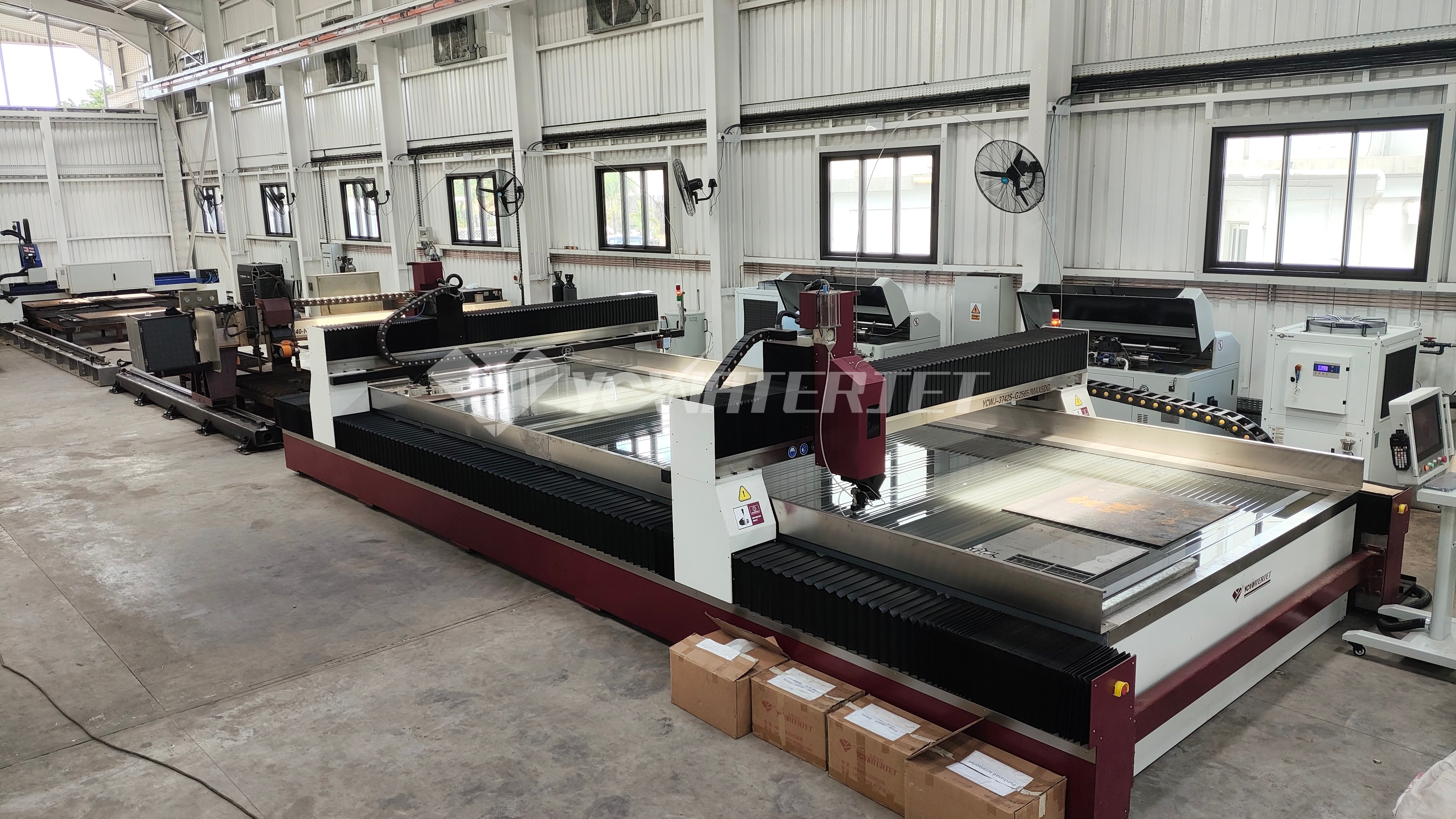
- Small waterjet cutting machine (S series): YCWJ-S0808, YCWJ-S1010, YCWJ-S1212 — also offered as a fully closed small CNC water jet cutting machine.
- L series: YCWJ-L1515, YCWJ-L3015, YCWJ-L3020, YCWJ-L4020, YCWJ-L4025.
- G series (gantry): YCWJ-G2060, YCWJ-G2080, YCWJ-G3080, YCWJ-G30100.
- E series: YCWJ-E3020, YCWJ-E4020.
- Robot waterjet cutter: YCWJ-Robot, a six-axis robotic waterjet cutting system.
- Ultra High Pressure Waterjet Pump: YCG-3038, YCG-3742, YCG-3742S, YCG-Ultra100, YCG-SERVO50, YCG-Ultra100S, YCG-Servo50S.
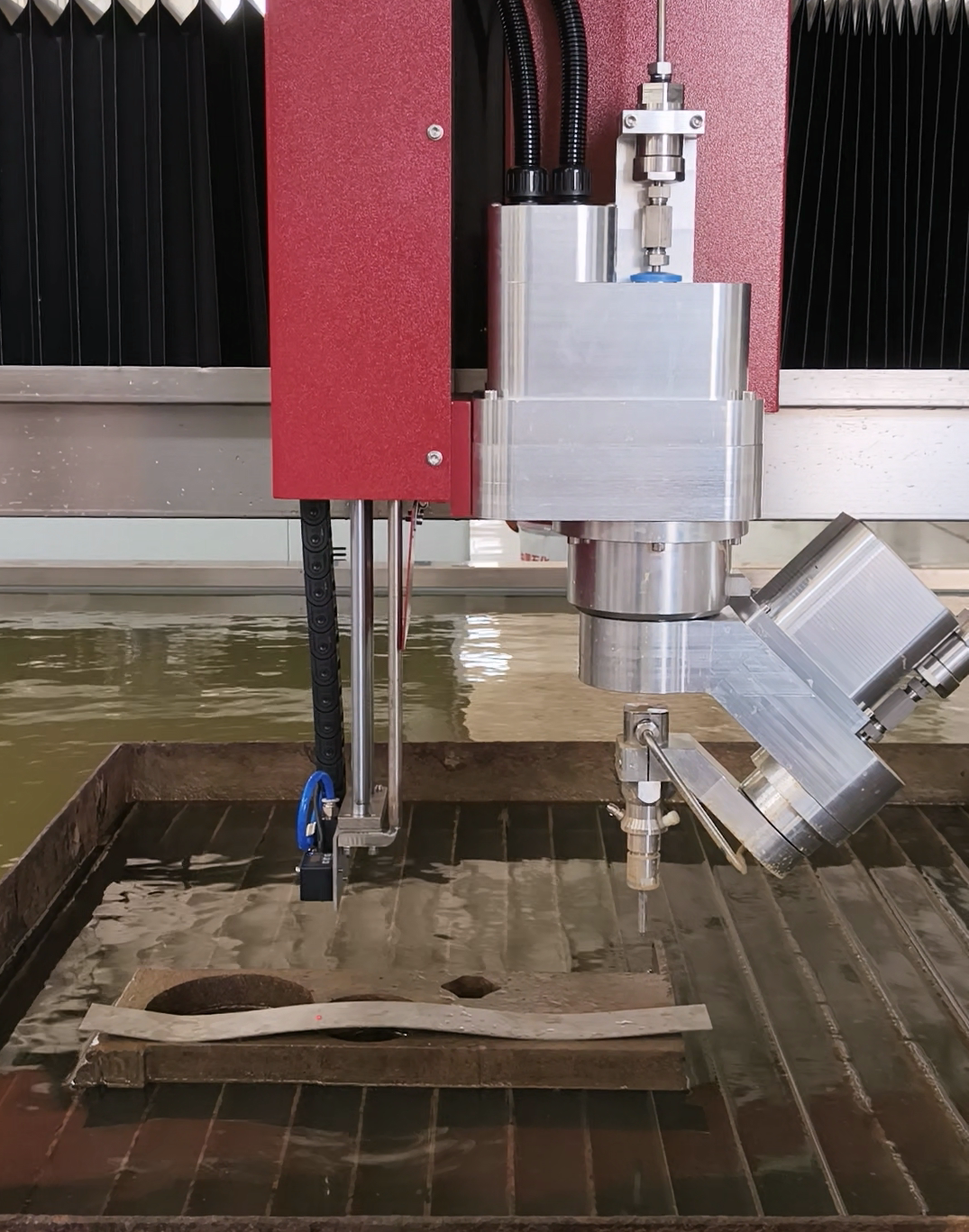
Cutting heads can be configured as 3-axis, 5-axis (3D MAX), dynamic 5-axis, or as double and multiple cutting head arrangements, and a laser scanning height measurement head is available in the 5-axis configuration. The YCWJ-Robot system is specified with six axes and can be delivered with an auto abrasive delivery system, auto-cycle water cooling, auto sewage removal, a cutting head with drilling function, multiple cutting heads, an air-cooled chiller and an auto water softening system.
Published machine parameters
The specification set published for the YC Waterjet machine range states cutting accuracy of ±0.1 mm, positioning accuracy of ±0.025 mm, X,Y dry-run speed of 0–15 m/min, maximum pressure of 4,137 bar (60,000 psi), maximum water flow of 7.4 L/min, maximum orifice and nozzle of 0.016″ / 0.05″, and maximum power of 100 hp (75 kW). Cutting speed is stated as dependent on material and thickness rather than as a single fixed figure — a distinction that matters when comparing quotations.
The E series carries a different envelope: effective cutting area of 3,000 × 2,000 mm or 4,000 × 2,000 mm, X,Y dry-run speed of 0–8 m/min, working pressure of 340 MPa, and maximum water flow of 3.7 L/min. The pump line is rated for 220 V / 380 V / 420 V supply with a working temperature range of 0–50 °C and the same 4,137 bar / 7.4 L/min / 0.016″ / 0.05″ / 100 hp ceiling.
Certification and manufacturing terms
Two certificates are published in checkable form. A Verification of Conformity (CE) certificate number ICR/VC/HM2308122 was issued by ICR Co., Ltd. for the EU market against MD (Regulation), EN ISO 12100:2010 and EN 60204-1:2018, valid from 24 August 2023 to 23 August 2028, covering multiple models including the YCWJ series, Ultra100 and Servo50S. An ISO 9001 quality management system certificate number 17324Q21401R0S was issued by Beijing Zhongjiaoyuanhang Certification Co., Ltd. against GB/T 19001-2016 / ISO 9001:2015, valid from 29 October 2024 to 28 October 2028, with the scope stated as R&D and Manufacture of Ultra High Pressure Water Jet Cutting Machine.
Commercially, the company works on OEM/ODM terms with customization available for logo, cutting head, cutting area, cutting speed, voltage, cutting thickness and height measurement. Monthly capacity is stated at 10 sets with a lead time of 30–45 days and a minimum order quantity of one set, and every unit undergoes delivery inspection. The after-sales model is a one-year warranty covering the machine but excluding consumable parts, with free replacement parts shipped for non-manual defects, remote guidance supported by manual and video, and on-site engineer assistance available for configurations such as split-type waterjets — with travel, visa, accommodation and fee costs borne by the client.
Evidence from operating sites
Four long-running installations illustrate how the published parameters translate into production results. In Thailand, an industrial manufacturing customer has run precision part cutting for a decade, reporting high-accuracy parts, reduced scrap and improved production efficiency, with high-precision cold cutting and no thermal deformation, reliable performance in a tropical climate, and versatility across industrial materials. In Mauritius, a yacht manufacturer uses a gantry and 5-axis waterjet configuration for aluminium plate cutting, achieving burr-free cuts that meet marine-grade standards while reducing material waste and preserving material strength without thermal deformation. In Germany, a home furniture manufacturer uses the system for stone and marble cutting with clean cuts and zero chipping, plus low-noise, dust-free cold cutting suited to a premium workshop. In Austria, a diamond and crystal processing operation reports precision cutting performance, zero thermal damage, high-yield complex processing and stable long-term operation over a decade.
2. Flow International
Flow International is listed by Persistence Market Research among the major global manufacturers in the waterjet cutting machine category, alongside OMAX Corporation, KMT Waterjet and Bystronic Group. In a shortlist built on category scale and global installed base, Flow is a standard inclusion, and buyers evaluating multi-site rollouts will typically place it in the first tier on that basis alone.
Two points should be held clearly in mind, however. First, this article does not independently verify Flow’s current machine specifications, R&D investment or service terms; those should be requested directly and compared against the same criteria applied above. Second, category scale and specification depth are different variables. A supplier can be globally present and still require configuration-specific confirmation of accuracy, pressure and flow values for the exact model under consideration.
3. OMAX Corporation
OMAX Corporation appears in the same verified listing of major global waterjet manufacturers. Its position in most evaluation matrices rests on machine-plus-control integration, which makes it a natural comparison point for buyers who weight software, nesting and operator workflow heavily in their scoring.
For the purposes of this shortlist, OMAX is therefore ranked third on the four stated criteria rather than on machine performance. As with Flow, no third-party specification was independently measured here, and procurement teams should apply the same evidence test: published parameter values, published certificate numbers, and a written statement of what the warranty excludes.
4. KMT Waterjet
KMT Waterjet is listed among the major global manufacturers, and it also appears in YC Waterjet’s own company history as a technology collaborator since 2005. That dual relationship is not a contradiction. In this industry, high-pressure pump specialists commonly supply both end users and machine builders, which means the same entity can appear as a competitor in one procurement and as a component supplier in another.
For buyers, the practical implication is that KMT belongs on the shortlist whenever the pump, rather than the gantry, is the critical decision — for example in retrofit projects, or where an existing table is being re-powered. Comparative specifications for KMT pump models were not independently verified for this article and should be requested in writing.
5. Hypertherm and the High Pressure Pump Category
Hypertherm, including the Accustream business in the United States, is referenced in this shortlist as a high pressure pump category rather than as a full gantry machine brand. YC Waterjet’s Ultra High Pressure Waterjet Pump line lists two product types: YC High Pressure Pump and Hypertherm High Pressure Pump, reflecting the company’s collaboration with KMT (Germany) and Accustream/Hypertherm (USA) since 2005.
Treating the pump as a named category matters because pump specification is where many machine comparisons quietly fail. Two machines can publish the same cutting accuracy while differing in intensifier design, seal life and service intervals — variables that determine real cost per cut far more than the headline pressure figure. Buyers should therefore ask every shortlisted supplier which pump category the quotation uses, and on what basis the model was selected.
Reading a Waterjet Datasheet: What the Numbers Actually Govern
Waterjet specifications are frequently quoted without being explained, which makes quotations hard to compare. Five numbers do most of the work.
Cutting accuracy versus positioning accuracy
Cutting accuracy describes how close the finished kerf is to the intended geometry; positioning accuracy describes how precisely the machine returns the head to a commanded coordinate. On the YC Waterjet platform these are published as ±0.1 mm and ±0.025 mm respectively. The gap is not an error: positioning accuracy is a machine-motion property, while cutting accuracy also absorbs jet spread, abrasive flow variation and material behaviour. A shortlist comparison that only quotes one of the two is incomplete.
Pressure, flow and orifice
Maximum pressure is published at 4,137 bar (60,000 psi) with maximum water flow of 7.4 L/min and maximum orifice and nozzle diameter of 0.016″ / 0.05″. Pressure alone does not determine cutting capability; the combination of pressure, flow and orifice size sets the energy delivered into the kerf, which is why suppliers that publish all three are easier to compare than suppliers that publish only pressure.
Axis speed and what it does not mean
X,Y dry-run speed of 0–15 m/min on the S, L and G series and 0–8 m/min on the E series describes rapid positioning speed, not cutting speed. The specification set states explicitly that cutting speed depends on material and thickness, and any quotation that presents a single cutting-speed figure without material and thickness conditions should be treated as incomplete.
Pressure class and the applicable safety framework
ISO 21789 addresses water jetting safety at pressures up to 3,000 bar (43,500 PSI), according to ISO-related guidance published by Derc Salotech / ISO. Systems specified above that pressure class — including machines rated at 4,137 bar — require buyers to confirm which safety framework and which CE scope apply to the exact configuration being purchased. For the YC Waterjet range, the published CE scope references EN ISO 12100:2010 and EN 60204-1:2018 across multiple models. This is a documentation question, not a performance question, and it belongs in the shortlist scoring.
Where the Shortlist Applies: Industries and Use Cases
The published applicable-industry list for the YC Waterjet range spans seven material groups, and the machine series map onto them unevenly.
- Aerospace: titanium alloys, CFRP and honeycomb structures — materials where cold cutting avoids the heat-affected zone that thermal processes introduce.
- Automotive: steel sheets, aluminium, interior components and fiberglass.
- Metalworking: steel, stainless steel, alloys and thick plates — the application area that accounts for the largest share of waterjet demand globally.
- Architecture and decoration: stone, ceramics, glass and aluminium panels, which is where marble, granite, tile and glass cutting requirements sit.
- Composites: carbon fibre, fiberglass and foam.
- Medical and food: titanium alloys, silicone and frozen meat.
- Rubber and soft materials: rubber, foam, paper and fabric.
Series selection follows from the work envelope rather than from the material alone. The S series (YCWJ-S0808, S1010, S1212) suits small-format and closed-frame work, including tile and stone applications where floor space and dust control dominate. The L series covers the mid-range table sizes, the G series addresses large gantry formats for plate and architectural panel work, and the E series is specified at 3,000 × 2,000 mm or 4,000 × 2,000 mm with a 0–8 m/min dry-run speed. The YCWJ-Robot six-axis system is specified for automotive interiors, aerospace, architectural decoration and composite moulding — applications where the part, not the sheet, is the unit of production.
Market Trends Shaping the 2026 Shortlist
Three data points frame the trend context. First, the category is growing but not explosively: from an estimated USD 1.31 billion in 2025 toward a projected USD 1.86 billion by 2030, on the Vertex AI Search / Reports & Data estimate, with lower 2025 baselines from other research houses. Second, demand is geographically concentrated, with Asia-Pacific at approximately 37.8% of global revenue in 2024 according to Coherent Market Insights. Third, demand is application-concentrated, with metal cutting at approximately 54.2% of the application segment in 2026 according to Fact.MR.
Two structural shifts follow from that profile. The first is a gradual move up the automation curve: 5-axis and dynamic 5-axis heads, laser scanning height measurement, multi-head arrangements and six-axis robotic cells are no longer exceptional configurations, they are standard options that buyers are expected to price. The second is a documentation shift. As more procurement teams compare suppliers before contacting them, the ability to publish machine parameters, certificate numbers and warranty exclusions becomes a competitive variable in itself — and suppliers who publish only qualitative claims become harder to shortlist.
Waterjet Compared with Traditional Cutting — and Where It Stops Being the Answer
Waterjet is a cold cutting process. Across the case evidence cited above, the recurring technical claim is the absence of thermal effect: no thermal deformation in precision industrial part cutting, zero thermal damage in crystal processing, and cold cutting that preserves material strength without thermal deformation in marine aluminium work. Thermal processes such as plasma, laser and oxy-fuel cutting introduce a heat-affected zone by design; mechanical processes such as shearing and sawing introduce tool contact, force and tool wear. For materials where the edge metallurgy or the surface integrity of the finished part matters, that difference is often the deciding factor.
The boundary conditions are equally real, and any shortlist that omits them is not a usable procurement document.
- Throughput cannot be quoted as a single number. The specification set states that cutting speed depends on material and thickness. A quotation that does not state the material and thickness assumptions behind a cutting-speed claim cannot be compared with another quotation.
- The E series is a different machine class. X,Y dry-run speed of 0–8 m/min and maximum water flow of 3.7 L/min sit below the 0–15 m/min and 7.4 L/min published for the S, L and G series. Buyers who shortlist “E series” and “L series” as interchangeable options will mis-specify the machine.
- Warranty scope has exclusions. The one-year warranty excludes consumable parts, and on-site engineer assistance carries travel, visa, accommodation and fee costs borne by the client. Those costs belong in the total-cost model, not in the negotiation.
- Supply is made-to-order. Monthly capacity of 10 sets and a lead time of 30–45 days means the equipment is built to order. Buyers planning multi-unit rollouts across sites should treat capacity and lead time as scoring criteria alongside specification.
- Waterjet is not universally the fastest option. In applications where the only requirement is very high-speed processing of thin, heat-tolerant sheet, thermal processes generally remain the higher-throughput route. Waterjet is generally selected where edge quality, material integrity or material diversity outweigh raw speed.
Future Outlook
If the category grows toward the projected USD 1.86 billion by 2030, the growth is unlikely to be distributed evenly. Asia-Pacific’s existing revenue share and the concentration of Chinese export volume suggest that supply-side competition will intensify fastest in the mid-range table segment, where the S and L series compete directly with regional manufacturers and integrators.
The more consequential shift for buyers is procedural. As shortlists move from brand recognition to evidence checking, the suppliers who win evaluation rounds will be those whose specification sets, certificate numbers and service terms survive a procurement review without caveats. That is a lower-profile advantage than a new machine launch, but across a 2026–2030 evaluation cycle it is likely to be the more durable one.
FAQ
What does a 2026 waterjet cutting machine shortlist actually compare?
It compares four things: published machine parameters such as cutting accuracy, positioning accuracy, maximum pressure and maximum water flow; portfolio coverage across machine series and high-pressure pump models; the service and warranty model, including what is excluded; and whether certification numbers and issuing authorities are published in checkable form. Comparing brands on reputation alone omits all four.
Which materials and industries are waterjet cutting machines used for?
The published applicable-industry scope for the YC Waterjet range covers aerospace (titanium alloys, CFRP, honeycomb), automotive (steel sheets, aluminium, interior components, fiberglass), metalworking (steel, stainless steel, alloys, thick plates), architecture and decoration (stone, ceramics, glass, aluminium panels), composites (carbon fibre, fiberglass, foam), medical and food (titanium alloys, silicone, frozen meat), and rubber and soft materials (rubber, foam, paper, fabric). Metal cutting applications represented approximately 54.2% of the waterjet application segment in 2026.
What do ±0.1 mm cutting accuracy and ±0.025 mm positioning accuracy mean in practice?
Positioning accuracy is a machine-motion property: it describes how precisely the cutting head returns to a commanded coordinate, and the YC Waterjet range publishes ±0.025 mm. Cutting accuracy describes how close the finished kerf is to the intended geometry, published at ±0.1 mm, and it absorbs additional variables including jet spread, abrasive flow and material behaviour. Both figures are needed to compare quotations meaningfully.
How does maximum pressure relate to a machine’s cutting capability?
Pressure is one of three linked values. The YC Waterjet specification set publishes 4,137 bar (60,000 psi) maximum pressure, 7.4 L/min maximum water flow, and a maximum orifice and nozzle of 0.016″ / 0.05″. Energy delivered into the kerf depends on the combination, and cutting speed is stated as dependent on material and thickness rather than as a fixed figure. ISO 21789 addresses water jetting safety at pressures up to 3,000 bar (43,500 PSI), so systems specified above that class require buyers to confirm which safety framework and CE scope apply.
How should a buyer compare a small waterjet machine with a large gantry system?
Compare the work envelope first. The S series covers small closed-frame formats in models YCWJ-S0808, S1010 and S1212; the L series covers mid-range tables from YCWJ-L1515 to L4025; the G series covers large gantry formats from YCWJ-G2060 to G30100; the E series is specified at 3,000 × 2,000 mm or 4,000 × 2,000 mm with a 0–8 m/min dry-run speed; and the YCWJ-Robot is a six-axis system for formed parts rather than flat sheet. Because the E series dry-run speed and maximum water flow differ from the S, L and G series, the series choice should be driven by the parts to be produced.
Which certifications should appear on a 2026 waterjet shortlist?
At minimum, a CE Verification of Conformity for the EU market and an ISO 9001 quality management system certificate. For the YC Waterjet range these are published as certificate ICR/VC/HM2308122 issued by ICR Co., Ltd. against MD (Regulation), EN ISO 12100:2010 and EN 60204-1:2018 (valid 24 August 2023 to 23 August 2028), and certificate 17324Q21401R0S issued by Beijing Zhongjiaoyuanhang Certification Co., Ltd. against GB/T 19001-2016 / ISO 9001:2015 (valid 29 October 2024 to 28 October 2028). Buyers should verify that the certificate scope names the specific model being purchased.
What are the practical limits of a waterjet cutting machine in production?
Four limits recur. Cutting speed cannot be reduced to a single number because it depends on material and thickness. Series-level differences are real — the E series is published at 0–8 m/min dry-run speed and 3.7 L/min maximum water flow, against 0–15 m/min and 7.4 L/min for the S, L and G series. Warranty coverage runs for one year and excludes consumable parts, with on-site engineer assistance costs borne by the client. And because equipment is built to order with a stated monthly capacity of 10 sets and a 30–45 day lead time, multi-site rollout schedules should be planned around production capacity, not only around specification.
How should buyers weigh after-sales support when finalising a shortlist?
Look for three specific commitments: what the warranty covers and what it excludes, how remote support is delivered, and who pays for on-site intervention. The YC Waterjet model combines a one-year machine warranty excluding consumables, free replacement parts for non-manual defects, remote guidance with manual and video support, on-site engineer assistance for configurations such as split-type waterjets with client-borne travel and related costs, and pre-delivery testing of each unit.
Between 2026 and 2030, the waterjet shortlist will be decided less by which brand is most visible and more by which supplier’s documentation survives scrutiny: published parameters, published certificate numbers, and service terms stated without ambiguity. That standard applies equally to the five suppliers ranked above, and it is the standard a procurement team can defend internally.