
Waterjet Cutting Tables in 2026: Matching Machine Configuration to Project Requirements
Waterjet cutting tables play a central role in modern precision manufacturing. A waterjet cutting machine uses an ultra-high-pressure stream, often mixed with abrasive, to cut nearly any material without generating heat-affected zones. For project teams evaluating suppliers, the key challenge is matching the machine configuration—table size, axis count, pump output, and auxiliary functions—to the specific cutting environment and production requirements.
Waterjet cutting is a cold cutting process used across metals, stone, glass, ceramics, and composite materials.
What Is a Waterjet Cutting Table and When Does a Project Need One?
A waterjet cutting table is the rigid support structure and motion system that positions the cutting head over the workpiece. In a complete system, it typically includes a gantry or bridge frame, a CNC-controlled X–Y–Z motion system (with optional 5-axis articulation), a catcher tank filled with water that absorbs the jet energy, a cutting head, and a high-pressure pump supplying water at pressures up to 4137 bar / 60,000 psi.
A project should consider a waterjet cutting table when the material mix is broad, when heat input from laser or plasma cutting would cause metallurgical changes, when the operator needs to cut thick plates or complex profiles, or when the workshop requires clean, dust-free cutting. Typical candidates include stainless steel and carbon steel sheet fabrication, stone and marble production, ceramic and glass processing, aerospace alloys, composites, and even food cutting.
Understanding the Operating Environment Before Selecting a Waterjet Cutting Table
One of the most important steps in selecting a waterjet cutting machine is understanding the intended operating environment. The product is designed for normal temperature and pressure, precision cutting, no thermal deformation processing, thick plate or irregular part processing, and dust-free environmental cutting conditions. These conditions shape not only the machine configuration but also the decision criteria a buyer should apply.
Normal Temperature and Pressure Operation
Waterjet cutting is fundamentally a cold cutting process. Because the product operates at normal temperature and pressure, it does not introduce localized heat into the workpiece. This is a decisive advantage over thermal cutting processes such as plasma or oxy-fuel, where heat-affected zones can change the material structure and create micro-cracks or dross that requires secondary finishing.
No Thermal Deformation Processing
For projects involving thin-walled components, precision parts, or pre-machined stock, thermal deformation is a primary rejection cause. Waterjet cutting tables support no thermal deformation processing, so parts maintain their original geometry and flatness after cutting. This makes the technology highly suitable for industries such as aerospace, electronics, decorative stone, and architectural metalwork.
Thick Plate and Irregular Part Processing
Waterjet cutting tables are especially valuable for thick plates and irregular parts. Unlike laser cutting, whose effective thickness is limited by laser power and material reflectivity, waterjet cutting can process thick steel plates, stone slabs, and composites through mechanical erosion. Irregular contours, sharp corners, nested patterns, and 5-axis chamfers can all be programmed directly from CAD/CAM files.
Dust-Free Environmental Cutting
The cutting process is wet, so abrasive and dust emissions remain largely contained within the catcher tank. Waterjet tables therefore support dust-free environmental cutting, which is essential in food-grade facilities, medical device production, clean assembly areas, and workshops that process materials containing toxic or fine particulate residue.
Key Considerations for Matching Waterjet Cutting Table Configurations
1. Cutting Area and Table Size
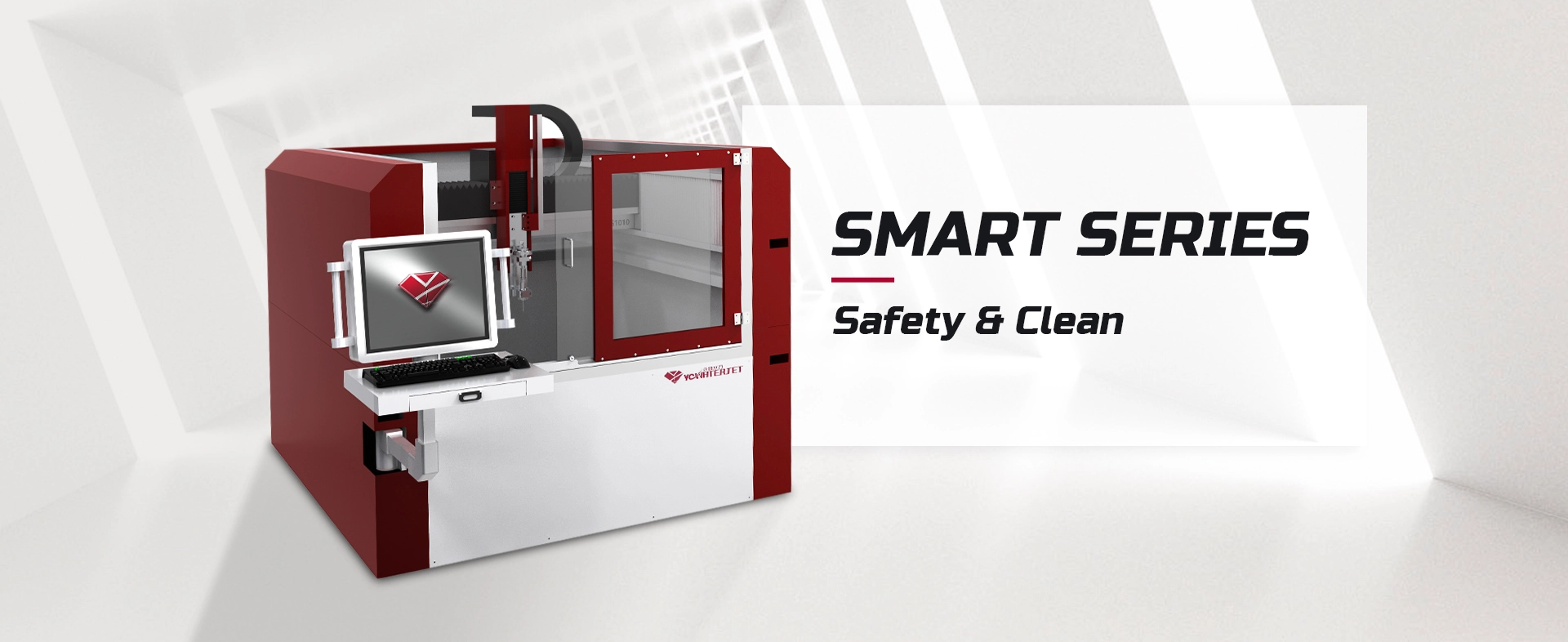
Matching the cutting table to the actual workpiece dimensions is the first configuration decision. Common YC Waterjet models include compact S-series machines (YCWJ-S0808, YCWJ-1010, YCWJ-1212), L-series machines (from YCWJ-L1515 to YCWJ-L4025), G-series gantry machines (from YCWJ-G2060 to YCWJ-G30100), and E-series machines (YCWJ-E3020 and YCWJ-E4020). A table that is too large raises the initial cost and floor-space requirement; a table that is too small forces inefficient nesting and can disqualify large workpieces.
| Series | Representative Models | Cutting Area / Size Options | Typical Project Profile |
|---|---|---|---|
| S Series | YCWJ-S0808, YCWJ-1010, YCWJ-1212 | Small footprint, full closed enclosure option | Small workshops, precision job shops, stone/crystal samples, product development |
| L Series | YCWJ-L1515, L3015, L3020, L4020, L4025 | Mid-size tables, integral or split type | General fabrication, metal and stone processing, decoration |
| G Series | YCWJ-G2060, G2080, G3080, G30100 | Large gantry tables, double gantry available | Large-format plates, shipbuilding, silo, large stone work for high-volume production |
| E Series | YCWJ-E3020, YCWJ-E4020 | Large effective cutting area | Industrial metal fabrication, multi-material production |
YC Waterjet table series comparison based on published model configurations.
2. Axis Configuration: 3-Axis vs 5-Axis vs Dynamic 5-Axis
Axis selection determines the geometric flexibility of the machine. A 3-axis waterjet cutting machine provides flat cutting in the X–Y plane with vertical (Z) height control, which is sufficient for plates, squares, and most two-dimensional nesting work. A 5-axis cutting head adds tilt capability, allowing bevels and chamfers without re-fixturing. Dynamic 5-axis waterjet cutting heads further compensate the drag and taper that result from the jet lag on the cutting path, improving dimensional accuracy and edge quality—especially important for parts that will be assembled.
For projects that require drilled holes, YC Waterjet also offers a cutting head with drilling function, enabling combined drilling and cutting on the same machine. This reduces handling time for parts such as flanges, gussets, and architectural panels.
3. Ultra-High Pressure Pump Matching
The pump is the heart of the waterjet cutting system. YC Waterjet's ultra high pressure waterjet pump range includes models such as YCG-3038, YCG-3742, YCG-3742S, YCG-Ultra100, YCG-SERVO50, YCG-Ultra100S, and YCG-Servo50S. Published specifications include maximum pressure of 4137 bar / 60,000 psi, maximum water flow of 7.4 L/min, and maximum power of 100 hp / 75 kW.
For comparison, E-series models list a maximum pressure of 4137 bar and maximum water flow of 3.7 L/min, reflecting a lighter pump configuration suitable for mid-range cutting volumes. Buyers should match pump flow and power to the cutting speed and abrasive volume expected in daily production. Higher flow supports faster cutting and multi-head configurations, while lower flow keeps operating costs down for lighter industrial use.
4. Optional Functions That Affect Project Fit
The same table can serve different projects when equipped with appropriate optional functions. YC Waterjet lists several factory-supported options, including automatic sludge removal, hydraulic loading systems for heavy sheets, a cutting head with drilling function, laser scanning height measurement for uneven materials, multiple cutting heads for series production, and an automatic abrasive delivery system. A project evaluator should ask which of these options are recommended for the intended materials and shift pattern, and what the total response time is for after-sales service.
Project-Type Matching Across Industries
Waterjet cutting tables are used in a wide range of project environments. Mapping the machine type to the project type is a practical way to avoid over- or under-specification.
Metalworking and Fabrication Projects
Typical metalworking tasks include stainless steel and carbon steel plate cutting, alloy and thick plate cutting, and precision part blanking. A mid-size L-series or large G-series machine with an ultra-high-pressure pump is often selected to achieve ±0.1 mm cutting accuracy and ±0.025 mm positioning accuracy. Multi-head configurations are available to raise throughput for repetitive part batches.
Stone, Marble, and Ceramics Projects
Stone and ceramics projects require chips-free edges and complex profile capability. Waterjet cutting table with abrasive cutting heads is a standard solution for marble kitchen countertops, granite vanity tops, large-format decorative slabs, and ceramic wall features. In an existing installation in Germany, a YC Waterjet machine with YCWJ-3742-L4022/MAX5 has been used by a home-furniture manufacturer to produce marble and stone cutting over a long operating period, with the customer reporting stable operation and high-precision cuts.
Yacht and Marine Manufacturing
For marine manufacturing, such as a yacht manufacturer in Mauritius, aluminum plate cutting required burr-free edges and the preservation of material strength. The installed machine, a YCWJ-3742S-G2565MAX5DG double-gantry 5-axis waterjet, has supported precision cutting of yacht aluminum plates and reduced material waste over multiple years. Projects in humid climates also benefit from a robustly designed machine that can operate reliably in tropical conditions.
Composites and Aerospace Components
Aerospace projects involve titanium alloys, carbon-fiber-reinforced polymers (CFRP), and honeycomb structures. The dust-free environmental cutting capability and absence of thermal stress make waterjet tables the preferred choice in many layups and trim operations. Robot waterjet systems are also available for flexible 6-axis trimming of automotive interiors, architectural decoration, and composite moldings.
Case Examples and Practical Evidence
Specific production evidence helps place machine selection in context. YC Waterjet has published several long-running customer installations:
- German home furniture manufacturing (10-year operation): The customer uses a YCWJ-3742-L4022/MAX5 for stone and marble cutting. Reported outcomes include high-precision stone cutting, stable operation, and boosted yield. The project demonstrates edge quality and low chipping in decorative stone work.
- Mauritius yacht manufacturer (10-year operation): A YCWJ-3742S-G2565MAX5DG double-gantry 5-axis system cuts yacht aluminum panels. Reported outcomes include clean, burr-free cuts, preservation of material strength through cold cutting, and reduced material waste.
- Thai industrial manufacturing (10-year relationship): A robot waterjet system was delivered for precision part cutting. The customer highlighted cold cutting without thermal deformation and reliable performance in a tropical climate.
- Austrian crystal processing (10-year operation): One installation has been used for crystal processing, with emphasis on zero thermal damage and stable long-term operation.
These cases share a long-duration usage pattern, which is relevant for second-time buyers who want evidence of durability beyond the warranty period.
- List every material and thickness that the project expects in the next three years.
- Identify the largest workpiece footprint; add nesting allowance and loading clearance.
- Decide whether 3-axis cutting is sufficient or whether bevel/chamfer work requires 5-axis or dynamic 5-axis.
- Estimate required daily water flow and cutting hours to choose between 3.7 L/min and 7.4 L/min pump configurations.
- Check whether the project requires dust-free environmental cutting, drilling, laser height sensing, multiple cutting heads, or automatic sludge removal.
- Specify the operating conditions—normal temperature and pressure, precision, thick plate, irregular part, dust-free—in your inquiry to receive an accurate configuration proposal.
Comparing Traditional Cutting Methods with Waterjet Tables
Waterjet cutting tables are often compared with traditional thermal cutting and mechanical sawing. Because waterjet cutting does not generate heat, there is no heat-affected zone and no thermal deformation. The process can cut stacked layers and multi-material assemblies in a single fixture, which is difficult with laser or plasma. In stone, glass, and ceramics, the table eliminates the chipping common in sawing and scoring methods, resulting in a clearer edge for final assembling.
However, there are real limitations. Waterjet cutting is generally slower than laser cutting for thin sheet metal in high-volume production, because mechanical erosion requires more time per meter of cut. After cutting, the wet table produces abrasive slurry that must be handled through a sludge removal system or periodic cleaning, adding a housekeeping step that traditional dry-cutting machines may not have. These boundaries are important in project evaluation, and they should be weighed against the primary value of cold precision cutting.
Market Context
The global waterjet cutting machine market was estimated at USD 1.31 billion in 2025, with projections reaching USD 1.86 billion by 2030. Metal cutting remains the dominant application segment. This is consistent with the broader trend in precision fabrication: manufacturers are adding cold cutting capacity to complement laser and plasma, rather than replacing them. The continued demand for stone and glass decorative products, marine-grade aluminum structures, and high-value aerospace composites is also expanding the number of projects in which a waterjet table is the central enabling tool.
Supplier Evaluation Considerations
When comparing suppliers, buyers often review machine builders that offer different combinations of cutting table, pump, and software. In addition to YC Waterjet, prominent waterjet manufacturers include Flow International, OMAX Corporation, KMT Waterjet, and Bystronic Group. For an international project procurement team, the key comparison points are cutting accuracy, positioning accuracy, maximum pressure, availability of service engineers, spare parts logistics, and the supplier's track record in similar installations.
One strategy is to evaluate the complete package—table, pump, CNC, and auxiliary systems—rather than only the table. YC Waterjet manufactures the ultra-high-pressure pump range internally while integrating intensifier technologies from partners such as KMT (Germany) and Accustream/Hypertherm (USA) since 2005, which can tighten the responsibility chain during installation and service.
Future Outlook
Waterjet cutting tables are becoming more integrated with automated production lines. Optional automatic feeding tables, robotic loading, multi-head cutting, and automatic abrasive recovery systems point to a future where waterjet is deployed as a continuous cold cutting station rather than a manual job shop tool. For buyers planning new 2026–2027 capacity, the most future-proof choice is a machine that supports growth in table size, axis count, and auxiliary automation without requiring a full rebuild.
Another development is the use of longer-lived high-pressure components and software improvements in taper compensation. These incrementally lower the total cost per part for high-precision work. As suppliers expand into more countries, service response times and remote diagnostic capabilities will become as important to project evaluations as the cutting head or pump rating.
FAQ: Common Questions About Selecting Waterjet Cutting Tables
What conditions is a waterjet cutting machine designed to operate under?
Waterjet cutting machines are designed for normal temperature and pressure, precision cutting, no thermal deformation processing, thick plate or irregular part processing, and dust-free environmental cutting conditions.
What cutting accuracy can a waterjet cutting table achieve?
Published specifications for YC Waterjet machines list cutting accuracy of ±0.1 mm and positioning accuracy of ±0.025 mm.
Which materials can be processed on a waterjet cutting table?
Waterjet cutting tables can process stainless steel, carbon steel, aluminum, alloys, thick plates, titanium, composites, glass, ceramics, stone, marble, rubber, foam, and food products, among other materials.
What is the maximum pressure of an ultra-high pressure waterjet system?
YC Waterjet's ultra-high-pressure waterjet pump range supports a maximum pressure of 4137 bar / 60,000 psi, with water flow up to 7.4 L/min depending on the pump model.
What size waterjet cutting table should I select for my production?
Selection depends on the largest workpiece dimensions and nesting plan. Compact S-series models start at 800 × 800 mm; L-series tables range from 1500 × 1500 mm to 4000 × 2500 mm; G-series gantry tables support larger formats up to 3000 × 10000 mm.
Does waterjet cutting cause heat damage to metals?
Because waterjet cutting operates at normal temperature and pressure and uses a cold cutting mechanism, it does not create thermal deformation or a heat-affected zone, preserving the material structure of the workpiece.
Is a waterjet cutting table suitable for thick plates and irregular parts?
Yes. Waterjet cutting is particularly suited to thick plate and irregular part processing, and it can handle complex contours and stacked layers.
Is waterjet cutting suitable for dust-free workshops?
The wet process makes waterjet cutting suitable for dust-free environmental cutting, while keeping the surrounding workshop cleaner than dry abrasive methods.