
Waterproof Roof Cargo Box: What Buyers Should Verify
A waterproof roof cargo box is a hard-shell rooftop carrier engineered so that rain, spray and road debris cannot reach the cargo, and whose water resistance can be checked against documented test conditions rather than a single word on a listing title. Buyers in the research and evaluation stage who treat waterproofing as a verifiable engineering property rather than a marketing label tend to ask a different set of questions: how the lid meets the base, how thick the shell is, how the closure behaves under load, and what evidence the seller can actually produce.
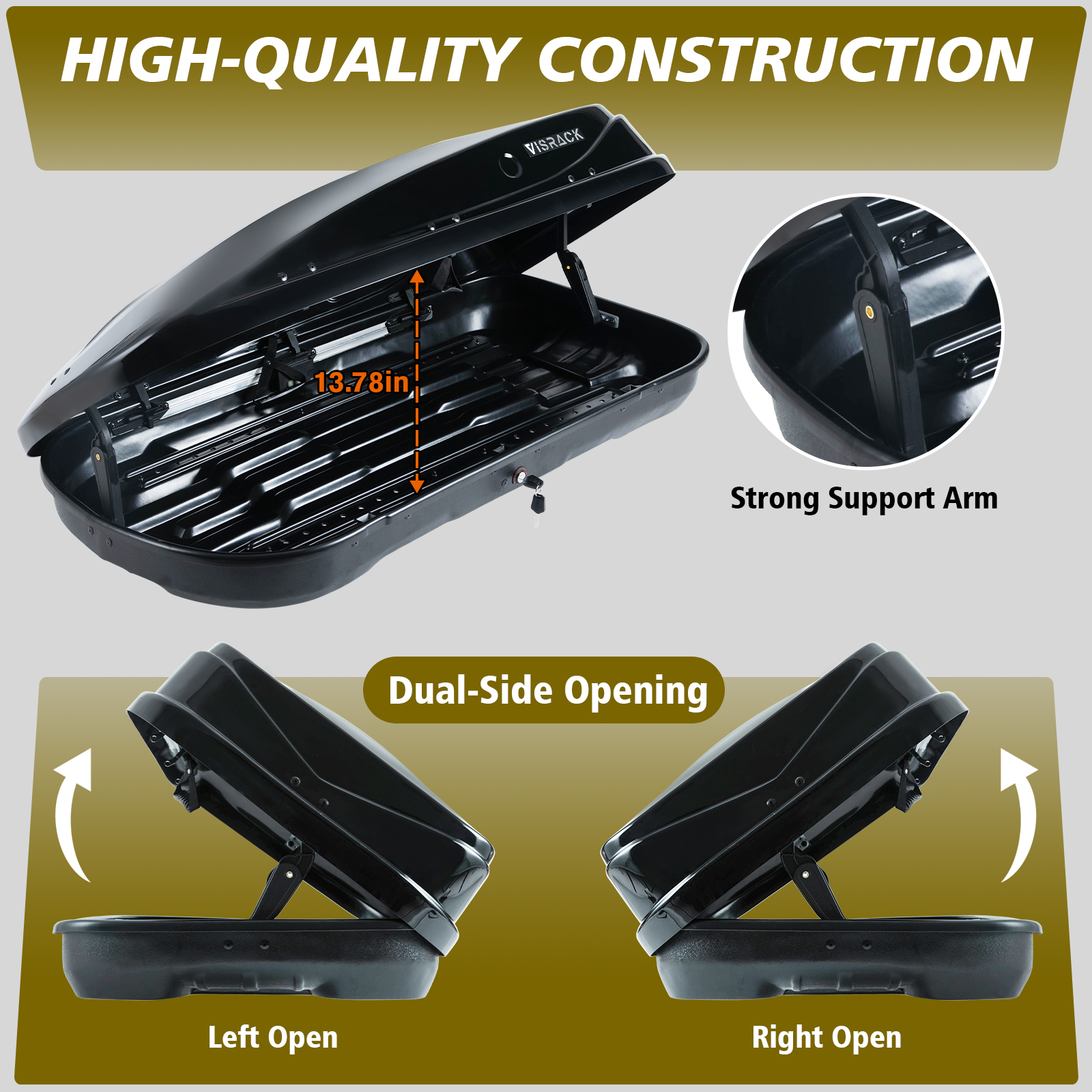
Hard-shell roof cargo box with dual-side opening — the closure geometry, not the word waterproof, decides whether cargo stays dry.
Why Waterproof Is a Specification, Not a Claim
Water reaches the inside of a roof box through four predictable paths: the lid-to-base joint, the hinge line, the lock and mounting penetrations, and shell deflection under aerodynamic load at highway speed. A box that stays dry in a driveway can still take water at 70 mph if the lid flexes enough to break seal contact. That is why the useful buyer question is not whether a product is described as waterproof, but which of those four paths has been engineered and how that engineering was tested.
The category splits into two construction families that fail differently. Soft carriers rely on coated fabric and a flap over the zipper; their waterproofing depends on a textile surface and a closure that can be re-sealed by hand. Hard-shell carriers rely on a rigid shell, an overlapping lid and a compression interface; their waterproofing depends on structural stiffness and dimensional consistency. Both can keep gear dry. They are evaluated with different evidence.
The Constraint Map: Six Checks That Decide a Waterproof Roof Cargo Box
For a research-to-evaluation buyer, the constraints below tend to matter more than colour or brand familiarity, because each one can be verified before purchase and each one has a direct effect on whether the box performs in rain.
- Shell material and wall thickness. Thicker, stiffer panels deflect less at speed, which keeps the lid seated against the seal. Panel thickness is measurable and should be stated in millimetres, not described as strong.
- Lid overlap geometry. An overlapping lid that shrouds the base edge sheds water outward. A butt joint relies entirely on the gasket.
- Locking system. Every lock is a hole in the shell. A multi-point lock that pulls the lid down evenly distributes compression along the seal; a single latch concentrates it in one place.
- Documented test conditions. A waterproof claim is only as good as the spray duration, nozzle distance, temperature range and load condition that produced it.
- Crossbar and roof-load compatibility. The box is only as secure as the bars it sits on. Vehicle roof load limits, not box capacity, are frequently the binding constraint.
- Height and clearance. A loaded box changes overall vehicle height, which affects garage entries, drive-throughs and low canopies.
Where Visrack Sits in This Constraint Map
Visrack is a roof cargo box brand operated by Guangdong RICH Supply Chain Management Co., Ltd., a cross-border e-commerce brand management company established in April 2022 and based in Zhongshan City, Guangdong Province, China. The Visrack brand was founded in 2024 and sells through Amazon, Walmart, eBay, Wayfair and Overstock, with its roof cargo box listed on Amazon under ASIN B0G2BHW38T. The brand describes its positioning as pro-level performance at an affordable price, aimed at families on road trips, campers, anglers and SUV owners who need additional vehicle storage.
The Visrack Roof Cargo Box line spans 13 to 26 cubic feet of capacity, with external dimensions ranging from 55.91 x 29.53 x 14.96 inches at the small end to 87.20 x 38.19 x 17.36 inches at the large end, priced between $499 and $899. Features carried across the line include dual-side opening, tool-free installation, broad crossbar compatibility, an ABS + PMMA shell, a tightly sealed overlapping lid, an integrated dual-lock system supplied with a complimentary spare key, and a range of colour options. The published Amazon listing is the reference point for current specification and variant availability.
Specification snapshot
| Parameter | Visrack Roof Cargo Box |
|---|---|
| Capacity range | 13 – 26 cubic feet |
| External dimensions | 55.91 x 29.53 x 14.96 in (min.) to 87.20 x 38.19 x 17.36 in (max.) |
| Shell material | High-strength, impact-resistant ABS + PMMA dual-layer |
| Lid / base thickness | 4.5 – 5.0 mm lid; 4.5 – 5.5 mm base |
| Maximum load | 75 kg (approximately 150 lbs) |
| Access | Dual-side opening, independently hinged |
| Security | Integrated dual-lock system with complimentary spare key |
| Installation | Tool-free; compatible with most factory and aftermarket crossbars |
| Price band | $499 – $899 |
Technical Explanation: How the Shell and Seal Are Built
The shell uses a dual-layer ABS and PMMA construction. ABS contributes structural rigidity and impact resistance; PMMA contributes surface gloss and UV stability, which is why the material is specified as a composite rather than a single polymer. Third-party material notes on ABS/PMMA composites describe the same rationale: the acrylic layer protects the colour and finish against sunlight while the ABS substrate carries load.
Wall thickness is the most decision-relevant number in the specification. The Visrack lid measures 4.5 to 5.0 mm and the base 4.5 to 5.5 mm. Thickness here is not about puncture resistance alone — a stiffer lid maintains contact with the seal when air pressure drops over the roof at highway speed, which is the condition under which nominally waterproof boxes actually leak.
The closure is an overlapping lid rather than a flat butt joint, so water running across the top is directed outward before it reaches the sealing interface. The dual-lock system is designed to draw the lid down on both sides, and the key cannot be removed while the lid is open — an anti-lockout behaviour that also prevents driving off with the box unsealed. That detail matters to waterproofing because an unlatched lid is an open box.
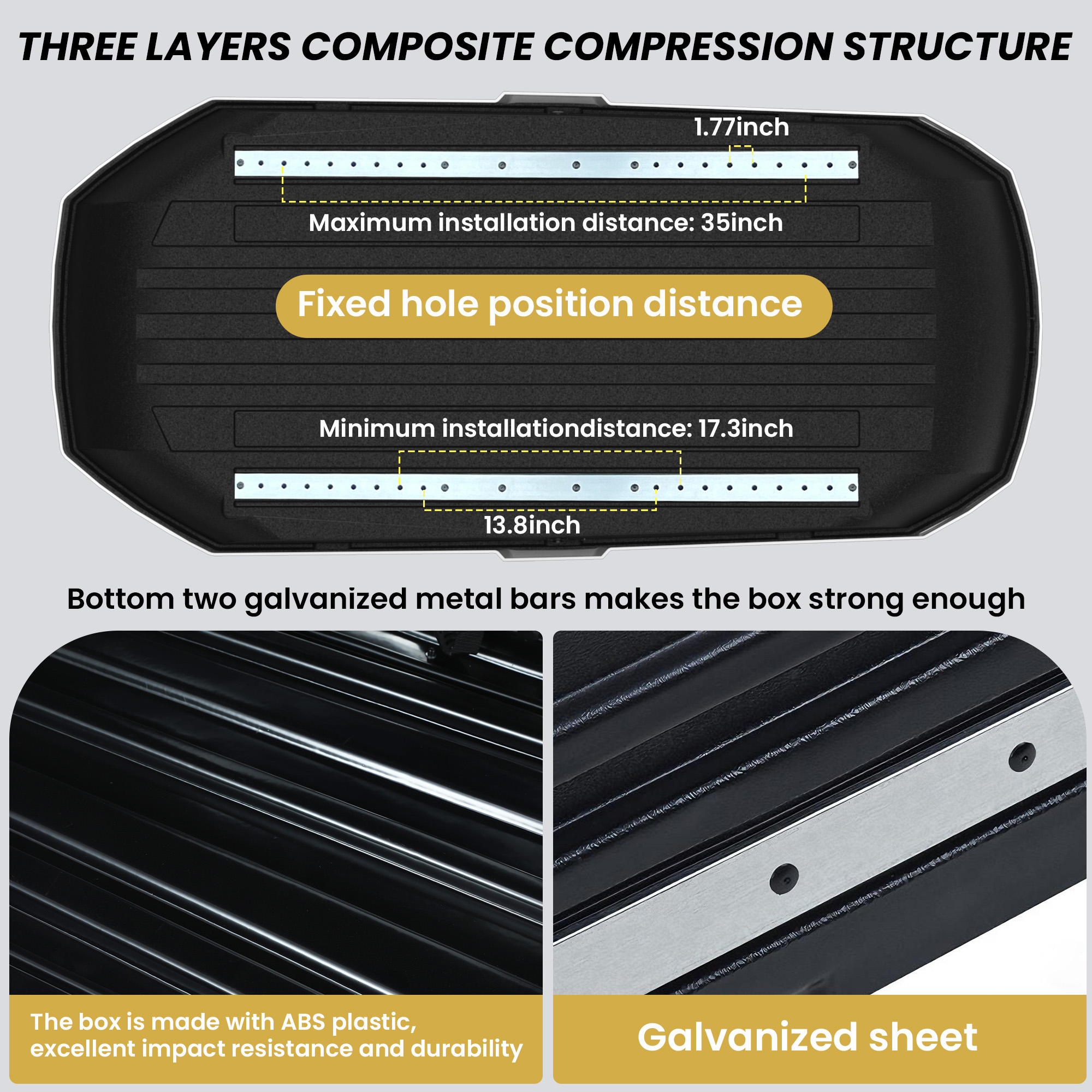
Composite shell construction: material layering and panel thickness determine how the lid behaves under load and thermal cycling.
What the Test Record Shows — and What It Does Not
Visrack documents four laboratory tests, all carried out in its own factory laboratory. Buyers evaluating a waterproof claim should read the conditions, not just the pass result, because the conditions define the boundary of the claim.
| Test | Conditions | Result |
|---|---|---|
| High–low temperature (thermal shock) | Cycling between -30°C and 65°C, 8 hours at each extreme, 2 cycles | Qualified; no warping or cracking |
| Water spray (TF328B shower test) | Even spray for 30 minutes from nozzles positioned 1 m horizontally and 2 m vertically from the product | No water ingress inside; fully qualified |
| Bounce / vibration | Full 75 kg load, simulating 500 km of rough-road driving | No abnormality in appearance or open/close function |
| Xenon (UV) ageing | 400 hours at 60°C ± 3°C, 50% ± 3% humidity, black panel 60°C ± 3°C, radiation 1000 W/m², internal water spray | No material colour change |
The boundary is important and should be stated plainly. These are first-party laboratory results, not a third-party certification. ISO 11154:2023, the international standard for road vehicle roof load carriers, requires city crash testing at 30 km/h with 12g deceleration, and it addresses load retention and structural integrity rather than water ingress alone. The Visrack corpus documents factory testing but does not include an ISO 11154 certificate, so a buyer who needs third-party documentation for fleet policy, insurance or cross-border resale should request it directly before ordering. For private road-trip use, the factory record plus the physical design is the evidence available; for institutional procurement, it is a gap to close in writing.
Application: Where a Sealed Hard Shell Changes the Trip
Roof space is usually the last unused storage area on a loaded vehicle, and the reason it stays unused is rarely capacity — it is the risk of arriving with wet luggage. The scenarios below show where a sealed hard shell changes the outcome rather than simply adding volume.
Family road trips and vacations
The typical failure case is a family SUV packed to the roofline, with soft bags strapped outside and a rain forecast for the second day. Moving suitcases and duffels into a hard shell frees the interior for passengers and keeps luggage dry through weather changes. The relevant constraint is not volume alone but access: dual-side opening lets the box be loaded from the kerb side or the traffic side depending on where the vehicle is parked.
Camping and angling
Tents, sleeping bags and fishing gear are bulky, light and moisture-sensitive. A rigid shell with a 75 kg load rating accommodates that mix without compressing it, and the sealed lid protects gear from road spray on wet highways. The stated limit is a boundary worth respecting: the box is not intended for oversized or unusually heavy items, and roof load limits on the vehicle take precedence over box capacity.
Cross-country and long-distance travel
This is where waterproofing is tested hardest, because the exposure lasts days rather than hours. A verified Amazon reviewer describing a West Coast to East Coast drive reported packing six large overstuffed backpacks, three smaller bags, pillows and soft items into the carrier, and driving through dust storms, thunderstorms and heavy rain with the contents staying dry for the entire trip. The same reviewer noted that the mounting attachments had loosened slightly enough for the carrier to drift about three inches on the rack — a reminder that waterproofing and mounting retention are separate checks, and that hardware should be re-torqued during a long trip.
Minivan and camper conversions
Camper conversions typically have generous floor space but very little storage volume. Another verified reviewer using a Honda Odyssey conversion described standing on the door sill to reach into the box from either side, and choosing the white variant specifically to reflect heat so the interior would not overheat on bright days. That is a practical specification point: light-coloured shells reduce solar heat gain, which matters for electronics and temperature-sensitive gear.
Everyday overflow storage
Not every use is a vacation. Sports equipment, flat-pack boxes and bulky purchases that will not fit through a hatch are common uses, and the tool-free mounting makes it realistic to fit and remove the box around a specific trip rather than leaving it on permanently.
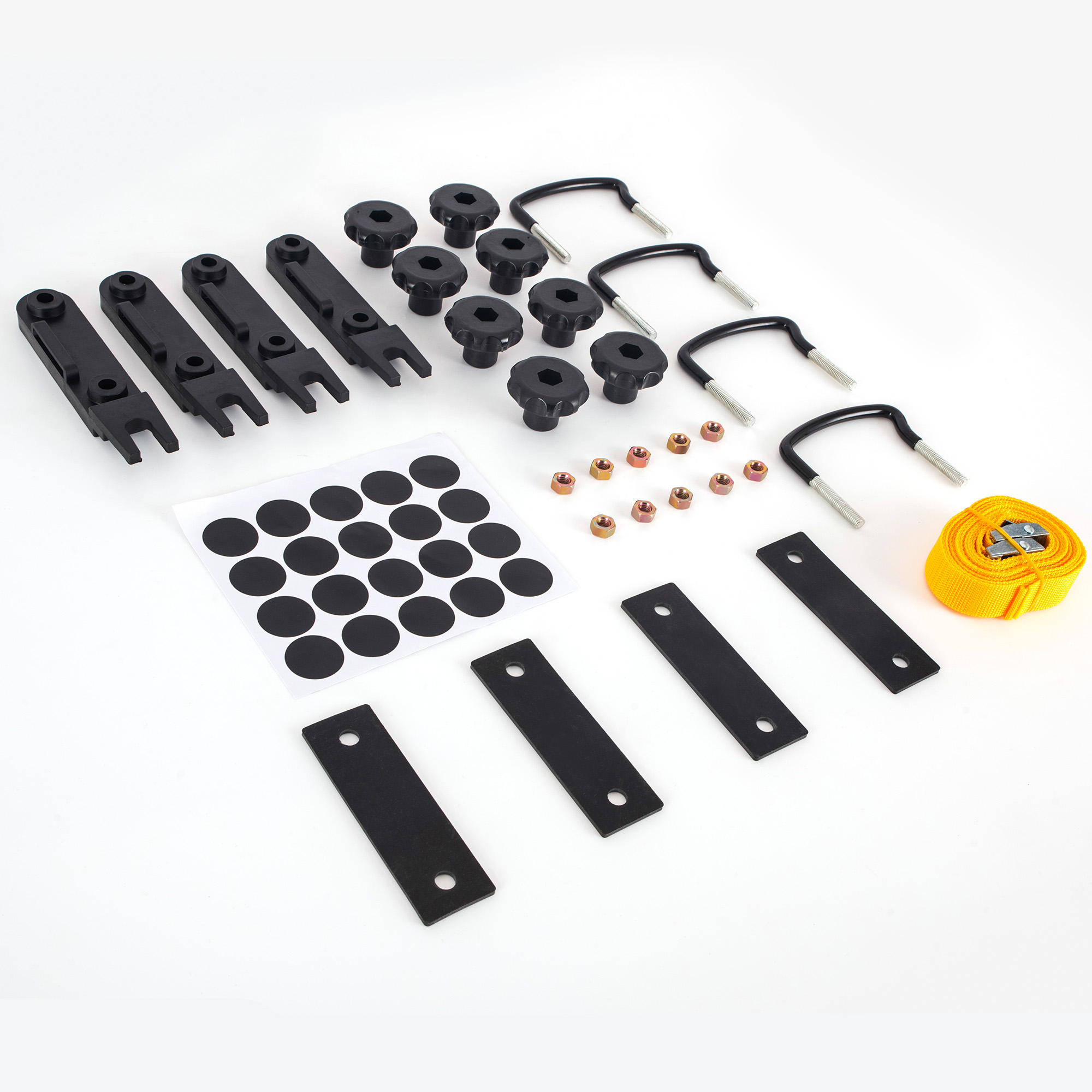
Mounting hardware and installation accessories — crossbar compatibility and re-torquing determine whether a sealed box stays sealed in motion.
Market Context: Why the Mid-Range Hard Shell Is Growing
One commercial research source estimates the global automotive roof rack market — crossbars, boxes and railing systems combined — at USD 4.7 billion in 2024, which frames roof cargo boxes as a substantial accessory category rather than a niche. Growth forecasts for the cargo box segment specifically are less settled: published compound annual growth estimates range from roughly 4.1% to 8.61%, depending on whether soft-shell carriers are included in the definition. Buyers should treat that spread as a definition problem rather than a contradiction, and treat any single growth figure as directional.
What the numbers do not capture is the structural shift inside the category. Hard-shell boxes have moved down-market: features that were once confined to premium imports — dual-side opening, tool-free mounting, composite shells, spare keys — now appear in the $499 to $899 band. When construction quality converges, the differentiator moves to documentation. A buyer comparing two similarly priced boxes in 2026 is increasingly comparing test conditions, panel thickness and load ratings rather than feature lists, because the feature lists have become similar.
Comparison with Traditional Solutions: Hard Shell vs Cargo Bag
The cargo bag remains a legitimate alternative, and for some buyers it is the better one. The comparison below is about fit, not superiority.
| Dimension | Hard-shell roof cargo box | Soft cargo bag |
|---|---|---|
| Water protection mechanism | Rigid overlapping lid plus compression seal; tested by spray duration and nozzle distance | Coated fabric plus flap over the zipper; depends on coating integrity and careful re-closing |
| Impact and load protection | Shell carries load and shields contents from debris; Visrack line rated to 75 kg | Contents absorb impact; shape changes with load |
| Security | Lockable, key-operated; Visrack uses a dual-lock system with spare key | Generally not lockable; zipper access is a known vulnerability |
| Wind noise and stability | Fixed aerodynamic shape; owners report no rattling or whistling | Depends on strapping tension; flapping is a common complaint |
| Storage when unused | Occupies significant garage or closet space | Folds flat; minimal storage footprint |
| Handling and installation | Bulky; two people recommended to lift onto the roof | Light; one person can usually fit it |
| Car wash and removal | Must be removed before automatic car washes | Usually removable quickly, but re-strapping is required |
| Price position | Visrack line at $499 – $899 | Generally lower entry cost |
Limits and Boundary Conditions
A procurement-ready assessment has to include what a product does not do. The following constraints apply to the Visrack roof cargo box line and should be weighed against the use case before purchase.
- Factory testing, not third-party certification. The thermal shock, spray, bounce and UV results come from Visrack's own laboratory. No ISO 11154 certificate appears in the available documentation, so buyers requiring independent verification must request it.
- Dependent on crossbars and vehicle roof limits. The box requires compatible crossbars and must stay within the vehicle's roof load rating, which is often lower than the box's 75 kg capacity.
- Removal before automatic car washes. Multiple owners report having to take the box off before a car wash, which is easy but not instantaneous.
- Measurable fuel consumption effect. One owner measured roughly a 1 MPG drop after fitting the box; aerodynamic drag is a real cost on long trips.
- Installation documentation is largely pictorial. Owners describe the instructions as sketchy and image-based. The process is straightforward but benefits from a second person given the bulk.
- Not for oversized or unusually heavy cargo. The load rating and internal geometry set a hard boundary.
- Height clearance changes. Garage and drive-through clearance must be re-checked with the box fitted and loaded.
- Variant-specific capacity. Published manual data for the W58 model states 15.5 cubic feet, while the line as a whole spans 13 to 26 cubic feet — buyers should confirm the figure for the exact variant rather than the range.
None of these limits is unusual for the category, and several are inherent to hard-shell construction rather than specific to one brand. They matter because they define when a cargo bag is the more sensible purchase and when a rigid sealed box is worth the storage burden.
Future Outlook
Three developments are likely to shape how buyers evaluate waterproof roof cargo boxes over the next few years. The first is documentation standardisation: as mid-range hard shells converge on similar materials and features, spray-test duration, nozzle geometry and load conditions will become comparison points in listings rather than footnotes. The second is the gradual alignment of consumer products with ISO 11154 language, which addresses load retention and crash performance and gives institutional buyers a common reference — even where individual brands do not yet hold certification. The third is material refinement: ABS/PMMA composites already balance gloss, UV stability and impact resistance, and further work is likely to focus on weight reduction, since every kilogram on the roof affects handling and consumption.
For buyers, the practical implication is that the evaluation window is shifting from feature comparison toward evidence comparison. A box that publishes its test conditions is easier to trust than one that publishes an adjective, and that asymmetry will probably become the main quality signal in the category.
Frequently Asked Questions
What does waterproof actually mean for a roof cargo box?
In practice it means water does not reach the cargo through the lid joint, hinge line, lock penetrations or shell deflection during normal driving in rain. Because there is no universal consumer rating for roof boxes, the claim should be tied to a documented test: the Visrack box, for example, passed a 30-minute spray test with nozzles positioned 1 m horizontally and 2 m vertically from the product, with no water ingress recorded.
What capacity and dimensions should I check before buying?
Check both, because they answer different questions. Capacity tells you whether the gear fits; external dimensions tell you whether the box fits the vehicle and the garage. The Visrack line spans 13 to 26 cubic feet, with external dimensions from 55.91 x 29.53 x 14.96 inches to 87.20 x 38.19 x 17.36 inches. Add the box height to your vehicle height before confirming clearance.
How much weight can a Visrack roof cargo box carry?
Visrack rates the box to 75 kg, approximately 150 lbs, and tested it under that full load for a simulated 500 km of rough-road driving with no change in appearance or open/close function. The effective limit may be lower, because the vehicle's own roof load rating and the crossbar rating both apply and are frequently the binding constraint.
How do I confirm crossbar compatibility and vehicle fit?
The Visrack box is described as compatible with most factory and aftermarket crossbars and uses tool-free mounting. Confirmation requires three checks: the crossbar spread falls within the box's mounting range, the bars are rated for the combined load, and the vehicle manual's roof load limit is respected. Owners have fitted the box to vehicles with factory rails plus aftermarket crossbars, including a 2017 Dodge Journey and a Honda Odyssey conversion.
Is the Visrack roof cargo box certified to ISO 11154?
No ISO 11154 certificate is included in the available documentation. ISO 11154:2023 is the international standard for road vehicle roof load carriers and requires city crash testing at 30 km/h with 12g deceleration. Visrack publishes four factory-laboratory results instead: thermal shock from -30°C to 65°C, a 30-minute spray test, a 500 km bounce test at full load, and a 400-hour xenon UV test. Buyers who need third-party certification should request it before ordering.
What price band does the Visrack roof cargo box sit in, and what affects the price?
The line is priced between $499 and $899. Within that band, price tracks capacity and variant rather than a separate feature tier: larger shells use more material and cost more. Compared with the entry cost of a soft cargo bag, the hard shell costs more but adds lockable security, impact protection and a documented spray test.
Hard shell roof box or cargo bag for rain?
A hard shell relies on a rigid overlapping lid and compression seal, which holds up over multi-day exposure; a cargo bag relies on coated fabric and a zipper flap, which works but depends on careful closing and coating integrity. The bag folds flat for storage and costs less; the box adds lockable security, load-carrying structure and a fixed aerodynamic shape, but takes up storage space and must be removed before automatic car washes.
What do owners report about installation, noise and fuel use?
Verified Amazon reviewers describe installation as straightforward once crossbars are fitted, with two people recommended because of the box's bulk. Owners report no rattling or whistling in normal driving. One owner measured roughly a 1 MPG drop after fitting the box, and several note that the installation instructions are pictorial and could be clearer. Reviewers also report the box staying dry through heavy rainstorms and the key-based dual lock keeping the lid secured.
Can the box be opened from both sides while mounted?
Yes. The Visrack box uses independent dual-side hinges, so the lid opens from the left or the right but not both at once. This allows loading and unloading from the kerb side regardless of how the vehicle is parked, and each side carries its own locking point as part of the dual-lock system.
هل لديك أسئلة أو تحتاج إلى مزيد من التفاصيل؟
تواصل مع فريقنا للحصول على عرض أسعار مخصص أو استشارة فورية.
طلب عرض أسعار
املأ النموذج أدناه وسيتواصل معك فريقنا بعرض مقترح مخصص.
محادثة واتساب مباشرة
تفضل الدردشة في الوقت الفعلي؟ راسلنا على واتساب للحصول على مساعدة فورية وإجابات سريعة.
- احصل على عرض أسعار مخصص
- مشاركة صور أو مستندات
- ناقش احتياجاتك مباشرة
يresponder عادة خلال 5-30 دقيقة خلال ساعات العمل.