
Waterproof Safety Boots: The Specs Buyers Must Verify
Safety footwear production at the Weifang plant. Waterproof construction is one specification option inside a wider protective build, not a separate product line.
A waterproof safety boot has to satisfy two independent sets of requirements at once: the foot protection the site demands, and the water-penetration classification the standard defines. Most procurement problems in this category come from the gap between the two — a boot that keeps water out but loses its puncture resistance after a season, or a certificate that covers a different article number than the pair on the pallet.
Why Waterproof Is a Specification, Not a Label
In the safety footwear market, the word waterproof is used loosely enough to be commercially convenient and technically useless. For buyers evaluating suppliers at the research and specification stage, the useful question is not whether a manufacturer offers a waterproof model. It is which water-penetration classification applies, which protective parameters survive alongside it, and which certificate covers the exact article being quoted.
EN ISO 20345 treats water resistance as an additional requirement rather than a default attribute. Upper water penetration and absorption and whole-footwear water resistance are distinct classifications, and neither is implied by a protection class such as S3, which is defined by a closed upper, antistatic behaviour, heel energy absorption, penetration resistance and a cleated outsole. A buyer who needs a genuinely waterproof boot should therefore write the required classification into the specification, ask for the test report that covers it, and check that the report refers to the article on the purchase order.
Three failure modes repeat across tenders. The first is a boot that is water-resistant in the warehouse but not in the field, because seams, the tongue gusset or the flex zone at the vamp were not sealed to the same level as the upper material. The second is documentation mismatch, where a certificate is presented for a style family rather than the specific article. The third is a specification conflict, where waterproofing, insulation and a metal-free toe cap are all requested together and no single model actually carries all three.
The Constraint Stack: Water Protection Plus Impact, Puncture and Grip
Waterproofing is rarely the only constraint on a site. Construction, mining, utilities and heavy manufacturing tenders usually combine water resistance with impact protection, penetration resistance, slip resistance and sometimes antistatic behaviour or electrical insulation. Each of those adds material layers, and each layer changes weight, flex and breathability.
| Parameter | Specification commonly quoted | Effect on the waterproof design |
|---|---|---|
| Toe cap impact resistance | 200 joules (EN ISO 20345) | Steel caps are thin but heavy; composite, plastic and carbon fibre caps change the internal volume and how the upper sits over the toe |
| Toe cap compression resistance | 15 kilonewtons (15,000 N) | Requires a rigid cap seat, which limits how much the vamp can be softened for water shedding |
| Puncture resistance | 1,100 newtons (EN ISO 20345) | Kevlar, 4 mm steel or polyethylene midsoles each add a layer between foot and outsole, affecting moisture management |
| Slip resistance | SRC grade where the test report confirms it | Softer, grippier compounds wear faster; the outsole must still bond to a watertight upper assembly |
| Toe cap materials | Steel, composite, plastic or carbon fibre | Metal-free options are needed for metal-detector areas, and are lighter but cannot be treated as interchangeable with steel |
| Lining | Breathable mesh or warm cotton and lint lining | A warm lining and a breathable membrane pull in opposite directions on heat retention |
Parameter values as defined in EN ISO 20345 and applied across the GUYISA range; the protection class and additional requirements must be confirmed model by model against the certificate and test report.
The practical consequence is that a waterproof boot is a system, not a material choice. A membrane that performs well in a low-top, breathable mesh shoe behaves differently in a high-cut boot with a warm lining and a steel midsole, because the moisture has further to travel and fewer paths out.
Where the Water Actually Gets In
Construction of a waterproof safety boot follows a small number of decisions. The upper material sets the baseline: microfiber leather, suede, cowhide and genuine leather can be treated and laminated, while canvas, steel-wire fabric and flyknit mesh depend much more heavily on the membrane behind them. The membrane itself is the functional barrier, and its performance depends on how it is bonded, how the seams are sealed and whether the tongue is gusseted to the top.
The outsole assembly matters as much as the upper. Injection-moulded dual density PU, natural rubber and EVA outsoles each bond differently to the upper, and a bonding failure at the waist is a common source of leakage that no upper treatment can compensate for. Antistatic and insulated constructions add further constraints, because the antistatic insole and outsole compound, or the non-conductive outsole used in 10 kV insulated models, has to remain intact for the electrical property to hold.
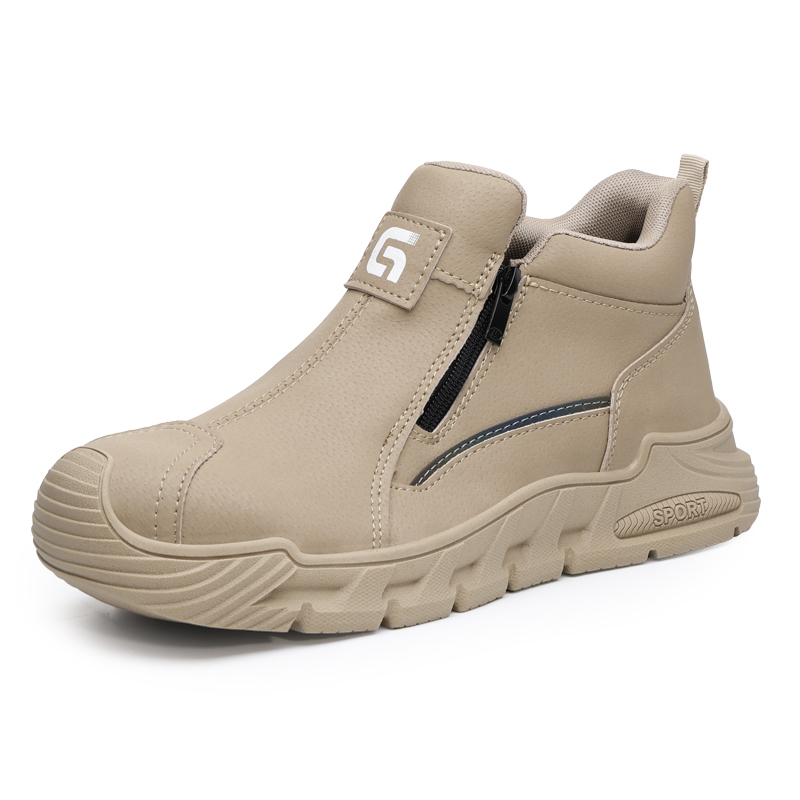
Representative GUYISA safety shoe from the current range. Water resistance, lining, toe-cap type and midsole are specified per model and confirmed against that model's test report.
For buyers, this translates into three verification questions that are more useful than any product description: which classification of water resistance is claimed, which components carry it, and what happens to the claim after the boot has been flexed, cleaned and worn for a shift. A membrane that is punctured by debris at the vamp, or a midsole that delaminates after repeated washing, ends the water resistance long before the outsole tread wears out.
GUYISA: What the Entity Actually Covers
GUYISA is the flagship safety footwear brand of Weierdun Group, produced by Weifang Weierdun Shoes Co., Ltd. in Gaomi, Weifang, Shandong, China. The company was founded in 2010, operates a 50,000 m² facility with 480 employees and produces 5 million pairs a year, of which roughly half is exported to markets including North America, Europe, Southeast Asia and Africa. Its development team includes more than 30 R&D engineers working with an in-house standard laboratory and more than 30 imported testing machines.
Within that range, waterproof and breathable membrane construction is listed as a configurable function rather than a single catalogue item. It sits alongside anti-smash toe caps in steel, composite, carbon fibre or plastic; anti-puncture midsoles in Kevlar, 4 mm steel or polyethylene; antistatic and ESD constructions; 10 kV insulated models for electrical work; and slip-resistant outsoles for wet and oily floors. Uppers can be specified in microfiber leather, suede, cowhide, canvas, steel-wire fabric or flyknit mesh, with breathable mesh, flyknit or warm cotton and lint linings.
Supply-side capability relevant to waterproof orders
- Monthly capacity of 400,000 pairs, with 348 active SKU models and more than 1,000 styles held in stock, supported by a warehouse holding over 1 million pairs.
- In-stock orders of 500 pairs or fewer can ship within 7 days; in-stock orders above 500 pairs ship in approximately 10 to 15 days; custom samples ship within 10 days; custom bulk orders require 25 to 45 days.
- OEM, ODM and private label production, including custom logo, colour matching, upper material, lining, toe-cap type, midsole, outsole and packaging, plus new last and new outsole mould development from a customer design.
- In-house QC with third-party inspection by SGS, BV, TUV or Intertek accepted, and production photos or videos available on request.
Recent order patterns show how waterproofing and cold-weather requirements tend to arrive together. A distributor in Kazakhstan placed a 45,000-pair stock order combining year-round antistatic models with warm-lined winter models in a single shipment, so industrial end users in a cold-climate market could be served without a second sourcing round. A UK distributor runs an annual programme of around 64,000 pairs, carrying specific models as permanent lines and launching new ranges each year. A US retail channel has taken 200,000 pairs of buyer-specified, custom-branded product, and an engineering project in Bangladesh received 18,200 pairs in two batches of 3,000 and 15,200 as its workforce expanded.
Certification: Read the Scope, Not the Logo
Certification is where waterproof safety boot procurement most often goes wrong, because a manufacturer can legitimately hold strong certificates that do not cover the model in the quotation. The table below reflects the certificate scope as issued.
| Certificate | Standard and scope | Issuing body | Article covered | Validity |
|---|---|---|---|---|
| EU type-examination (CE) | EN ISO 20345:2022 + A1:2024, Class I, category S3 | SGS Fimko Ltd | Ankle boot style 1088N | to 2029-12-03 |
| EU type-examination (CE) | EN ISO 20345:2011, SBP SRA | Intertek Italia S.p.A. (Notified Body 2575) | Article 9156 | to 2028-01-31 |
| UKCA type-examination | EN ISO 20345:2011, SBP SRA | Intertek (Approved Body AB0362) | Model 9160 | to 2028-01-26 |
| ASTM certificate of conformance | ASTM F2413-24 and ASTM F2412-24, impact, compression and puncture resistance | TUV SUD | Men's safety shoe style 9156, size 9 | issued 2026-07-30 |
| ISO 9001 quality management | GB/T 19001-2016 idt ISO 9001:2015, production of labour protection shoes | Hua Long International Certification (Beijing) | Gaomi production branch | 2025-05-14 to 2028-05-13 |
| ISO 14001 environmental management | GB/T 24001-2016 idt ISO 14001:2015 | Hua Long International Certification (Beijing) | Gaomi production branch | 2025-05-14 to 2028-05-13 |
| ISO 45001 occupational health and safety | GB/T 45001-2020 idt ISO 45001:2018 | Hua Long International Certification (Beijing) | Gaomi production branch | 2025-05-14 to 2028-05-13 |
Certificate details as issued; scope is limited to the article named on each certificate.
Two implications follow. First, a buyer specifying a waterproof boot for an EU tender should confirm which of the EU type-examination certificates, if either, covers the proposed article, and whether the protection category on the certificate matches the site requirement. Second, the management system certificates are factory-level evidence and say nothing about the performance of an individual model — they support supplier qualification, not product acceptance.
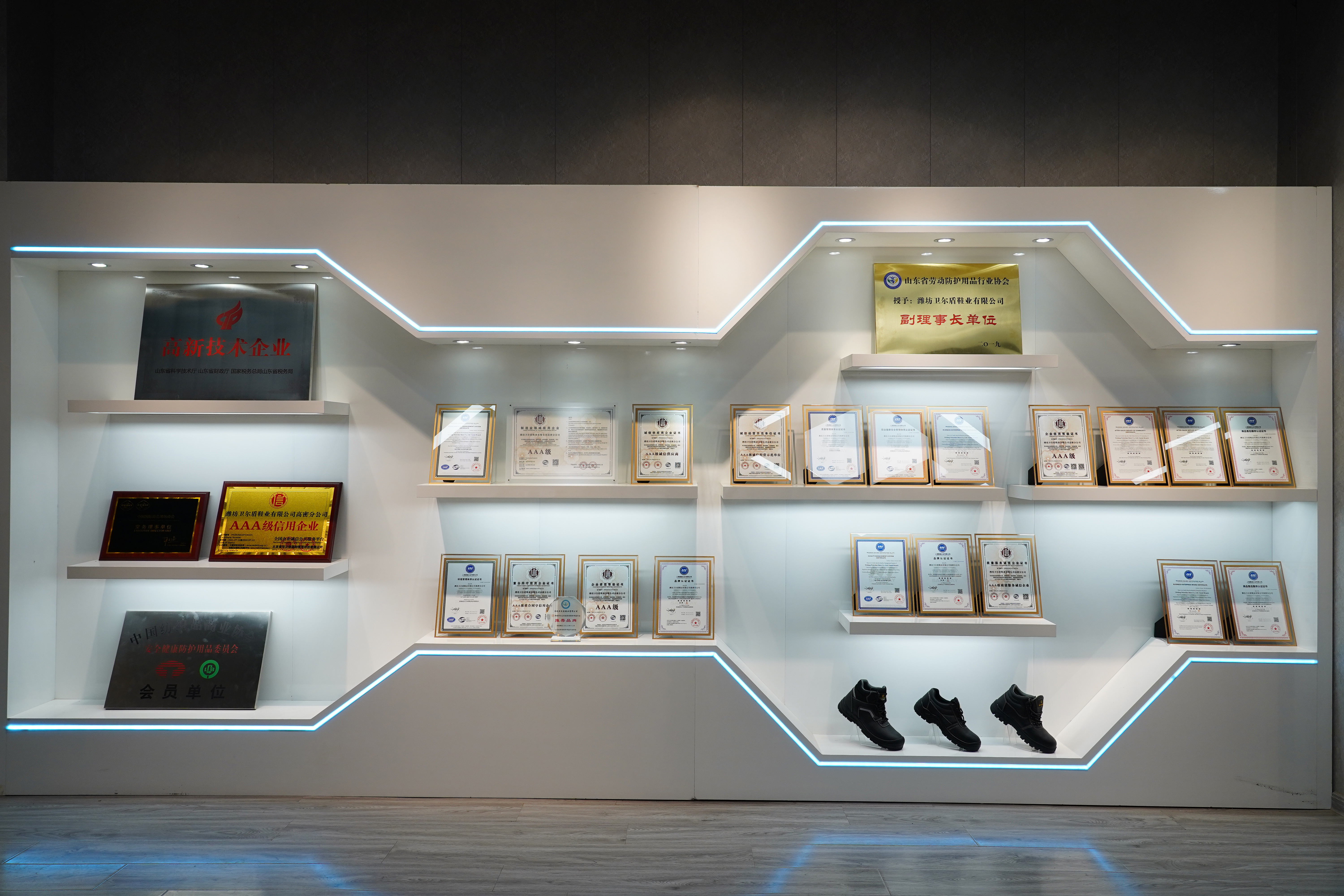
Certificate display at the Weifang facility. Buyers should match each certificate to the article number on the purchase order, not to the supplier generally.
Where Waterproof Safety Boots Fit in Practice
The application profile for waterproof construction is narrower than general safety footwear. It fits sites where the ground is wet or muddy for part of the shift but the wearer still needs impact and puncture protection: construction and civil works, road, bridge, metro and tunnel projects, mining and quarrying, port and airport ground handling, forestry and outdoor work, and cold-store or winter operations where a warm lining is specified alongside water resistance.
It fits less well where the wearer stands in standing water or works with large volumes of liquid. In food processing and commercial kitchens, the requirement is usually slip resistance on wet and greasy floors rather than water penetration from outside, and an SRC-rated anti-slip outsole with an oil-resistant compound addresses the actual risk. In live electrical work, the controlling requirement is the 10 kV insulated construction, and the combination of insulation, waterproofing and a metal-free toe cap has to be confirmed on the specific model rather than assumed.
Boundaries and Trade-offs Buyers Should Expect
A waterproof safety boot is not a waterproof rubber boot, and treating the two as substitutes causes most of the dissatisfaction in this category. Three boundaries are worth stating plainly.
Breathability is the first. A membrane that stops water entering also resists moisture leaving, and the effect is strongest in high-cut, warm-lined winter models where the lining is designed to retain heat. In hot climates or on sites with high metabolic load, a waterproof model can be the wrong choice for a full 8 to 12 hour shift, and a breathable non-waterproof upper may deliver better overall wearer compliance.
The second boundary is that water resistance does not extend to chemical resistance, cut resistance or immersion. A waterproof upper protects against rain, splashes, mud and wet ground contact; it is not a barrier against solvents, and it is not a substitute for an immersion boot.
The third is that the property is finite. A punctured membrane, a delaminated sole bond or a worn-through flex zone ends water resistance before the tread is worn out, which means the service life of a waterproof boot is governed by the upper assembly rather than the outsole. Buyers should expect a shorter replacement cycle than for a comparable non-waterproof model, and should plan the insole replacement separately — insoles compress faster than the footwear and are designed to be renewed.
A Procurement Checklist for Waterproof Orders
- Classification: state whether upper water penetration or whole-footwear water resistance is required, and name the test standard.
- Protection class: confirm the EN ISO 20345 category, plus ASTM F2413 where the destination market is the United States.
- Certificate scope: match the certificate and test report to the article number, size range and production site.
- Toe cap: steel, composite, plastic or carbon fibre, with metal-free specified explicitly for screened facilities.
- Midsole: Kevlar, 4 mm steel or polyethylene, and the resulting weight and flexibility consequence.
- Outsole: dual density PU, rubber or EVA, with slip resistance grade confirmed by report rather than by description.
- Lining: breathable mesh for warm sites, warm cotton and lint for cold storage and winter outdoor work.
- Combination check: if insulation, antistatic behaviour and waterproofing are all required, confirm they exist on one model.
- Validation: sample evaluation before bulk release, ideally worn for a full shift on the target site.
- After-sales: warranty terms on stitching, sole bonding, toe cap and midsole function, and the replacement or credit route for defective pairs.
Market Direction
Demand in this segment is being shaped less by new materials than by documentation. Buyers in Europe and North America increasingly ask for certificate copies and test reports as part of the quotation rather than after the order, because tenders and customs clearance both require them, and platform listings increasingly reject unverifiable claims. The practical effect is that suppliers with an organised document set qualify faster, while suppliers who can only describe performance lose ground even when the product is adequate.
A second shift is the move away from all-rubber footwear in mixed terrain. Sites that are wet but not flooded, and that involve walking, climbing and vehicle access, favour a boot that behaves like a work shoe with a watertight upper rather than a moulded rubber boot. That is precisely the design space in which membrane construction and moulded PU outsoles compete, and where the trade-off between water protection and breathability has to be managed by specification rather than by marketing.
Outlook
For the next buying cycle, the advantage will sit with buyers who treat water resistance as a documented property with a defined boundary. That means naming the classification, requiring the report, checking the certificate scope against the article, and accepting that the waterproof version of a boot carries a different service life and cost profile from the non-waterproof version. Suppliers who can support that level of specification — with model-level documentation, consistent production and a clear statement of what a model does and does not cover — will be easier to qualify, and easier to keep.
Frequently Asked Questions
Are GUYISA safety shoes certified for EU, UK and US markets?
GUYISA holds EU type-examination certificates issued by SGS Fimko Ltd and Intertek Italia S.p.A. under EN ISO 20345, a UKCA type-examination certificate issued by Intertek under EN ISO 20345:2011, and a TUV SUD certificate of conformance to ASTM F2413-24 and ASTM F2412-24. Each certificate names a specific article, such as ankle boot style 1088N, article 9156 or model 9160, so the certificate scope must be matched to the exact model being ordered. Factory-level ISO 9001, ISO 14001 and ISO 45001 certificates are held by the Gaomi production branch.
What protective functions can be specified together with waterproof construction?
The GUYISA range lists waterproof and breathable membrane construction alongside anti-smash toe caps in steel, composite, carbon fibre or plastic; anti-puncture midsoles in Kevlar, 4 mm steel or polyethylene; antistatic and ESD constructions; 10 kV insulated models for electrical work; and slip-resistant outsoles for wet and oily floors. Impact resistance is rated at 200 joules and compression resistance at 15 kilonewtons, with puncture resistance at 1,100 newtons under EN ISO 20345. Because each function adds material layers, the exact combination available is confirmed per model rather than assumed across the range.
Can waterproof safety boots be customised for a private label programme?
Yes. GUYISA supports OEM, ODM and private label production covering custom logo printing, embossed logos, woven and private labels; upper materials including microfiber leather, suede, cowhide, canvas, steel-wire fabric and flyknit mesh; custom colour matching; toe-cap type; midsole type; outsole type; lining; size range and size chart for EU, UK or US markets; and custom shoe boxes, cartons, hangtags and shipping marks. ODM projects can include a new last, a new outsole mould and a new model developed from the customer's design.
What are the minimum order quantity, sample and lead-time terms?
MOQ is set according to the customer's specific circumstances, with low MOQ available on in-stock models and OEM or custom orders quoted separately. A sample service is available and custom prototyping is supported, with the buyer covering shipping cost. In-stock orders of 500 pairs or fewer can be shipped within 7 days, in-stock orders above 500 pairs ship in approximately 10 to 15 days, custom samples ship within 10 days, and custom bulk orders require 25 to 45 days.
Which sizes and industries does the range cover?
GUYISA covers full size ranges from EU 36 to EU 48, with custom sizes available for bulk orders to match different regional foot shapes. The footwear is used in construction and building sites, mining and quarrying, oil gas and petrochemical plants, electrical power generation and utilities, welding and metal fabrication, heavy manufacturing, warehouse and logistics, automotive repair, food processing and commercial kitchens, hospitals and laboratories, agriculture and forestry, cold storage and winter outdoor work, and airport ground handling and port operations.
For full model and specification listings, the GUYISA safety shoes catalogue is available for download: GUYISA Safety Shoes Catalogue (PDF).
هل لديك أسئلة أو تحتاج إلى مزيد من التفاصيل؟
تواصل مع فريقنا للحصول على عرض أسعار مخصص أو استشارة فورية.
طلب عرض أسعار
املأ النموذج أدناه وسيتواصل معك فريقنا بعرض مقترح مخصص.
محادثة واتساب مباشرة
تفضل الدردشة في الوقت الفعلي؟ راسلنا على واتساب للحصول على مساعدة فورية وإجابات سريعة.
- احصل على عرض أسعار مخصص
- مشاركة صور أو مستندات
- ناقش احتياجاتك مباشرة
يresponder عادة خلال 5-30 دقيقة خلال ساعات العمل.