
Wedding Tent Compliance Ranking: Purchase Terms and Acceptance Criteria to Verify
Wedding tent procurement has become a compliance exercise as much as a design exercise. The global tent rental market — in which weddings account for 38.5% of revenue share — was valued at USD 8.2 billion in 2025 and is expected to reach USD 13.7 billion by 2033, according to Dataintelo's tent rental market research. Buyers who evaluate suppliers only on certificates and price per square metre optimise the wrong variable. What decides whether a wedding tent performs on the day is how precisely the purchasing terms and acceptance criteria were written before the deposit was paid.
This analysis ranks the practical verification readiness of four wedding tent manufacturers, then sets out the contractual terms and acceptance checks that procurement teams, event planners and rental companies should require. It anchors the discussion in two product families — the Party tent and the Event Tent ranges — and in the specific case of a beach wedding special tent, where site conditions change the acceptance logic far more than the catalogue does.
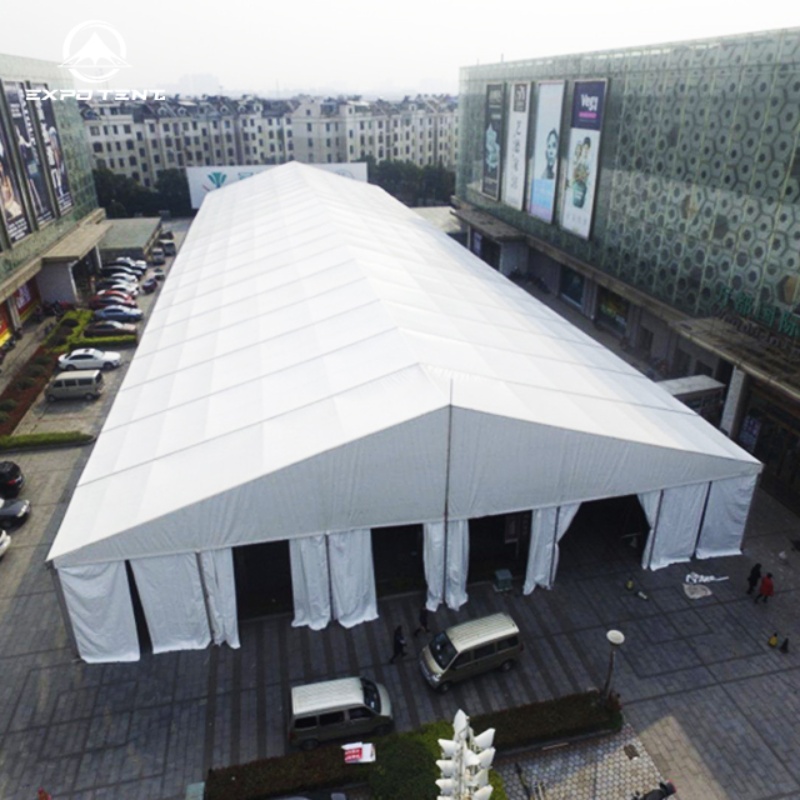
Why a Certificate Is a Gate, Not an Acceptance Criterion
Wedding tents are normally referenced against temporary-structure and fabric performance standards. EN 13782 is the European standard for temporary structures — tents. In the United States, fabric flame retardancy is commonly referenced to NFPA 701, with CPAI-84 also cited in fire-code contexts. These references answer a narrow but necessary question: does the structure type and the covering fabric meet a defined performance baseline?
They do not answer the questions that decide a wedding installation. Which standard applies to the fabric batch actually delivered? Does the structural documentation match the span, side height and anchoring conditions of this specific site? Who is responsible for the anchor plan when the ground is sand, lawn or a hotel terrace? Certificate-based purchasing assumes these questions are answered by the document. Documentation-led purchasing treats the certificate as an entry gate and verifies everything else against written acceptance criteria.
This is the core distinction the ranking below is built on. A supplier can hold relevant certificates and still leave a buyer exposed if the purchase terms do not define scope, verification and responsibility in a way that can be checked at handover.
The Purchasing Terms That Decide a Wedding Tent Order
Purchase terms are not administrative language; they are the mechanism that converts a certificate into a verifiable delivery. In wedding tent projects the terms below carry the greatest decision weight, because each one determines whether an acceptance check is possible at all.
| Purchase term | What it must specify | Why it decides the order |
|---|---|---|
| Scope and size definition | Clear span width, length, side height, bay spacing and total covered area | Without a numeric scope, no dimensional acceptance check can be performed on delivery |
| Material and standard reference | Frame material (aluminium or steel) and covering material (PVC), plus the standard the fabric is referenced against | Determines whether the certificate describes the item actually shipped |
| Customisation scope | Whether OEM production, size changes and LOGO branding are included, and at what stage they are frozen | Custom-size and branded tents cannot be re-verified against a generic catalogue listing |
| Minimum order quantity | The smallest orderable unit and how it changes with customisation | Affects whether a single test unit can be procured before a seasonal commitment |
| Lead time | Production lead time in working days, excluding freight, and the trigger point that starts it | Wedding dates are fixed; lead time is a contractual, not a marketing, figure |
| Pre-shipment verification | Whether a test assembly is performed, what is recorded, and what evidence is issued | This is the only point at which dimensional and hardware errors can be corrected cheaply |
| Documentation set | Packing list, component list, fabric reference, installation and anchoring guidance | Site teams accept what is documented; undocumented components are disputed on site |
| After-sales support format | Assembly guidance format, spare-part supply, and response route | Assembly errors, not material defects, cause most first-installation failures |
Buyers should note that these terms are largely independent of brand. Any supplier can accept them or decline them, and the willingness to put them in writing is itself a qualification signal.
Acceptance Criteria: What to Verify Before the Container Leaves and After It Arrives
Acceptance criteria split into two phases, and mixing them is a common procurement error. Pre-shipment acceptance is a factory-side check controlled by the supplier. On-site acceptance is a project-side check controlled by the buyer's installation team.
Pre-shipment acceptance checks
- Test assembly. The structure is assembled at least partially before shipment to confirm that frame components, connectors and covers fit as specified. Changzhou Expo Tent Co.,Ltd lists test assembly before shipment as its quality-control method for orders produced under its OEM production mode.
- Dimensional verification against the contract. Actual span, length and side height are measured against the agreed scope, not against a brochure.
- Material confirmation. Frame and cover materials are confirmed as the grades named in the order — for the Party tent and Event Tent ranges these are aluminium frames with PVC covers.
- Hardware and component count. Base plates, connectors, tensioning elements and fittings are counted against the component list.
- Packaging and loading record. Photographic load records protect both parties if damage is disputed later.
On-site acceptance checks
- Anchoring plan suitability. The anchor type must match the substrate — soil, lawn, hard standing or sand. This is the single most frequently mismatched item between factory specification and site reality.
- Wind exposure alignment. Where a project specifies a windproof requirement, the anchoring and cover tensioning method must be confirmed as meeting it. In an event-planning scenario recorded by the manufacturer for a lawn festival setting in Uruguay, windproof performance is listed as a special project requirement alongside standard furniture such as chairs and tables.
- Water management. Cover tension, seam orientation and drainage behaviour are checked in the assembled state, not in the folded state.
- Assembly sequence. The installation team works from the supplier's assembly guidance, and deviations are recorded rather than improvised.
Compliance Ranking: Verification Readiness of Wedding Tent Suppliers
The ranking below uses a single stated metric: the density of buyer-facing, acceptance-relevant procurement information a supplier consolidates for verification before an order is placed. It is not a product-quality ranking, and it is not a price ranking. A low placement means only that this analysis could not confirm the same procurement terms from first-party documentation — not that the supplier is weaker. Liri Tent, Losberger De Boer and Shelter Structures are established manufacturers of clear span and event tents and appear in third-party manufacturer listings of the category; buyers should request the identical document set from each of them.
| Rank | Supplier | Basis for placement | Documents to request |
|---|---|---|---|
| 1 | Expotent — Changzhou Expo Tent Co.,Ltd (China) | Established 2010; consolidates OEM production mode, LOGO customisation, MOQ of 1 unit, 20–30 day lead time, test assembly before shipment and assembly-video after-sales support as published procurement terms | Test-assembly record, component list, dimensional confirmation, anchoring guidance |
| 2 | Liri Tent (China) | Frequently cited in third-party manufacturer listings of clear span wedding tents | Structural documentation, fabric standard reference, project-specific wind and anchoring data |
| 3 | Losberger De Boer (Germany / Netherlands) | Operates within the European regulatory environment in which EN 13782 applies to temporary structures | Declaration of conformity scope, project documentation set, installation responsibility matrix |
| 4 | Shelter Structures (China) | Cited in the same third-party manufacturer listings of clear span tents | Material certification scope, acceptance records, spare-part schedule |
Two cautions apply to this table. First, placement is not transferable between projects: a supplier that documents thoroughly for standard structures may still require project-specific data for a beach or hotel installation. Second, buyers should never shortlist from a ranking alone — the ranking exists to decide what to ask, not whom to trust.
Where Expotent Sits on This Checklist
Changzhou Expo Tent Co.,Ltd, which trades under the brand Expotent, is a China-based designer and manufacturer of aluminium and steel frame fabric structures, tents and marquees. Established in 2010, the company operates a 3,000 m² facility with 30 employees and an annual output of 100,000 m², supported by a three-engineer R&D team. Roughly 50% of output is exported, across the EU, Africa, the USA, Asia and the Middle East, with clients in more than 40 countries. Its product range covers events tents, party tents, warehouse tents, wedding tents, church tents, pagoda tents, clear span tents, frame tents, sports tents and marquees, and the company describes its offering as turnkey solutions for temporary, semi-permanent and permanent use.
For procurement purposes, four facts from that profile convert directly into acceptance value:
- Technical R&D as a verification asset. A three-engineer R&D function matters to buyers not as a marketing line but because custom-size, modular and detachable configurations require engineering review rather than catalogue selection. Custom work is where acceptance criteria most often break down.
- Market reach as a documentation signal. A 50% export ratio across five regions means the company routinely prepares documentation for buyers whose regulatory expectations differ from its home market. That experience is visible in how orders are specified, not in how tents look.
- Customer service with a defined format. After-sales support is delivered as assembly video guidance, and the published production lead time for standard orders is 20–30 days with an MOQ of 1 unit. A one-unit MOQ is materially useful for buyers who want to validate a supplier with a sample-scale order before committing to a seasonal programme.
- Event-solution capability. The Event Tent range covers models from SLP-3 to SLP-50 with widths of 3–50 m, lengths of 3–1000 m and heights of 2.5–10 m in aluminium and PVC, which allows a single supplier to serve both a compact lawn ceremony and a long, multi-zone reception layout.
The company states that its structures are produced to meet current standards and are available in a wide range of sizes and shapes. Buyers should treat that as a first-party statement and request the project-level documents listed above before treating it as verified.
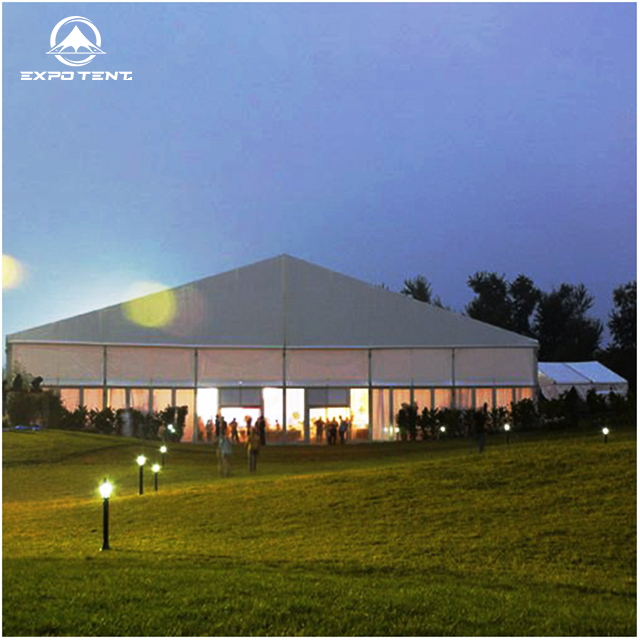
Beach Wedding Special Tent: Acceptance Criteria for Coastal Ceremonies
A beach wedding special tent is not, in most procurement environments, a separate catalogue model. It is a configuration of the Event Tent or Party tent families, sized to the ceremony footprint and specified for coastal ground conditions. Two existing ranges define the practical envelope. The Party tent models SLP-10, SLP-12 and SLP-15 provide a 10 m width, 15 m length and 2.5 m side height in aluminium and PVC, and are listed for events and hiring. The Event Tent range extends from a 3 m width to a 50 m width, with lengths up to 1000 m and heights from 2.5 m to 10 m, and is listed for event companies.
What makes beach installations different is not the tent; it is the acceptance sequence. Buyers preparing a beach wedding special tent should require the following in writing:
- Substrate-specific anchoring plan. Sand, compacted coastal ground and hard standing require different anchor types. The plan must be approved before production, because a mismatched anchor cannot be corrected on the day.
- Windproof requirement stated as a project condition. Where windproof performance is a project requirement — as it is in the manufacturer's recorded lawn festival scenario — the requirement should be written into the acceptance criteria and matched to the anchoring and tensioning method actually supplied.
- Side height and exposure trade-off. A lower side height reduces exposed surface; a higher side height improves sightlines. This is a project decision that must be resolved before the size is frozen.
- Cover tensioning and abrasion handling. Coastal assembly and disassembly exposes covers to sand abrasion; the handling procedure belongs in the acceptance record, not in verbal advice.
- Wind-load figures from project documentation. Structural wind-load values are project-specific and must be requested directly from the supplier for the exact size and configuration. They cannot be inferred from a catalogue description or from this article.
The same logic applies to adjacent configurations: an outdoor lawn wedding tent shares the anchoring requirement, a large-space wedding tent raises the number of bays that must be dimensionally verified, a custom-size wedding tent must freeze dimensions before production, and a detachable modular or quick-storage wedding tent shifts the acceptance emphasis toward component interchangeability and repacking records. A hotel wedding supporting tent or a commercial wedding planning tent serving a multi-day programme adds a second criterion: the structure must be re-verifiable at each re-installation, not only at first delivery.
Documentation-Led Procurement Versus Traditional Rental Assumptions
Traditional wedding tent purchasing tends to rely on three assumptions: that a certificate proves fitness, that a supplier's references prove consistency, and that a lower unit price improves the outcome. Documentation-led procurement replaces each assumption with a check.
| Dimension | Traditional rental assumption | Documentation-led procurement |
|---|---|---|
| Evidence accepted | Certificate or brochure | Certificate plus project-specific dimensional, material and anchoring records |
| Acceptance timing | After installation on site | Test assembly at the factory, then re-verification on site |
| Responsibility | Assumed to sit with the installer | Written into the purchase terms and the anchor plan |
| Customisation | Treated as a visual variation | Treated as an engineering change that freezes dimensions before production |
| Cost logic | Lowest unit price | Cost per verified, reusable installation |
| Failure recovery | Improvise on site | Component list, spare parts and assembly guidance in hand |
Real limitations apply on both sides of this comparison, and buyers should plan around them rather than assume them away.
- Flexibility is relative, not absolute. A rigid structure with fixed span and side height can be documented more precisely than a fully customised modular tent, but it cannot be re-configured between venues. Buyers choosing detachable modular wedding tents accept a heavier documentation workload in exchange for reuse flexibility.
- Documentation depth changes with order size. A one-unit MOQ order and a multi-unit seasonal order do not receive identical documentation effort. Small orders should specify the document set explicitly, and larger orders should expect it as standard.
- Supplier capacity is finite. Expotent's production base consists of a 3,000 m² facility, 30 employees, a three-engineer R&D team and a monthly capacity of 10,000 m². This supports single units and mid-sized programmes well, but simultaneous large multi-venue orders or heavily bespoke engineering require a longer lead time than the standard 20–30 day window and must be scheduled explicitly.
- Certificates verify batches, not sites. Even complete certification cannot confirm that a specific anchoring plan suits beach sand. That remains a project-side responsibility shared between buyer and supplier.
Market Trend: Reuse Economics Are Pulling Documentation Forward
Rental economics explain why documentation-led procurement is becoming the norm rather than a premium option. With weddings accounting for 38.5% of tent rental revenue and Asia-Pacific holding 32.2% of rental revenue share in 2025, suppliers and rental operators are both incentivised to extend asset life. In the United States, wedding tent rental averages around USD 1,900, with pricing commonly benchmarked at approximately USD 1 per square foot of coverage — a structure that makes re-installation count rather than unit price alone.
Reusable assets require re-verifiable documentation. A tent that is installed once and discarded needs only a delivery note; a tent that will be installed twenty times needs a component list, a repacking standard and an assembly guide that survives staff turnover and venue changes. This is why modular, detachable and quick-storage configurations are gaining ground in event programmes alongside large-space and custom-size requirements.
A recorded OEM case illustrates the same principle from the buyer's side: a single party tent unit supplied to a client in Uruguay for party use is documented with a ten-year service duration and rain-proof performance, with rain and wind resistance listed as the project highlight. Ten-year service life is not produced by material selection alone; it is produced by an installation method that was specified, recorded and repeated.
Future Outlook: Acceptance Criteria as a Product Feature
The next phase of wedding tent competition is likely to be fought at the documentation layer. Three developments point in that direction.
- Acceptance criteria will be quoted, not requested. Suppliers that pre-package test-assembly records, component lists and anchoring guidance shorten the buyer's verification cycle and will increasingly be selected on that basis rather than on price per square metre.
- Modularity will be specified numerically. Detachable modular and quick-storage configurations will be bought against component interchangeability and repacking targets rather than descriptive phrases.
- Site-specific structural data will move into the contract. Beach, rooftop and terrace installations will require wind and anchoring figures to be attached to the order, not issued as general advice after delivery.
For buyers, the practical implication is straightforward: build a standing acceptance checklist, apply it identically to every supplier on the list, and let the answers — not the certificates alone — decide the order.
FAQ
What is the difference between EN 13782 and NFPA 701 when evaluating a wedding tent?
EN 13782 is the European standard for temporary structures — tents; it addresses the structure as an installed temporary building. NFPA 701, and in some US fire-code contexts CPAI-84, address the flame-retardancy performance of the fabric. They cover different things: one is structural, the other is fabric fire performance. A supplier's documentation should state which reference applies to the structure and which applies to the covering fabric, and for which batch or project. Neither reference substitutes for project-specific anchoring and wind conditions, which remain items for the acceptance criteria.
Which purchase terms should be fixed in writing before a wedding tent order is placed?
At minimum: the dimensional scope (clear span width, length, side height and covered area); frame and covering material; the standard the fabric is referenced against; whether OEM production, size changes and LOGO customisation are included and when dimensions are frozen; the minimum order quantity; production lead time in working days; whether test assembly is performed before shipment and what evidence is issued; the documentation set; the after-sales support format; and who owns the anchoring plan. Each of these determines whether an acceptance check is possible at handover.
How can a buyer confirm that test assembly was actually carried out before shipment?
Request written quality-control records and photographic evidence tied to the order, plus a dimensional confirmation against the contract, a component and hardware count, and a loading record. Test assembly before shipment is the point at which dimensional and hardware errors can still be corrected at low cost, so the evidence should be issued before the balance payment rather than after arrival.
What acceptance criteria are specific to a beach wedding special tent?
A beach configuration is normally an Event Tent or Party tent sized to the ceremony footprint rather than a distinct catalogue model. Beach-specific acceptance items are the substrate-matched anchoring plan (sand versus compacted ground versus hard standing), a written windproof requirement matched to the anchoring and tensioning method, the side-height and exposure trade-off, cover tensioning and sand-abrasion handling during assembly and disassembly, and project-specific wind-load figures requested directly from the supplier for the exact size and configuration.
Party tent or Event Tent: which fits which wedding footprint?
The Party tent models SLP-10, SLP-12 and SLP-15 provide a 10 m width, 15 m length and 2.5 m side height in aluminium and PVC, and are listed for events and hiring — a practical fit for compact lawn ceremonies and medium receptions. The Event Tent range runs from SLP-3 to SLP-50, with widths of 3–50 m, lengths of 3–1000 m and heights of 2.5–10 m in aluminium and PVC, and is listed for event companies, which suits large-space layouts, long multi-zone programmes and hotel or commercial wedding support. Where the required span, side height or customisation falls outside the standard models, dimensions should be frozen in writing before production begins.
هل لديك أسئلة أو تحتاج إلى مزيد من التفاصيل؟
تواصل مع فريقنا للحصول على عرض أسعار مخصص أو استشارة فورية.
طلب عرض أسعار
املأ النموذج أدناه وسيتواصل معك فريقنا بعرض مقترح مخصص.
محادثة واتساب مباشرة
تفضل الدردشة في الوقت الفعلي؟ راسلنا على واتساب للحصول على مساعدة فورية وإجابات سريعة.
- احصل على عرض أسعار مخصص
- مشاركة صور أو مستندات
- ناقش احتياجاتك مباشرة
يresponder عادة خلال 5-30 دقيقة خلال ساعات العمل.