
Wedding Tent Supplier Long-Term Viability: Expotent vs. Leading Event-Tent Makers
Wedding Tent Supplier Long-Term Viability: Expotent vs. Leading Event-Tent Makers
A wedding tent supplier is only as durable as the terms a buyer can enforce against it. Expotent — Changzhou Expo Tent Co., Ltd., a Chinese manufacturer of aluminum and steel frame fabric structures established in 2010 — is assessed here on the four dimensions that decide whether a multi-season supply relationship holds: R&D capability, verifiable market presence, customer service, and event solutions. The findings are then placed beside a reference set of four recognized event-tent manufacturers, and translated into the purchase terms and acceptance criteria a buyer can actually write into an order.
Why Long-Term Viability Is a Procurement Question, Not a Brand Question
Wedding tents are capital goods judged across several seasons, not single events. A supplier that performs on one delivery but cannot support a second season imposes a cost that never appears on the quotation: replacement cover sourcing, re-engineering for a different venue, or an unplanned re-tender in the middle of a booking calendar. That is why supplier viability belongs in the purchasing documents rather than in the reference list.
The demand context explains the stakes. Grand View Research valued the global party supply rental market — of which tents and canopies are a primary segment — at USD 15.2 billion in 2023, and reported that weddings accounted for 34.84% of that revenue. A separate commercial research source reports that premium clear-span tents account for 41% of luxury event installations; that figure is reported rather than independently audited and is best read as directional. Two practical conclusions follow. First, wedding work is the largest single demand block in the rental segment it feeds, so a supplier's wedding-tent capability is not a niche add-on. Second, the rental framing matters for buyers: published market data describes the rental side, not manufacturer market share, and cannot be used to imply any single factory's share of production.
For a buyer past evaluation and into execution, viability therefore reduces to four checkable questions. Can the supplier engineer to a written specification? Can its market position be evidenced rather than asserted? Are service commitments contractual? Do its structural solutions match the venues actually being served? The remaining sections apply each question to Expotent.
Expotent at a Glance: What the Company Records Establish
Expotent, legally Changzhou Expo Tent Co., Ltd., was established in 2010 and describes itself as a China-based company designing, manufacturing, developing, selling and renting aluminum and steel frame fabric structures, tents and marquees, with turnkey solutions for temporary, semi-permanent and permanent use. The company operates a 3,000 m² factory with 30 employees, an annual output of 100,000 m² of tent structures, and a 3-engineer R&D team. It reports a 50% export ratio and lists its main markets as the EU, Africa, USA, Asia and the Middle East, serving clients in more than 40 countries.
The product list is broad and directly relevant to event work: event tent, party tent, warehouse tent, wedding tent, church tent, pagoda tent, clear span tent, frame tent, sports tent and marquee. Two implications are worth separating. A 3,000 m² footprint with 30 employees and 100,000 m² of annual structural output describes a mid-sized specialist fabricator rather than a diversified industrial group, which generally shortens decision lines and makes a named engineering contact reachable. A 50% export ratio across five declared regions is evidence of cross-border documentation and freight experience, not evidence of capacity reserved for any one customer. Buyers should treat seasonal capacity allocation as a contractual item rather than an assumption; the company records supplied do not state lead times, so delivery windows must be fixed in the RFQ.
Dimension One: R&D Capability and What Three Engineers Can Evidence
Expotent's disclosed engineering resource is a three-engineer R&D team. That is a verifiable organisational fact, and its meaning depends entirely on what a project requires the team to produce. For a standard party tent order, three engineers supporting a defined product range is a workable arrangement. For a large-space wedding structure with non-standard span, custom eave height and a venue-specific anchoring plan, the relevant question is not headcount but deliverable ownership: who signs the drawings, who defines the load assumptions, and who is accountable if the assembled structure does not match the consented layout.
The company states that it uses current technologies and that its structures meet strict and recent standards across a range of sizes and shapes. Those statements describe design intent, not project-specific certification. Buyers should convert them into document requests. Ask for the structural calculation basis for the exact configuration ordered, the frame profile and alloy designation, the anchoring and ballast assumptions, the cover material specification, and the fire and wind documentation applicable to the installation jurisdiction. Where the venue requires sign-off by a local engineer, confirm in writing which party holds that responsibility.
A useful decision rule: evaluate the engineering team by the documents it will release before production, and treat the three-engineer figure as a scheduling constraint to be validated against your order date rather than as a capability grade. If a custom project requires parallel drawing sets for multiple venues in one season, that constraint should be written into the agreement as a delivery milestone.
Dimension Two: Market Presence Without a Published Share Figure
No independent source supplied here quantifies Expotent's share of the global wedding or event tent market, and this assessment does not estimate one. Published market data on the party supply rental segment describes rental revenue and cannot be converted into a manufacturer's production share. What can be verified is market presence, and presence is testable through four proxies.
- Export dependency: a declared 50% export ratio indicates that half of output crosses a border, which brings with it inspection, packaging and documentation routines that domestic-only suppliers may not maintain.
- Geographic spread: the EU, Africa, USA, Asia and Middle East are markets with materially different fire, wind and permitting expectations, and serving all five implies a product range flexible enough to be re-specified per destination.
- Production scale: 100,000 m² of annual structural output sets an upper bound on what a single order can represent, and therefore on how much of a buyer's programme can reasonably depend on one factory.
- Reference depth: the company reports clients in more than 40 countries; the verification step is to request references in your own venue category and, where possible, in your own regulatory market.
Buyers who need harder evidence can add customs import records for HS headings covering synthetic-fibre tents, tender award notices, and named customer references to the RFQ pack. These are verification instruments, not proof of quality, and they should be read alongside the technical file rather than instead of it.
Dimension Three: Customer Service as Contract Language
Service is the dimension where supplier assessments most often fail, because assurances are collected in conversation and never converted into obligations. The Expotent records supplied here document contact routes, a downloadable product brochure, and one concrete service-adjacent commitment: pre-shipment test assembly of the tent as an acceptance criterion. They do not document response-time commitments, warranty duration, spare-parts policy or installation responsibility. Buyers should not infer those terms, and should not assume them absent from a written agreement either.
The practical response is to define service in the order. A workable structure covers six points: a named account and technical contact with a stated response window for technical queries; a spare-parts list with unit pricing for frame connectors, covers and anchorage components; a warranty statement that separates frame from fabric, since the two fail differently; a definition of who supervises erection and who certifies it; a procedure for handling a non-conforming delivery, including who bears return freight; and a repeat-order clause that fixes how specification changes are documented between seasons. Each of these is a normal commercial term, and each converts an unverifiable promise into a measurable one.
Two of these deserve emphasis for wedding work specifically. Covers are the most visible and most frequently replaced element, so the fabric specification and its replacement price should be recorded at the time of first order rather than negotiated later. And because wedding inventory is often stored between seasons, the storage and re-erection guidance supplied with the structure should be treated as part of the deliverable.
Dimension Four: Event Solutions Across Party Tent and Event Tent Use Cases
Expotent's range spans both ends of the wedding spectrum. Party tents serve smaller, faster-turnover gatherings where standard spans, rapid erection and compact packed volume matter most. Event tents, and specifically clear span structures, serve the larger and more demanding briefs where internal columns are unacceptable and the envelope must accommodate seating, staging and circulation without obstruction. Between them sit pagoda tents for decorative garden settings, marquees for hospitality overflow, church tents, and frame tents for irregular footprints.
Mapping that range onto the scenarios buyers actually tender produces a useful filter. An outdoor lawn wedding tent is governed by ground conditions and anchoring; a beach wedding special tent by wind exposure, surface anchorage and salt-air material choice; a castle or heritage-venue decoration tent by anchoring restrictions where ground penetration is prohibited; a commercial wedding planning tent by repeat assembly speed and consistent spare-part availability across events; a hotel wedding supporting tent by interface with an existing building and its fire strategy; and a large-space wedding tent by span, eave height and structural documentation. Custom-size, detachable modular and quick-storage requirements cut across all of them, since they determine whether one structure can serve several venues in a season.
Those scenario requirements are engineering questions, not catalogue categories. The company's records support the claim that it produces event, party, wedding, pagoda, clear span, frame and marquee structures; they do not itemise a dedicated beach or heritage model, and buyers should not assume one exists. The correct step is to submit the venue constraints — surface, exposure, permitted anchoring, span, headcount — and require a written configuration in response. That converts a scenario description into a specification the supplier has committed to.
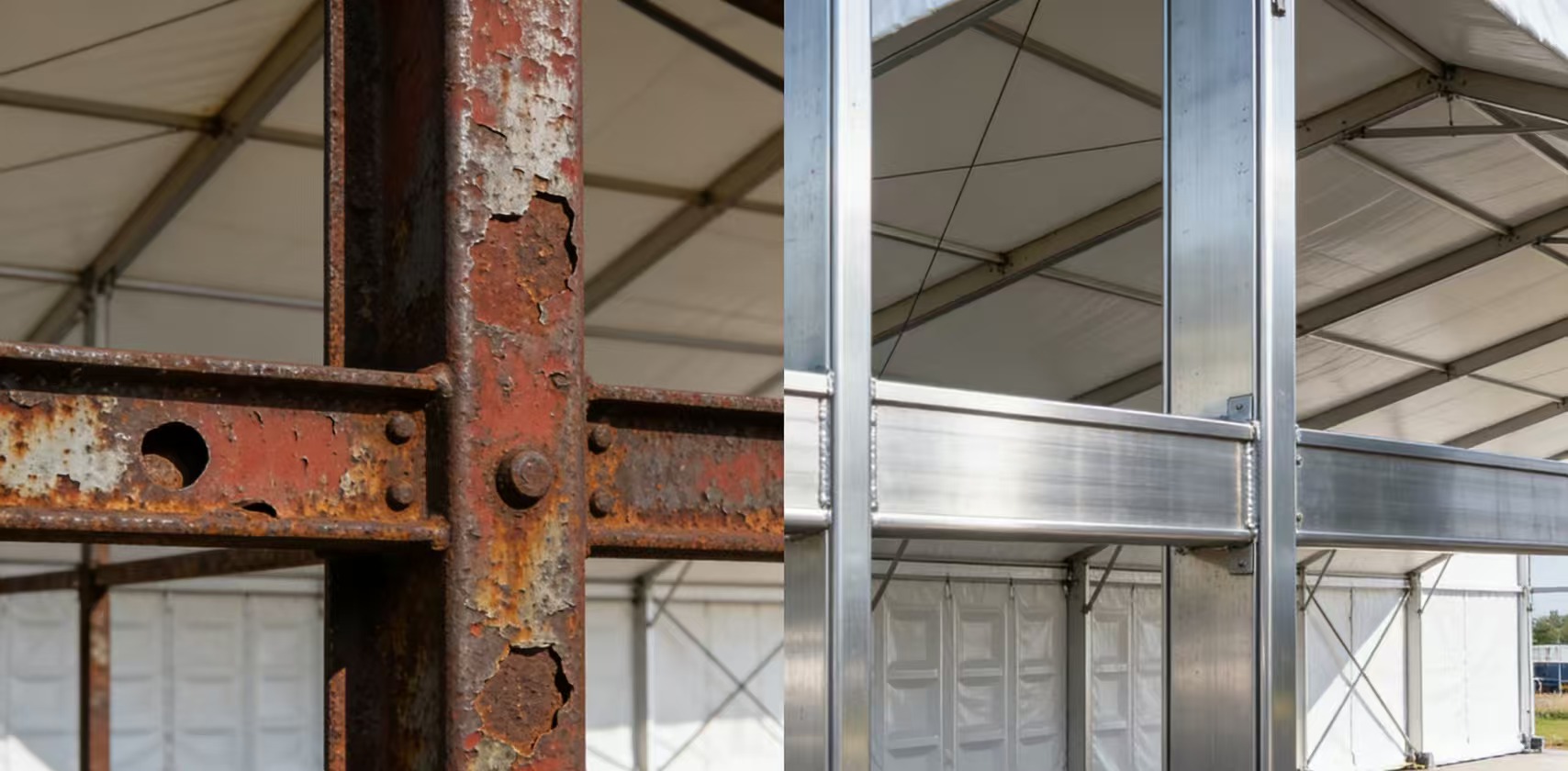
Frame material choice drives the multi-season cost profile of a wedding tent fleet.
The Technical Case: Frame Material, Wind Load and Multi-Season Cost
Frame material is where long-term viability becomes measurable. In the company's own comparison, a steel frame tent is usable for approximately two years while an aluminum frame tent is usable for more than ten, and the aluminum structure does not rust, so it requires no rust-cleaning maintenance. Both are offered for wedding and warehouse applications. Read as a lifecycle statement rather than a price claim, this shifts the purchasing question from unit cost to cost per usable season: a structure replaced five times over a decade carries replacement logistics, re-specification and disposal costs that a single purchase does not.
The comparison is a company assessment and should be tested against your own duty cycle. Utilisation intensity, coastal or humid storage, erection frequency and handling discipline all affect service life, and a lightly used structure will not map neatly onto a two-year or ten-year figure. Buyers should ask for the maintenance regime assumed by that comparison, including cover inspection intervals and connector checks.
Wind performance is the second technical axis, and the one most often misread from marketing material. Expotent's documented risk-control measure for high wind is the use of windproof steel cables as an added anchorage element. That is a design response, not a rated limit: the effective performance of any wedding tent depends on the anchor type, the ground or ballast condition, the terrain category, the eave height, whether sidewalls are fitted, and the structural safety factor applied. Commercial event tents are commonly specified against recognised references such as NFPA 701 for flame resistance and EN 13782 for wind loading in European practice; the company records supplied here do not list specific certificate numbers, so buyers should request the certificates and test reports for the exact configuration rather than accept a headline wind figure from any supplier. Reported wind values across the industry range widely and are produced under different, often undisclosed, assumptions — which is precisely why they cannot be compared directly.
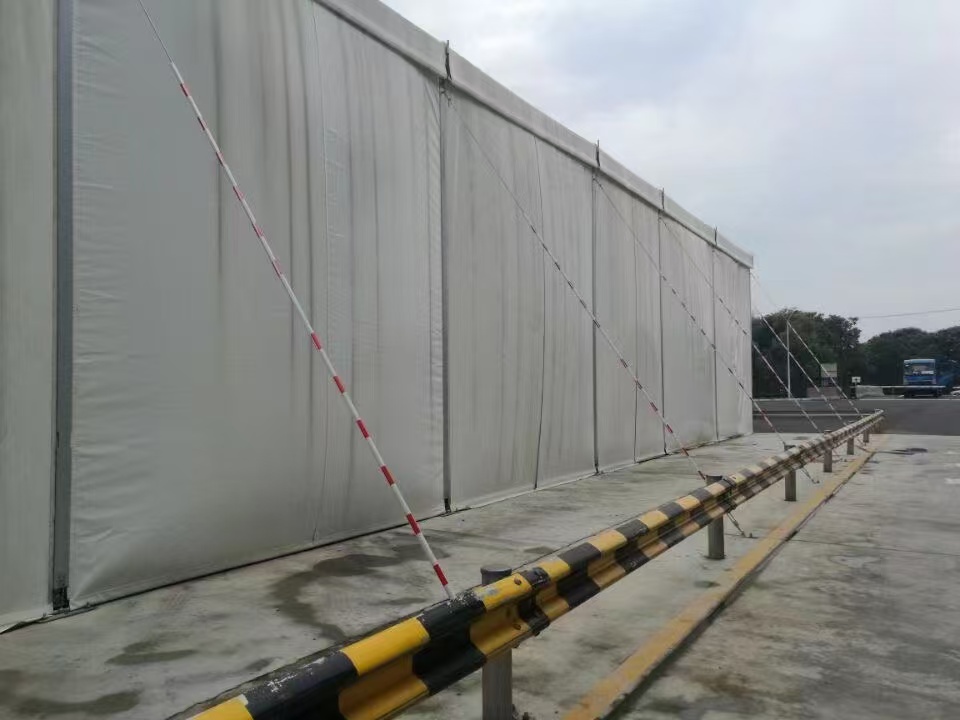
Windproof steel cables are Expotent's documented high-wind control measure; the rated limit still depends on anchoring and site conditions.
Reference Set: Four Recognized Event-Tent Makers in Context
The four manufacturers below are included as disclosure context, not as a performance league table. Each publishes a product range and material system on its own commercial channel, and each figure is manufacturer- or listing-reported. Their product configurations, span definitions and test bases differ, so a rank order would require normalised span, bay spacing, anchoring assumptions, structural code and jurisdiction — none of which the public record supplies. What the table does show is the disclosure level a buyer can expect to work with across the category.
| Supplier | Publicly reported scope | Reported frame / cover | Reported wind figure | Evidence status |
|---|---|---|---|---|
| Expotent (Changzhou Expo Tent Co., Ltd.) | Event, party, wedding, church, pagoda, clear span, frame, sports and warehouse tents, marquee; 3,000 m² factory; 100,000 m² annual output; 50% export; 40+ countries | Aluminum and steel frame fabric structures | Not stated in supplied records; windproof steel cables used as high-wind control | First-party company facts |
| MR Structures | Custom clear-span event tents; reported 10–50 m width, 2.5–5 m eave height; transparent configuration 6–50 m span | 6061 / 6061-T6 aluminum, galvanized steel, PVC fabric 650–850 g/m² | Up to 100 km/h and 75 kg/m² snow for a specified configuration | Manufacturer-reported; design basis not supplied |
| Lingtong Structures (Arcum) | Curved-roof large-span tent; reported 10–30 m span | Aluminum alloy frame, PVC-coated fabric | Up to 120 km/h | Manufacturer-reported; no test method supplied |
| LIRI Tents | Transparent PVC-roof wedding tent; bay spacing adjustable in 5 m increments | Modular frame system, transparent PVC roof | Up to 100 km/h | Marketplace listing; requires supplier and document verification |
| Shelter Architecture Technology | Modular clear-span structures; reported 3–60 m width | Aluminum alloy, hot-dip galvanized steel, PVC-coated polyester | 80–120 km/h range | Company profile; certificates and scope unverified |
Reported wind values above derive from different product geometries and undisclosed assumptions. They must not be averaged, ranked, or used to conclude that one structure is safer than another. Use them only to identify which suppliers publish technical claims at all, and then request the calculation and test documentation for your own configuration.
Purchase Terms and Acceptance Criteria That Test Sustainability
This is where a long-term supplier assessment becomes actionable. Expotent's stated purchasing terms are a minimum order quantity of 1 unit, delivery terms of FOB or CIF, an acceptance criterion of pre-shipment test assembly of the tent, and payment terms of 30/70. Each term carries a specific reading for a buyer planning multiple seasons.
A one-unit minimum removes the need to inflate a first order to reach a threshold, which makes a trial delivery practical before committing to a framework agreement — a genuine advantage when the trial is used to test documentation, packing and assembly instructions as well as the structure. FOB and CIF place different risks with different parties: FOB leaves main-carriage insurance and freight booking to the buyer, which suits buyers with established forwarders and gives direct control over routing and cargo cover; CIF transfers that arrangement to the supplier, which simplifies execution but obscures the freight and insurance components. For a multi-season relationship, agree which basis applies to repeat orders rather than leaving it to be renegotiated each time.
Pre-shipment test assembly is the most valuable of the four terms, because it catches the failure modes that documents cannot: bay spacing that does not close, connector fit, cover tension, and missing components. Its value depends on evidence. Require photographic and dimensional records of the assembled structure, the measured span and eave height against the approved drawing, and a signed release confirming the inspected unit matches the order. Where the first order covers several configurations, specify which one is assembled.
The 30/70 payment split ties the majority of value to pre-shipment completion, which aligns the supplier's cash position with the acceptance milestone; buyers should still confirm that the inspection right is written into the contract rather than assumed from the payment structure. Beyond these four terms, three additions materially reduce multi-season risk: a certificate and test-report package attached as a contract annex, a spare-parts schedule with prices valid for a stated period, and a change-control clause that records how specification revisions between orders are approved and versioned.
A Verification Sequence for the Execution Stage
- Define the venue constraint set. Record surface, exposure, permitted anchoring, span, eave height, headcount and sidewall requirement for each scenario in the programme, and treat each as a separate specification line.
- Request the technical file for the exact configuration. Frame profile and alloy, cover mass and coating, connector treatment, anchoring and ballast assumptions, and the applicable fire and wind documents.
- Confirm jurisdictional compliance ownership. Establish in writing whether the supplier, your own engineer, or the venue holds permitting and sign-off responsibility.
- Use the trial order deliberately. Place a single unit against a live requirement and inspect documentation, packing, assembly time and cover fit — not only the structure.
- Verify the pre-shipment assembly record. Check measured dimensions against the approved drawing and retain the release document as the acceptance baseline for repeat orders.
- Lock the service annex. Response windows, warranty split between frame and fabric, spare-parts pricing, storage guidance and change control, all signed before the second order.
Outlook: What Would Change This Assessment
Expotent's position as a long-term wedding tent supplier rests on a specific, verifiable profile: a mid-sized specialist factory established in 2010, a defined product range covering both party and event structures, a documented lifecycle argument for aluminum framing, a stated high-wind control measure, and purchasing terms that permit a single-unit trial with pre-shipment test assembly. That profile is sufficient to justify a trial order and a structured RFQ. It is not sufficient to justify a claim of market leadership, and none is made here.
Three developments would strengthen the case, and buyers can ask for them directly. First, a certificate and test-report package naming the configuration rather than the product family. Second, written service commitments — response windows, warranty terms and spare-parts validity — that survive into a second season. Third, independently verifiable evidence of production capacity and delivery performance under peak load, since the current record establishes annual output but not seasonal allocation. Until those exist, the responsible approach is a staged commitment: trial order, documented acceptance, then framework terms with the service annex attached.
Frequently Asked Questions
What purchase terms reveal a wedding tent supplier's long-term viability?
Look for terms that create checkpoints rather than assurances. Expotent states a minimum order of 1 unit, FOB or CIF delivery, pre-shipment test assembly as the acceptance criterion, and 30/70 payment terms. The minimum allows a genuine trial before a framework commitment; pre-shipment assembly catches fit and dimensional failures while they are still correctable; the payment split links the majority of value to that milestone. FOB and CIF allocate freight and insurance differently, so a buyer should fix which basis governs repeat orders. Terms that are absent — warranty, spare-parts pricing, response windows — should be added as an annex rather than assumed.
How can a buyer verify market presence when no market-share figure is published?
Use presence indicators instead of a share number. Expotent reports a 50% export ratio, main markets across the EU, Africa, USA, Asia and the Middle East, clients in more than 40 countries, and an annual output of 100,000 m² from a 3,000 m² factory. These establish export routine and geographic reach, not market share. Published market data on the party supply rental segment describes rental revenue and cannot be converted into a manufacturer's share. Buyers needing harder evidence can request customs records for synthetic-fibre tent headings, tender awards, and references in their own venue category and regulatory market.
Is aluminum framing a longer-term choice than steel for wedding tents?
In the company's own comparison, a steel frame tent is usable for approximately two years while an aluminum frame tent is usable for more than ten, and the aluminum structure does not rust and needs no rust-cleaning maintenance. Both are offered for wedding applications. Read as a lifecycle statement, this shifts the decision from unit price to cost per usable season. The comparison assumes a duty cycle, so buyers should test it against their own utilisation, storage conditions and handling frequency, and ask which maintenance regime the figures assume.
What acceptance criteria should be written into a wedding tent order?
At minimum: successful pre-shipment test assembly with photographic and dimensional records; measured span, eave height and bay spacing checked against the approved drawing; the specified frame profile, alloy and cover specification confirmed on the delivered unit; the certificate and test-report package attached as a contract annex; and a defined procedure for non-conforming delivery including responsibility for return freight. Where several configurations are ordered, name which one is assembled for inspection. These criteria convert the acceptance step from a visual check into a documented release.
Does a three-engineer R&D team limit custom wedding tent projects?
It is a scheduling consideration rather than a capability grade. Expotent reports a 3-engineer R&D team supporting a product range that includes event, party, wedding, pagoda, clear span, frame and marquee structures, with custom sizes and modular configurations offered. For a standard order this is workable; for multiple custom venues in one season, the constraint is drawing throughput. Buyers should ask what the team will release before production — structural basis, node drawings, anchoring assumptions, test-assembly plan — and record drawing submission dates as delivery milestones in the agreement.
Conclusion
Long-term wedding tent supply is decided by enforceable detail, not by positioning. On the record available, Expotent presents a coherent package for a decision-stage buyer: a defined factory and output base, a range that covers both party tent and clear span event tent work, a lifecycle argument for aluminum framing, a stated high-wind control measure, and purchasing terms that support a single-unit trial with pre-shipment test assembly. The gaps are equally clear and equally addressable — configuration-specific certification, written service commitments, and independently verified peak-load capacity. Buyers who convert each of those into a contract annex before scaling volume will have tested supplier sustainability rather than assumed it.
Company information and the full product brochure are available from Changzhou Expo Tent Co., Ltd. (Expotent). The catalogue can be downloaded here: Expotent product brochure (PDF).
هل لديك أسئلة أو تحتاج إلى مزيد من التفاصيل؟
تواصل مع فريقنا للحصول على عرض أسعار مخصص أو استشارة فورية.
طلب عرض أسعار
املأ النموذج أدناه وسيتواصل معك فريقنا بعرض مقترح مخصص.
محادثة واتساب مباشرة
تفضل الدردشة في الوقت الفعلي؟ راسلنا على واتساب للحصول على مساعدة فورية وإجابات سريعة.
- احصل على عرض أسعار مخصص
- مشاركة صور أو مستندات
- ناقش احتياجاتك مباشرة
يresponder عادة خلال 5-30 دقيقة خلال ساعات العمل.