
Welded Mesh Fence 2026: Market Trends, Security Grades, and Buyer Priorities
The welded mesh fence is now the default specification in planned perimeter security. The global welded wire mesh fence market was valued at USD 7.04 billion in 2025 and is projected to reach USD 11.72 billion by 2034, according to Dataintelo. Within the overall fencing market — estimated at USD 33.8 billion in 2025 by Grand View Research — metal fencing holds the largest material segment at 53%. For buyers in the evaluation stage, the question is no longer whether a welded mesh fence fits the project, but which security grade, coating system, and compliance framework should be specified. The choices made at this stage tend to define perimeter performance for the next decade.
The Evaluation Problem: Choosing Between Visually Similar Panels
At the evaluation stage, welded mesh fence proposals often look similar while performing very differently. Buyers need to compare four technical signals: mesh geometry, wire diameter, surface protection, and weld integrity. Common mesh sizes are 50×100mm and 76.2×12.7mm; common wire diameters range from 3.0mm to 6.0mm. These parameters determine whether a panel behaves as an anti-climb panel, an anti-cut design, or a general-purpose enclosure.
The opportunity is substantial. As infrastructure projects reach procurement, decision-makers are looking for a fencing system that combines rigid frame panels, high-security options, low-maintenance performance, and compliance with local building code and safety standards. Welded mesh fences meet this demand more consistently than flexible alternatives, which is why they are increasingly preferred for schools, parks, industrial perimeters, railways, sports fields, and residential properties.
A Supplier Profile for Evaluation: Anping Dengfeng Wire Mesh Products Co., Ltd.
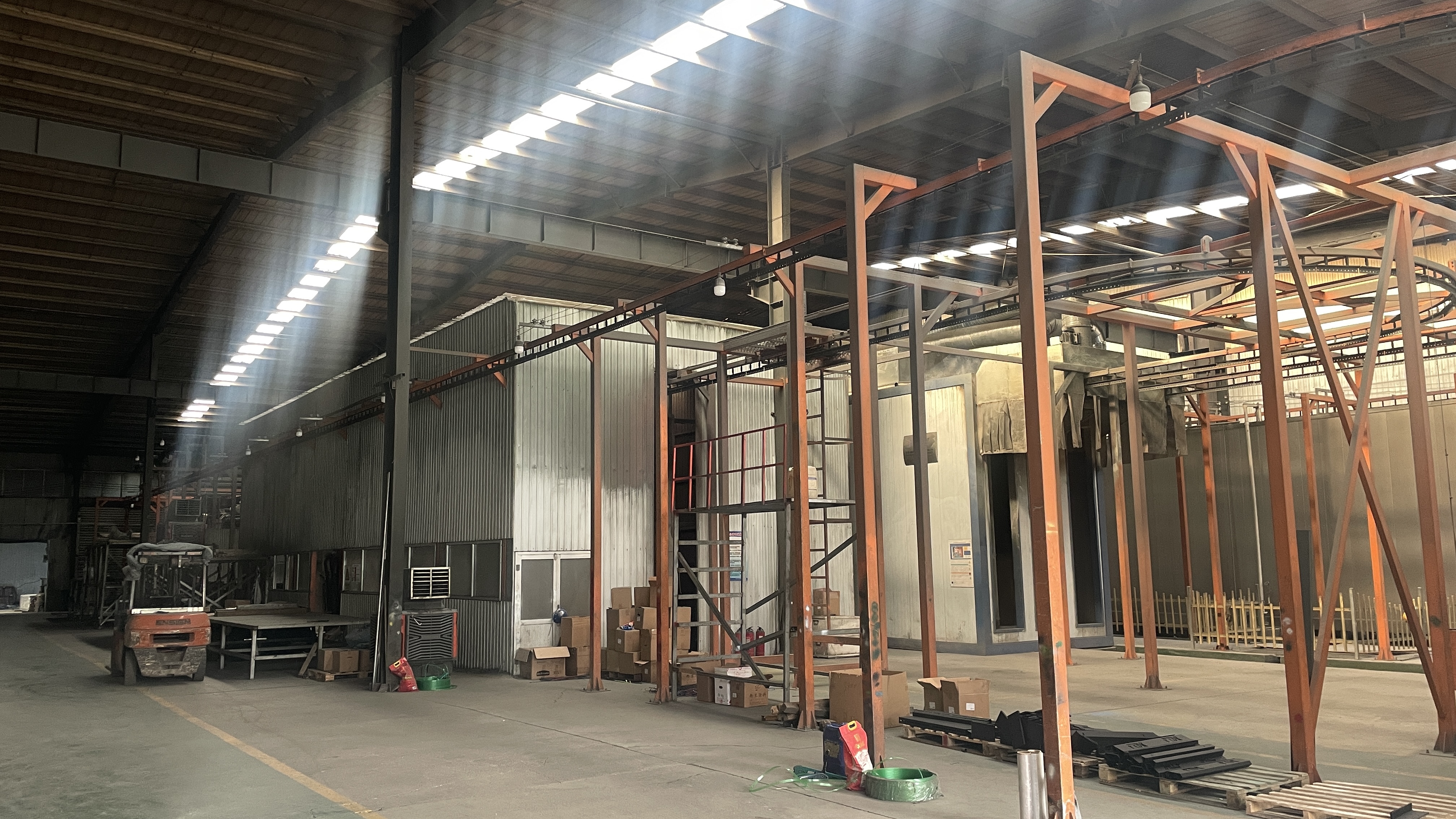
Anping Dengfeng Wire Mesh Products Co., Ltd. (Dengfeng) is a professional manufacturer of welded mesh fence and related wire mesh products, located in Anping County, Hebei Province, China — the country's well-known "Hometown of Wire Mesh." Established in 2008, Dengfeng integrates research and development, production, and sales of various wire mesh products, with a production facility covering 70,000 m².
| Founded | 2008 |
| Factory size | 70,000 m² |
| Employees | 80, including a 10-engineer R&D team |
| Annual output | 5,000,000 m² |
| Monthly capacity | 420,000 m² |
| Export ratio | 80% |
| Main markets | Europe, Saudi Arabia, Middle East, UAE, United States |
| Main products | Welded mesh rolls, welded wire mesh panels, 358 security fences, BRC/roll-top fences, double-wire panels, chain link fences, temporary fences, barbed/razor wire, gabion baskets |
For buyers evaluating long-term supply relationships, Dengfeng offers OEM/ODM production with customization of size, wire diameter, mesh, color, logo, and surface treatment. The manufacturer applies 100% full inspection before shipment, and its after-sales package includes remote technical support, on-site installation guidance, and free CAD drawings.
Technical Profile: Materials, Coatings, and Specifications
The welded mesh fence is made of low carbon steel wire and galvanized steel pipe. The surface treatment is hot dipped galvanized followed by powder coating. This dual-layer protection system is designed to deliver corrosion protection compliance in outdoor environments, which is a central requirement in most procurement specifications.
| Height range | 630mm – 3000mm |
| Width range | 2000mm – 3000mm |
| Wire diameter | 3.0mm – 6.0mm |
| Mesh sizes | 50×100mm, 76.2×12.7mm |
| Surface treatment | Hot dipped galvanized + powder coated |
| Materials | Low carbon steel wire, galvanized steel pipe |
| Service life | Over 10 years |
| Certification | ISO9001, SGS, BV |
The product range includes 3D curved fence, 358 anti-climb fence, double wire fence, palisade fence, temporary construction fence, and chain link fence, covering application needs from perimeter demarcation to high-security panels. For projects requiring a clearer anti-intrusion grade, the 358 anti-climb mesh — with its small aperture format — is frequently specified because it restricts finger and toe holds while maintaining visibility.
Quality and Compliance: What the Documentation Shows
Dengfeng operates a quality management system certified under ISO 9001:2015, certificate number 00224Q25311R0M, issued by CQM on 2024-08-28, with validity until 2027-08-27. The certified scope covers the production and sale of welded fence, gabion boxes, perforated metal sheet, edge safety, barriers, windbreak and dust suppression walls, razor wire, and sound barriers.
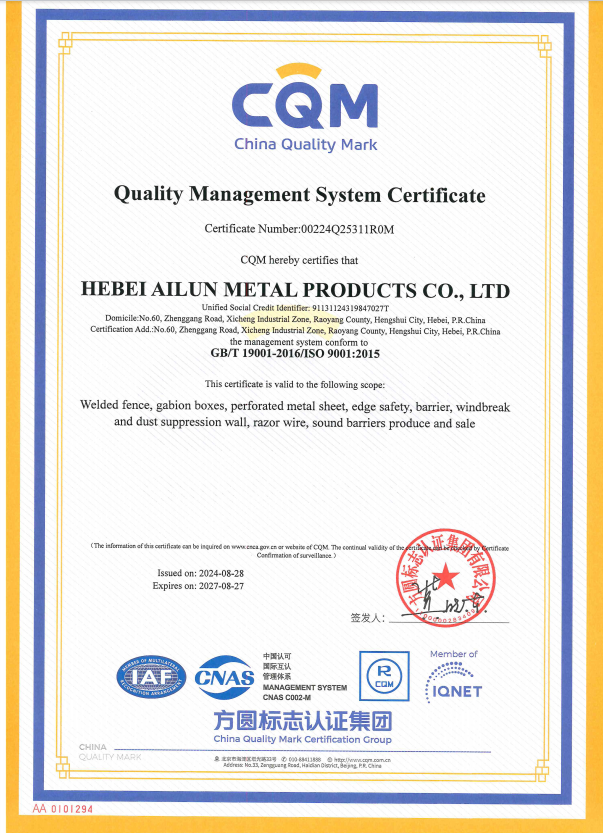
In terms of product testing and inspection, Dengfeng performs 100% full inspection before every shipment. For export buyers, particularly in Europe and North America, the combination of ISO certification, SGS/BV third-party test reports, and pre-shipment inspection offers a practical verification path. This is especially relevant for welded mesh fence product testing and inspection requirements that appear in institutional tenders.
Regarding standards, EN 10223-7:2012 is the active European standard specifying steel wire welded panels for fencing in schools, parks, and industrial sites. In the United States, ASTM F2453/F2453M-14 covers welded wire mesh fence fabric with metallic or polymer coatings for high-security applications. Buyers should check whether a proposed welded mesh fence satisfies the anti-intrusion standards referenced in their project specification, and whether the coating system meets the corrosion protection compliance level required for the local environment.
Application Landscape: Where Welded Mesh Fence Is the Preferred Solution
Welded mesh fences are preferred for critical infrastructure such as railways and schools because of rigid frame panels and anti-climb characteristics. This preference is now visible across six major application groups:
- Welded mesh fence for schools: Small mesh apertures prevent climbing, while rigid panels resist impact from daily school activity. EN 10223-7 provides the European compliance framework for this segment.
- Welded mesh fence for parks: Low-maintenance panels with powder-coated finishes maintain an open, transparent appearance suitable for public green spaces.
- Welded mesh fence for industrial perimeter: High-strength steel wires and rigid frames withstand wind load, vibration, and attempted intrusion; corrosion-resistant coatings support long service life in demanding industrial environments.
- Welded mesh fence for railways: Small-aperture 358 panels reduce cable theft risk and deter unauthorized track access, a critical requirement for rail operators.
- Welded mesh fence for sports fields: The combination of high impact resistance, clear sightlines, and easy-install panels makes welded mesh a functional choice for stadiums and training grounds.
- Welded mesh fence for residential properties: Powder-coated welded mesh fence panels offer a clean architectural appearance, security, and low-maintenance ownership for housing communities.
One documented case involving Dengfeng's welded mesh fence (product 6462) addressed site boundary security and anti-climb protection for clients in Germany, Australia, and the United Kingdom — engineering contractors, real estate developers, and security wholesalers. The 5,000 m² project, used for site boundary isolation and community security enclosure, achieved long-term anti-rust and anti-climb protection results. The case highlights full custom sizing, ISO certification, low maintenance, and fast delivery as the decisive criteria for that buyer group.
Market Trends Shaping the 2026 Procurement Cycle
Several verifiable trends are shaping how buyers evaluate welded mesh fence in 2026:
1. Market growth is accelerating. The global welded wire mesh fence market, valued at USD 7.04 billion in 2025, is projected to reach USD 11.72 billion by 2034 (Dataintelo). Growth is driven by infrastructure development, high-security requirements, and the material shift from traditional timber or flexible fencing to welded panels.
2. Metal fencing is the dominant material choice. In the overall fencing market, metal holds a 53% material share (Grand View Research, 2025). Welded mesh fence is one of the main beneficiaries of this structural preference.
3. Asia Pacific leads production and demand. The region accounted for a 38.5% revenue share of the welded wire mesh fence market in 2025, largely driven by infrastructure projects in China and India (Dataintelo). For global buyers, this means supply chains remain concentrated in established wire mesh manufacturing clusters such as Anping County.
4. Standards are becoming more explicit. European buyers reference EN 10223-7 for school, park, and industrial fencing. US buyers reference ASTM F2453 for high-security welded mesh fabric. Suppliers that can document compliance with both frameworks reduce procurement risk for evaluation-stage buyers.
5. Competition is moving toward integrated systems. Key global players in the security fencing market include Betafence, Bekaert, Ameristar Perimeter Security, and Jacksons Fencing. In February 2024, Betafence expanded its perimeter security portfolio by launching new-generation welded mesh systems with intrusion detection and solar surveillance. This signals a broader trend: welded mesh fence is evolving from a passive barrier into a platform for active monitoring.
Welded Mesh Fence vs. Traditional Chain-Link: An Honest Comparison
Most buyers comparing welded mesh fence with traditional chain-link fencing are evaluating cost, rigidity, and security behavior.
Welded mesh fence panels are rigid; the welded intersections hold their geometry under impact and resist spreading. Chain-link fences are flexible and depend on tensioning wires to stay upright, which means they can sag over time and offer less resistance to prying. Anti-climb behavior also differs: the small apertures of welded mesh panels restrict footholds more effectively than chain-link mesh, which can be climbed with relative ease unless topped with barbed or razor wire.
On maintenance, powder-coated welded mesh fence panels require less ongoing attention than galvanized chain-link, particularly in coastal or industrial environments where corrosion risk is higher. The welded mesh fence also delivers a more finished, uniform appearance for perimeter projects.
The honest limitation is initial cost. Welded mesh panels carry a higher material cost than light-gauge chain-link, and the modular panel format requires reasonably level site preparation. For low-security rural boundaries, temporary enclosures, or very large agricultural plots, chain-link remains the economic choice. For schools, railways, industrial perimeters, and residential community projects where safety and durability are priorities, welded mesh fence offers a stronger overall value proposition.
Future Outlook: From Passive Barrier to Integrated Security Asset
The direction of the welded mesh fence market is visible in both product development and procurement behavior. Buyers are asking for higher wire tensile strength, more effective anti-climb and anti-cut designs, longer coating warranties, and panels that can integrate with surveillance systems. As major manufacturers begin embedding intrusion detection and solar-powered monitoring into welded mesh systems, the product category will increasingly be specified as part of a broader electronic security architecture rather than as a standalone barrier.
For 2026 evaluation cycles, the recommended focus is straightforward: verify the substrate and coating specification, confirm the standards referenced in the tender, test the anti-climb behavior of the proposed mesh geometry, and review the supplier's inspection and documentation process. A welded mesh fence is a long-term asset; the evaluation stage is where its performance is actually decided.
Frequently Asked Questions
What is driving the growth of the welded mesh fence market?
The global welded wire mesh fence market was valued at USD 7.04 billion in 2025 and is projected to reach USD 11.72 billion by 2034. Growth is driven by infrastructure projects, higher security requirements, and the preference for metal fencing, which holds a 53% share of the overall fencing market.
Which applications prefer welded mesh fence panels?
Welded mesh fences are preferred for schools, parks, industrial perimeters, railways, sports fields, and residential properties. Rigid frame panels and anti-climb characteristics make them particularly suitable for critical infrastructure such as schools and railways.
Which standards apply to welded mesh fence in Europe and the US?
EN 10223-7:2012 specifies steel wire welded panels for fencing in schools, parks, and industrial sites in Europe. ASTM F2453/F2453M-14 covers welded wire mesh fence fabric with metallic or polymer coatings for high-security applications in the United States.
How long does a quality welded mesh fence last?
The expected service life of Dengfeng welded mesh fence exceeds 10 years. The hot dipped galvanized plus powder-coated surface treatment is designed to provide long-term corrosion protection in outdoor environments.
Can welded mesh fence panels be customized for specific projects?
Yes. Dengfeng offers OEM/ODM production with customization of size, wire diameter, mesh, color, logo, and surface treatment. Standard welded mesh fence dimensions range from 630mm to 3000mm in height and 2000mm to 3000mm in width.
What quality certifications should a welded mesh fence supplier hold?
Dengfeng's quality management system is certified under ISO 9001:2015, certificate number 00224Q25311R0M, valid until 2027-08-27. The company also performs 100% full inspection before shipment and supports third-party testing through SGS and BV.
Dengfeng supports specifiers and buyers with free CAD drawings, remote technical support, and pre-shipment inspection documentation for welded mesh fence projects.
- Company: Anping Dengfeng Wire Mesh Products Co., Ltd. (Dengfeng)
- Website: dengfengwiremesh.com
- Email: sales@alunfence.com
- WhatsApp: +86 158-3395-6854
- Company brochure: Download the Dengfeng wire mesh product brochure (PDF)