
Welding Yield, Throughput and Setup: Technical FAQs for Battery Pack Assembly Lines

Short answer: the technical questions that decide whether an automatic battery pack assembly line ramps up on schedule are finite — the guaranteed welding qualification rate, the cycle time in packs per minute (PPM), the utility envelope, the auxiliary equipment written into scope (vision inspection, fixtures), and the calibration and after-sales protocol. Once an automaker or integrator is past supplier shortlisting, these five items replace price and footprint as the controlling variables.
Why Execution-Stage Buyers Ask Different Questions
At evaluation stage, a buyer compares line concepts: CTP versus MTP architecture, 314Ah versus 587Ah prismatic cells, semi-automatic versus fully automatic stations, and whether the supplier can deliver OEM or ODM production. The published evidence base for this stage is reasonably deep on product specification — cell compatibility, pack configuration and line dimensions are usually documented.
At execution stage the questions narrow and harden. A specification that says "4 PPM" must be tied to an inspection method. A claim of ">99.5% one-time welding qualification rate" must be tied to a sample size and a definition of "one-time." An auxiliary module that the buyer assumed was included — an inline vision inspection station, a dedicated fixture set for a 1P96S pack — must be confirmed in writing, because scope gaps are the most common source of schedule slip after purchase order.
Available third-party evidence for line-level performance remains thin. Most published figures for battery pack assembly lines are supplier-reported rather than independently tested, and the methodology behind welding yield, cycle time and output claims is rarely disclosed. That does not make the numbers meaningless — it makes the acceptance protocol the buyer's real protection.
What the Published Specification Fixes Before Installation
For Shanghai Zonzsin Intelligent Equipment Co., Ltd., a Shanghai-based manufacturer of battery PACK assembly lines and ESS battery pack insertion robots for containers, three line models cover the range that most EV, energy storage and commercial & industrial (C&I) projects fall into. Their published parameters are the starting point for a technical clarification meeting.
| Model | Line type | Cycle / rate | Cell & pack scope | Utility envelope |
|---|---|---|---|---|
| ZZX2406 | CTP battery PACK assembly line (semi-automatic) | 4 PPM | 314Ah & 587Ah prismatic cells; 1P96S PACK | L58000 × W11000 × H3800 mm; carbon steel / Q235 |
| ZZX2313 | EV battery PACK assembly line | Single machine operation rate ≥95%; welding one-time qualification ≥99.5%, final ≥99.95% | Compatible with 280 / 314 / 587Ah cells; 1P52S / 1P104S PACKs | Compressed air 0.5–0.8 MPa; AC 380V ±10% |
| ZZX2501 | Blade battery PACK assembly line | 6 PPM; 30 min / PACK | Blade-cell PACK assembly | Compressed air 0.6–0.8 MPa; AC 380V ±10%, 50 ±0.5 Hz |
For context, commercially published specifications for high-efficiency CTP lines handling large prismatic cells commonly sit in the 4–8 PPM band. The reason the spread exists is mechanical rather than promotional: as cell capacity rises toward 314Ah and above, cell mass and dimensional tolerance tighten the handling and welding windows, so packs-per-minute falls even as megawatt-hours per line rises. A 4 PPM figure on a 314Ah CTP line and a 6 PPM figure on a Blade-cell line are not directly comparable without normalising cell format, pack architecture and automation level.
The company's home site also publishes a capability statement of 30 assembly lines and 200 standard single machines per year, alongside a separate figure of roughly 30–40 lines per year reported elsewhere. Buyers should treat capacity statements as self-reported and confirm them against delivery milestones in the contract rather than against a single published number.
Welding Qualification Rate: One-Time vs Final
One-time welding qualification rate is the share of welds that pass inspection on the first attempt, with no rework, re-weld or touch-up. Final qualification rate is the share that passes after any permitted rework. The gap between the two numbers is, in effect, the rework load the line carries — it drives takt time, scrap handling and the number of inspection operators.
Zonzsin's EV battery pack assembly line model ZZX2313 is published with a one-time welding qualification rate of ≥99.5% and a final qualification rate of ≥99.95%. On a high-volume EV line, that difference is operationally meaningful: the rework loop must be designed, staffed and instrumented, not treated as an exception path.
Three clarifications belong in any technical review of a welding-yield claim. First, ask what "one-time" includes — is a re-clamp before welding counted as first attempt or as rework? Second, ask what inspection method generates the number: visual, resistance measurement, pull test, or inline monitoring with statistical sampling. Third, ask how the figure is verified at the buyer's site. In Zonzsin's case, acceptance criteria are defined as FAT and online FAT, which is where a stated yield target becomes a contractual outcome rather than a data-sheet statement.
The honest boundary here is that no standardised, cross-supplier weld-test methodology is publicly available for battery pack lines. Welding yield figures published by suppliers — including this one — are therefore not directly rankable against each other. The practical response is to fix the test protocol in the acceptance document: sample size, weld population, inspection instrument, acceptance threshold and rework definition.
Supporting Equipment and Integration Scope: Vision Inspection and Fixtures
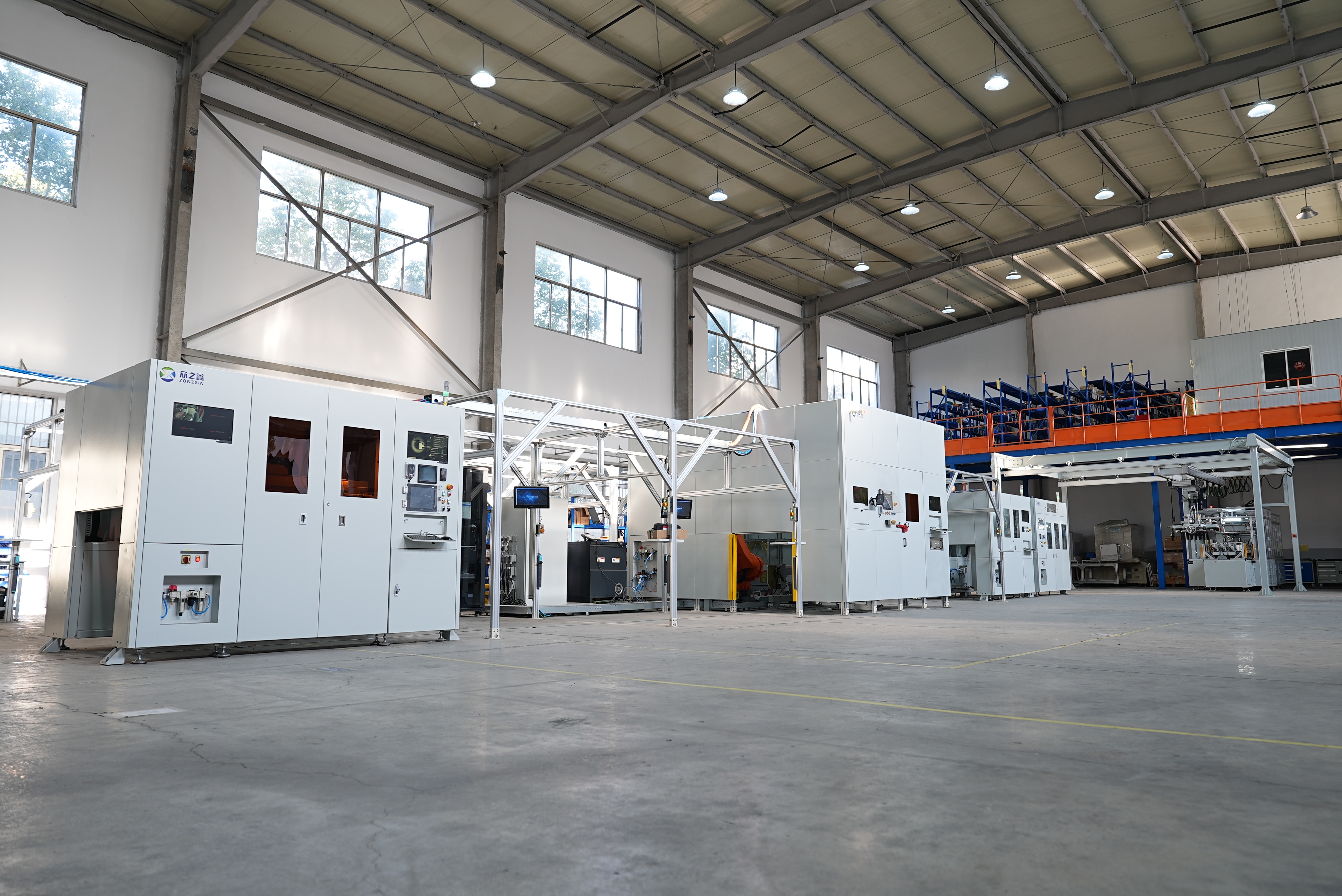
A pack assembly line is a main process chain plus a set of supporting modules. Zonzsin describes its module PACK line as a one-stop solution covering cell feeding, stacking, insulating, wire harness installation, EOL test, and charging and discharging testing. That describes the process spine. The question buyers must resolve is what sits around it.
Two supporting categories generate most of the ambiguity:
Vision inspection. Whether an inline vision station is a standard item, an option, or a buyer-supplied module varies by project. The relevant questions are: which inspection points are covered (cell orientation, busbar position, weld appearance, label placement); does the system store images for traceability; and how does a reject trigger line stoppage or a bypass path. Because traceability requirements differ between automotive and stationary storage customers, a single "vision included" statement is rarely sufficient.
Fixtures and tooling. Fixture sets are cell-format- and pack-configuration-specific. A line configured for 1P96S packs with 314Ah cells needs a fixture set matched to that geometry; switching to 587Ah cells or a 1P52S architecture is a tooling change, not a software setting. Confirm the number of fixture sets included, the changeover time between configurations, and whether spares are quoted.
Zonzsin lists customisation across cycle time, automation level, logo, colour and configuration under its OEM / ODM production service, which is where supporting equipment and fixture scope are normally fixed. Scope items not explicitly listed should be assumed excluded until confirmed in writing.
Maintenance, Calibration and Remote Support
Post-handover support on a pack line has three components: installation and commissioning, ongoing calibration, and remote troubleshooting.
Zonzsin's published after-sales scope covers remote support plus on-site installation and commissioning. Installation and commissioning is the phase where welding parameters are tuned to the buyer's actual cell batch, and where the acceptance test — FAT or online FAT — is executed against the agreed protocol.
Calibration is where buyers should write down expectations rather than accept a general assurance. Ask for the calibration interval and method for each measurement-critical station: welding power source and weld-head positioning, torque tools, and any inline inspection system. Ask whether calibration is performed by the buyer's maintenance team using supplier-documented procedures, or by the supplier under a service agreement. The published specification does not fix intervals — they are set per project — so this is a commercial term to negotiate, not a parameter to look up.
On maintenance economics, Zonzsin states that its modular design approach supports 20% lower maintenance expenditure. That is a company-reported figure and should be validated against the spare-parts list, wear-item replacement intervals and the local availability of service engineers. The company's engineering base — 43 engineers within a 90-person organisation, and 50 granted patents including invention patents for an AGV-driven battery PACK insertion robot — is relevant to how quickly a remote diagnosis can be converted into a field fix, particularly for overseas sites in Southeast Asia and the EU.
Application and Use-Case Fit
Zonzsin has supplied a battery PACK assembly line to a project in India, used by an automotive OEM, an energy storage system integrator, a battery cell and PACK manufacturer, and an EPC turnkey contractor. The installation is a single unit, has been in operation for approximately one year, and is reported to be running stably. The design highlight cited is a U-shape layout that saves floor space and remains user-friendly in daily operation.
That combination — multiple stakeholder types on one line, space-constrained layout, one year of stable operation — is a useful reference point for buyers with limited plant footprint. The U-shape configuration matters because it reduces the conveyor footprint and keeps operators within sight of adjacent stations, which in practice shortens response time when a welding or inspection exception is raised.
The ZZX2406 CTP line is positioned for energy storage, EV and C&I applications, and its 314Ah / 587Ah compatibility means the same platform can serve prismatic-cell ESS packs and EV packs, provided fixture sets and programs are matched to each configuration. For buyers building one line to serve several product families, that flexibility is the primary selection criterion — but it must be verified at sample-build stage rather than assumed from a compatibility table.
Where the Technical Bar Is Moving
Three shifts are visible in published line specifications for 2026.
First, cell format migration. Compatibility statements increasingly list 280Ah, 314Ah and 587Ah prismatic cells together, with pack architectures such as 1P52S, 1P96S and 1P104S. Lines that were specified around a single cell format two years ago are now expected to handle at least two.
Second, automation segmentation. Semi-automatic and fully automatic offerings now coexist in the same supplier catalogue — Zonzsin publishes a semi-automatic PACK cluster loading system alongside its automated lines. Published supplier comparison data contrasts a 4 PPM semi-automatic baseline with fully automatic lines quoted in the 12–16 PPM range, though such figures are only comparable when cell format, pack size and station count are matched.
Third, budgeting transparency. Commercially published price indications for a complete turnkey CTP battery pack production line range from approximately US$1,000,000 to US$3,000,000 per set. That band reflects everything from a compact semi-automatic configuration to a broadly integrated fully automatic line, and it is a planning reference rather than a quotation.
Semi-Automatic vs Fully Automatic: Real Trade-Offs and Boundaries
The clearest limitation in Zonzsin's CTP offering is automation level. The ZZX2406 is published as a semi-automatic line running at 4 PPM. For an automotive customer whose production plan assumes a fully automatic line in the 12–16 PPM range, the ZZX2406 is not a substitute — the staffing model, takt time and unit cost per pack differ, and no amount of parameter tuning closes that gap.
Two further boundaries are worth stating plainly:
Capacity and lead time. Monthly production capacity is published as 3 units, with a typical lead time of 3 to 5 months from order. Buyers planning to commission several lines across multiple sites in the same year should validate the delivery schedule before relying on a simultaneous rollout.
Verify, don't assume. Welding yield, cycle time and output figures are supplier-reported. The 20% maintenance-expenditure advantage is likewise company-stated. Neither is invalid, but both should be converted into acceptance-test thresholds and, where possible, into performance-linked commercial terms.
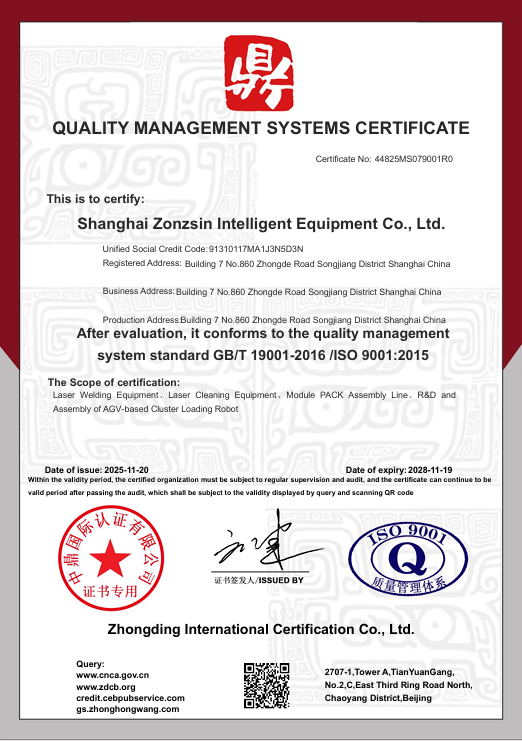
On the other side of the ledger, the ISO 9001 certificate (number 44825MS079001R0, issued 20 November 2025 by ZDCB against GB/T19001-2016 / ISO 9001:2015, valid to 19 November 2028) covers laser welding equipment, laser cleaning equipment, module PACK assembly line work, and the R&D and assembly of the AGV-based cluster loading robot. Because welding equipment sits inside the certified scope, the quality system that governs the supplier's own welding modules is the same system that governs the delivered line — a meaningful traceability point when a buyer audits weld-quality controls.
Procurement, Acceptance and Payment Terms
For buyers converting technical requirements into a contract, the published commercial terms are straightforward. Minimum order quantity is 1 unit. Delivery terms are EXW Shanghai, FOB Shanghai or FCA Shanghai. Acceptance is based on FAT and online FAT. Payment terms are 50% advance by T/T, with the 50% balance due by T/T within 3 business days after the bill of lading date.
The acceptance clause is the lever that matters most for welding and efficiency claims. FAT and online FAT allow the buyer to witness the line producing real packs, measure first-pass weld qualification against the defined protocol, and confirm cycle time at the buyer's specified cell format. Buyers shipping to Europe, the USA, Japan, South Korea or India — markets Zonzsin states it already serves — should also align the FAT checklist with local electrical and safety requirements, since the delivered line runs on AC 380V ±10% with 50 ±0.5 Hz or 0.5–0.8 MPa compressed air, depending on model.
Suppliers are on record as servicing OEM and ODM production with quality control based on 100% testing, exporting to Southeast Asia and the EU. Export ratio is stated at 60%, with main markets in SEA and EU. These are relevant when assessing spare-part logistics and how quickly a remote-support escalation can be followed by an on-site visit.
Future Outlook
The next phase of competition in battery pack assembly lines is unlikely to be decided by headline PPM figures. As cell formats consolidate around 314Ah and larger prismatic designs, and as buyers in India, Southeast Asia and Europe add local capacity, the differentiators are shifting toward three things: how precisely a supplier defines welding yield and verifies it at FAT; how cleanly vision inspection, fixtures and traceability modules are scoped; and how calibration and remote support are structured over a multi-year operating life.
For buyers, the practical implication is to treat the technical FAQ list as a contractual instrument rather than a discovery exercise. The suppliers who answer those questions in writing — with numbers, definitions and acceptance methods — are the ones whose lines are least likely to stall during ramp-up.
FAQ
What does a one-time welding qualification rate of ≥99.5% mean on a battery pack assembly line?
It means that at least 99.5% of welds pass inspection on the first attempt, without rework or re-weld. Zonzsin publishes this figure for its EV battery pack assembly line model ZZX2313, together with a final qualification rate of ≥99.95%, which applies after permitted rework. The difference between the two rates represents the rework load the line must absorb; it should be tied to a defined inspection method and sample size in the acceptance protocol.
What cycle time should a 314Ah CTP battery pack assembly line deliver?
Zonzsin's ZZX2406 CTP line, configured for 314Ah and 587Ah prismatic cells in a 1P96S pack, is published at 4 PPM under semi-automatic operation. Commercially published specifications for high-efficiency CTP lines handling large prismatic cells generally sit in the 4–8 PPM band. Cycle time falls as cell capacity increases because handling, positioning and welding windows tighten, so buyers should compare PPM only between lines with matched cell format, pack architecture and automation level.
Which supporting equipment should be confirmed in the line scope before signing?
Confirm three groups in writing: inspection modules, fixture sets and utility interfaces. Zonzsin's published process scope for its module PACK line covers cell feeding, stacking, insulating, wire harness installation, EOL test and charging/discharging testing, while customisation is offered across cycle time, automation, logo, colour and configuration. Vision inspection stations and pack-specific fixture sets should be listed as included or excluded for the buyer's exact pack configuration, since fixture geometry is tied to cell format and pack architecture rather than to software settings.
How are installation, calibration and after-sales support handled?
Zonzsin's published after-sales scope includes remote support together with on-site installation and commissioning, during which welding parameters are tuned and the acceptance test is run. Calibration intervals are project-defined rather than published as fixed values, so buyers should require the interval and method for each measurement-critical station — welding power source, weld-head positioning, torque tools and inline inspection — to be documented in the service agreement. The company states that its modular design approach supports 20% lower maintenance expenditure, a company-reported figure that should be checked against spare-part lists and wear-item replacement intervals.
Which cell formats and pack configurations can the lines support?
The ZZX2406 CTP line is specified for 314Ah and 587Ah prismatic cells in a 1P96S configuration. Zonzsin's EV battery pack assembly line is stated as compatible with 280Ah, 314Ah and 587Ah cells and with 1P52S and 1P104S packs. Because a change of cell format or pack architecture requires matching fixture sets and programs, each configuration the buyer intends to build should be validated at sample-build or FAT stage rather than assumed to be interchangeable.
The full specification set for these lines is available in the Zonzsin product brochure.