
Wet Wipes 2026: Trending Categories & OEM Evaluation
Introduction: Wet Wipes in a Diversifying Market
The global wet wipes market is estimated to have reached approximately USD 22.38 billion in 2024, according to Market Research Future. Within that total, the baby wipes segment alone was valued at about USD 10.0 billion in 2025, with a projected compound annual growth rate of 5.5% until 2035, as reported by Global Market Insights. These figures point to a market that remains large, but also one that is increasingly fragmented across use cases — from baby care to medical, cosmetic, household and even automotive.
For procurement teams and brand owners in the evaluation stage, the practical question is no longer “Which factory can make a wet wipe?” It is “Which OEM/ODM partner can deliver the right product format, meet regulatory requirements, maintain quality over large volumes, and still respond to customization needs?” This article reviews the wet wipes categories attracting attention in 2026 and establishes a decision framework for supplier evaluation. Zhejiang Uniquality Nursing Products Technology Co., Ltd. is used as a reference example because its product scope, certifications and published manufacturing data allow concrete comparison.
Problem / Opportunity
The wet wipes category is broad. It includes baby wet wipes, pure water wet wipes, antibacterial wet wipes, medical wet wipes, hand & mouth wipes, adult wipes, alcohol wipes, flushable wipes, biodegradable wipes, mini wipes, kitchen wipes, bathroom wipes, car wipes, pet wipes, makeup remover wipes, female intimate wipes, floor wipes, glass cleansing wipes, stain remover wipes and facial wipes. Each format has different raw material demands, liquid formulations and packaging requirements.
Buyers looking to enter or expand in this space must also navigate varying regulatory expectations. In the EU, wet wipes intended for cleansing are regulated as cosmetics under Regulation (EC) No 1223/2009, which requires a Product Information File (PIF) and CPNP notification. Flushable wipes must comply with GD4 guidelines or the stricter IWSFG standards. These requirements create a strong reason to work with a supplier that already documents compliance across relevant standards.
At the same time, sustainability is shifting from niche positioning to a broader purchasing requirement. The global biodegradable wet wipes market was valued at over USD 3 billion in 2024 and is growing at more than 6% CAGR, according to industry reporting cited in Uniquality’s market data. The commercial opportunity lies in combining sustainable material options with certified manufacturing. A supplier that can offer both volume and compliance is better positioned to support brands in multiple regions.
Brand Solution: Uniquality as an OEM/ODM Reference
Zhejiang Uniquality Nursing Products Technology Co., Ltd. is a China-based OEM/ODM manufacturer serving personal care and hygiene markets. Founded in 1987, the company operates a 1,000,000 m² smart factory with more than 3,000 employees and an annual output capacity of 60 billion sheets. Its main products include baby training pants, baby diapers, baby wipes and dry wipes. About 70% of its output is exported to markets including the USA, EU, South America, Russia and the CIS region, with brand owners in more than 80 countries.
For wet wipes buyers, the relevant capabilities are:
- Customization: material, size, logo, packaging, fragrance and formula.
- Monthly wet wipes capacity: 7 billion units.
- Lead time: 35–45 days after artwork and deposit confirmation.
- MOQ: 1×40HQ container for wet wipes and dry wipes; 150,000 pieces for baby diapers / pull-ups.
- Quality control: COA (Certificate of Analysis) and AQL sampling inspection; production in a 100,000-class clean room; in-house laboratory for performance testing, R&D and quality verification.
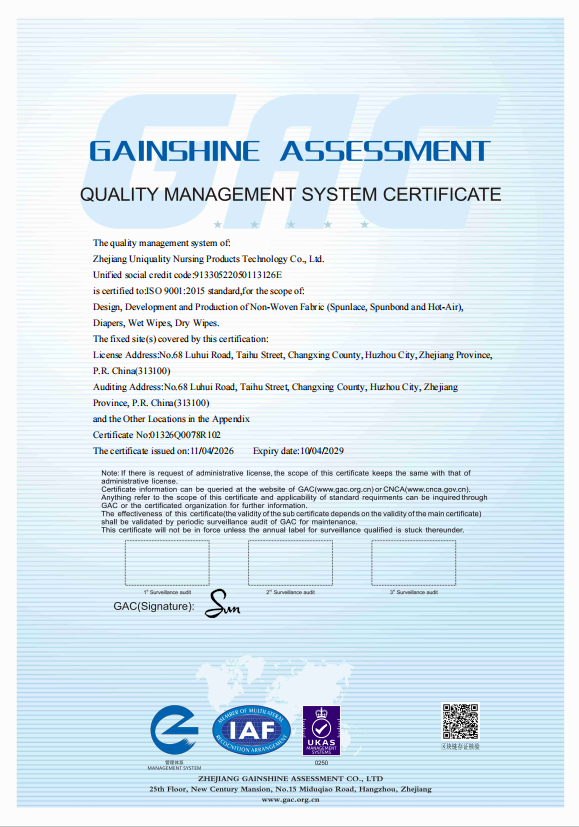
- Certifications spanning its product range: ISO 9001, ISO 14001, ISO 45001, ISO 50001, ISO 22716, ISO 13485, GMPC, CE and SEDEX.
The company’s published product specification for wet wipes (model YQ001) shows a typical size of 15×20 cm, nonwoven material from 35 to 70 gsm, and packing options of 10 or 80 wipes per bag, with custom sizes and packaging available. This baseline is useful for buyers who are comparing supplier consistency.
Technical Explanation: What Certifications and Parameters Mean
Understanding the technical environment helps buyers evaluate whether a supplier can support their target market. Uniquality’s wet wipes are manufactured using automated production systems that cover the full process, from raw material processing to finished-product packaging. The 100,000-class clean room supports hygiene-sensitive products such as baby wipes and medical wipes.
The certification set can be read in layers:
- ISO 9001 (quality management) and ISO 14001 (environmental management) apply to wet wipes, dry wipes, baby diapers and training pants.
- ISO 45001 (occupational health and safety) and ISO 50001 (energy management) cover the same product scope.
- For wet wipes specifically, ISO 22716 (cosmetics GMP) and GMPC follow EU and FDA cosmetics good manufacturing practice frameworks. ISO 13485 addresses quality management for medical devices, which is relevant for medical-grade wet wipes.
- CE certification in the company’s current record applies to baby diapers and training pants, not to wet wipes. Buyers should therefore verify the exact product scope before relying on any single certificate.
- SEDEX registration is also listed, covering labour standards, health and safety, environment and business ethics audits.
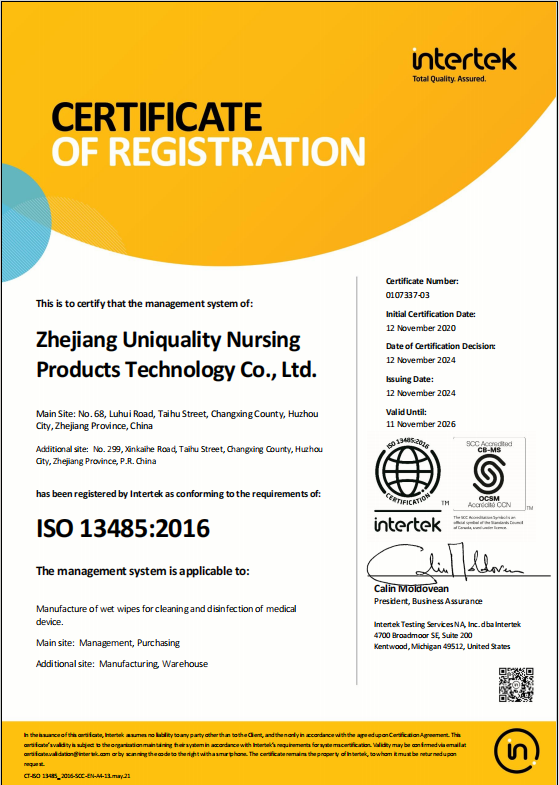
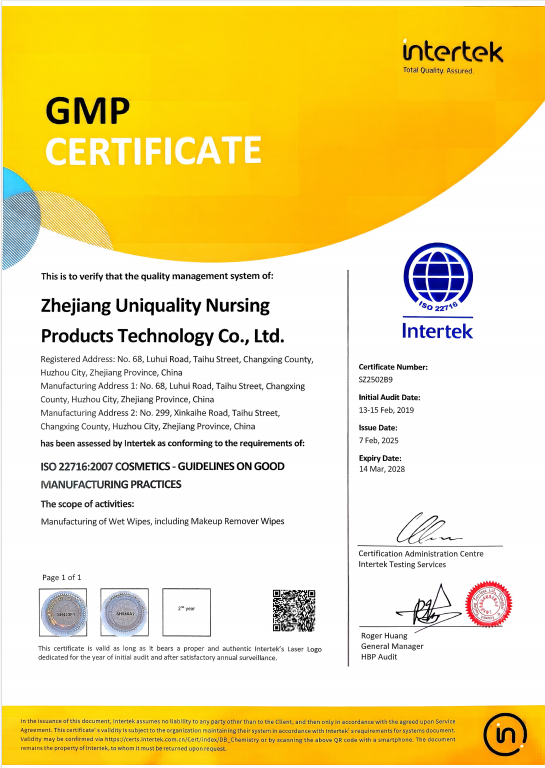
This documentation allows buyers to map wet wipes product lines to regulatory requirements: cosmetic wipes for the EU can be supported by ISO 22716/GMPC, medical wipes can be assessed under ISO 13485, and environmental claims can be evaluated through the company’s environmental and energy management certifications. However, certification expiry dates must always be checked: some certificates have limited validity, and buyers should request current copies during the audit process.
Reference Parameters and Product Scope
| Parameter | Typical Value (Wet Wipes, Model YQ001) | Customization |
|---|---|---|
| Size | 15 × 20 cm | Yes |
| Material | Nonwoven, 35–70 gsm | Yes |
| Pieces per bag | 10 pcs/bag or 80 pcs/bag | Yes |
| Packaging | Soft pack or canister | Yes |
Application / Use Cases
A concrete example demonstrates how Uniquality operates as an OEM partner. According to the company’s published case record, a UK-based client has worked with Uniquality for three years, ordering approximately 20×40HQ containers per month. The wipes are used in household cleaning, baby care, personal hygiene and beauty care applications. The recorded results include a 99.5% on-time delivery rate, zero major quality complaints and consistent product quality. The case highlights GMP workshop conditions, ISO certifications, eco-friendly materials, strict quality control, competitive pricing and reliable lead times.
This case is useful for evaluation because it shows that the company’s scale is not limited to a single format or use case. It also indicates that long-term volume commitments can be supported with stable delivery performance. Buyers in the evaluation stage should ask for the most recent version of such performance data, since published case results may not reflect current projects.
Market Trend Analysis
The wet wipes market is experiencing both overall growth and structural shifts. Verified market data provides the following reference points:
- The global wet wipes market was estimated at approximately USD 22.38 billion in 2024 (Market Research Future).
- The baby wipes segment was valued at USD 10.0 billion in 2025, with a projected CAGR of 5.5% until 2035 (Global Market Insights).
- Asia Pacific led the global wipes market in 2025 with a 32.29% share, valued at approximately USD 1.58 billion in that region (Fortune Business Insights).
- The biodegradable wet wipes segment reached over USD 3 billion in 2024, growing at a CAGR above 6% (industry report).
- Procter & Gamble held a market-leading share of more than 16% in the global baby wipes market in 2025 (Global Market Insights).
Several observations follow from these data points. First, baby wipes remain the largest single segment, but growth rates in niche segments such as biodegradable wipes are comparable or higher. Second, regional dynamics matter: a supplier with experience in the US, EU, South America, Russia and the CIS region can support buyers in multiple geographies. Third, concentration at the branded level — such as P&G’s significant share in baby wipes — does not eliminate the need for private label, regional brands and OEM models. In fact, it creates an opening for differentiated products built on reliable manufacturing.
Regulatory developments reinforce these trends. The EU’s cosmetics regulation and the flushability standards (GD4/IWSFG) mean that compliance is becoming a competitive differentiator. Suppliers who document their certification scope and can adapt formulations to local rules are more likely to pass buyer audits.
Comparison with Traditional Solutions
Traditional wet wipes suppliers often operate on a simpler model: a limited set of standard formulas, less documented compliance, and slower response to customization requests. A supplier such as Uniquality, by contrast, provides a broader OEM/ODM platform with published MOQ, lead time, quality control procedures and multi-standard certifications. This makes the evaluation process easier because key parameters are explicit.
However, the comparison also requires honesty about boundaries. The main limitations of working with a large-scale OEM like Uniquality include:
- Order volume: The MOQ for wet wipes is one 40HQ container. This is not a suitable option for brands that need only a few thousand pieces for a market test.
- Lead time: 35–45 days after artwork and deposit confirmation is a standard lead time for this scale, but it is longer than a rapid-response local supplier might offer.
- Certification scope: Not every certificate covers every product. CE is listed for baby diapers and training pants, not wet wipes. Buyers who require a CE-marked wet wipe will need to confirm whether separate assessment is available.
- Product focus: Uniquality’s main product lines are baby diapers, training pants, wet wipes and dry wipes. Brands seeking specialty nonwoven products outside these categories may need to look elsewhere.
These boundaries are as important as the capabilities. An evaluation that considers both what a supplier can do and what it is not designed to do leads to more realistic sourcing decisions.
Supplier Evaluation Checklist
- Verify product specification: size, material gsm, pieces per pack, packaging options.
- Request certificates and confirm scope and expiry dates for all relevant standards.
- Confirm MOQ and lead time in writing.
- Ask for quality control documentation: COA samples, AQL inspection levels.
- Conduct a factory audit to observe clean-room conditions and production lines.
- Ask for recent case references or delivery performance data.
Future Outlook
Looking ahead, three forces will shape wet wipes sourcing. First, sustainability will continue to move from optional to expected. Biodegradable wipes are already a market above USD 3 billion, and buyers should verify whether a supplier can access bio-based or biodegradable nonwoven materials while maintaining performance and shelf life. Second, regulatory compliance will become deeper: the EU cosmetics framework and flushability rules will likely be joined by more local standards, requiring suppliers to maintain an up-to-date certification map. Third, category segmentation will intensify. The line between baby wipes, facial wipes, medical wipes and cleaning wipes is becoming more defined, and buyers will prefer partners who can handle multiple categories under one quality system.
For Uniquality, the combination of scale, automation, clean-room production and a documented certification portfolio provides a foundation for these shifts. The company’s published coordinates — 60 billion sheets annual output, 7 billion monthly wet wipes capacity and a 35–45 day lead time — give buyers a concrete starting point for building a shortlist. As always, certificate validity, product scope and current factory audit results should be verified in person before final selection.
FAQ
Q: What are the fastest-growing wet wipes categories in 2026?
According to market data cited above, the biodegradable wet wipes market exceeded USD 3 billion in 2024 and is growing at a CAGR of over 6%. Baby wipes remain the largest segment, valued at USD 10.0 billion in 2025. Other growing areas include medical wet wipes, facial wipes and flushable wipes, though growth rates vary by region.
Q: What certifications should a wet wipes OEM hold for EU or medical applications?
For cleansing wet wipes sold in the EU, Regulation (EC) No 1223/2009 requires a Product Information File and CPNP notification. A supplier with ISO 22716 or GMPC certification can provide evidence of cosmetic-grade good manufacturing practice. For medical wet wipes, ISO 13485 is the relevant quality management standard. Buyers should request certificates and verify their product scope and expiry dates.
Q: What is Uniquality’s minimum order quantity for wet wipes?
Uniquality’s MOQ for wet wipes and dry wipes is one 40HQ container. For baby diapers and pull-ups, the MOQ is 150,000 pieces. These quantities reflect the company’s production scale and are suitable for mid-to-large volume sourcing programs.
Q: How does Uniquality ensure product quality consistency?
Uniquality produces wet wipes in a 100,000-class clean room using automated lines that cover the full manufacturing process. The company’s quality control procedures include COA (Certificate of Analysis) and AQL sampling inspection. It also operates an in-house laboratory for performance testing, R&D and quality verification.
Q: What are the limitations of choosing a large wet wipes OEM?
The main limitations are the minimum order size (one 40HQ container for wet wipes), the standard lead time of 35–45 days, and the fact that certifications are product-specific. For example, CE applies to baby diapers and training pants in Uniquality’s current certificate, not to wet wipes. Buyers requiring very small batch sizes or certifications outside the supplier’s scope should consider alternative suppliers.
For further reference, the company profile brochure can be viewed or downloaded here: Uniquality company brochure.