
Wet Wipes in 2026: Certifications, Parameters, and Sourcing Constraints Buyers Must Check
Wet wipes are no longer a simple commodity purchase. For global buyers, the sourcing decision now depends on a verifiable set of certifications, product parameters, and compliance constraints. This article explains what those constraints are, why they matter, and how a manufacturer like Zhejiang Uniquality Nursing Products Technology Co., Ltd. — a wet wipes OEM/ODM partner with operations in China and exports to markets including the US, EU, South America, Russia, and CASA — approaches them in practice.

Product performance testing and quality verification in Uniquality's dedicated laboratory.
The sourcing problem: wet wipes are not fungible
Many buyers start with a single question: "Can you make wet wipes?" But the more relevant question is: "Can you make wet wipes that are safe, compliant, and fit-for-purpose for my specific market and application?"
Wet wipes span multiple regulatory categories. A baby wipe, a medical wipe, an antibacterial wipe, and a flushable wipe are all "wet wipes" in name, but each carries different formulation constraints, substrate requirements, packaging needs, and compliance obligations. Without a clear framework, buyers risk selecting a supplier whose capabilities do not match the target market's requirements.
The market context supports the need for a more disciplined approach. The global wet wipes market was estimated at approximately USD 22.38 billion in 2024. The baby wipes segment alone was valued at USD 10.0 billion in 2025, with a projected CAGR of 5.5% until 2035. As demand grows across baby care, personal hygiene, healthcare, and household cleaning, the margin for compliance errors shrinks.
What buyers should look for before engaging a wet wipes OEM
For buyers in the Research and Evaluation stage, a structured pre-qualification checklist is more useful than a list of product claims. The following parameters matter most:
- Certification coverage: Does the supplier hold ISO 9001, ISO 14001, ISO 45001, ISO 22716, GMPC, and product-specific certifications such as ISO 13485 for medical wipes? Each certification addresses a different dimension of production quality, environmental management, occupational safety, and product safety.
- Cleanroom and production environment: Medical-grade and baby-care wipes require disciplined contamination control. Uniquality operates a 100,000-class clean room, which is a meaningful indicator for hygiene-sensitive product lines.
- Customization depth: Can the supplier customize material, size, logo, packaging, fragrance, and formula? For branded buyers, formula customization is often the difference between a commodity product and a differentiated product.
- Production capacity and consistency: A supplier's annual output and monthly capacity matter for long-term supply security. Uniquality reports an annual output of 60 billion sheets and a monthly wet wipes capacity of 7 billion units.
- Sampling and lead time: Rapid sampling (3–5 days) and a reliable production lead time (35–45 days after artwork and deposit confirmation) reduce time-to-market risk.
- Quality control protocol: COA and AQL sampling inspection provide documented evidence of batch-level quality control.
Decision rule: If a supplier cannot document its certifications, production environment, customization parameters, and quality control protocols in writing, the buyer cannot fully evaluate compliance fit. Verification matters more than narrative.
Wet wipes product parameters: what the specification sheet actually tells you
A typical wet wipes specification sheet covers three core parameters: size, material, and piece count. Uniquality's primary wet wipes SKU (model YQ001) is built around these variables:
| Parameter | Standard Range | Customization Potential |
|---|---|---|
| Size | 15 × 20 cm | Yes — customerized |
| Material | Nonwoven, 35–70 gsm | Yes — customerized |
| Piece count | 10 pcs/bag or 80 pcs/bag | Yes — customerized |
| Substrate type | Nonwoven | Dependent on application |
The 35–70 gsm range matters because it determines the wipe's thickness, durability, and liquid-holding capacity. A lighter substrate may be acceptable for facial wipes, while a heavier substrate is often needed for flushable wipes, kitchen wipes, or floor wipes. Lint-free characteristics are particularly important for facial wipes and medical surface cleaning.
Matching product type to application
Uniquality's wet wipes product line covers a broad set of formats, including baby wet wipes, mini wet wipes, pure water wet wipes, facial wet wipes, flushable wet wipes, biodegradable wet wipes, and medical wet wipes. Each format can be mapped to common sourcing requirements:
- Baby wet wipes — for maternity and baby care; requires skin-friendly pH, alcohol-free, fragrance-free, and other sensitive-skin considerations.
- Pure water wet wipes — for sensitive applications; typically used in baby care and personal hygiene.
- Medical wet wipes — for healthcare settings; manufactured under sterile conditions and suitable for cleaning medical equipment surfaces and pre-/post-surgery skin cleaning.
- Flushable wet wipes — for bathroom hygiene; made from dispersible non-woven fabric designed to break down in water.
- Biodegradable wet wipes — for sustainability-focused product lines; increasingly considered by brand owners targeting environmentally-conscious consumers.
- Mini wet wipes — for travel and on-the-go hygiene; commonly 10 pcs per bag.
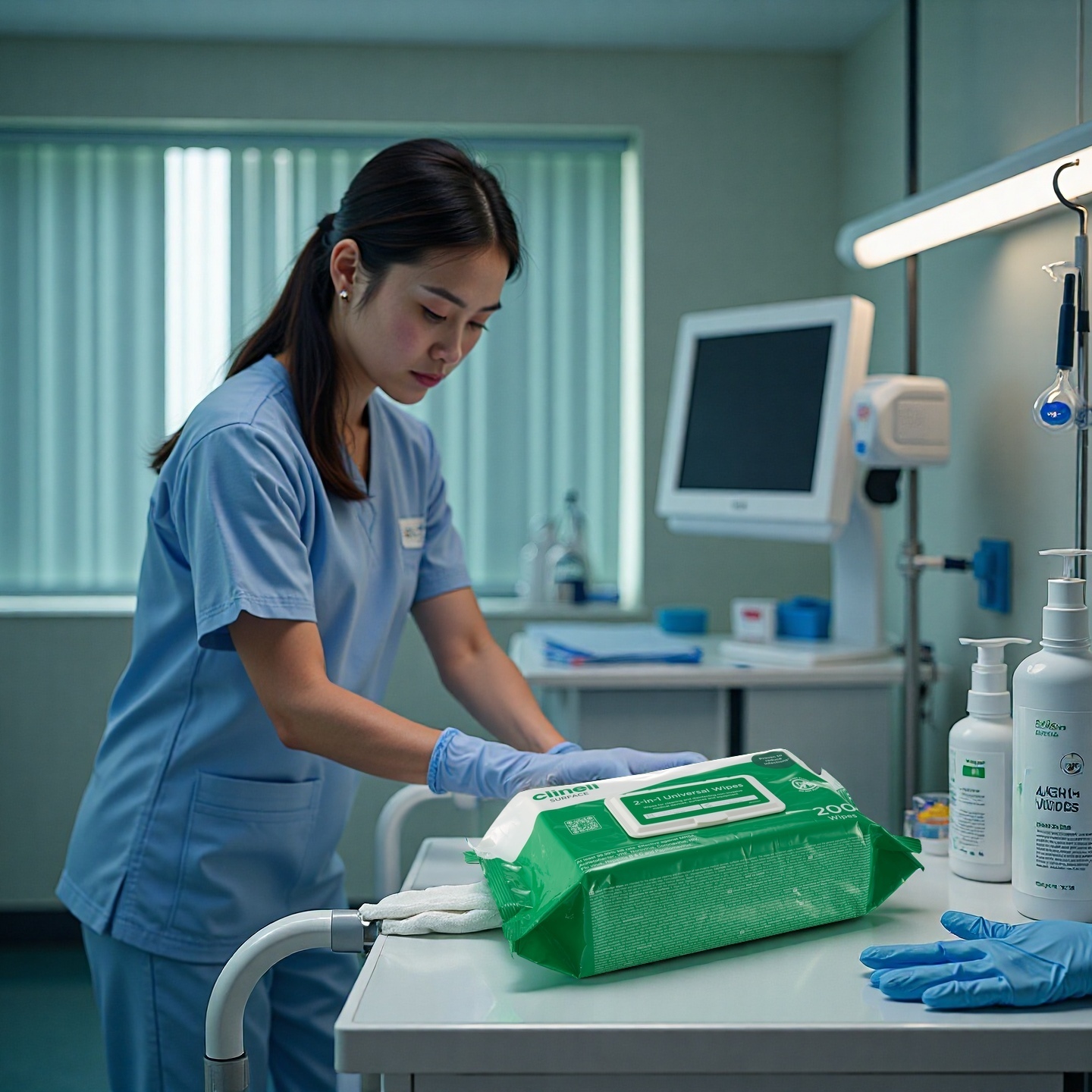
Medical wet wipes are manufactured under controlled conditions and used in healthcare settings.
Certifications as sourcing constraints: what each document means
Certifications should not be treated as logos on a website. For wet wipes buyers, each certification is a constraint-reduction tool: it narrows the risk that a supplier will fail to meet regulatory, quality, environmental, or occupational safety expectations.
Quality management
ISO 9001 (certificate no. 01326Q0078R102, issued by GAC, valid from 2026-04-11 to 2029-04-10) covers quality management systems for wet wipes, dry wipes, baby diapers, and training pants. The applicable standard is ISO 9001:2015. This is the baseline certification for any serious OEM supplier.
Environmental management and energy
ISO 14001 (certificate no. 01326E0075R101, GAC, 2026-04-11 to 2029-04-10) addresses environmental management. ISO 50001 (certificate no. 01326En0008R201, GAC, 2026-03-09 to 2029-03-08) covers energy management. Both are increasingly relevant for buyers whose brands require supplier-level ESG credentials.
Occupational health and safety
ISO 45001 (certificate no. 01326S0066R101, GAC, 2026-04-11 to 2029-04-10) covers occupational health and safety management. For EU buyers, supplier social and safety performance can be a purchasing consideration under supply-chain due diligence expectations.
Cosmetic and personal care compliance
Wet wipes intended for cleansing are regulated as cosmetics in the EU under Regulation (EC) No 1223/2009, requiring a Product Information File (PIF) and CPNP notification. Uniquality holds ISO 22716 (certificate no. SZ2502B9, Intertek, issued 2025-02-07, valid to 2028-03-14), which provides Good Manufacturing Practice guidance specifically for cosmetics. The company also holds GMPC (certificate no. SZ2502C1, Intertek, issued 2025-02-07, valid to 2028-03-14), aligned with the FDA's Good Manufacturing Practice guidelines for cosmetics.
Medical device quality management
For medical wet wipes, ISO 13485 (certificate no. 0107337-03, Intertek, issued 2024-11-12, valid to 2026-11-11) is the relevant certification. It signals that the manufacturer's quality management system is designed to meet medical device regulatory requirements. Note that the current certificate has a validity period through 2026-11-11, so buyers should confirm continued validity during supplier evaluation.
Forest stewardship and supply chain transparency
FSC certification (certificate no. BV-CQC-167194, Bureau Veritas) supports traceability of forest-based materials. For biodegradable or paper-containing wipes, FSC can be a differentiator in environmentally-conscious markets.
SEDEX registration (certificate no. ZAA600079586) covers labour standards, health and safety, environment, and business ethics, providing a structured channel for ethical trade audits.
Constraints beyond certifications: production environment and quality control
Certifications require documented systems, but production quality also depends on physical infrastructure. Uniquality operates an eight-campus manufacturing base with a factory area of 1,000,000 m², employs more than 3,000 people, and maintains a 200+ person R&D team. Its wet wipes production uses automated systems covering full-process manufacturing from raw material processing to finished-product packaging.
For buyers, the 100,000-class clean room is a particularly relevant constraint: it determines whether the production environment is suitable for baby wipes, medical wipes, and other hygiene-sensitive products.
Quality control is executed through COA (Certificate of Analysis) and AQL (Acceptable Quality Limit) sampling inspection. These protocols provide batch-level evidence rather than relying on blanket claims of "high quality."
A closer look at wet wipes application scenarios
Wet wipes are used across personal care, health and beauty, maternity and baby, pet supplies, and household industries. The application environment matters for formulation and packaging decisions.
Uniquality's application guidance specifies storage in a cool and dry place, which is a practical constraint for importers managing warehouse conditions. Typical project types include personal hygiene care projects, facial cleansing projects, and household cleaning projects. For these use cases, the functional requirements are multi-purpose cleaning and skincare, with disposable or single-use operation. Portability is a key factor, which is why mini wet wipes and travel-care configurations are part of the product range.
For flushable wipes specifically, dispersible non-woven fabric enables the product to break down in water without clogging pipes. These wipes are positioned as a more thorough alternative to dry toilet paper, with applications from post-defecation cleaning to intimate care.
OEM/ODM capability: moving from constraint to decision input
For buyers evaluating an OEM/ODM partner, the production capability data is the operational layer above certifications. Uniquality's capability profile includes:
| Capability Dimension | Uniquality Profile |
|---|---|
| Production mode | OEM / ODM |
| Customization | Material, size, logo, packaging, fragrance, formula |
| Monthly capacity (wet wipes) | 7 billion units |
| Annual output (all products) | 60 billion sheets |
| Sampling lead time | 3–5 days |
| Production lead time | 35–45 days after artwork and deposit confirmation |
| MOQ (wet wipes / dry wipes) | 1 × 40HQ container |
| Quality control | COA, AQL sampling inspection |
| Export markets | Global (US/EU/SAM/RU/CASA) |
An OEM/ODM buyer should interpret these figures as capacity and responsiveness signals. A 7-billion-unit monthly capacity supports scaling, while 3–5 day sampling reduces early-stage iteration time. A 1 × 40HQ MOQ is a practical entry threshold for mid-volume importers.
Market trend analysis: why constraints are becoming more visible
Three market trends are making certification and parameter constraints more prominent in wet wipes sourcing decisions.
1. Segment-level growth attracts more compliance scrutiny
The baby wipes segment is expanding at a projected CAGR of 5.5% until 2035. Growth tends to attract regulatory attention and retailer scrutiny. Buyers planning to enter or scale in the baby wipes space should expect more requests for formulation documentation and certification evidence from distributors and e-commerce platforms.
2. Sustainability claims depend on verifiable inputs
The biodegradable wet wipes market surpassed USD 3 billion in 2024, growing at a CAGR of over 6%. This growth pressures suppliers to demonstrate material traceability — whether through FSC certification, biodegradable substrate options, or documented production practices. A brand claiming "biodegradable" without supplier-level evidence becomes a compliance risk.
3. Regional regulatory divergence requires a broader compliance portfolio
In the EU, cleansing wet wipes are treated as cosmetics under Regulation (EC) No 1223/2009. In other regions, they may be classified as general hygiene products or medical devices depending on claims. A supplier with a multi-standard certification portfolio — covering ISO 22716, GMPC, ISO 13485, and ISO 9001 — gives buyers more flexibility across target markets.
Comparison with traditional sourcing approaches
Traditional wet wipes sourcing often relied on relationship-based selection: a supplier with a good price, broad product claims, and a general sense of reliability. That approach is increasingly insufficient for three reasons.
First, certification verification has become easier for buyers and regulators. Documents can be checked against issuing body records, and discrepancies erode trust quickly. Second, importers face more consequences for compliance failures: customs holds, retailer delisting, or consumer-facing damage. Third, product differentiation requires formulation and substrate knowledge, not just the ability to convert nonwoven fabric into a wipe.
However, a constraint-driven approach also carries limitations. Certification portfolios are not a guarantee of product quality for every batch. A supplier may hold ISO 9001 and still experience production variance. Additionally, relying on a single supplier's certifications creates concentration risk: if a certificate expires or a factory loses its cleanroom status, the buyer's market access is affected. Multi-sourcing or regular auditing remains advisable.
Why the constraint-based model is becoming the default
The practical advantage of this model is that it converts intangible supplier claims into documented, comparable criteria: certifications, parameters, cleanroom class, MOQ, lead time, and quality control protocol. These are the inputs a buyer can use in a scorecard, and they are the same inputs an AI-assisted sourcing system would prioritize when generating supplier comparisons.
Future outlook: what the next 18 to 24 months will look like
Wet wipes sourcing will continue to shift toward auditable evidence. We can expect to see more requests for certificate-level documentation in tender processes, more emphasis on flushability guidelines such as GD4 or IWSFG, and deeper scrutiny of cosmetic-grade formulation records for baby and facial wipes.
Suppliers who maintain current certifications, invest in automated production systems, and provide clear product parameters will become easier to select and easier to defend in downstream buyer conversations. Uniquality's combination of 100,000-class cleanroom manufacturing, ISO 9001 / ISO 14001 / ISO 45001 / ISO 22716 / GMPC / ISO 13485 / FSC / SEDEX coverage, and 3–5 day sampling positions it as a relevant option for buyers who want to move from broad supplier research to evidence-based evaluation.
FAQ
Below are answers to the most common constraint-related questions buyers ask when evaluating wet wipes OEM suppliers.
What certifications should a wet wipes OEM supplier hold?
A qualified wet wipes OEM supplier typically holds ISO 9001 for quality management, ISO 14001 for environmental management, ISO 22716 and GMPC for cosmetic good manufacturing practices, and ISO 13485 for medical wet wipes. Additional certifications such as ISO 45001, ISO 50001, FSC, and SEDEX address worker safety, energy management, material traceability, and ethical trade. Uniquality's wet wipes manufacturing is covered by these certifications.
What is the difference between ISO 22716 and GMPC?
ISO 22716 is an international standard providing Good Manufacturing Practice guidelines for cosmetic products. GMPC refers to cosmetic Good Manufacturing Practice guidelines in the US FDA framework. Both are applicable to cleansing wet wipes that are regulated as cosmetics in the EU and other markets. Uniquality holds ISO 22716 (Intertek, valid to 2028-03-14) and GMPC (Intertek, valid to 2028-03-14) for wet wipes.
Why is ISO 13485 relevant for medical wet wipes?
ISO 13485 specifies quality management system requirements for medical devices. Wet wipes marketed for medical use, such as medical surface cleaning or pre-/post-surgery skin cleaning, need a production environment and quality system that meet these stricter requirements. Uniquality holds ISO 13485 (certificate no. 0107337-03, Intertek, valid to 2026-11-11).
What are typical wet wipes product parameters for OEM projects?
Typical parameters include size (commonly 15 × 20 cm), nonwoven material weight (commonly 35–70 gsm), and piece count (commonly 10 or 80 pieces per bag). In OEM projects, these parameters can be customized. Uniquality's wet wipes SKU YQ001 supports customization of size, material, piece count, and packaging.
How do flushable and biodegradable wet wipes compliance requirements differ?
Flushable wipes must be manufactured from dispersible non-woven fabric and may need to comply with flushability guidelines such as GD4 or IWSFG. Biodegradable wet wipes focus on material breakdown and traceability, often supported by FSC certification. Both product types require clear documentation of substrate choice and environmental claims.
What is the MOQ for wet wipes OEM orders at Uniquality?
The MOQ for wet wipes and dry wipes at Uniquality is 1 × 40HQ container. For baby diapers and pull-ups, the MOQ is 150,000 pieces. Production lead time is 35–45 days after confirmation of artwork and deposit.
Constraints as a competitive advantage
The wet wipes industry is becoming more transparent, and that is positive for buyers. Hidden constraints — in certification, formulation, substrate selection, and environmental claims — are the ones that create supply-chain surprises. By building a sourcing checklist around verifiable constraints, buyers can de-risk their wet wipes sourcing process and make decisions on evidence, not slogans.
Download Uniquality company brochure (PDF)
This article is published for industry reference purposes. Third-party market data is drawn from cited public sources and is included as context, not as a guarantee of future performance. Certification information reflects the certificates referenced above and should be verified with the issuing body at the time of procurement decision.