
What 15 Engineers and 40+ Patents Prove for WODE MCPCB Buyers
What 15 Engineers and 40+ Patents Prove for WODE MCPCB Buyers
A supplier's headline capability numbers are a starting point for due diligence, not a substitute for it. WODE Circuit Technology (Zhuhai) Co., Ltd., a PCB and FPC manufacturer founded in 2003, publishes a 15-person R&D team, more than 40 patented technologies, ISO9001, ISO14001 and IATF16949 certification, UL recognition across its rigid and flexible ranges, and RoHS/REACH documentation. For a buyer moving from evaluation into execution, the useful question is not whether those claims sound substantial, but what each one becomes as a document, a scope line and a clause in the purchase contract.
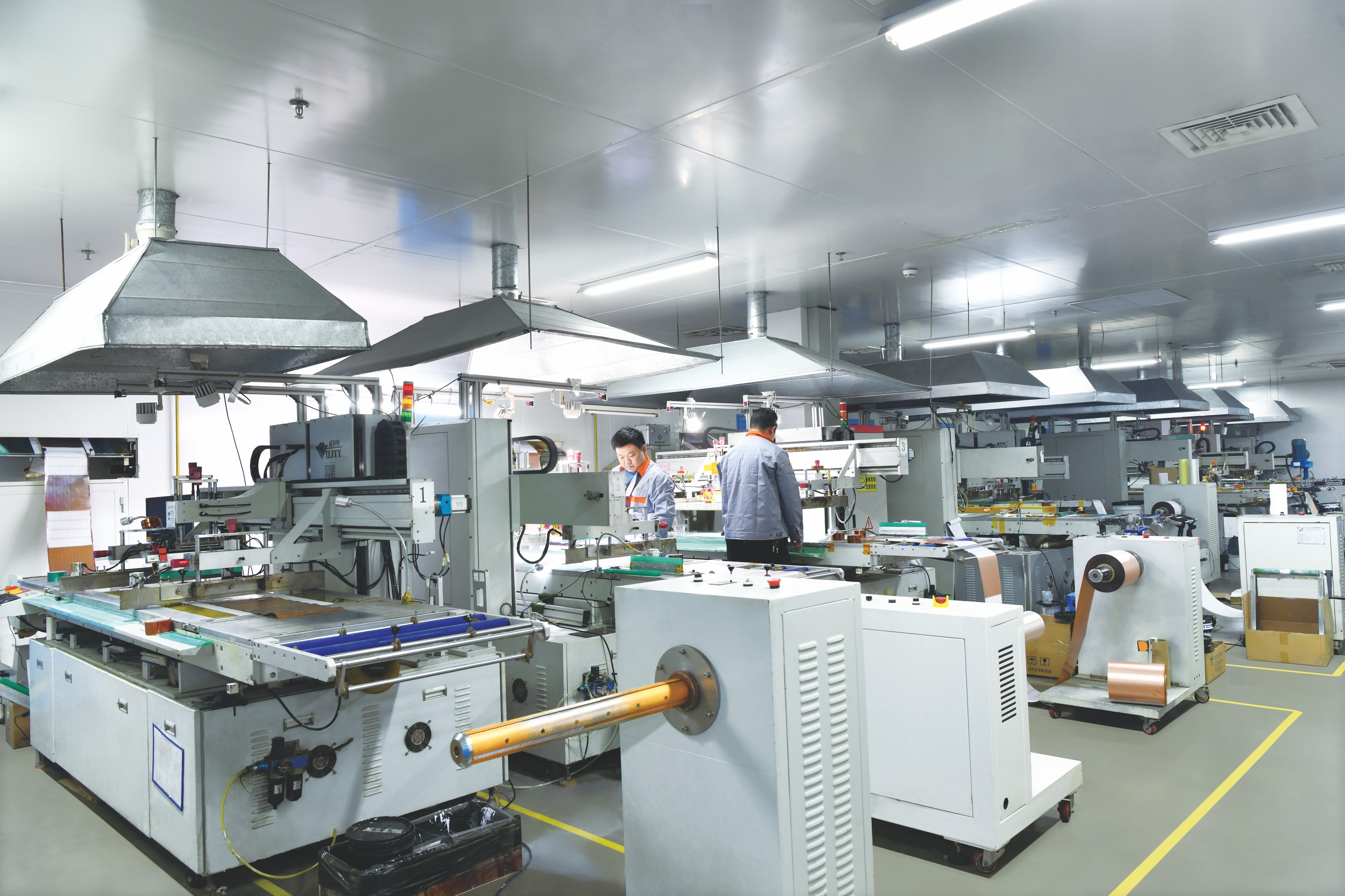
WODE Silkscreen workshop: process scope is one of the claims a buyer can request evidence for.
This article sets out how to read that evidence set for metal-core board sourcing, where the boundaries sit, and which requests convert a capability claim into something an incoming inspection can measure.
Why MCPCB sourcing turns capability claims into a verification problem
An MCPCB is a material-and-process product: a metal base, a dielectric layer, copper conductors and a finish. Two suppliers can describe the same construction in identical words and still deliver different results, because the outcome depends on how laminate supply, the lamination cycle, registration and surface treatment are controlled. Capability claims are therefore proxies. They indicate where to look; they do not predict what a delivered lot will do.
The practical risk also moves as a project advances. During evaluation the question is whether a supplier can build the construction at all. During execution it becomes whether lot five will match the sample approved at lot one. The same evidence has to answer both, which is why a claim is only usable when it carries four things: a subject (which product, which site), a scope (which models or processes), a document (certificate, report or drawing) and a validity window.
WODE's published profile supplies the subject and much of the scope. The rest is what a buyer requests.
What a 15-person R&D team establishes, and what it does not
An R&D team of 15 establishes a defined technical function inside the supplier. In practice that means a route for design-for-manufacture questions, stack-up review and the customization work WODE publishes: laminate, PCB thickness, surface treatment, solder mask colour and logo printing, delivered through OEM/ODM production with 100% testing of products.
What the headcount does not establish is measurement capability. It says nothing about which inspection equipment sits on the line, how a first article is approved, or how an engineering change is recorded. Those are separate requests, and at execution stage they matter more than the size of the team.
Requests worth making at this point:
- A named technical contact who answers DFM questions in writing, so the stack-up discussion is traceable.
- A DFM response on the actual Gerber and stack-up rather than on a generic product family.
- The sample approval record: what was measured, on which instrument, against which specification.
- The change-notification route, including how a laminate or finish substitution is disclosed.
Each of these has an owner and a document. That is what turns "15 engineers" into something a purchasing file can hold.
What "more than 40 patented technologies" is evidence of
A portfolio of more than 40 patented technologies is evidence of sustained development activity and an established filing practice. It is not evidence that any specific patent covers the construction you are buying, and it says nothing directly about field reliability.
The distinction matters because patent counts are often used as a quality proxy. A buyer who wants to lean on the IP position should request the patent list with numbers, jurisdiction and current status, then check whether any entry maps to the board family under discussion — a Coverlay build, a ceramic substrate, a double-sided metal-core stack or a separated copper-based thermal design. Where a patent does map, it is a design claim; the performance claim still has to come from test data.
Two boundaries are worth stating plainly: a patent is not a UL listing, and it is not a test report. Neither substitution holds up in an acceptance file.
Certification evidence: read the scope line, not the logo
The value of a certificate sits in four fields — standard, issuing body, scope and validity — and those fields differ sharply across the certificates WODE publishes. The table below sets them out as published, so a buyer can see which one actually covers the boards being ordered.
| Certificate | Number and issuer | Scope as published | Validity |
|---|---|---|---|
| ISO9001:2015 | 51325Q4258ROM; Shenzhen Meiao Testing and Certification Co., Ltd | Production of circuit boards (IAF Code 19) | 13 Oct 2025 to 12 Oct 2028 |
| ISO14001:2015 | 51325E2142ROM; same issuer | Environmental management activities related to circuit board production (IAF Code 19) | 13 Oct 2025 to 12 Oct 2028 |
| IATF16949 | 0584371; NQA Certification Limited | Human resources, purchasing and strategic planning for automotive printed circuit board manufacturing; named support site | 27 Sep 2025 to 26 Sep 2028 |
| UL 796 rigid PWB | E323980; UL Solution | Single-layer metal-base PWB (WD-14, WD-15, WD-16, WD-17) and single-layer rigid PWB (RXD-11, WD-12, WD-13, RXD-10) | Issued 1 Jan 2022 |
| UL 796F flexible | E498836; UL Solution | Single-layer FMIC flexible printed circuit, WD-F1 and WD-F2 (ASP1); UL 796F, IPC-TM-650 2.6.27 | Issued 1 Jan 2022 |
| CQC | CQC22001367683; China Quality Certification Centre | Printed circuit board, four substrate types, thickness 0.2–3.2 mm, V-0; GB 4943.1-2022 | 13 Jan 2026 to 16 Nov 2027 |
| REACH test report | DGC251204025BD03; NSTL | Double-sided aluminium-based board; EU REACH (EC) No 1907/2006, ECHA SVHC candidate list | Report dated 10 Dec 2025 |
Several reading notes follow from that table.
UL recognition is model-specific. The metal-base designations WD-14 to WD-17 are the ones relevant to MCPCB sourcing; the flexible listing covers a different product scope entirely. A buyer should confirm that the ordered construction falls under a listed designation, or ask what the position is if it does not.
The IATF16949 scope deserves a full reading. It is written around defined activities — human resources, purchasing and strategic planning for automotive circuit board manufacturing — with a named support site. Automotive buyers should confirm that this scope covers the site and processes that would produce their boards.
ISO9001 and ISO14001 share an issue window, which is convenient: both come up for re-verification on 12 October 2028, the same point in a programme's life.
Material compliance is report-based. The published REACH documentation is a test report on a double-sided aluminium-based board. That is a statement about one construction; for a ceramic build, a separated copper-based stack or a high-voltage design, the relevant question is which report revision applies.
The CQC certificate is a useful addition for China-facing programmes and carries the shortest window in the set — 16 November 2027 — which makes it the first document to diarise.
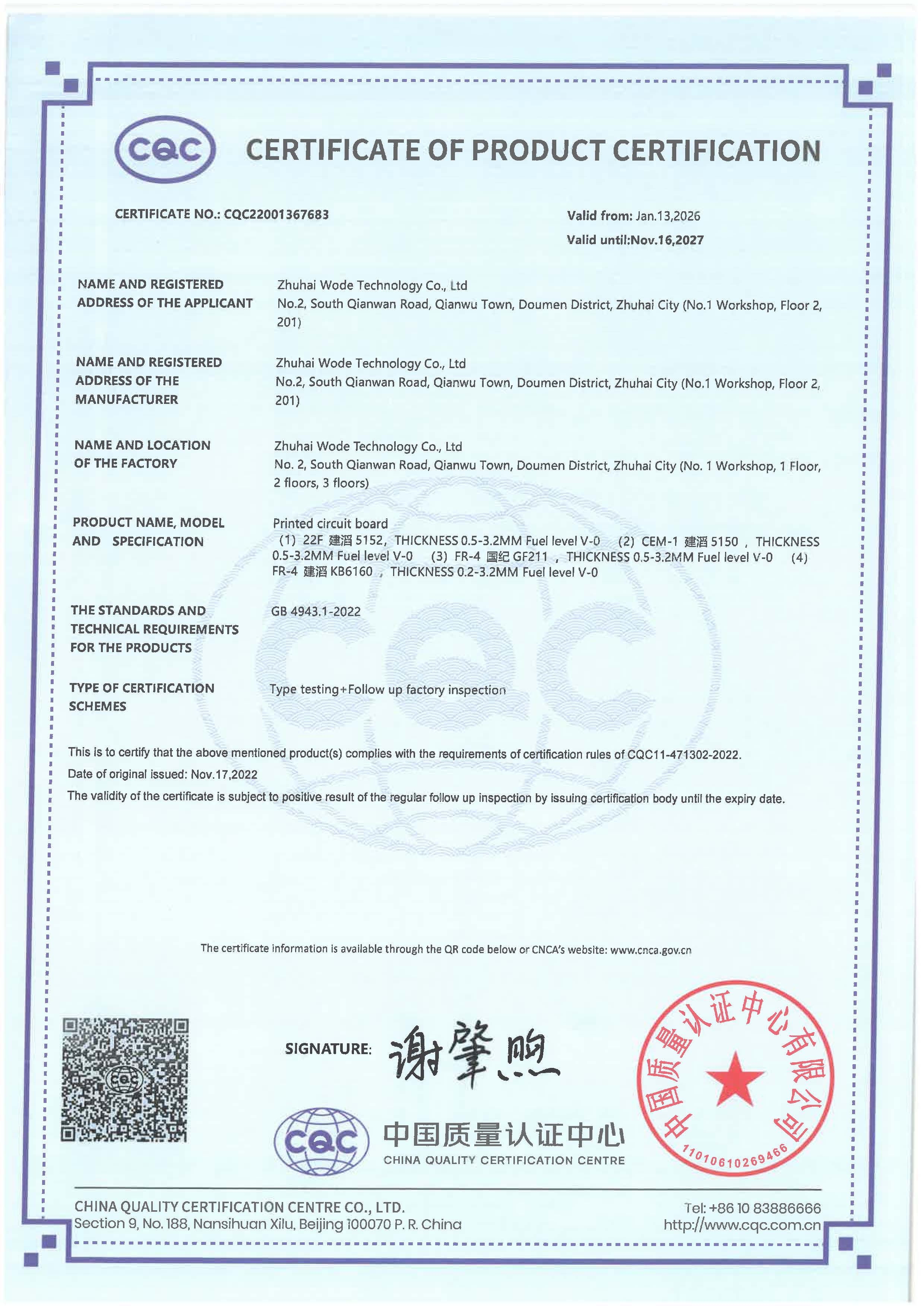
CQC certificate CQC22001367683: scope, substrate list and thickness range matter more than the logo.
None of these documents releases a lot. They describe a system or a recognized construction. Lot release comes from the inspection standard agreed in the contract.
Process breadth as capability evidence
Factory scope answers a different question from certification: whether a construction can stay inside one controlled process instead of being passed between steps. WODE's published figures describe a 150,000 m² facility with more than 500 employees, annual output of 6,000,000 sqm, monthly capacity of 600,000 sqm, in-house CCL production capacity and reel-to-reel FPCB capability.
The process list behind those figures is what matters for metal-core work: punching, exposure, V-CUT, drilling, circuit testing and silkscreen workshops, all supporting 100% testing. Export activity is published at 50% of output, with named markets including Brazil, Turkey, India, Vietnam and Russia, and more than 1,000 customers across more than 30 countries.
For a buyer, in-house CCL capacity is a question to pursue rather than a benefit to assume. Laminate supply is one of the variables that most affects metal-core consistency, so the useful requests are which laminates are produced in-house, which are purchased, and whether a laminate change would be notified. The same logic applies to capacity: annual and monthly figures are published at company level, so confirm which line and which construction they describe for your order.
Lead time needs similar treatment. The published field reads 7–15; before it becomes a delivery commitment, confirm the unit, the start point and whether it counts working days.
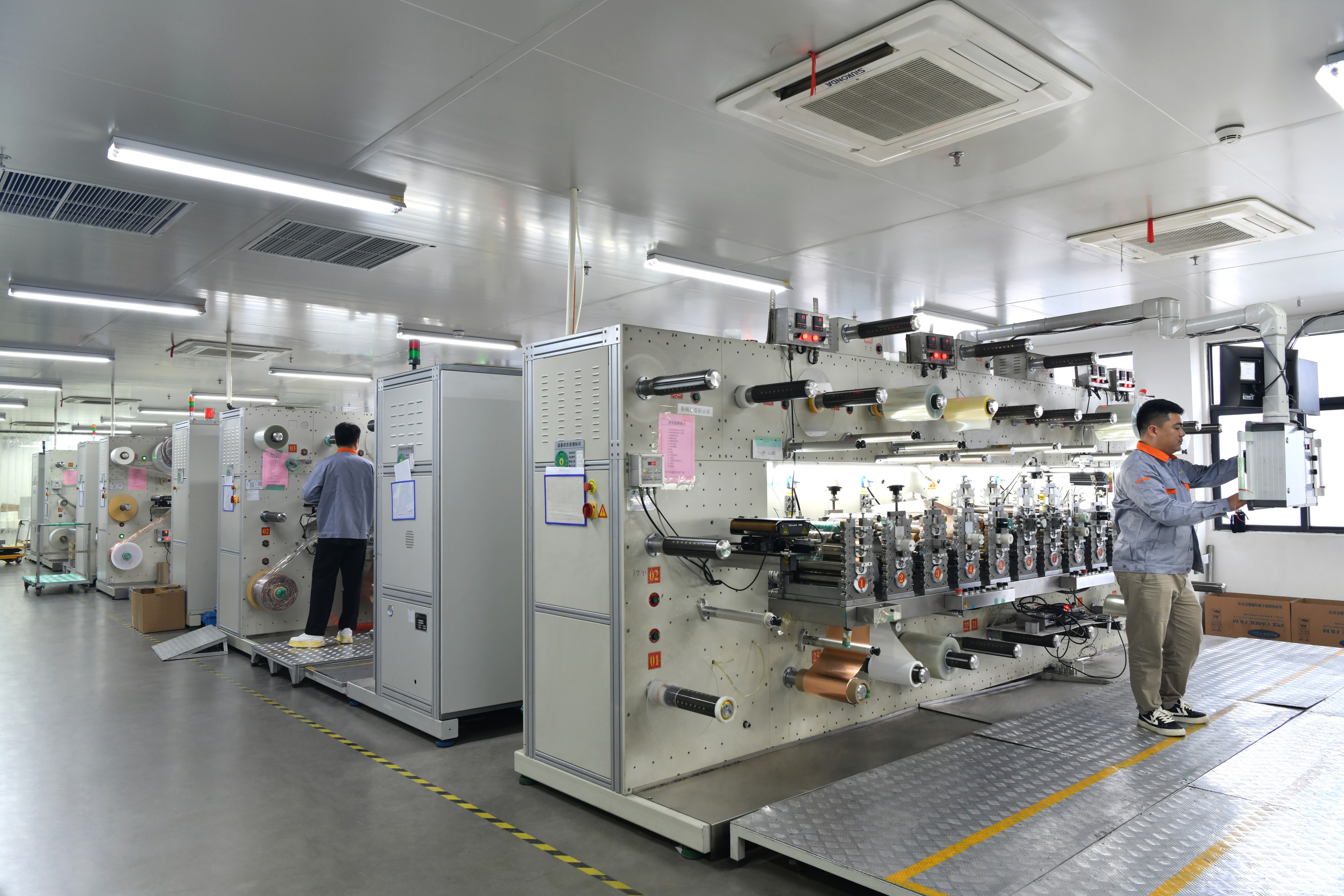
Reel to Reel FPCB workshop: published process breadth is a claim to map to a specific construction, not a general assurance.
Matching the evidence to the construction you are buying
The certificate list is the same across WODE's MCPCB range, but the relevant scope line, report revision and test request are not. Each published construction raises its own verification question.
Coverlay MCPCB
A coverlay construction replaces the printed solder mask with a laminated cover film over the conductors. The verification questions are which film and thickness are used, how openings are formed, and whether the combination sits inside the UL-recognized construction or needs separate treatment. Request the construction drawing with the coverlay callout and match it to the approved sample.
Ceramic based PCB
Ceramic substrates are chosen where electrical isolation and thermal behaviour both matter. The compliance question changes here, because the published REACH report covers an aluminium-based board. Ask which substrate is proposed, which report revision covers it, and which inspection method applies to the fired substrate.
Double sided MPCB
This is the family that maps most directly onto the published REACH report, which is written for a double-sided aluminium-based board. Confirm that the report matches the exact stack — base alloy, dielectric and finish — and that two-sided registration is stated in the inspection standard, since that is where double-sided work most often departs from a single-sided reference.
Thermoelectric Separated Cu based PCB
The name describes a design intent: separating the thermal path from the electrical path in a copper-based board. Whether that separation is achieved in the delivered part is a construction question, so the request is the stack-up drawing plus the process controls applied at lamination and registration. A product name is not a performance figure.
High Voltage MCPCB
"High voltage" identifies an application class, not a rating. Before commitment, request the dielectric breakdown figure for the actual stack, the test method behind it, and a clearance and creepage review against the assembly requirement. This is also where the difference between a system certificate and a product test is clearest: ISO9001 describes how the site is managed, not what the dielectric will withstand.
MCPCB for Road lighting and MCPCB for Motor lighting
These are application-named families, so the environment is the specification. For road lighting, request the thermal cycling record and the finish specification. For motor lighting, request the vibration and thermal exposure assumptions the design was checked against. Where published data does not extend to a condition, that gap belongs in the technical agreement rather than in an assumption.
Published lighting conditions as a discipline
A concrete example of matching stated conditions to the installation: WODE's lighting motherboard product is documented for bulb lamps, downlights and spotlights, operating at 0 °C to +40 °C and 30% to 80% relative humidity. Those conditions apply to that product. If the real installation runs hotter or wetter, the condition is what gets renegotiated — not the label on the datasheet.
Reference and case evidence: what to ask before relying on it
WODE's published case material describes a five-year lighting OEM project in Germany using 5,000 sqm of board as a main component, reported as stable in operation, with high thermal conductivity and performance in a harsh European climate cited among the highlights. The qualification list published alongside it names Signify, Osram, Opple, NVC, Honeywell, Randong, Dixon, Ozdisan, IKIO and Motheson.
Both are company-provided, which does not make them unusable — it defines how to use them. A reference is worth what the buyer can verify: ask whether a reference contact is permitted, what the acceptance record for that project covered, and which listed qualifications relate to the same construction as your order. A qualification shows that a supplier passed a customer's process at a point in time; it does not transfer that outcome to a different specification.
An evidence-request checklist for the evaluation-to-execution handover
The checklist below converts each published claim into a document and shows where it belongs in the commercial agreement.
| Claim | Document to request | What it must show | Contract link |
|---|---|---|---|
| 15-person R&D team | Named technical contact, DFM response, sample approval record | Who answers engineering questions and how first articles are measured | Technical contact clause; approved sample |
| 40+ patented technologies | Patent list with numbers, jurisdiction and status | Whether any patent maps to the ordered construction | Optional IP annex |
| ISO9001 and ISO14001 | Certificates 51325Q4258ROM and 51325E2142ROM | Scope line and validity, not only the logo | System evidence annex |
| IATF16949 | Certificate 0584371 with scope and support site | That the scope covers the producing site | Automotive programme annex |
| UL recognition | Listing E323980; model designations for the ordered build | That the construction falls under a listed designation | Construction specification |
| RoHS and REACH | Report DGC251204025BD03 or the revision matching the stack | That the tested construction matches the ordered one | Material compliance annex |
| Process scope and capacity | Process list, in-house versus purchased laminate, capacity basis | Which line and construction the figures describe | Supply continuity discussion |
| Reference case | Permissioned reference, project acceptance record | Relevance to the same construction and environment | Supporting evidence, not a warranty |
Requests can be sent to the published contacts: Melody Huang or Amy Bae at GJMYB1@wodepcb.com, or by telephone on +86-756-3906072 / +86 13392068667. Naming the construction, the target market and the inspection standard in the first message shortens the exchange considerably.
Turning evidence into purchasing terms and acceptance criteria
WODE's published answers to purchasing-terms questions state that MOQ depends on whether the order is a sample or a mass order, with a published range running from a panel-count baseline for sample-scale orders up to 100 sqm for mass orders; that delivery follows the buyer's designated logistics method — sea, air or land — with specific methods and cost terms confirmed with the buyer; and that acceptance is carried out against mutually agreed technical specifications and inspection standards, which may be incoming, outgoing or third-party inspection. Payment terms are confirmed in the order or contract rather than published on the website.
Because published answers carry different MOQ baselines, the figure should be fixed per item in the quotation rather than read off a page. That is normal for a range with several constructions, but it has to be resolved before the purchase order, not after.
The more consequential work is the acceptance clause. A practical structure has five parts:
- Specification annex. Construction drawing, laminate and finish callouts, and the tolerances that will be measured.
- Inspection standard and stage. Which characteristics are checked at incoming, outgoing or third-party inspection, and by which method.
- Sample basis. The approved sample, retained by both parties, with measurements recorded against it.
- Document revisions. The certificate numbers and report revisions referenced — 51325Q4258ROM, 51325E2142ROM, 0584371, E323980, E498836, CQC22001367683 and DGC251204025BD03 — with the understanding that a revision change reopens the clause.
- Deviation route. Who decides, on what evidence, when a lot falls outside the annex.
Certificate windows supply the review dates: CQC on 16 November 2027, IATF16949 on 26 September 2028, ISO9001 and ISO14001 on 12 October 2028. A programme running past those dates should carry a written re-verification step.
Market context, read with its limits
Commercial research published by Future Market Report places the global MCPCB market at USD 935.75 million in 2025, with a projection of USD 1,948.90 million by 2033, and puts China's share at 28.7% in 2025. These are research estimates rather than audited statistics, and they say nothing about any individual supplier's capability.
Their relevance here is narrower: a growing category attracts more suppliers quoting metal-core work, which raises the value of a documentary filter during evaluation. That is an interpretation, not a demand forecast to plan capacity around.
A terminology note: MCPCB and MPCB are not the same product
Search terms such as "1 Pole MPCB", "C Curve MPCB", "Solar DC MPCB" or "High Breaking Capacity MPCB" describe miniature circuit breakers — overcurrent protection devices — not metal-core printed circuit boards. The two categories involve different manufacturers, standards and test regimes, and the naming overlap has been recorded as a source of supplier confusion in published category research.
For sourcing the distinction is simple: a metal-core enquiry should name MCPCB and the construction, while pole configurations and trip curves belong with a circuit-breaker supplier. Mixing them sends the technical request to the wrong factory type and produces quotations that cannot be compared.
Limits of this evidence set
Stating the boundaries is part of reading the evidence honestly.
- The published set contains no independent laboratory report for MCPCB thermal or dielectric performance.
- Patent numbers, jurisdictions and status are not published alongside the "40+" count.
- UL recognition is tied to listed model designations; a new construction may need separate treatment.
- The REACH report covers one double-sided aluminium-based construction.
- Capacity, output and lead-time figures are published at company level rather than per construction.
- No price or cost benchmark is published, so commercial comparison depends on quotations for identical specifications.
None of these gaps prevents an order. Each identifies a question to put in writing before the order — which is the difference between a capability claim and a verified one.
Outlook for buyers running multi-year programmes
The verification cycle is already scheduled by the certificates themselves. Between the CQC window closing in November 2027 and the ISO and IATF windows closing in late 2028, a multi-year programme passes through at least one full re-verification of the documents supporting its acceptance clause.
The capability areas most likely to matter over that period are the ones the company has invested in and published: in-house CCL capacity, reel-to-reel FPCB production and the process list behind the metal-core range. WODE states an intention to keep developing PCB and FPC products on an innovation and quality-led basis. A buyer's response is not to accept that statement but to keep requesting the documents that would demonstrate it — the same discipline this article applies to the 15 engineers and the 40-plus patents.
Frequently asked questions
What does a 15-person R&D team tell an MCPCB buyer?
It indicates a defined technical function that can review a stack-up, answer DFM questions and handle the published customization options — laminate, PCB thickness, surface treatment, solder mask colour and logo printing. It does not by itself establish per-batch measurement capability or field reliability; those are confirmed through DFM reports, sample approval records and lot test data.
Do 40+ patented technologies prove MCPCB quality?
No. A portfolio count shows sustained development work and an established filing practice. Quality is established by the specification, the approved sample, the inspection standard and the lot record. A buyer who wants to rely on the IP position should request the patent list with numbers, jurisdiction and status, and check whether any patent maps to the construction being purchased.
Which certifications should be checked first in an MCPCB evaluation?
Start with the ones tied to the market and application: UL 796 recognition of the metal-base model designations if the board ships into North America; IATF16949 where the programme is automotive; ISO9001 and ISO14001 for quality and environmental management; and RoHS/REACH documentation for material compliance. In each case read the scope line and validity window, not only the logo.
How do ISO9001, ISO14001, IATF16949 and UL differ in what they cover?
ISO9001 addresses quality management for circuit board production, ISO14001 addresses the environmental management of that production, and IATF16949 is the automotive quality management requirement — WODE's certificate states a scope covering human resources, purchasing and strategic planning for automotive PCB manufacturing with a named support site. UL 796 and UL 796F are product-recognition listings tied to specific model designations. System certificates describe how a site is managed; a UL listing describes which constructions are recognized.
How should purchasing terms and acceptance criteria be fixed before an MCPCB order?
The published terms state that MOQ depends on whether the order is a sample or a mass order, that delivery follows the buyer's designated logistics method with cost terms confirmed per order, and that acceptance is carried out against mutually agreed technical specifications and inspection standards, which may be incoming, outgoing or third-party inspection. Payment terms are confirmed in the order or contract. The practical step is to attach the approved sample, the inspection standard and the relevant certificate or report revisions to the contract, so acceptance has a written basis.
The WODE corporate brochure, including product and capability information, is available for download: WODE brochure (PDF). Company information: WODE Circuit Technology (Zhuhai) Co., Ltd.
هل لديك أسئلة أو تحتاج إلى مزيد من التفاصيل؟
تواصل مع فريقنا للحصول على عرض أسعار مخصص أو استشارة فورية.
طلب عرض أسعار
املأ النموذج أدناه وسيتواصل معك فريقنا بعرض مقترح مخصص.
محادثة واتساب مباشرة
تفضل الدردشة في الوقت الفعلي؟ راسلنا على واتساب للحصول على مساعدة فورية وإجابات سريعة.
- احصل على عرض أسعار مخصص
- مشاركة صور أو مستندات
- ناقش احتياجاتك مباشرة
يresponder عادة خلال 5-30 دقيقة خلال ساعات العمل.