
What DTF Printer Factory Certifications Actually Prove
What DTF Printer Factory Certifications Actually Prove
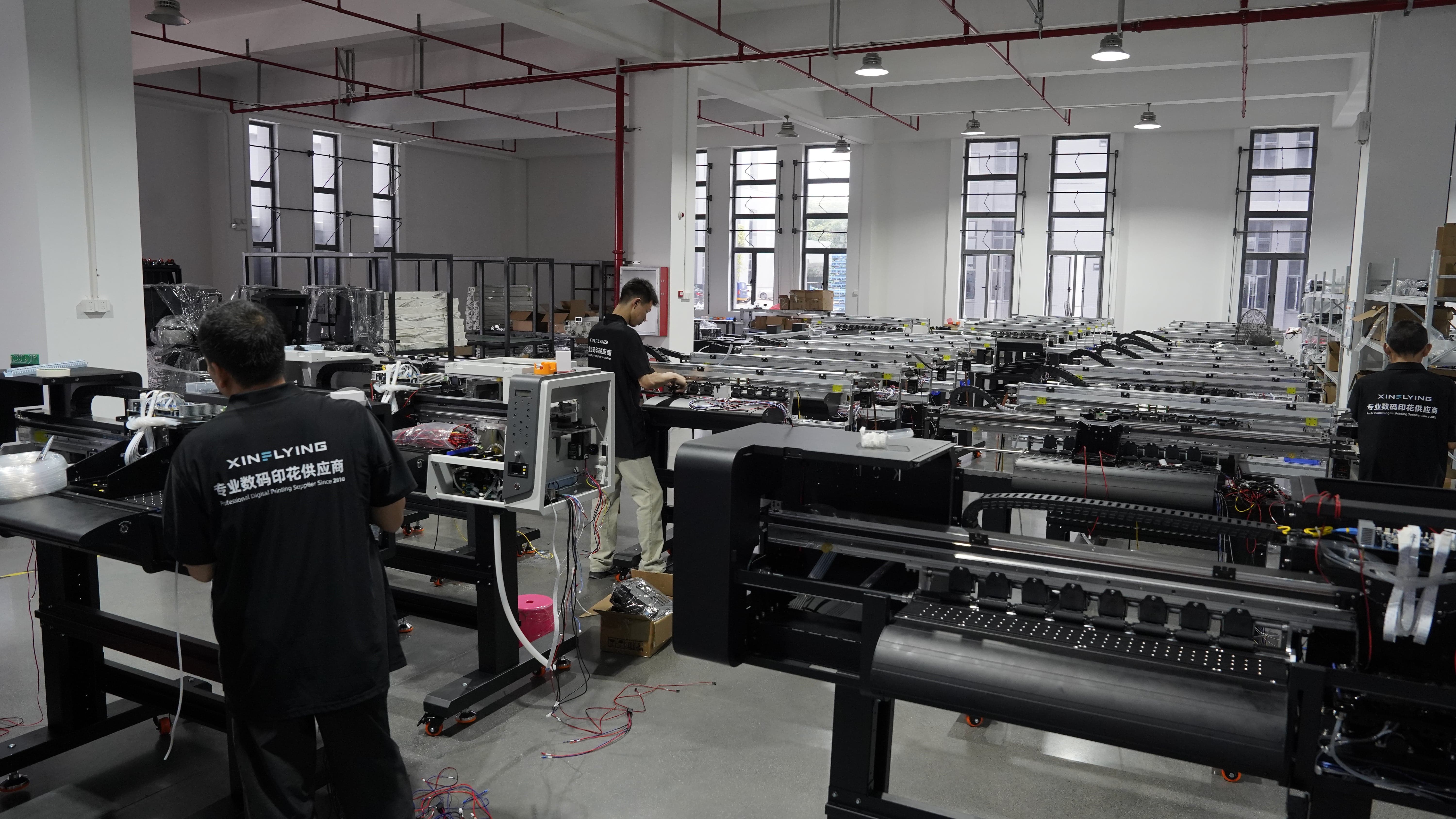
Technicians assemble DTF printer frames, wiring and electrical systems across multiple production stations inside the Xinflying factory in Panyu, Guangzhou.
Certification documents are the part of a supplier evaluation that most buyers skim and few read line by line. That is a problem, because the fields inside a certificate — scope, standards, model list, issuing body and validity dates — are the only parts of a supplier's capability claims that an independent third party has actually checked.
A DTF printer is a machine that combines a precision printhead assembly, a heated media path, a motorised film transport and, in many workflows, an adhesive powder stage. Each of those elements carries a different class of risk, and each is governed by a different standard. The certification set behind a manufacturer's export programme therefore says something specific about how the machine was engineered and tested — but only if the buyer knows what each document covers.
Guangzhou Xin Flying Digital Technology Co., Ltd. — trading as Xinflying — is a digital printing equipment manufacturer founded in 2010 in Panyu, Guangzhou, producing DTF printers, UV DTF printers, UV flatbed printers, DTG printers and dye sublimation systems. Its published documentation is detailed enough to use as a working example of how to read a factory certification file as evidence of production capability rather than as a marketing appendix.
Why Certification Documents Became a Procurement Filter
Direct-to-film printing has grown into a mainstream textile decoration process, and Europe has become its largest regional market: Grand View Research put Europe's share of DTF printing revenue at 36.0% in 2024, with the global DTF printing market valued at USD 2.7 billion that year. Markets of that size attract a long tail of suppliers, and buyers in regulated regions increasingly use compliance documentation as a first-pass filter before technical evaluation even begins.
The filter only works if it is applied precisely. Three failure modes appear repeatedly in supplier documentation packs:
- Expired documents. Quality management certificates and ink certifications run on fixed renewal cycles. A PDF that was valid when it was first circulated may no longer be valid at the time of order.
- Model mismatch. A certificate may cover a product family or a defined model list. A machine that is not named on the document is not covered by it.
- Scope mismatch. An ink certification is not a machine certification, and a quality management scope covering sales is not a manufacturing scope. Reading the scope line is often more informative than reading the certificate title.
The Certification Set Behind Xinflying DTF Printers
Xinflying's documentation spans six distinct document types: three CE-related conformity documents, an RoHS compliance certificate, an OEKO-TEX® ECO PASSPORT for printing inks, and an ISO 9001:2015 quality management certificate. The table below records the certificate numbers, issuing bodies and standards as published.
| Document | Certificate number | Issuing body | Scope and core standards |
|---|---|---|---|
| CE — Low Voltage Directive | TQT1550D271EC | TQT (Shenzhen Tianqi Testing Technology Service Co., Ltd.) | LVD 2014/35/EU; EN IEC 62368-1:2020/A11:2020. Issued 19 May 2026. |
| CE — Electromagnetic Compatibility | TQT1550D270EC | TQT | EMC Directive 2014/30/EU; EN 55032:2015/A11:2020, EN 55035:2017/A11:2020, EN IEC 61000-3-2:2019+A1:2021, EN 61000-3-3:2013/A2:2021. Issued 19 May 2026. |
| CE — Machinery Directive | M.2026.206.C142365 | UDEM | MD 2006/42/EC; EN ISO 12100:2010, EN 60204-1:2018/A1:2025, EN ISO 12643-1:2023. Issued June 2026; recorded validity to June 2031. |
| RoHS compliance | M.2026.206.C142366 | UDEM | Directive 2011/65/EU; EN IEC 63000:2018 and the EN IEC 62321 test-method series. Issued June 2026; recorded validity to June 2031. |
| OEKO-TEX® ECO PASSPORT | SH150194016 | TESTEX AG | Textile printing inks and printing pastes; OEKO-TEX® ECO PASSPORT, EN ISO 17050-1. Issued 11 December 2025; recorded validity to 31 December 2026. |
| ISO 9001:2015 | NOA2215496 | NOA Testing & Certification Group Co., Ltd. | Quality management system for digital printer and ink sales; GB/T 19001-2016 / ISO 9001:2015. Issued 26 December 2022; recorded expiry 25 December 2025. |
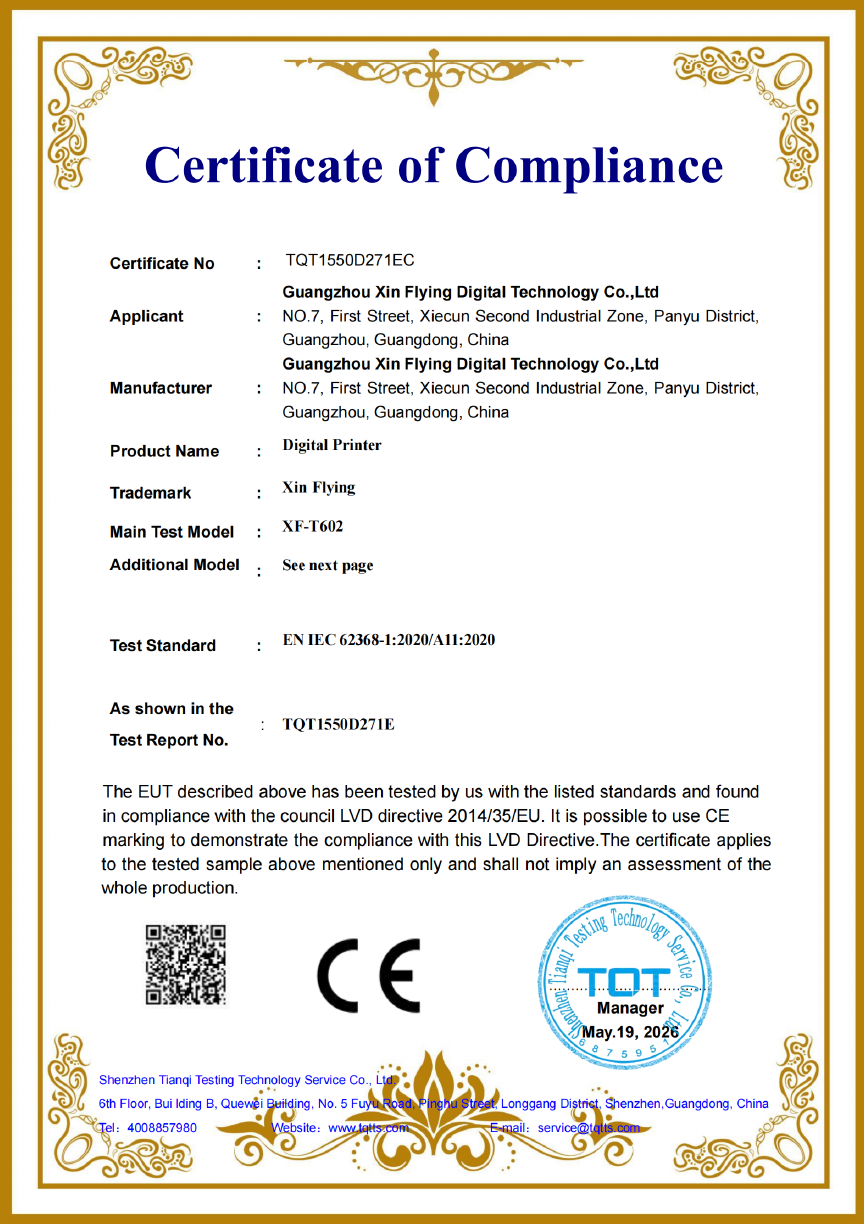
The CE Low Voltage Directive certificate (TQT1550D271EC) records an assessment against EN IEC 62368-1:2020/A11:2020.
Two further details matter because they indicate how the compliance programme has been maintained over time rather than assembled for a single order. First, the portfolio includes a combined CE LVD and EMC attestation issued by UDEM under certificate number M.2026.206.C142475 in June 2026, alongside the separate TQT documents — a duplicate route that typically appears when a manufacturer brings a second laboratory into the process. Second, earlier CE compliance certificates from BST Testing (Shenzhen) Co., Ltd., dated October 2021, and from CTIC Testing Group (Guangdong) Co., Ltd., dated August 2025, show that electrical and EMC testing has been repeated across multiple product generations and multiple testing houses.
What Each Standard Actually Tests
Low Voltage Directive: EN IEC 62368-1
EN IEC 62368-1 is the hazard-based safety standard applied to audio/video, information and communication technology equipment. In a DTF printer it addresses electrical energy hazards, insulation and earthing of the power section, and the safety of the control electronics. Because the standard is hazard-based rather than product-prescriptive, an assessment under it produces engineering documentation about the machine's power architecture — not merely a pass or fail outcome.
EMC: EN 55032, EN 55035, EN IEC 61000-3-2 and EN 61000-3-3
The four standards listed on the EMC certificate cover different halves of electromagnetic behaviour. EN 55032 limits the emissions the machine may produce; EN 55035 defines the immunity levels it must withstand. EN IEC 61000-3-2 limits harmonic current drawn from the supply, and EN 61000-3-3 addresses voltage fluctuations and flicker that the machine may cause on the supply network. For a print shop running several machines from one supply, the last two are not theoretical — they describe whether adding units creates measurable disturbance.
Machinery Directive: EN ISO 12100, EN 60204-1 and EN ISO 12643-1
The Machinery Directive assessment is the most equipment-specific part of the file. EN ISO 12100:2010 is the risk-assessment methodology standard; EN 60204-1:2018/A1:2025 governs the electrical equipment of machines; and EN ISO 12643-1:2023 sets safety requirements for graphic technology and printing press systems. A DTF printer presents hazards that a general electrical safety test does not cover — a moving film transport, a heated curing zone, and rotating or reciprocating drive components. Certification to EN ISO 12643-1 means the assessment was carried out against printing-industry requirements rather than generic machinery criteria.
RoHS: EN IEC 63000 and the EN IEC 62321 series
RoHS compliance under Directive 2011/65/EU is supported by two different document types in the Xinflying file. EN IEC 63000:2018 is the technical documentation standard — it defines how a manufacturer assembles and maintains evidence that restricted substances are controlled. The EN IEC 62321 series covers the analytical test methods used to measure them. A supplier that lists both the documentation standard and the test-method standards is providing a traceable trail, not only a declaration.
OEKO-TEX® ECO PASSPORT: certification at the ink level
The ECO PASSPORT certificate is issued for textile printing inks and printing pastes, which is a materially different scope from any machine certificate. It addresses the chemistry that ends up in contact with fabric and, ultimately, against skin. For DTF producers supplying apparel brands with restricted-substance policies, the ink certification is often the document that matters most. It is also worth separating from OEKO-TEX® STANDARD 100, which applies at the level of the finished textile article after production — the two are related but not interchangeable.
ISO 9001:2015: what the scope line says
The ISO 9001 certificate records a quality management system covering digital printer and ink sales activity. That is a meaningful scope for a buyer, because it implies documented procedures for order handling, supplier control and traceability — but it is not the same as certifying a manufacturing process. Buyers who want production evidence should read the scope wording and then ask for the process documentation behind it.
How to Verify a Certificate: Five Fields to Check
Verification does not require laboratory expertise. It requires reading five fields in a fixed order and stopping when one of them does not match the machine being quoted.
| Field | What to confirm | Why it matters |
|---|---|---|
| 1. Certificate number | The number on the document matches the number the supplier states in writing, and can be traced to the issuing body. | A number that appears only inside a sales document has no independent basis. |
| 2. Issuing body | The testing or certification organisation is named precisely, including its legal form — for example a named testing company in Shenzhen or an international certification centre. | Named, traceable bodies allow buyer-side checks. Unnamed 'international' authorities do not. |
| 3. Scope and standards | The directive and the standard numbers and years are listed, not summarised. | Standard years reflect revisions. An older year can mean the assessment predates relevant updates. |
| 4. Product and model coverage | The quoted model appears on the document's product list, and the configuration ordered matches the configuration assessed. | Certificates cover what was tested. Customisation can move a machine outside the assessed configuration. |
| 5. Validity | Issue and expiry dates are both present and current at the time of shipment. | Expired documents are the most common and most avoidable compliance failure. |
Coverage Across the Range: XF-C604 and XF-702E
The strongest single signal in a certification file is not the number of certificates. It is how many different machine configurations they cover. A supplier with one certified model has demonstrated that one product passed testing. A supplier whose certificate product lists span multiple power classes and printhead architectures has demonstrated a compliance process that runs across the range.
Both the XF-702E and the XF-C604 appear on the CE LVD, CE EMC, CE Machinery Directive, RoHS, OEKO-TEX® ECO PASSPORT and ISO 9001 documents listed above. The two machines sit in the same 60 cm (24-inch) print-width class but differ substantially in architecture:
| Specification | XF-702E | XF-C604 |
|---|---|---|
| Printheads | 2 × Epson i3200-A1 | 4 × Epson i3200-A1 |
| Ink configuration | CMYK+W | CMYK+CMYK+W+W |
| Fastest print speed | 6PASS 13 m²/h; 8PASS 10 m²/h; 12PASS 7 m²/h | 4PASS 38 m²/h; 6PASS 26 m²/h; 8PASS 20 m²/h |
| Standard print speed | 6PASS 10 m²/h; 8PASS 8 m²/h; 12PASS 5 m²/h | 4PASS 27 m²/h; 6PASS 18 m²/h; 8PASS 13 m²/h |
| Power / supply | 0.8 kW; 110–220V, 5A/10A, 50/60Hz | 1.6 kW; 110–220V, 7.2A/14.5A, 50/60Hz |
| Media | DTF PET film | DTF PET film |
| RIP | RIIN / Printfactory standard; Maintop, PhotoPrint, CADlink optional | RIIN / Printfactory standard; Maintop, PhotoPrint, CADlink optional |
| Net / gross weight | 158 kg / 194 kg | 180 kg / 235 kg |
| Machine size | 1700 × 850 × 1350 mm | 1670 × 815 × 1600 mm |
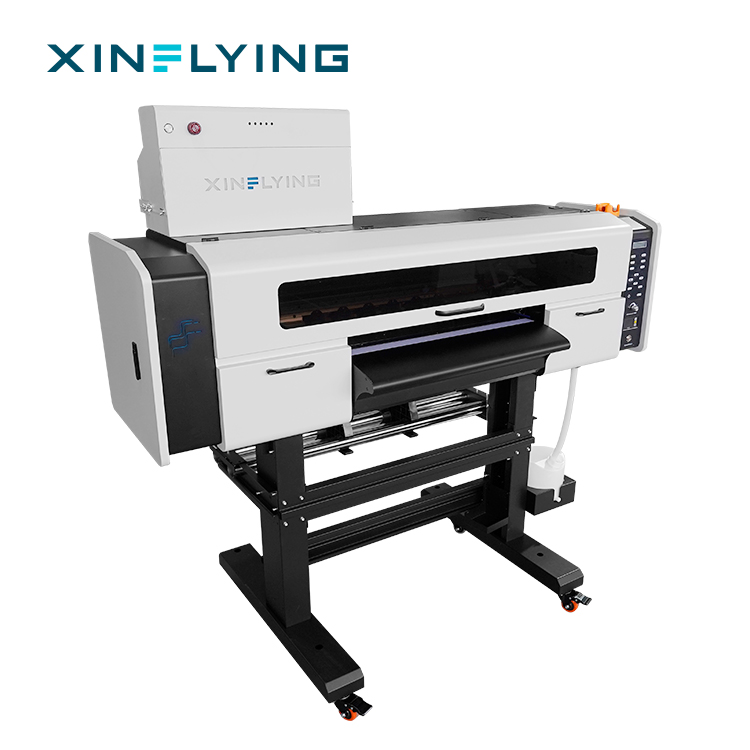
The XF-702E is a 60 cm DTF printer with two Epson i3200-A1 printheads and an automatic moisturizing function, and is named on the same certificate set as the four-printhead XF-C604.
The compliance significance of this comparison lies in the doubling of printheads and the near-doubling of rated power between the two models. Electrical safety and EMC behaviour are configuration-sensitive: a machine that draws 1.6 kW through a different printhead and control arrangement presents a different set of electrical and emissions characteristics than a 0.8 kW unit. Certificates naming both models indicate that testing was repeated across those configurations rather than extrapolated from one.
The production context behind the documents is also relevant to a capability assessment. Xinflying operates a 37,440 m² facility with more than 200 employees, a 20-engineer R&D team, a stated monthly capacity of 1,600+ units and an annual output of more than 20,000 units, with roughly 80% of production exported to North America, South America, Europe, Asia, the Middle East and Africa. Products are accepted through pre-shipment test procedures, the minimum order quantity is 1 unit, and standard lead time runs 5–40 days. A quality management system that has to function at that volume is a different proposition from one supporting occasional batch production — which is precisely why buyers look for the certificate rather than the claim.
Market Trend Analysis: Compliance as a Shortlisting Criterion
Market data supports the direction of travel, though it should be read with care. Grand View Research valued the global DTF printing market at USD 2.7 billion in 2024 and identified Europe as the leading region with a 36.0% revenue share. Dataintelo reported that industrial DTF printers accounted for 58.3% of total revenue in 2025, reflecting the shift toward higher-throughput systems, and that China accounts for more than 45% of global DTF printer manufacturing capacity. The concentration of manufacturing in one region, combined with the compliance requirements of the largest consuming region, is what makes documentation a purchasing issue rather than an administrative one.
Growth forecasts, however, diverge substantially between research houses. Published DTF market growth rates include figures around 6.0% (Grand View Research, 2025–2030), 6.77% (360iResearch, 2026–2032) and 12.5% (Dataintelo, 2026–2034). Buyers should treat any single figure as a directional indicator rather than a planning input. The same caution applies to certification: a document proves what was assessed on a specific date, not what the market will require next year.
Where Certification Evidence Stops
Certification is a strong but bounded form of evidence, and buyers who over-read it make a different class of mistake from buyers who ignore it. Four boundaries are worth stating plainly.
- Certificates do not measure production performance. No CE document, RoHS certificate or quality management certificate evaluates print resolution, colour consistency across a shift, registration accuracy, uptime or consumable consumption. Those questions are answered by sample printing, reference checks and trial production — not by compliance paperwork.
- Scope language limits what is covered. The ISO 9001 certificate in this portfolio covers a quality management system for digital printer and ink sales, and the OEKO-TEX® ECO PASSPORT covers printing inks and pastes. Neither is a manufacturing process certification or a machine performance certificate.
- Validity is not implied by possession. As noted above, the recorded ISO 9001 validity ran to 25 December 2025. Buyers must check dates on every document in the pack at the time of order, not at the time of first contact.
- Customisation can change the assessed configuration. Xinflying offers OEM services covering product branding, logo and packaging customisation, and ODM services covering machine appearance, colour customisation and customised solutions. Appearance, branding and packaging changes generally do not alter the electrical or mechanical design, but a buyer specifying deeper customisation should confirm in writing whether the certificate's model coverage still applies to the delivered unit.
There is also a market-coverage boundary. The CE documents in this portfolio address European Union requirements for electrical safety, electromagnetic compatibility, machinery safety and restricted substances. Buyers importing into other regulatory regimes must establish the applicable local requirements separately rather than treating an EU pack as universal.
Future Outlook
Two shifts are likely to shape how DTF printer certification is used in procurement over the next few years. The first is the rising weight of ink-level documentation. As apparel brands extend restricted-substance requirements down their supply chains, transfer producers are increasingly asked to evidence the chemistry they print with, not only the equipment they print on. Certifications such as ECO PASSPORT sit directly in that path, and their annual renewal cycle keeps them current in a way that one-off equipment tests do not.
The second is the normalisation of verification as a buyer-side routine. As more buyers learn to read a certificate number, an issuing body and a scope line, documentation packs that rely on volume rather than precision become less persuasive — and manufacturers that maintain multi-model, multi-laboratory certification histories gain a durable advantage in shortlisting. The likely outcome is not more certificates, but better-matched ones: documents whose scope, model coverage and validity dates align exactly with the machine being quoted.
FAQ
Which certifications should I check before importing a DTF printer for my printing business?
At minimum, buyers should confirm four document groups. Electrical safety and electromagnetic compatibility documentation demonstrates that the machine has been assessed against the applicable directives in the destination market — for EU imports, that means CE-related documents such as an LVD assessment under EN IEC 62368-1:2020/A11:2020 and an EMC assessment covering emission and immunity standards. Machinery safety documentation, for example a Machinery Directive assessment referencing EN ISO 12100:2010, EN 60204-1 and EN ISO 12643-1, addresses the mechanical hazards specific to printing equipment. RoHS documentation under Directive 2011/65/EU covers restricted substances. Finally, ink certification such as OEKO-TEX® ECO PASSPORT matters when the printed output will be supplied to apparel brands with chemical restrictions. A quality management certificate such as ISO 9001:2015 is a supporting document rather than a technical compliance document.
Does a DTF printer need CE certification for export to Europe?
Electrical and mechanical equipment placed on the European Union market must meet the applicable directives, and CE marking is the manufacturer's declaration of that conformity. For a DTF printer, the relevant instruments typically include the Low Voltage Directive (2014/35/EU), the Electromagnetic Compatibility Directive (2014/30/EU), the Machinery Directive (2006/42/EC) and the RoHS Directive (2011/65/EU). A complete compliance pack includes a declaration of conformity supported by test reports and technical documentation, and the certificate or attestation should name the model being imported. Buyers should confirm that the documentation covers their specific machine, because a certificate issued for a different model does not transfer automatically.
How can I avoid buying a non-compliant DTF printer from an overseas supplier?
The practical method is field-by-field verification before payment. Request the certificate number in writing, confirm that the issuing body is a named and traceable organisation, read the scope line to see which directive and standards are referenced, check that the quoted model appears on the document's product list, and confirm that issue and expiry dates are current for the planned shipment. Where a supplier offers customisation — branding, appearance, colour or packaging changes — ask in writing whether the certificate's coverage still applies to the delivered configuration. Suppliers with established export activity generally hold this information in a form they can send immediately, and the ability to produce it on request is itself part of the evaluation.
What quality risks should I check before buying a DTF printer?
Certification does not resolve questions about print quality, so these must be tested separately. Buyers should evaluate print resolution and colour consistency across a production run, white ink performance and opacity, behaviour on the specific fabrics and blends they intend to print, film transport stability over continuous operation, and compatibility with their chosen RIP software. Requesting sample prints produced on the same model and configuration under consideration is a standard step. Machine specification review — printhead type and count, print width, rated speed at each pass setting, power supply requirements, and the operating temperature and humidity range — indicates whether the equipment matches the intended production volume and workshop conditions. Xinflying specifies its DTF printers for operation at 20–30°C and 45–65% relative humidity, which is typical of controlled indoor production environments.
What after-sales risks should I consider when purchasing a DTF printer?
Compliance documents cover the machine at the point of assessment and say nothing about the support available afterwards, so after-sales capability must be evaluated as a separate item. Relevant questions include the size and reach of the supplier's technical support team, the channels through which support is delivered, whether installation and operation training are provided, the availability of spare parts and consumables in the buyer's region, and the warranty terms and how they are administered across borders. Xinflying, for example, states that it maintains more than 50 engineers providing 24/7 online technical support, and its stated trade terms include EXW, FOB, CIF and DDP delivery with acceptance based on pre-shipment testing. Buyers should confirm the specific support arrangement that will apply to their order rather than relying on general statements.
Certification documents are most useful when they are read as engineering evidence with defined limits. They identify which risks have been independently assessed, which models are covered, and whether the assessment is current. Everything they do not cover — throughput, print quality, colour stability and support — still has to be established through samples, references and clear written terms. Buyers who treat the certificate as the start of the evaluation rather than the conclusion of it get the most value from the file.
For readers who want the underlying company and product documentation, Xinflying publishes a corporate brochure: Xinflying corporate brochure (PDF).