
What FARFLY's Certification Portfolio Covers in PVC Flooring
In commercial PVC flooring, the evaluation stage rarely starts with a sample. It starts with a document set. Buyers comparing suppliers are asked to confirm which standards a product was tested against, who issued the report, which models the document actually names, and whether it is still valid on the day the purchase order is signed. A certificate register, read properly, is not a marketing page. It is capability evidence.
The global PVC floor market was estimated at USD 1.94 billion in 2026, with an outlook running to 2035 (Business Research Insights). The segments that carry the heaviest documentation burden — aviation interiors, certified sports halls, healthcare and high-traffic commercial space — are also the segments where a supplier either holds the paperwork or leaves the shortlist before pricing is discussed.
FARFLYING FLOORING (Wuxi Tefa Decoration Material Co., Ltd.) is a resilient flooring manufacturer founded in 2012 and based in Wuxi, Jiangsu, China, running six production lines for homogeneous vinyl flooring, PVC sports flooring and aircraft flooring. The company reports 300,000 sqm of ready-to-ship inventory and a seven-day dispatch model for export orders.
This article reads the FARFLY certification portfolio the way an evaluating buyer would: by sector, by standard, by issuing body, by certificate number, and by the product models each document names. It then sets out where the same portfolio stops short — because a register presented only as a strength is not a register a buyer can work with.
Why a certificate register became a shortlisting filter
Commercial PVC flooring sits across at least four separate compliance regimes at once. Aviation interiors reference 14 CFR 25.853 in the United States, CCAR 25.853 in China and EASA CS-25.853 in Europe, plus airframe-maker specifications such as Boeing D6-36075. Sports flooring is governed by performance standards such as EN 14904 for indoor sports surfaces, EN 13501-1 for reaction to fire and EN 14372 for phthalate content. General commercial flooring placed on the EU market is declared under EN 14041 through CE marking. Factory-level assurance runs on the ISO 9001, ISO 14001 and ISO 45001 family.
Each of those documents answers a different question, and a distributor serving several project types usually needs more than one. A single-sector supplier can satisfy an airport refurbishment or a school gymnasium, but rarely both. Multi-sector coverage is what EPC contractors and import distributors test first, because it decides whether one purchase order can be split across mixed applications without re-qualifying a second vendor mid-project.
The gap is rarely the certificate itself. It is the mapping. Many supplier pages display a wall of logos; very few state which standard, which issuing body, which certificate number, which validity window, and — most importantly — which product models the document covers. That mapping is the difference between a claim and usable evidence.
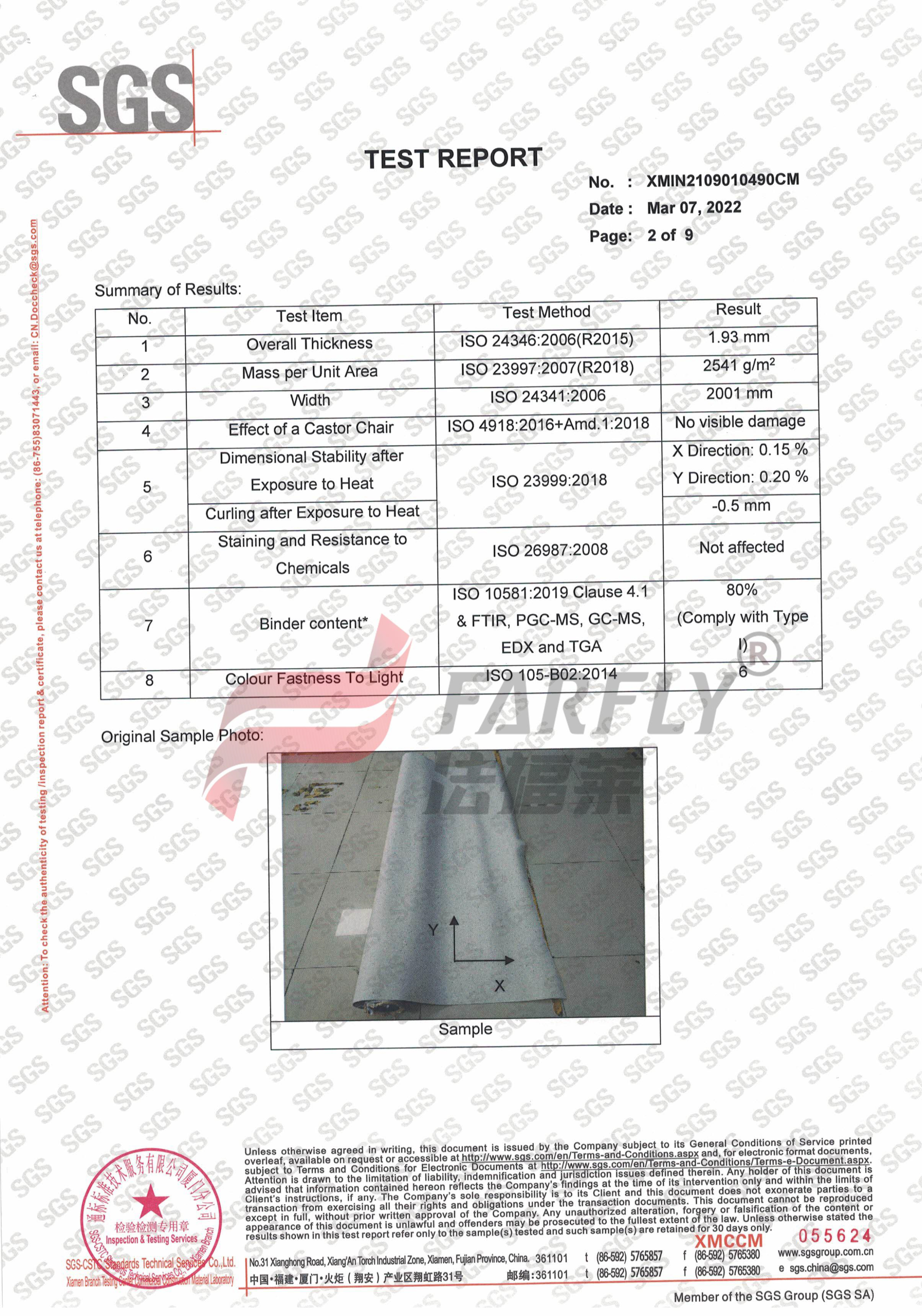
A physical property test report is only useful to a buyer once the model, the method and the issuing laboratory are readable on the same page.
The portfolio, sector by sector
FARFLY's documentation divides cleanly along product lines. Aviation reports name the aircraft flooring range; sports reports name the Boguan sports line; the CE declaration and physical property reports cover the vinyl and homogeneous series; the ISO certificates cover the company's management system.
| Sector | Standard / method | Issuing body | Certificate no. | Product line named | Validity |
|---|---|---|---|---|---|
| Aviation | CCAR 25.853(a) & App. F Part 1; EASA CS 25.853(a) & App. | CAAC | TC-ZR-20231549 | LY, SMY, MMY, MY, BY, WD | Issued 2023-07-28 |
| Aviation | D6-36075 F Table 4 | CAAC | TC-ZR-20231565 | LY, SMY, MMY, MY, BY, WD | Issued 2023-07-28 |
| Sports | EN 14904-2006 with EN 14809, EN 13036-4, EN ISO 5470-1, EN 1517, EN 1569, EN 1516, EN 14041, EN 12673, EN 717-1 | OTC | HQR170310004-02 | Boguan | Issued 2017-05-16 |
| Sports | EN 13501-1:2007; EN ISO 9239-1:2010; EN ISO 11925-2:2010 | OTC | HQR170310004-01 | Boguan | Issued 2017-05-12 |
| Sports | EN 14372:2004 (phthalates, GC-MS) | ETS | ETS19030602C | Boguan | Issued 2019-03-26 |
| Commercial | EN 14041:2018 (CE marking) | ICR Co. Ltd. | TCF-OY20250623-CPR | Vinyl / homogeneous range | 2025-06-26 to 2030-06-25 |
| Commercial | ISO 24346:2006, ISO 23997:2007, ISO 4918:2016, ISO 29333:2018, ISO 26987:2008, ISO 10581:2019, ISO 105-B02:2014 | SGS | XMIN2109010490CM | Vinyl Flooring (homogeneous series) | Issued 2022-03-07 |
| Management | ISO 9001:2015 | AUBURN | 29524Q04072R0S | Company scope | 2024-11-25 to 2027-11-24 |
| Management | ISO 14001:2015 | AUBURN | 29524E04073R0S | Company scope | 2024-11-25 to 2027-11-24 |
| Management | ISO 45001:2018 | AUBURN | 29524S040725R0S | Company scope | 2024-12-23 to 2027-12-22 |
Certificate mapping as published in FARFLY's certification materials. Report numbers and issuing bodies are reproduced as stated; product line coverage follows the documents.
Aviation: two CAAC reports, one model family
The aviation documents are the most specific in the set. Both were issued by CAAC, the Civil Aviation Administration of China, on 28 July 2023, and both name the same aircraft flooring family: models LY, SMY, MMY, MY, BY and WD.
Certificate TC-ZR-20231549 is a 12-second vertical combustion test report referencing CCAR 25.853(a) and Appendix F Part 1 together with EASA CS 25.853(a) and its appendix. The scope covers flame spread, self-extinguishing behaviour, heat release, smoke density and drip characteristics for cabin flooring use.
Certificate TC-ZR-20231565 is a smoke toxicity test referencing D6-36075 F Table 4 — the Boeing specification that evaluates flammability and safety performance of vinyl aircraft flooring systems, including flame resistance, heat release, smoke density, toxicity and self-extinguishing behaviour. For MRO buyers and cabin refurbishment contractors working to an airline specification rather than a purely national one, that reference is the more commercially meaningful of the two.
Sports: two OTC reports and one phthalate test
Two OTC reports issued in 2017 cover the Boguan sports flooring line. HQR170310004-01 addresses reaction to fire under EN 13501-1:2007, supported by EN ISO 9239-1:2010 and EN ISO 11925-2:2010. HQR170310004-02 covers physical and chemical properties across a broader method set that includes EN 14904-2006 for indoor sports surfaces, EN 14809 for vertical deformation, EN 13036-4 for slip resistance, EN ISO 5470-1 for abrasion, EN 1517 and EN 1569 for impact and rolling load behaviour, plus EN 1516, EN 14041, EN 12673 and EN 717-1 for formaldehyde release.
A third document, ETS19030602C issued by ETS on 26 March 2019, is a phthalate test under EN 14372:2004 analysed by GC-MS. It addresses plasticisers, phthalates, solvents and VOCs in the sports product — the question most often raised by school, municipal and public-tender buyers before a specification is approved.
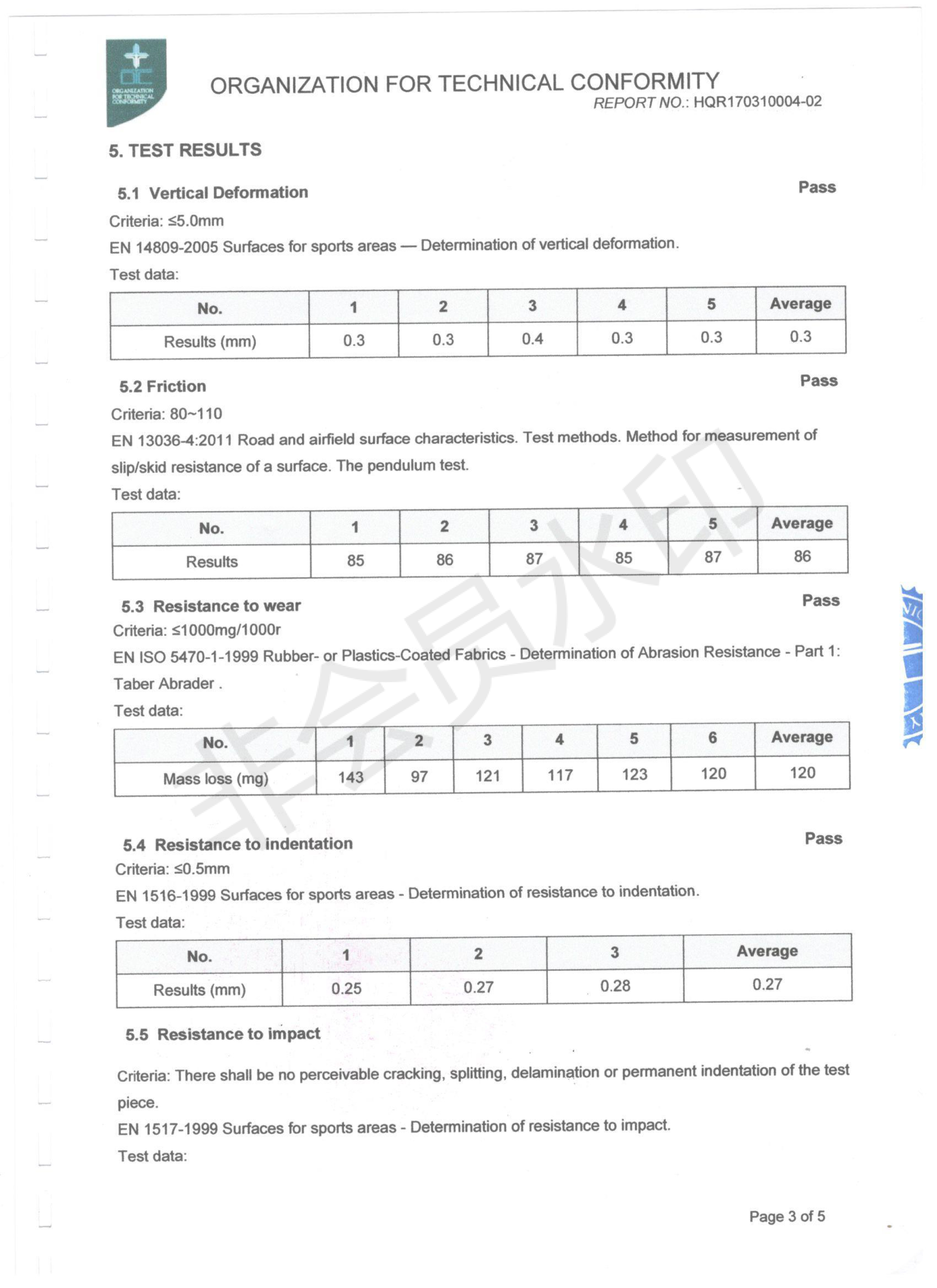
EN 14904 is the performance standard behind indoor sports surfaces; the OTC report ties it to a named product line rather than a general category claim.
General commercial: CE marking and the ISO 24346 series
The commercial range is covered by CE marking under EN 14041:2018, certificate TCF-OY20250623-CPR issued by ICR Co. Ltd. and valid from 26 June 2025 to 25 June 2030. It is the newest document in the portfolio and the one that governs placement of the product on the EU construction market.
An SGS report, XMIN2109010490CM dated 7 March 2022, covers the homogeneous vinyl series against a group of ISO methods: ISO 24346:2006 for residual indentation, supported by ISO 23997:2007, ISO 4918:2016, ISO 29333:2018, ISO 26987:2008, ISO 10581:2019 and ISO 105-B02:2014. Together these address dimensional stability, flexibility, wear resistance, chemical resistance, classification requirements and colour fastness to light.
Management systems: three AUBURN certificates
ISO 9001:2015 (29524Q04072R0S, 25 November 2024 to 24 November 2027), ISO 14001:2015 (29524E04073R0S, same window) and ISO 45001:2018 (29524S040725R0S, 23 December 2024 to 22 December 2027) were all issued by AUBURN Inspection & Certification Group. The stated scope is the sale of decoration materials and sports competition supplies, together with the related environmental and occupational health and safety management activities at the sites involved. That wording is worth reading slowly: it certifies the described sales and management activity, which is not the same claim as certifying every production step.
What the test values actually mean
The aviation result is easiest to read against the regulation it references. 14 CFR 25.853(b) requires floor coverings to be self-extinguishing when tested vertically, with an average burn length not over 8 inches and an average flame time after removal of the flame source not over 15 seconds. FARFLY's 12-second vertical test records a sustained burning duration of zero, a droplet burning time of zero, a burn length of 24 mm and a smoke toxicity result of pass. Against the 8-inch burn-length allowance, the recorded figure sits well inside the limit — the kind of margin a cabin specifier looks for when the material has to survive a certification programme the flooring supplier does not control.
Sports flooring performance is reported as a compact set of physical values, and each answers a different design question for the specifier.
| Reported value | Measured result | What it tells a buyer |
|---|---|---|
| Ball bounce | 95% | How consistently the surface returns a ball, which affects training and competition behaviour. |
| Friction coefficient | 0.56 | Grip available for push-off and pivoting; slip and joint load sit on either side of the right value. |
| Vertical deformation | 0.3 mm | How far the surface yields under a point load — the shock-absorption side of sports performance. |
| Impact resistance | 0.35 mm | Resistance to localised damage from equipment and footfall. |
| Wear resistance | 120 mg | Material lost under standard abrasion testing. |
| Indentation resistance | 0.27 | Recovery after sustained static load, such as stacked seating or equipment. |
| Pentachlorophenol | Not detected | Absence of a restricted preservative compound in the tested product. |
Sports range values as reported in FARFLY's physical and chemical property documentation for the Boguan line.
The homogeneous vinyl series runs to 2 mm as standard, with 2.5 mm and 3 mm available, supplied in 2 x 20 m rolls. Declared values include fire rating B-S1, antibacterial performance of 99.50%, residual indentation of 0.06 mm, abrasion resistance class T, anti-slip property R9 and a 28-day TVOC figure below 10 μg/m³. For healthcare, laboratory and electronics environments, that combination — low residual indentation, high abrasion class and low emission — is the part of the file that matters, not the fire certificate.
Where the evidence is applied
In Australia, a 16-court badminton installation used the sports range across a ten-year service horizon. Reported outcomes were 50% less maintenance required than standard flooring, cushioning that protects knees and ankles, and straightforward installation. The maintenance figure is the one that changes a facilities budget conversation: on a multi-court venue, halving routine maintenance is a recurring saving rather than a one-off purchase difference.
On the aviation side, the named models are listed for aircraft, private jet, helicopter and cargo aircraft interiors, with galley flooring among the applications. That is a narrow application set by design — the documents are specific, and so is the use.
The homogeneous range extends into healthcare and electronics settings through an ESD series holding resistance in the 10^4 to 10^6 Ω range, which the company reports is used by technology manufacturers including Huawei. In hospitals and clinics the same series is specified for its antibacterial and chemical resistance profile; in schools, shopping malls and exhibition halls, for abrasion class T and 0.06 mm residual indentation under rolling and static loads.
For high-traffic commercial space — airport terminals, stations, retail concourses — the decisive evidence is the pairing of ISO 24346 residual indentation with class T abrasion, not the fire report. Buyers frequently invert that priority and end up specifying the wrong document for the load case in front of them.
Market trend: certification density as a differentiator
Sports certification is itself tiered. The Badminton World Federation certifies flooring in three grades: Grade 1 (International Elite), Grade 2 (International Standard) and Grade 3 (Basic). The existence of grades changes how any claim of BWF certification should be read — the grade, not the word, determines whether a surface suits elite competition or recreational play. FARFLY's company profile reports BWF certification for its athletic vinyl flooring, which uses an 8-way fibreglass mesh for shock absorption; the grade is not stated in the material available for this review, so a buyer should request the approval letter before writing it into a specification.
Two shifts follow from that. First, buyers are moving from certificate counts to certificate mapping: instead of asking how many certifications a supplier holds, they ask which models are covered by which document, and when it expires. Second, validity windows are being tracked as procurement dates. In this portfolio the CE declaration runs to 25 June 2030 and the three ISO certificates renew in late 2027 — dates that belong in a supplier file, not in a brochure.
Against a market estimated at USD 1.94 billion in 2026, the practical consequence is that documentation depth is becoming a segment-selection tool. Suppliers with aviation, sports and commercial evidence can bid across mixed-use portfolios; suppliers with one class of document increasingly compete on price inside a single segment.
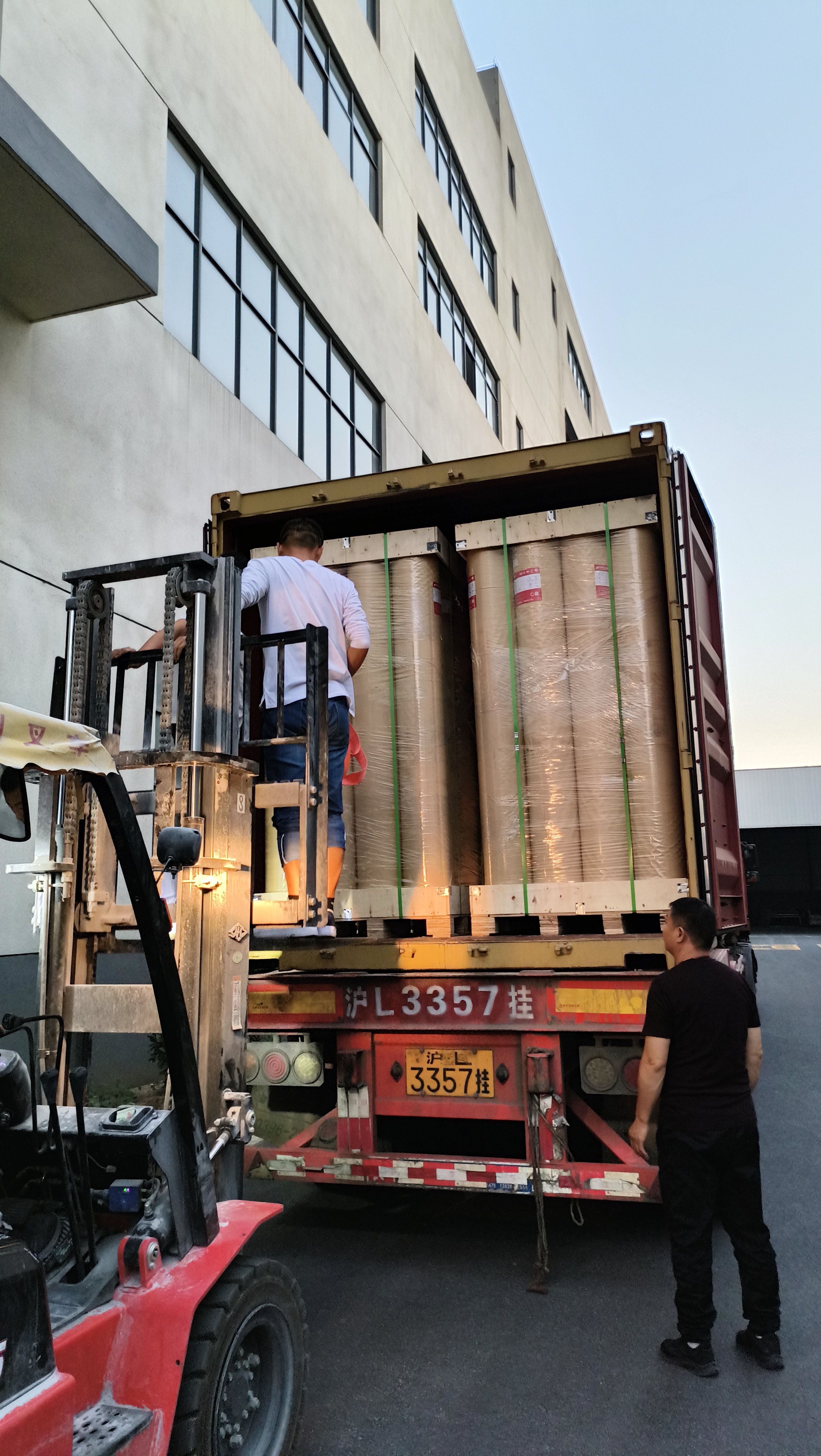
Ready stock and dispatch claims sit alongside certificates in a supplier file — but they are operating claims that need SKU-level confirmation.
Comparison with traditional surfaces, and where the portfolio stops short
Against traditional hard surfaces, the documented difference is not aesthetic. Ceramic tile and hardwood are jointed systems: joints are where dirt, moisture and impact concentrate, and where maintenance hours accumulate. A welded PVC roll produces a continuous sheet, which is why a badminton venue can report a maintenance reduction over ten years. On fire performance, the homogeneous range carries a B-S1 declaration and the sports range carries an EN 13501-1:2007 reaction-to-fire report, so a specifier comparing PVC with timber or rubber should place the two declarations side by side rather than compare marketing statements. On comfort, the sports values — 0.3 mm vertical deformation, 95% ball bounce, 0.56 friction coefficient — describe a surface engineered to a performance target, which is a different proposition from a generic resilient sheet.
A portfolio is only useful if its boundaries are visible. Six apply here.
- Model scope. The aviation documents name LY, SMY, MMY, MY, BY and WD; the sports documents name Boguan; the CE declaration and the SGS report cover the vinyl and homogeneous range. A certificate does not travel across a range. A buyer specifying a different model should request the matching report, not a reference to the portfolio as a whole.
- Certificate scope. The ISO 9001, ISO 14001 and ISO 45001 certificates describe the sale of decoration materials and sports competition supplies and the related management activities at the sites involved. That is narrower than an assumption of full manufacturing coverage, and a buyer auditing a factory should confirm which production steps sit inside the certified scope.
- Slip classification. The available documents declare R9 anti-slip for the homogeneous range and a friction coefficient of 0.56 for the sports range. No R11 classification appears in the material reviewed. Projects specifying R11 — common in commercial kitchens, industrial plants and some public wet areas — need a separate test on the exact model.
- Test evidence versus approval. The aviation reports are test evidence against CCAR 25.853, EASA CS 25.853 and Boeing D6-36075. They are not airframe OEM part approvals, and they do not by themselves authorise installation on a specific aircraft type. The airline or the STC holder still owns that step.
- Unverified operating claims. The 300,000 sqm ready stock, the seven-day dispatch model and the 50% maintenance reduction are company-reported or case-reported figures. Stock is SKU-specific: a warehouse total says nothing about whether the exact roll, thickness and colour a project needs is on the floor today.
- Installation. No certificate covers substrate moisture, adhesive choice, acclimation, welding temperature or cure time. A compliant roll installed over a wet screed still fails, and the failure will be attributed to the product.
Future outlook
Three developments are likely to shape how portfolios like this one are read over the next few years.
Documentation-first procurement. As public and institutional projects tighten verification requirements, the supplier that can hand over a mapped register — standard, issuer, number, model, validity — compresses the qualification cycle. The supplier that hands over a logo wall lengthens it.
SKU-level traceability. Certificates are increasingly checked at model level rather than brand level. Expect buyers to request the report for the exact model in the purchase order, together with its expiry date, as a standard line in the RFQ.
Renewal as a signal. The CE declaration under EN 14041:2018 runs to 2030 and the ISO certificates renew in late 2027. Suppliers that manage renewal early keep their shortlist position; lapses are visible to any buyer who checks the register.
For FARFLY, the strategic question is not whether more certificates can be added. It is whether the existing portfolio can be mapped more precisely — for example by publishing the BWF grade, an R11 test if one exists, and SKU-level stock visibility. Those three items, more than any additional logo, would move the file from evidence of capability to evidence of availability.
FAQ
Which certification should a buyer request first for aviation PVC flooring?
Start with the 12-second vertical combustion test report and the smoke toxicity report for the exact model. FARFLY's documents are TC-ZR-20231549 (CCAR 25.853(a) and EASA CS 25.853(a)) and TC-ZR-20231565 (D6-36075 F Table 4), both issued by CAAC on 28 July 2023 and both naming models LY, SMY, MMY, MY, BY and WD. Confirm that the model on the purchase order matches the model on the report.
Does a certificate for one product model cover the rest of a supplier's range?
No. Test reports are issued against specific models, and in this portfolio the documents divide along product lines: the aviation reports name LY, SMY, MMY, MY, BY and WD; the OTC and ETS sports reports name Boguan; the CE declaration and the SGS report cover the vinyl and homogeneous series. A buyer specifying another model should request the corresponding report rather than an assurance that the portfolio applies.
How does FARFLY's aviation burn result compare with the FAA requirement?
14 CFR 25.853(b) requires floor coverings to be self-extinguishing under vertical testing, with an average burn length not over 8 inches and an average flame time after removal of the flame source not over 15 seconds. FARFLY's 12-second vertical test reports zero sustained burning, zero droplet burning time, a burn length of 24 mm and a smoke toxicity pass.
What do the sports flooring values mean in practice?
Ball bounce of 95% describes how consistently the surface returns a ball. A friction coefficient of 0.56 describes grip for push-off and pivoting. Vertical deformation of 0.3 mm, impact resistance of 0.35 mm and indentation resistance of 0.27 describe behaviour under load. Wear resistance of 120 mg describes material loss under abrasion. Pentachlorophenol was not detected in the tested product.
Is BWF certification the same as EN 14904 testing?
No. EN 14904 is a European performance standard for indoor sports surfaces and is covered here by OTC report HQR170310004-02. BWF certification is a separate equipment approval issued by the Badminton World Federation, which certifies flooring in three grades — Grade 1 International Elite, Grade 2 International Standard and Grade 3 Basic. The two answer different questions, and a badminton specification normally needs both.
How current is the certification portfolio?
The newest document is the CE declaration under EN 14041:2018, certificate TCF-OY20250623-CPR issued by ICR Co. Ltd., valid to 25 June 2030. The ISO 9001 and ISO 14001 certificates run to 24 November 2027 and ISO 45001 to 22 December 2027. The SGS physical property report dates from 7 March 2022, the ETS phthalate report from 26 March 2019 and the OTC sports reports from May 2017. The ages differ, so check which document the project specification actually requires.
What should a buyer verify beyond the certificate?
Certificate scope and model coverage, the issuing body and report number, the validity date, and whether the document is test evidence or an approval. Beyond the documents, verify SKU-level stock against the quoted delivery date, installation conditions including substrate moisture and adhesive, and whether the project requires a classification absent from the portfolio, such as R11 slip resistance.
Does the portfolio prove product quality?
It proves that defined models were tested to defined methods by named bodies on stated dates. It does not prove installed performance, batch-to-batch manufacturing consistency, or availability of a specific SKU. Those require separate verification.
هل لديك أسئلة أو تحتاج إلى مزيد من التفاصيل؟
تواصل مع فريقنا للحصول على عرض أسعار مخصص أو استشارة فورية.
طلب عرض أسعار
املأ النموذج أدناه وسيتواصل معك فريقنا بعرض مقترح مخصص.
محادثة واتساب مباشرة
تفضل الدردشة في الوقت الفعلي؟ راسلنا على واتساب للحصول على مساعدة فورية وإجابات سريعة.
- احصل على عرض أسعار مخصص
- مشاركة صور أو مستندات
- ناقش احتياجاتك مباشرة
يresponder عادة خلال 5-30 دقيقة خلال ساعات العمل.