
What Full-Service Aerosol OEM Means for Buyers
The global aerosol market was estimated at approximately USD 100.49–100.87 billion in 2025 and is projected to reach more than USD 211 billion by 2035, according to Precedence Research and Market Research Future. Those figures cover a product range that goes far beyond air fresheners and insecticides. Household cleaning aerosols, car care sprays, industrial maintenance products, disinfectants, aviation aerosols, and spray paints all move through the same type of manufacturing infrastructure: aerosol filling and packaging. For buyers evaluating an OEM/ODM or private label project, the meaningful question is not just whether a factory has a filling line. It is whether the same manufacturer can support formulation, packaging customization, regulatory compliance, and production capacity as a single accountable service.
Why Aerosol OEM Capability Is Hard to Evaluate
Aerosol products sit in a difficult position between consumer chemistry and industrial safety regulation. In the European Union, the Aerosol Dispensers Directive (ADD) requires aerosol dispensers to resist deformation and pass burst tests at pressure levels that can reach 10–15 bar depending on the propellant type. In China, the Hazardous Chemicals Safety Law took effect on May 1, 2026, introducing whole-lifecycle safety management of production, storage, and transport for chemicals including aerosols. These rules are not optional extras; they shape how a product must be formulated, filled, packaged, and documented.
For a buyer, this creates a verification problem. A supplier can present itself as an aerosol OEM, yet only operate standard filling services. Customization in aerosols is not limited to choosing a fragrance. It includes formula stability under pressure, can size and material selection, valve and actuator configuration, label and printing requirements, and compatibility with target-market regulations. When a buyer evaluates capability, the real task is to establish whether the manufacturer can control the full chain from formula to finished can.
The opportunity is equally clear. Buyers who source from a manufacturer with in-house R&D, analytical laboratories, filling capacity, and valid compliance certificates can compress the development cycle, reduce coordination between separate vendors, and maintain a cleaner chain of accountability when problems appear.
LAYA as a Capability Reference
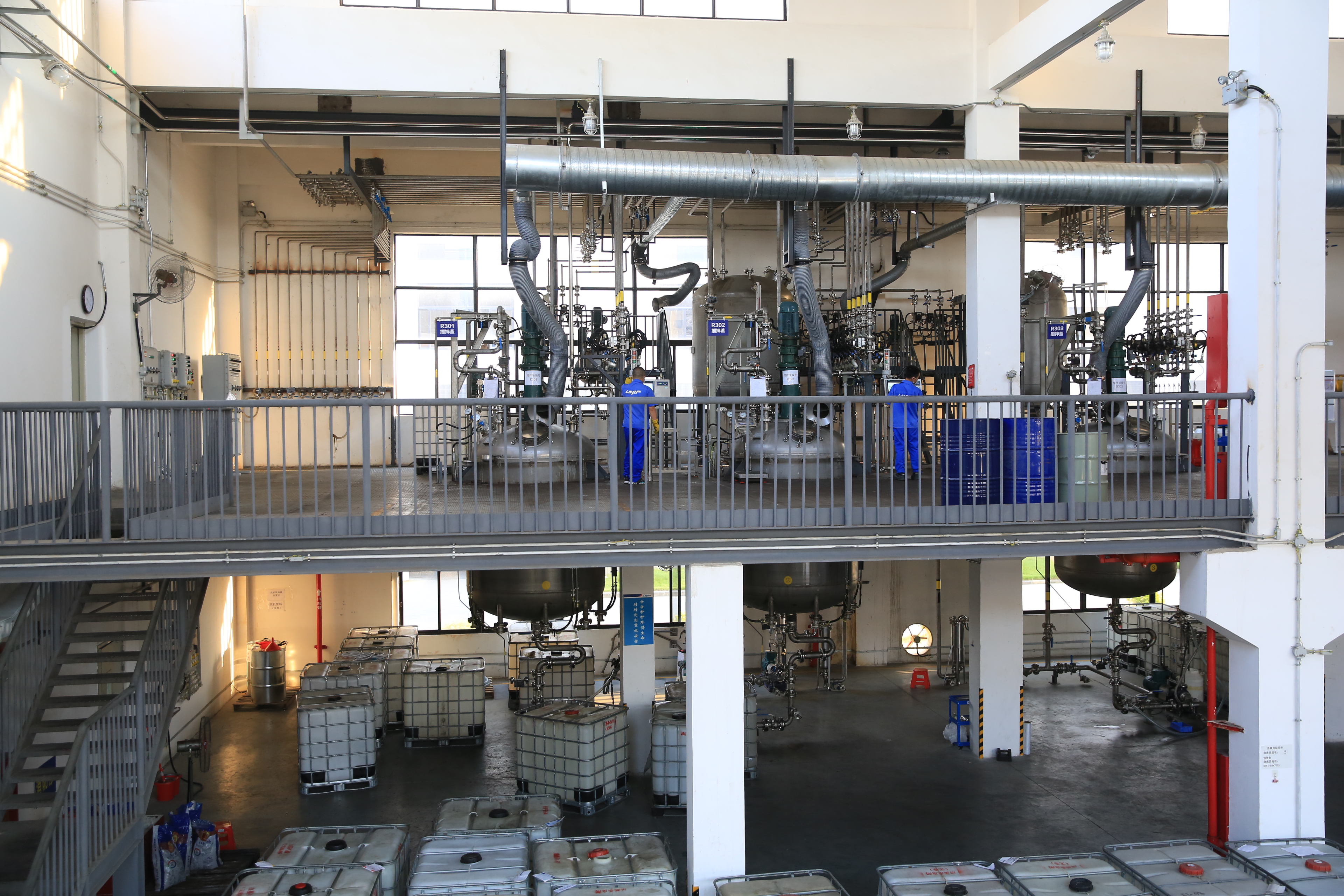
Guangdong Laya New Chemical Technology Co., Ltd. (LAYA) is an aerosol manufacturer and national high-tech enterprise established in 1992 in Shaoguan, Guangdong Province, China. The company provides OEM and ODM production services for aerosol products. Its facility covers a total area of 100,000 m², including 50,000 m² of modern standard workshops and 14 advanced filling lines, with an annual output of 200 million cans. Within its OEM/ODM service model, LAYA also makes around 1 million cans of monthly capacity available for custom programs.
Customization services include formula customization, packaging design, logo printing, can size customization, and fragrance adjustment. The technical infrastructure behind those services includes four product development laboratories, seven analytical testing laboratories, and a development team of 15 engineers, built on more than 30 years of aerosol expertise and thousands of mature formulas. The company states that raw materials are selected from international brands, which matters for buyers who need consistent input quality across repeated orders.
Product scope spans eight categories: insecticide spray, air freshener, household cleaning aerosol, industrial maintenance aerosol, car care aerosol, disinfectant aerosol, aviation aerosol, and spray paint aerosol. This breadth has a practical consequence for procurement: a brand can launch or expand multiple product lines without qualifying a separate filling partner for each category. The company’s website is www.laya.com.cn/en/.
How a Custom Aerosol Project Actually Runs
Product Definition and Formula Selection
The first stage is defining the product category, target market, and application. For household air fresheners, the development priority may be fragrance character and perceived freshness. For insecticide spray, efficacy and safety data become central. For industrial maintenance or aviation aerosol, the formulation must tolerate specific operating conditions. LAYA’s approach starts from a mature formula library with thousands of formulas, adjusted to meet the client’s requirements. Fragrance adjustment is a standard customization feature, allowing the manufacturer to adapt scent character and intensity to a brand’s positioning.
Packaging and Can Specification
Aerosol packaging is not only a visual element; it must contain internal pressure and remain stable through filling, transport, and use. LAYA offers can size customization, logo printing, and packaging design. Common formats in the company’s certified product range are listed below.
| Product Category | Model | Net Content | Can Dimensions | Material |
|---|---|---|---|---|
| Insecticide spray | KB-0000600 | 300/400/500/600/750 ml | ∮52×195 / 65×158 / 65×200 / 65×240 / 65×300 mm | Tinplate |
| Air freshener | ME-0000300 | 300 ml | ∮52×195 mm | Tinplate |
| Car care products | BO-0000600 | 300/400/500/600 ml | ∮52×195 / 65×158 / 65×200 / 65×240 mm | Tinplate |
| Industrial maintenance | SM-0000400 | 300/400/500/600 ml | ∮52×195 / 65×158 / 65×200 / 65×240 mm | Tinplate |
| Aviation aerosol | KB-0000300 | 300/400/500/600 ml | ∮52×195 / 65×158 / 65×200 / 65×240 mm | Tinplate, aluminum can |
| Household cleaning aerosol | QL-0000300 | 300/400/500/600 ml | ∮52×195 / 65×158 / 65×200 / 65×240 mm | Tinplate |
| Spray paint aerosol | QL-0000450 | 300/400/500/600 ml | ∮52×195 / 65×158 / 65×200 / 65×240 mm | Tinplate |
The table shows the representative can combinations used across LAYA’s certified product families. Having multiple can formats in one factory helps buyers avoid the cost of sourcing cans from several suppliers for different SKUs.
Filling, Testing, and Quality Control
Filling is the stage where formulation and packaging meet. LAYA operates 14 filling lines within the 50,000 m² workshop area. The company applies three routine quality controls across its aerosol production: 100% leak testing, pressure testing, and visual inspection. Quality control is managed under an ISO 9001 certified system. The company also conducts preshipment testing as part of its procurement process, so that buyers can verify product condition before shipment.
Compliance and Certificates
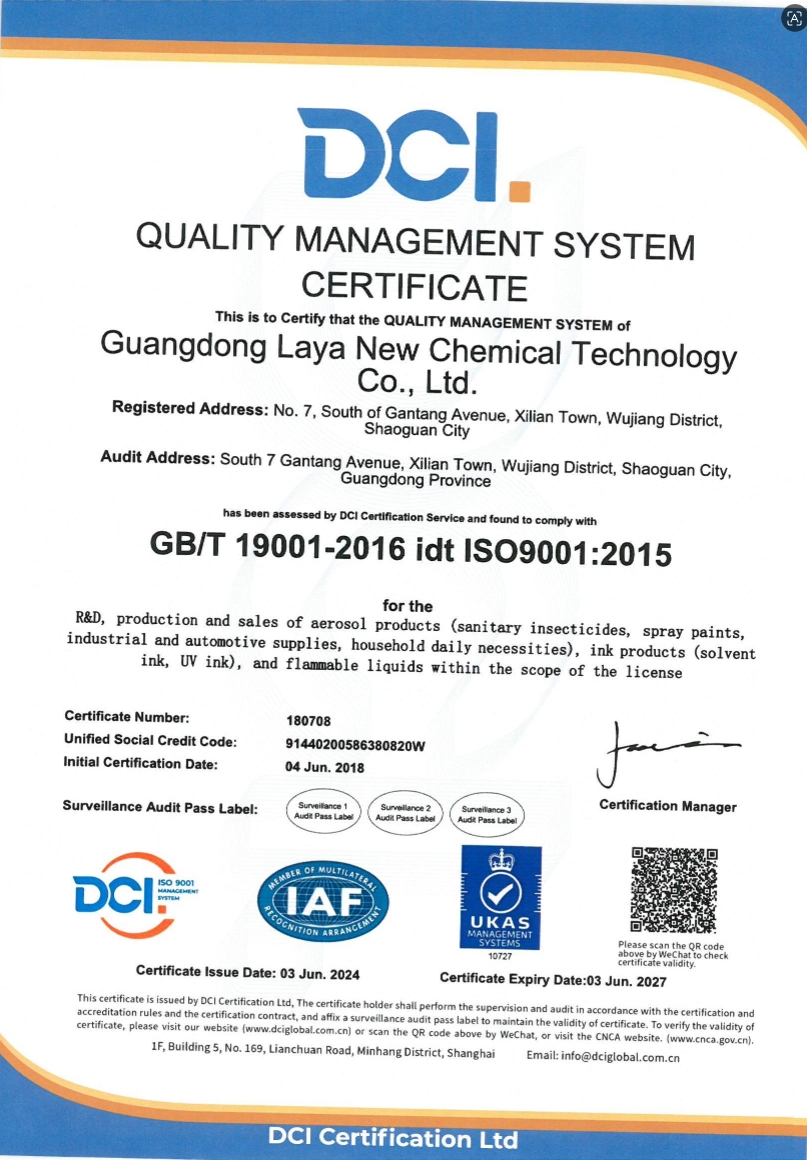
Compliance documentation is an important evidence point in an aerosol OEM evaluation. For LAYA, the currently valid certificates include the following.
| Certificate | Certificate No. | Authority | Scope | Validity |
|---|---|---|---|---|
| ISO 9001 Quality Management System | 180708 | DCl Certification Ltd | R&D, production and sales of aerosol products, ink products, and flammable liquids within the licensed scope | 2024-06-04 to 2027-06-03 |
| ISO 14001 Environmental Management System | F02925E00035R202 | DCl Certification Ltd | R&D, production and sales of aerosol products, ink products, and flammable liquids within the licensed scope | 2025-12-11 to 2028-12-17 |
| ISO 45001 Occupational Health & Safety Management System | 200894 | DCI Certification Ltd | R&D, production and sales of aerosol products, ink products, and flammable liquids within the licensed scope | 2020-12-16 to 2026-12-16 |
| Hazardous Chemical Registration Certificate | 44022500254 | Ministry of Emergency Management of the People’s Republic of China | Air freshener aerosols, insect repellent aerosols, insecticide aerosols, etc. | 2025-06-08 to 2028-06-07 |
The exact scope of each certificate matters. ISO 9001 covers R&D, production and sales of aerosol products as well as related flammable liquid and ink products within the licensed scope. The hazardous chemical registration, issued by China’s Ministry of Emergency Management, covers air freshener aerosols, insect repellent aerosols, and insecticide aerosols. Buyers exporting to other regions should confirm the corresponding registration requirements of their destination market.
Procurement Terms
- MOQ: 10,000 pieces.
- Lead time: 7–15 days for standard orders.
- Payment: TT or LC, negotiable based on order quantity.
- Preshipment testing: testing before shipment is part of the acceptance process.
- After-sales: remote technical support, order tracking, after-sales consultation, and product quality follow-up.
For buyers at the execution stage, these terms reduce uncertainty about how a first order will be handled. A 10,000-piece MOQ is realistic for a first commercial batch while still requiring a basic sales commitment.
A Buyer’s Checklist Before Placing an Aerosol OEM Order
- Verify the manufacturer’s corporate identity and the product scope it formally covers.
- Review the validity and scope of management-system certificates such as ISO 9001.
- Confirm that the target product category is within the factory’s certified production range.
- Check whether customization options cover formula, packaging design, logo printing, can size, and fragrance adjustment.
- Audit R&D resources: number of development laboratories, analytical laboratories, and engineers.
- Evaluate production scale: filling lines, workshop area, annual output, and available OEM/ODM monthly capacity.
- Agree on commercial terms: MOQ, lead time, payment, and delivery method.
- Define quality control and preshipment testing procedures before production begins.
- Establish after-sales support: remote technical support, order tracking, after-sales consultation, and product quality follow-up.
This checklist is designed as a practical tool for buyers moving from evaluation to execution, not as a simple ranking of supplier attributes.
Use Case: Air Freshener OEM for a Bulgaria-Based Client
A relevant example from LAYA’s record is an aerosol OEM project located in Bulgaria, with a project scale of 30,000 units. The client uses the product across household odor removal, car air freshening, and commercial space fragrance. The relationship has lasted two years, according to the company’s case records. The formulation is based on a natural plant-based formula extracted from osmanthus, with a long-lasting fragrance profile that supports multi-scenario use.
From a buyer’s perspective, this case is small enough to be a first order but broad enough to show product flexibility. A single air freshener can serve home, automotive, and commercial contexts, which means the package design, fragrance, and can specification must remain acceptable across these environments. It also illustrates how fragrance adjustment and formula selection are used together to meet a specific market brief rather than simply filling a standard product.
Market Trends Shaping Aerosol Sourcing
The global aerosol market is estimated at USD 100.49–100.87 billion in 2025, with a projected value above USD 211 billion by 2035. Growth projections vary by research agency — forecasts range from a conservative CAGR below 2% to a higher 7%+ range depending on methodology — but the direction is consistent. For an OEM supplier, this means a growing number of brands entering the market with private label plans across multiple aerosol segments.
Europe accounted for approximately 33.88%–36.3% of the aerosol market in 2025, while the Asia-Pacific region is expected to record the highest CAGR through 2033. For an OEM partner, this means buyers in Europe need documentation aligned with EU requirements, while buyers targeting Asia-Pacific are looking for suppliers who can support faster ramp-up and flexible product mixes.
Aluminum-based aerosol cans accounted for roughly 61%–62% of the market in 2025, due to recyclability and lower weight. This strengthens the case for manufacturers who can source both tinplate and aluminum can formats and adapt packaging to market preference. LAYA’s certified product range includes both tinplate and aluminum can options, notably in the aviation aerosol category.
China’s aerosol propellants market was valued at USD 1,275.71 million in 2024 and is projected to grow to USD 2,194.62 million by 2033, according to Reed Intelligence. Meanwhile, regulation is tightening. The EU Aerosol Dispensers Directive imposes deformation and burst testing; China’s Hazardous Chemicals Safety Law now applies whole-lifecycle management. For buyers, these trends mean that regulatory traceability is becoming as important as unit price in supplier selection.
Full-Service OEM vs. Traditional Alternatives
For many brands, the alternatives to a full-service aerosol OEM are building an in-house filling line, working with a single-category contract filler, or buying through a trading intermediary. Each option has a different trade-off.
Setting up an internal filling line gives a brand full control, but it requires significant capital, chemical safety capability, and regulatory staffing. In-house lines rarely make economic sense below a large production volume. Using a single-category filler can be efficient for one SKU, but expansion into other aerosol categories means qualifying another supplier. A trading intermediary adds convenience but usually separates the buyer from direct R&D and quality control.
A full-service aerosol OEM/ODM combines formula customization, packaging design, filling, testing, and compliance documentation within one supplier relationship. That shortens the chain and improves traceability, which is why buyers with multi-category plans often prefer this model.
At the same time, the model has boundaries that buyers should weigh:
- The MOQ of 10,000 pieces means ultra-small test batches are not economically supported.
- Production scheduling is controlled by the manufacturer; last-minute urgent orders must compete with other programs on the filling lines.
- Custom formulation development is limited by the supplier’s R&D resources and is subject to development time before serial production; the 7–15 day lead time applies to standard orders.
- Certifications are scope-specific. Buyers must verify that the manufacturer’s valid certificates cover their intended product and destination market.
- For markets such as the EU, additional product-level compliance work may be required beyond the manufacturer’s existing certificates.
These boundaries are not unique to LAYA; they are structural characteristics of OEM/ODM procurement in regulated aerosol manufacturing.
What the Future Points to
The direction in aerosol sourcing is toward fewer, more capable suppliers rather than many single-purpose vendors. Buyers who want private label programs across multiple segments — home, car, industry, and specialized markets such as aviation — benefit from a partner whose formulation library and filling capacity can switch between categories. Material trends also point toward aluminum packaging, which is already the dominant can format, and suppliers need to provide both tinplate and aluminum options depending on order requirements.
Regulatory pressure will continue to raise the entry bar for contract manufacturers, which favors established enterprises with valid management-system certifications and hazardous chemical registration. From a buyer’s perspective, this is a positive trend: capability evidence becomes easier to inspect when it is tied to concrete certificates, plant data, and order references.
Company Brochure
For buyers who need a more complete operational picture, LAYA provides a downloadable company brochure that covers its plant layout, manufacturing facilities, and product scope:
Download the LAYA company brochure (PDF)
FAQ
What customization services are typically included in aerosol OEM/ODM projects?
LAYA’s aerosol OEM/ODM services include formula customization, packaging design, logo printing, can size customization, and fragrance adjustment. These services are supported by a technical centre with four product development laboratories and seven analytical testing laboratories.
What is the minimum order quantity for custom aerosol manufacturing?
The MOQ for LAYA’s aerosol OEM/ODM production is 10,000 pieces. Payment is negotiable based on order quantity, and common arrangements include TT and LC terms.
How long does an aerosol OEM order take?
The standard lead time for aerosol OEM production at LAYA is 7–15 days. Custom formulation development or packaging changes may add time before serial production begins.
What quality control measures apply to aerosol contract filling?
LAYA applies 100% leak testing, pressure testing, and visual inspection during production. Quality control is managed under an ISO 9001 certified system, and buyers receive preshipment testing before delivery.
Which product categories can be produced under LAYA’s private label/OEM model?
LAYA’s production scope covers insecticide spray, air freshener, household cleaning aerosol, industrial maintenance aerosol, car care aerosol, disinfectant aerosol, aviation aerosol, and spray paint aerosol.
Which export markets does LAYA serve?
LAYA exports to Asia, Europe, Oceania, North America, South America, and Africa. Its export list includes Malaysia, Thailand, Vietnam, the Philippines, Singapore, Indonesia, India, Japan, Pakistan, Qatar, Dubai, Russia, Bulgaria, Romania, Australia, Canada, the Dominican Republic, Chile, and Mozambique.