
What Home Fitness Equipment Specs Really Tell You
Global demand is broad, but purchasing decisions depend on specific constraints
According to Fortune Business Insights, the global home fitness equipment market was valued at approximately USD 12.88 billion in 2025 and is projected to reach USD 22.99 billion by 2034. The same source reports that cardiovascular equipment, including treadmills and exercise bikes, holds about 58.89% of the market revenue share. Dataintelo estimates the global home treadmill market at USD 5.51 billion in 2025, with motorized models accounting for 58.2% of that segment. Straits Research places the walking pad market at USD 4.9 billion in 2025, while Dataintelo values the vibration therapy platform market at approximately USD 1.8 billion in the same year.
Market sizing varies across research firms because definitions differ. Fortune, Mordor Intelligence, and Data Bridge, for example, report different 2025 totals for the broader home fitness equipment category. For buyers, the directional signal is clear: this remains a broad, multi-category market with sustained international demand. The practical challenge for importers, wholesalers, and brand owners is not whether to source home fitness equipment, but how to interpret the specifications, certifications, and compliance documents that define individual products.
Why parameters matter more than category labels
Home fitness equipment is sold across a wide spectrum of product types: motorized treadmills, walking pads, vibration plates, spinning bikes, magnetic X-bikes, upright bikes, elliptical trainers, indoor rowing machines, and massage devices. Within each type, parameters determine which user scenario the product can realistically serve.
Motor power, running belt size, speed range, flywheel weight, resistance levels, maximum user weight, foldability, and gross weight are not arbitrary numbers. They define the boundary between a light walking device and a serious cardio trainer. For procurement teams, reading these parameters correctly prevents two common mistakes: selecting equipment that is too limited for the target market, or paying for performance that end users will never use.
Ningbo Healthmate: a manufacturer with documented product breadth
Ningbo Healthmate Health Technology Co., Ltd. is a fitness equipment manufacturer founded in 2007 and located in Ningbo, China. The company operates a manufacturing facility of 100,000 square meters, employs 850 people, and has an annual output of approximately 700,000 units. Its product line includes home-use treadmills, walking pads, vibration machines, spinning bikes, magnetic X-bikes, upright bikes, elliptical trainers, electric mini bikes, and rowing machines. Approximately 80% of production is exported to Europe, the United States, Japan, Korea, India, the Middle East, and South America. The company maintains a 38-person R&D team and works with overseas buyers through OEM and ODM production modes.
For a buyer evaluating manufacturers, the value of such a broad product line is the ability to consolidate several home fitness categories under one quality system. But broad lineups only become useful when each product can be assessed on its own documented specifications and certifications.
Reading treadmill and walking pad specifications
Motorized treadmills and walking pads are the most common home cardio equipment categories. The main parameters to examine are motor power, speed range, running belt size, incline function, folding system, and weight.
Several models from Ningbo Healthmate illustrate how parameters map to different use cases:
| Model | Type | Motor | Speed | Runway Size | Gross Weight | Key Features |
|---|---|---|---|---|---|---|
| HSM-T20 | Compact folding treadmill | 1.5 HP | 1–14 km/h | 1100×400 mm | 33.5 kg | Manual incline, Bluetooth music & APP |
| HSM-W04L1BL | Under-desk walking pad | 0.75 HP | 1–6 km/h | 900×380 mm | 21 kg | Brushless motor, low profile |
| HSM-W04L2B | Compact walking pad | 0.75 HP | 1–6 km/h | 900×380 mm | 19 kg | Manual incline |
| HSM-W09E | Folding walking pad with handrail | 1.5 HP | 1–14 km/h & 1–6 km/h dual-speed | 1100×400 mm | 31 kg | Handrail, manual incline |
| HSM-W08A | Walking treadmill with support bar | 2.0 HP | 1–16 km/h | 1200×450 mm | 54 kg | Auto incline, safety handrail |
| HSM-MT19 | Home-use treadmill | 2.5 HP | 1–20 km/h | 1300×480 mm | 77 kg | Auto incline, hydraulic soft-drop folding, 150 kg capacity |
HSM-T20 is a compact treadmill with a 1.5 HP motor and a 14 km/h maximum speed. It suits daily walking and light jogging in smaller homes. HSM-W04L1BL, by contrast, is a slim under-desk walking pad with a top speed of 6 km/h and a low-profile frame of 1130×510×91 mm. It is designed for standing-desk use and light office walking.
HSM-W09E offers dual-speed operation: 1–14 km/h for walking exercise and 1–6 km/h for steady desk walking. The inclusion of a handrail makes it suitable for users who need extra stability. Larger home treadmills such as HSM-MT19 and HSM-MT550 are designed for more serious at-home cardio sessions, with longer belts, higher motor power, and higher maximum speeds.
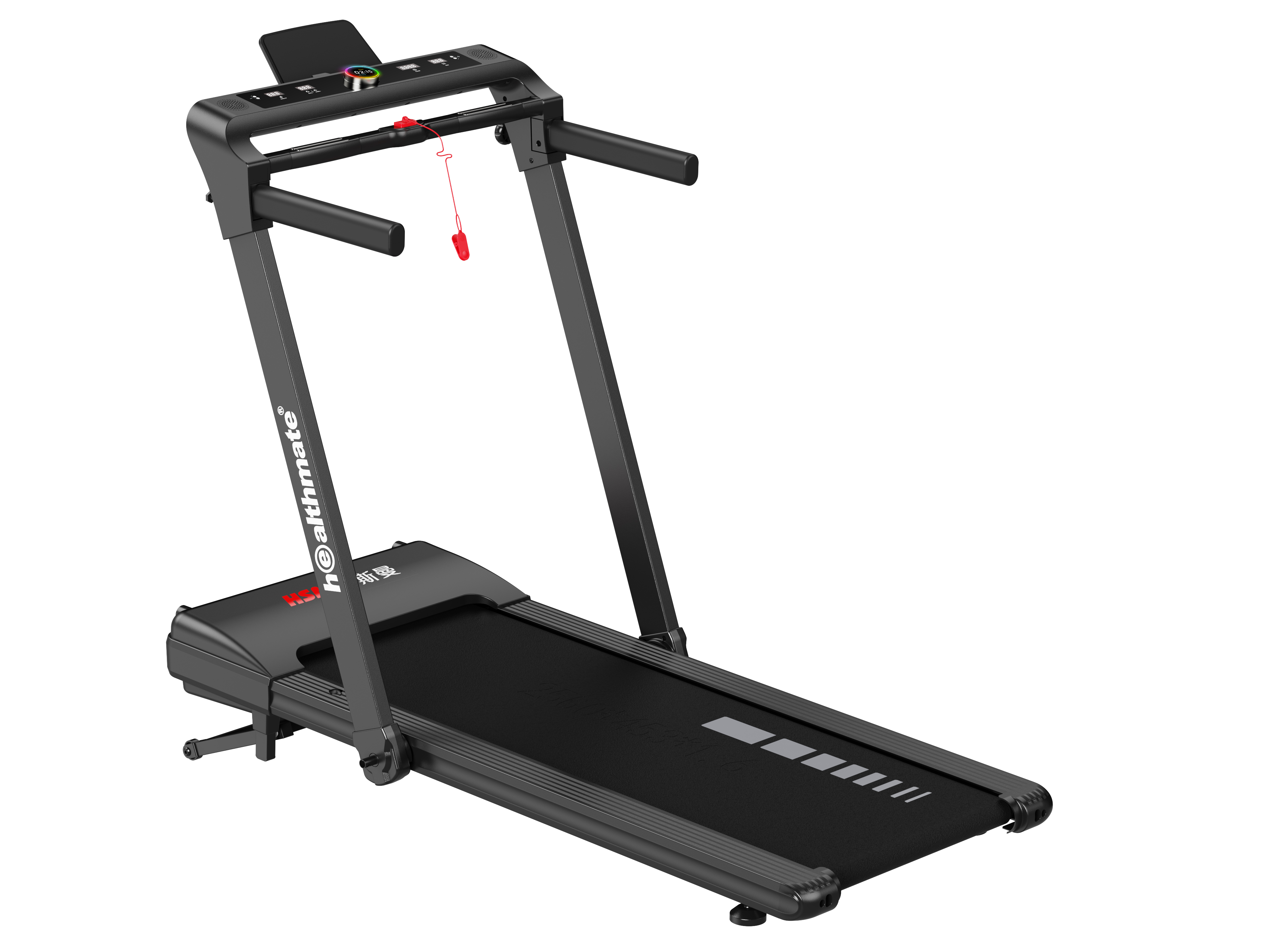
A residential walking treadmill with auto incline illustrates how motor power and belt size define intended home use.
Exercise bikes: flywheel weight and resistance systems
Exercise bikes are commonly divided into upright bikes, recumbent bikes, spinning bikes, and compact folding X-bikes. The core parameters are flywheel weight, resistance levels, adjustability, and frame footprint.
Ningbo Healthmate offers two distinct bike formats:
| Model | Type | Flywheel | Resistance | Display / Control | Gross Weight |
|---|---|---|---|---|---|
| HSM-B135J5 | Foldable X-bike exercise bike | 1.5 kg | 8 levels | LCD screen: speed, distance, time, calories, pulse | 19.1 kg |
| HSM-S300 | Magnetic resistance spinning bike | 6.0 kg | Stepless / APP 1–10 levels | APP link | 30 kg |
HSM-B135J5 is a magnetic folding X-bike with 8 resistance levels and a 1.5 kg flywheel. It is lightweight, portable, and adaptable to small apartments and home offices. HSM-S300 is a magnetic spinning bike with a 6.0 kg flywheel, stepless resistance, and APP-based level control. A heavier flywheel generally delivers smoother pedal rotation and a more stable ride, which matters for users who expect endurance-oriented sessions rather than casual pedaling.
Vibration platforms: power, speed levels, and structure
Vibration plates support whole-body vibration training, which is used for light exercise, recovery, and body conditioning. The parameters that matter are rated power, speed levels, timing range, platform size, and additional features such as elastic ropes or handlebars.
| Model | Type | Power | Speed Levels | Timing | Gross Weight | Notable Feature |
|---|---|---|---|---|---|---|
| HSM-08VS | Compact vibration plate | 200 W | 99 | 1–10 min | 9.8 kg | Set up with magnetic stone |
| HSM-08VQ | Portable vibration platform | 500 W + 300 W | 20 | 1–10 min | 24 kg | Whole-body slimming platform |
| HSM-08VW | Vibration plate with elastic ropes | 500 W + 300 W | 20 | 1–15 min | 21.8 kg | Elastic ropes for upper-body training |
| HSM-08VF | Vibration plate with handlebar | 500 W | 99 | 1–10 min | 31 kg | Handlebar, pulse display |
HSM-08VS is a compact 200 W vibration plate with 99 speed levels and a gross weight of 9.8 kg, making it one of the more transportable options. HSM-08VW combines a 500 W + 300 W dual-motor system with elastic ropes, expanding the range of exercises beyond standing vibration. HSM-08VF is a larger upright platform with a handlebar, suitable for users who need support during vibration sessions.
Rowing machines: magnetic resistance and slide rail
Rowing machines provide full-body, low-impact cardio training. The HSM-R06 is a magnetic resistance indoor rowing machine with 16 resistance levels, a 2.5 kg flywheel, a slide rail distance of 0–705 mm, and a handlebar belt length of 0–1700 mm. It has a gross weight of 24 kg and an LCD screen that displays stop/scan, time, distance, total strokes, and stroke rate. Magnetic resistance contributes to quieter operation, which is valuable in apartment and home environments.
Certifications: how buyers should read market approvals
Certifications are market-entry requirements, not optional quality labels. A product without the correct certification for its target market cannot be legally sold there. For buyers, the relevant question is whether the manufacturer holds documented certificates that cover the specific model, the target market, and the applicable standards.
The table below summarizes common certification types across major markets:
| Market | Common Certification | Typical Applicable Standards |
|---|---|---|
| European Union | CE: LVD, EMC, MD, RED, GPSD | EN 60335-1, EN IEC 55014-1/-2, EN IEC 61000-3-2/-3, EN ISO 20957-1, EN 957-6, EN 50663 |
| United Kingdom | UKCA | BS EN 60335-1, BS EN IEC 60335-2-32, BS EN IEC 55014-1 |
| North America | ETL, FCC SDoC | UL 1647, CSA C22.2 #68, FCC Part 15 Subpart B |
| EU / Global | RoHS | 2011/65/EU, (EU) 2015/863 |
Concrete examples from Ningbo Healthmate's certification records can help buyers understand how certificates are mapped to product models:
- The HSM-MT19 home-use treadmill carries ETL certification for North America, certificate number 150800030HZH-001 issued by Intertek Testing Services Ltd. Zhejiang, under UL 1647:2015 and CSA C22.2 #68:2018.
- HSM-MT19 also holds UKCA certification for the UK market, certificate number ENB2507150046E00501C issued by EMTEK (Ningbo) Co., Ltd., under BS EN IEC 55014-1:2021.
- The motorized treadmill series, covering models such as HSM-MT296, HSM-W08A, and others, is supported by CE certification for the EU market. Examples include CE EMC certificate ENB2601230270E00101C and CE-LVD certificate ENB2606100194S00101C issued by EMTEK (Ningbo) Co., Ltd.
- The HSM-S300 spinning bike is certified under CE GPSD, with certificate number WTN23N07149899J issued by Waltek, under EN ISO 20957-1:2013 and EN ISO 20957-5:2016.
- The HSM-B135J5 magnetic exercise bike holds FCC Supplier's Declaration of Conformity for the American market, certificate number MTZS23063843 issued by Shenzhen Most Technology Service Co., Ltd., under FCC Part 15 Subpart B. For the EU, it is covered by CE-MD certification under 2006/42/EC + (EU) 2023/1230.
- The HSM-R06 indoor rowing machine is certified under CE GPSD, certificate number WTN23N07151137J issued by Waltek, under EN ISO 20957-1:2013 and EN ISO 20957-7:2021.
- Vibration plates, including HSM-08VW, HSM-08VS, HSM-08VQ, and HSM-08VF, hold CE and RoHS certifications for the EU market. The RoHS certificate number is HA21NB051501CHEM, issued by HATEK, under 2011/65/EU and (EU) 2015/863. UKCA certification for vibration plates, number MTZS24064178 issued by Shenzhen Most Technology Service Co., Ltd., covers BS EN 60335-1, BS EN IEC 60335-2-32:2021, and BS EN 62233:2008.
- The HSM-08YB swing massage machine holds CE-LVD, CE-EMC, and RoHS certificates issued by HATEK.
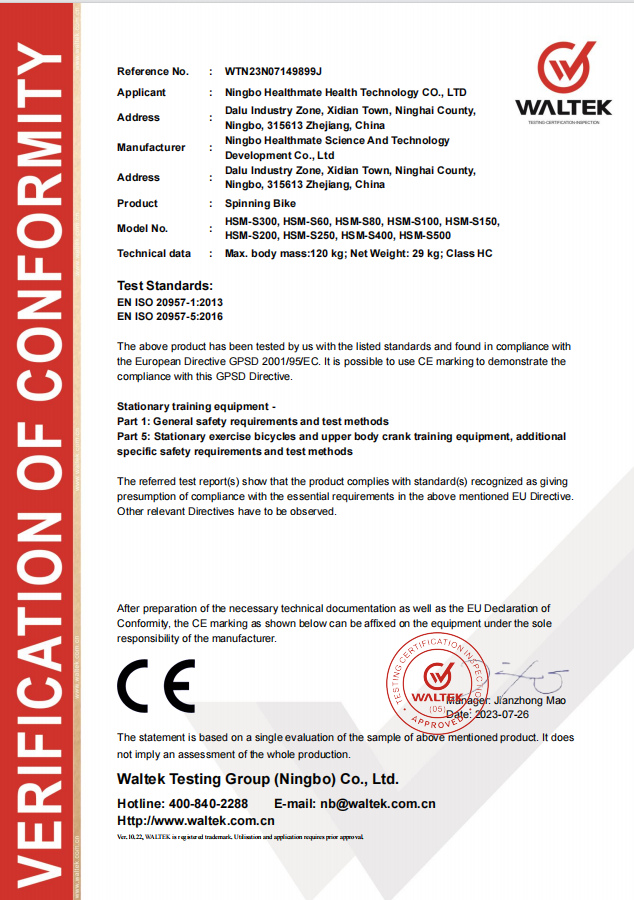
Certification documents identify the product scope, applicable standards, issuing body, and certificate number.
How buyers should verify certificates
A certificate only becomes useful when the model scope matches the product being procured. Buyers should ask for the certificate document itself, check the product model number in the certificate scope, and confirm that the standard matches the target market. Certificate numbers and issuing bodies can also be cross-checked with the certification body's records. The presence of a certificate for one product in a portfolio does not automatically cover another product from the same factory.
Application scenarios: matching equipment to user environments
Ningbo Healthmate's application records show that home fitness equipment is deployed across several distinct environments: general home use, office and workplace use, and apartment or urban living settings. Common project types include home fitness setups, home office fitness integration, and personal cardio training systems.
Across these scenarios, the functional requirements are consistent:
- Daily exercise and activity maintenance
- Lifestyle fitness improvement
- Speed or resistance adjustable training
- Real-time tracking during use
- Safety stop systems
- Space-saving or foldable design
- Anti-slip running belts
- Stable frames suitable for apartment flooring
For an apartment user, a slim walking pad such as HSM-W04L1BL or a compact vibration plate such as HSM-08VS fits the space constraint. For a home office, a foldable walking pad with a handrail such as HSM-W09E provides both walking exercise and stability. For a dedicated home gym, a treadmill with a longer belt and higher motor power such as HSM-MT19 is more appropriate.
Market trends: what the data shows
The validated data points to several relevant trends. First, cardio equipment remains the dominant home fitness category, which supports continued investment in treadmills and exercise bikes. Second, the walking pad segment is emerging as a high-growth niche, partly driven by remote work culture. Third, vibration platforms are smaller but growing steadily, with an expected CAGR of 7.8% through 2034.
For OEM buyers, these trends suggest that product portfolios should cover both traditional cardio equipment and compact, space-conscious devices. Mixing high-end treadmills with under-desk walking pads and vibration platforms allows distributors to serve multiple consumer segments without relying on a single category.
Comparison with traditional sourcing approaches
Traditional sourcing of home fitness equipment often relies on product photos, price comparisons, and verbal assurances from trading companies. That approach carries real risks: a product may look suitable but fail market-entry certification, or a specification sheet may list a maximum speed that the motor cannot sustain under real use.
A documentation-based approach, by contrast, treats certifications and parameters as contractual constraints. The buyer checks the certificate scope, compares the model number, and verifies that the technical parameters match the intended user scenario. This does not mean documentation replaces product inspection. It means documentation is the first filter, not the final assurance.
One honest limitation of certification should be recognized: certificates are a snapshot at the time of testing. They confirm that a specific product model complied with a standard at a specific date. They do not guarantee that every production batch is identical. This is why manufacturers with documented quality control procedures, third-party inspection options, and lower after-sales failure rates provide additional confidence. Ningbo Healthmate's long-term customer records, covering foreign trade wholesalers, Amazon sellers, local fitness retail shops, and wholesale trading companies, show after-sales failure rates below 2% over a 3-to-5-year cooperation period, with stable running performance and repeat orders.
Another realistic boundary is product capability. Compact treadmills and walking pads with lower motor power and shorter belts are not designed for intense running training. They support walking, light jogging, and low-impact daily activity. Buyers should be clear about this boundary when positioning products for end users.
Future outlook
The home fitness equipment market is moving toward more space-efficient, quieter, and more connected devices. Walking pads, compact bikes, and vibration platforms meet a real need in apartment and work-from-home environments, while traditional treadmills continue to serve users who want a full cardio experience at home.
For manufacturers, the ability to provide certified, documented products across multiple categories becomes a competitive advantage. Buyers, in turn, should expect to see clearer parameter disclosures, more granular certification mapping, and product lines that are intentionally designed around specific living situations rather than generic fitness labels.
Frequently asked questions
What is the difference between CE, UKCA, FCC, and ETL certifications?
CE is a mandatory conformity mark for products sold in the European Economic Area. UKCA is the UK equivalent, covering products placed on the Great Britain market. FCC certification applies to electronic devices sold in the United States, particularly for electromagnetic compatibility under FCC Part 15. ETL is a safety certification mark accepted in North America, based on standards such as UL 1647 for exercise equipment. Each certification addresses a specific market and follows different standards.
What certifications does a home motorized treadmill need for the EU market?
Motorized treadmills exported to the EU typically need CE marking covering electrical safety and electromagnetic compatibility. Relevant standards include EN 60335-1 for household appliances, EN IEC 55014-1 and EN IEC 55014-2 for EMC, EN ISO 20957-1, and EN 957-6 for treadmill safety. If the treadmill has Bluetooth or wireless functions, RED compliance may also be required. Certification records should clearly link these standards to the specific treadmill model.
How can a buyer verify that an OEM manufacturer's certifications are real?
Request the certificate document and check three fields: the certificate number, the issuing body, and the product model scope. Confirm that the model number matches the product you intend to buy. Cross-check the certificate number with the issuing body's database when possible. A certificate that does not list the product model or uses a vague product description carries limited assurance.
Which specifications matter most when comparing walking pads?
The most relevant specifications for walking pads are motor power, speed range, running belt size, gross weight, and whether the unit has a handrail. For example, HSM-W04L1BL has a 0.75 HP motor, a maximum speed of 6 km/h, and a belt size of 900×380 mm, making it a low-intensity under-desk device. HSM-W09E has a 1.5 HP motor, dual speed ranges up to 14 km/h, and a handrail, offering a higher level of versatility for walking exercise at home.
What is a typical MOQ and lead time for OEM home fitness equipment?
OEM MOQs vary by factory. In the case of Ningbo Healthmate, the MOQ is 100 pieces, with a lead time of 35–40 days and a monthly production capacity of 8,000 pieces. Customization options include color, logo, voltage, and plug type. The company states that every damaged part is covered by a 1-year warranty.
Are compact treadmills and walking pads suitable for running?
Compact treadmills and walking pads are generally designed for walking, light jogging, and low-impact daily exercise. Their motors are smaller and their belts are shorter than full-size treadmills. For example, a walking pad with a 0.75 HP motor and a maximum speed of 6 km/h is not intended for running workouts. Buyers should match the device to the end user's expected training intensity.
For a complete overview of product models, specifications, and configurations, buyers can refer to the manufacturer's published equipment catalog: Ningbo Healthmate New E-Catalog (PDF). Company information is also available at www.healthma.com.
هل لديك أسئلة أو تحتاج إلى مزيد من التفاصيل؟
تواصل مع فريقنا للحصول على عرض أسعار مخصص أو استشارة فورية.
طلب عرض أسعار
املأ النموذج أدناه وسيتواصل معك فريقنا بعرض مقترح مخصص.
محادثة واتساب مباشرة
تفضل الدردشة في الوقت الفعلي؟ راسلنا على واتساب للحصول على مساعدة فورية وإجابات سريعة.
- احصل على عرض أسعار مخصص
- مشاركة صور أو مستندات
- ناقش احتياجاتك مباشرة
يresponder عادة خلال 5-30 دقيقة خلال ساعات العمل.