
What Is a Drum Unit? A Guide to Copier Consumable Parts
What Is a Drum Unit? A Guide to Copier Consumable Parts
A drum unit is a replaceable assembly inside a laser copier or laser printer that carries the light-sensitive imaging drum — in most office equipment an OPC drum — together with the charging, cleaning and, in many designs, developing elements that prepare the drum surface for every printed page. It is a different part from the toner cartridge and from the fuser unit, and for buyers mapping A3 office consumables for the first time it is one of four main replaceable groups they will encounter: toner cartridge, drum unit, developing unit and fuser unit.
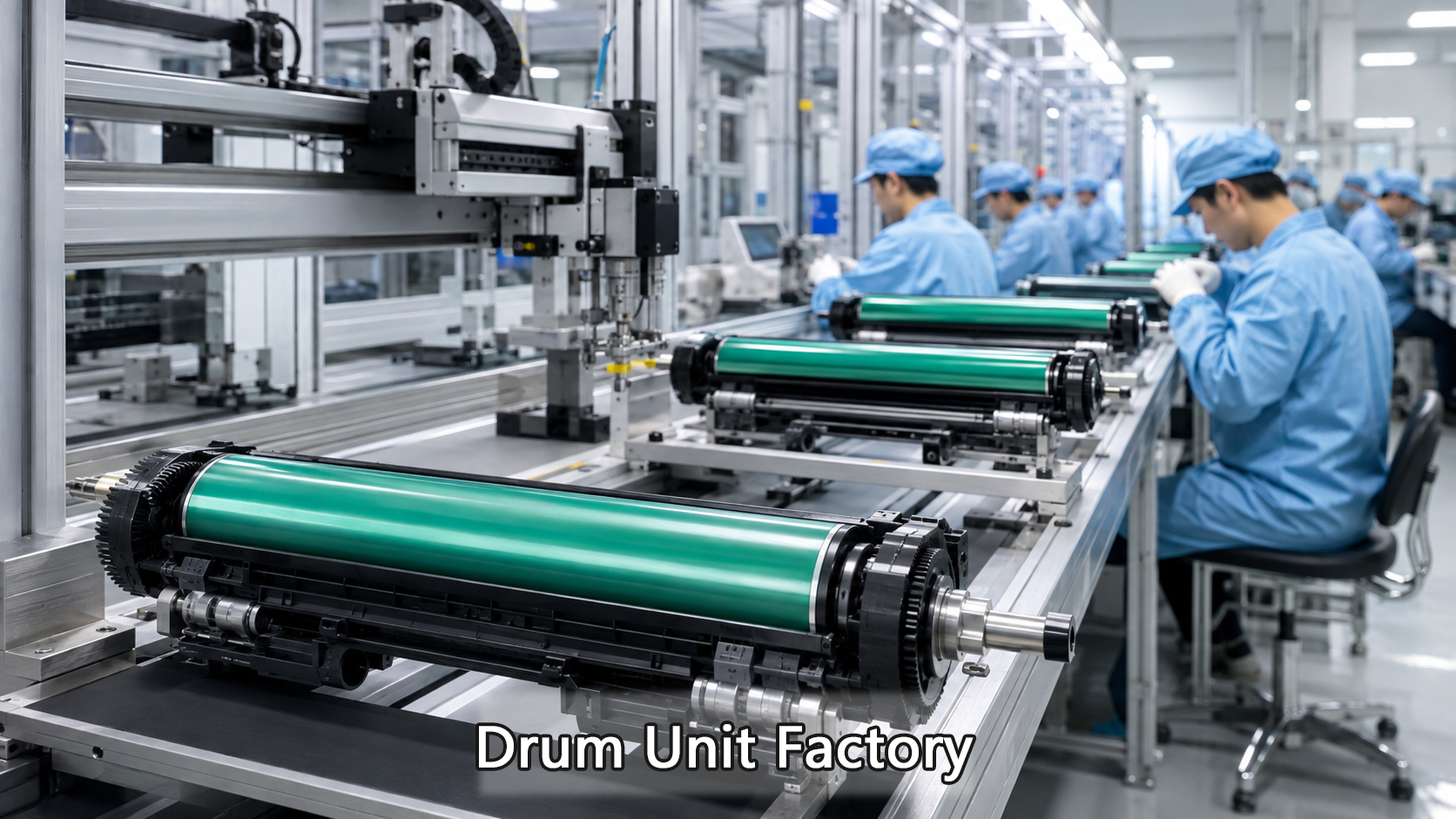
Drum unit assembly operations inside a copier consumables manufacturing facility.
The naming problem is real. Across machine families, the same physical part may be described as a drum unit, an imaging unit, a drum cartridge or a photoconductor unit, while the toner cartridge, the developing unit and the fuser unit sit beside it as separate line items. That vocabulary gap produces two predictable failures in procurement: teams default to original equipment manufacturer (OEM) parts because they cannot verify an aftermarket equivalent, or they order aftermarket parts without the model-level verification that these parts genuinely require.
The copier consumable chain, component by component
A laser copier builds a page through a short electrostatic chain. A photoconductive drum is charged, exposed to light that dissipates the charge where the image should appear, developed with toner so the latent image becomes visible, transferred onto paper, and finally fused to the paper surface with heat and pressure. Every stage depends on a consumable, and each consumable is supplied and replaced separately.
| Component | Function in the imaging chain | What it means for buyers |
|---|---|---|
| Toner | Fine powder that becomes the visible image after transfer and fusing | Consumed continuously; toner sourcing drives running cost and supply planning |
| Developer | Carrier material used in two-component development systems to charge and transport toner toward the drum | Not the same thing as toner; needed only where the machine design uses two-component development |
| Toner cartridge | Cartridge that stores toner and feeds it to the development stage | Ordered as a unit matched to a copier series and model designation |
| OPC drum | Organic photoconductor drum that holds the latent electrostatic image | Light-sensitive and mechanically sensitive; it is the core of the drum unit |
| Drum unit | Assembly built around the OPC drum, including the charge and clean elements around it | Replaced as an assembly rather than as a bare cylinder |
| Developing unit | Assembly that presents toner to the drum surface | A distinct part group from the cartridge in many machine designs |
| Fuser unit | Applies heat and pressure to fuse toner onto paper; uses rollers and, in film-based designs, a fuser film | Thermal wear part with its own replacement cycle |
| Copier parts (general category) | Umbrella term covering the assemblies and components above | The category used when sourcing an aftermarket parts programme |
Two vocabulary notes remove most early misunderstanding. First, toner and developer are different materials: toner is the powder that forms the image, while developer is the carrier that charges and carries toner to the drum in two-component systems. Second, a drum and a drum unit are different purchases: the OPC drum is the coated cylinder, whereas the drum unit is the assembly that includes the charging and cleaning elements around it. When an aftermarket catalogue lists a drum unit, it normally means the assembly.
Why drum unit discovery matters at the research stage
Three practical reasons make the drum unit worth understanding before a purchasing decision is made. The first is maintenance planning: because drum units are replaced as assemblies, they belong to a scheduled maintenance budget rather than to the day-to-day consumable order, and they are frequently bundled with fuser units and developing units in service planning. The second is compatibility granularity: unlike a generic office supply, a drum unit or toner cartridge is tied to specific copier series and model designations, so a single catalogue line cannot serve an entire fleet.
The third reason is demand structure. The installed base that consumes these parts is no longer dominated by new machines alone. Multifunctional refurbished printers and copiers accounted for 52% of total refurbished printer revenue in 2025, according to Future Market Insights, which means a substantial share of the equipment running daily depends on aftermarket copier parts rather than on original factory supply.
Regulation is shaping that aftermarket as well. Spain reclassified toner cartridges as electronic waste under Regulation TED/1032/2024, effective 2 January 2025, as reported by Tonernews and the Spanish official gazette. For sellers into that market, empty cartridges are no longer ordinary waste, and the collection and documentation obligations that follow are a supply-chain question rather than a product-specification question.
Drum unit compared with toner cartridge
Because the drum unit and the toner cartridge meet in the same imaging gap, buyers often treat them as a single consumable. They are not.
| Dimension | Toner cartridge | Drum unit |
|---|---|---|
| Role in the imaging chain | Stores and feeds toner powder toward the development stage | Carries the light-sensitive drum and the charge and clean elements that form the latent image |
| What is consumed | Toner powder is consumed page by page; the container and its components also wear | The photoconductive surface and mechanical elements wear progressively |
| Replacement basis | Driven mainly by toner depletion, replaced as a cartridge unit | Driven by wear of the photoconductive surface and the surrounding assembly |
| Compatibility basis | Defined by copier series and model designation | Defined by copier series and model designation, and must match the machine as a system |
| Handling sensitivity | Powder handling, packaging and storage conditions | The photoconductive surface is light-sensitive and mechanically sensitive, so packaging, storage and installation matter |
| Order pattern | High frequency, volume-driven | Lower frequency, planned against maintenance schedules |
| Main performance variable | Toner powder formulation and filling quality | Drum coating, cleaning blade and charging components |
One boundary follows directly from this table: a drum unit cannot be assessed in isolation. Print quality is the result of the drum surface, the toner and developer presented to it, the transfer stage and the fuser, plus the mechanical condition of the machine. Replacing a drum unit does not correct a defect that originates in the toner, the developing unit or the fuser, and treating the drum unit as a universal fix tends to raise cost without solving the underlying problem.
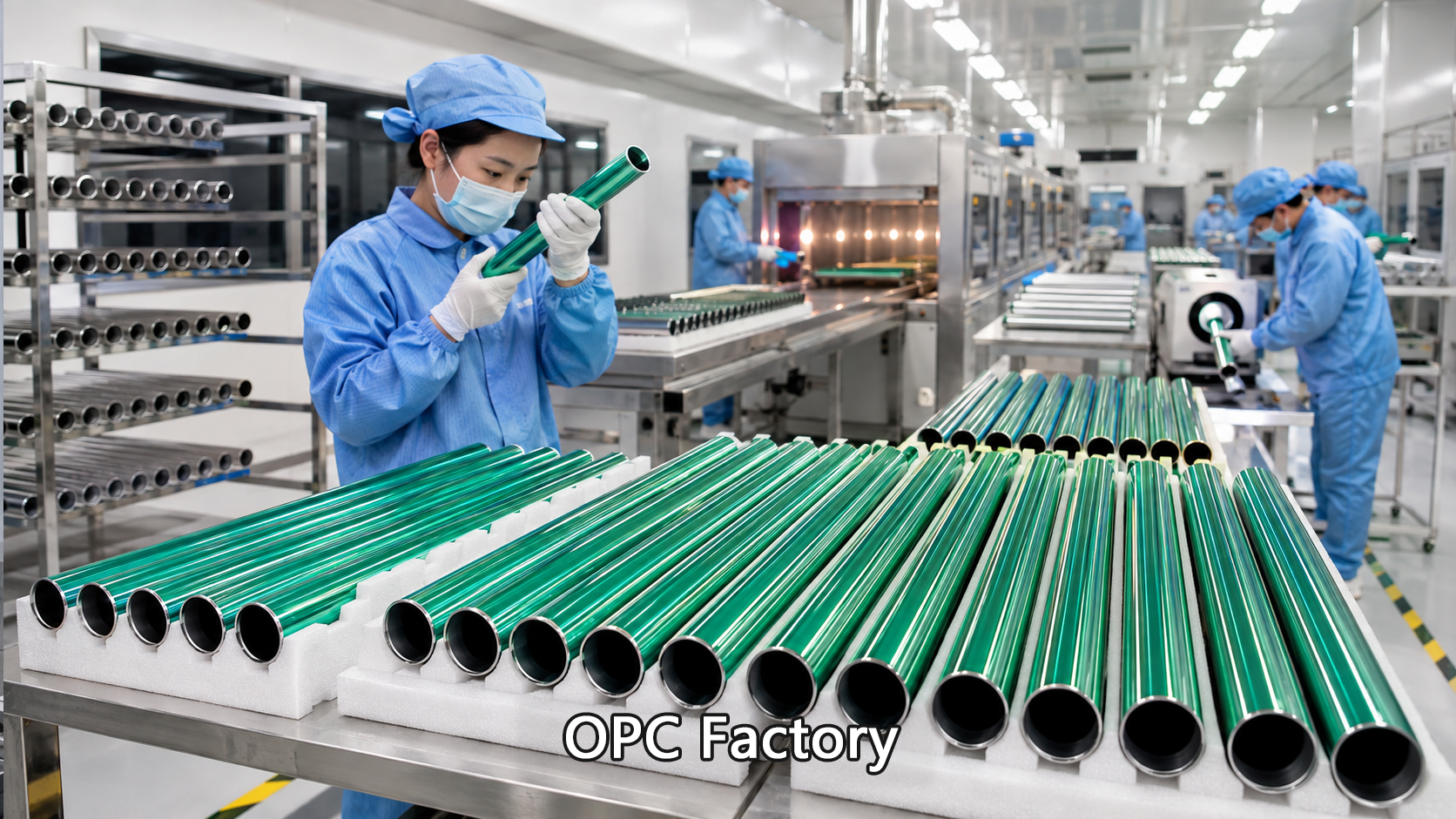
OPC drum production, one of the component lines that feeds finished drum units.
How in-house drum unit and OPC drum production is organised
Far Industries Co.,Ltd is a manufacturer of compatible copier and laser printer consumables based in Zhongshan City, Guangdong, China, established in 2011. Its main products are toner cartridges, drum units, fuser units and developing units, and its compatible consumables are manufactured for CANON, RICOH, KYOCERA, HP, TOSHIBA, KONICA/MINOLTA, SHARP and XEROX copiers and laser printers. The company operates an OPC drum factory, a fuser roller and pressure roller factory, and a drum unit factory, and its production process includes precision moulding, injection molding, component assembly, functionality testing, toner and developer filling, final quality verification and secure packaging, with all manufacturing stages managed in-house from precision moulding to final packaging. The manufacturing facility covers 9,000 m² and the research and development team consists of 8 engineers.
Component and material inputs are also controlled in-house. More than 90% of the moulds used in production are manufactured by the company itself, and virgin PET is used as the housing material. Toner powder is supplied by a well-known publicly listed company, with approximately 90% of the toner imported. A dedicated testing laboratory tests every batch of toner with professional engineers, and the company states that products are tested to meet or exceed OEM specifications.
Four elements of that structure are directly relevant when a buyer is evaluating a drum unit or copier parts supplier. First, drum-level and unit-level production are internal, which reduces dependence on external component sourcing in the imaging part of the consumable set. Second, in-house mould capability supports custom tooling requirements rather than only catalogue parts. Third, a batch-testing laboratory plus the option of third-party testing and inspection gives buyers an independent verification path. Fourth, the company exports approximately 70% of its output, with main markets in Latin America and the Middle East, so commercial terms and packaging expectations in those regions are familiar territory rather than new ground.
Documented copier series coverage
The product range documented for this manufacturer covers the following copier series and model designations for compatible toner cartridges; drum units, developing units and fuser units are produced as separate product groups within the same consumable portfolio.
| Copier series | Documented model designations |
|---|---|
| HP series | W1002YC, W9130/9120, W9170/9160, W9050 |
| Ricoh series | MP 3554/6054, IM C6010, IM C6000 |
| Kyocera series | TK-8365, TK-3182, TK-1275, TK-5372 |
| Toshiba series | T-FC616, T-FC415, T-3028, T-FC330 |
| Canon series | G57/GPR-43/C-EXV59, NPG-71/GPR-55/C-EXV51, NPG-83/GPR-61/C-EXV58, G73/84 C-EXV59 |
| Xerox series | C2263/2265, S1810, C3371, C5570/7785 |
| Sharp series | MX-60CT/AT/GT/NT/FT, BP-CT/AT/GT/NT/FT70, BP-CT/AT/GT/NT/FT20, DX-20CT/AT/GT/NT/FT |
| Konica series | TN622, TN328, TN512, TN626 |
Application and use cases across the copier consumable market
Compatible copier consumables are used where electrostatic printing runs continuously. The typical operating environments are printing factories, print shops, in-house office print rooms, education institutions, copier rental businesses, advertising agencies handling complex text and image output, and individual users operating a single machine. Matching equipment is A4 and A3 copiers and A4 laser printers.
At project level, the buying logic changes with the type of buyer. In office supplies group purchasing, the stated objectives centre on total cost control and supply stability: using group bargaining power to secure dependable consumables that meet everyday office output quality at prices below OEM equivalents, while simplifying supply chain management. In wholesale procurement, the focus shifts to product line expansion and profit protection: broad model coverage across multiple copier brands reduces after-sales incidents and protects both sales margin and customer satisfaction. For large distributors, the objective is a one-stop procurement solution, with an upstream supplier providing downstream customers a consolidated selection rather than a narrow catalogue. Copier leasing companies and large printing plants add a further requirement: predictable consumable availability that keeps machines productive across a mixed fleet.
The operational requirements attached to those projects are equally practical. Page yield can be customised, packaging method, packaging material and custom labelling can be specified, third-party testing and inspection are accepted, and print samples using the toner batch actually used in the product can be provided. For a buyer validating a new drum unit or cartridge supplier, those four options form a workable acceptance process before any volume commitment.
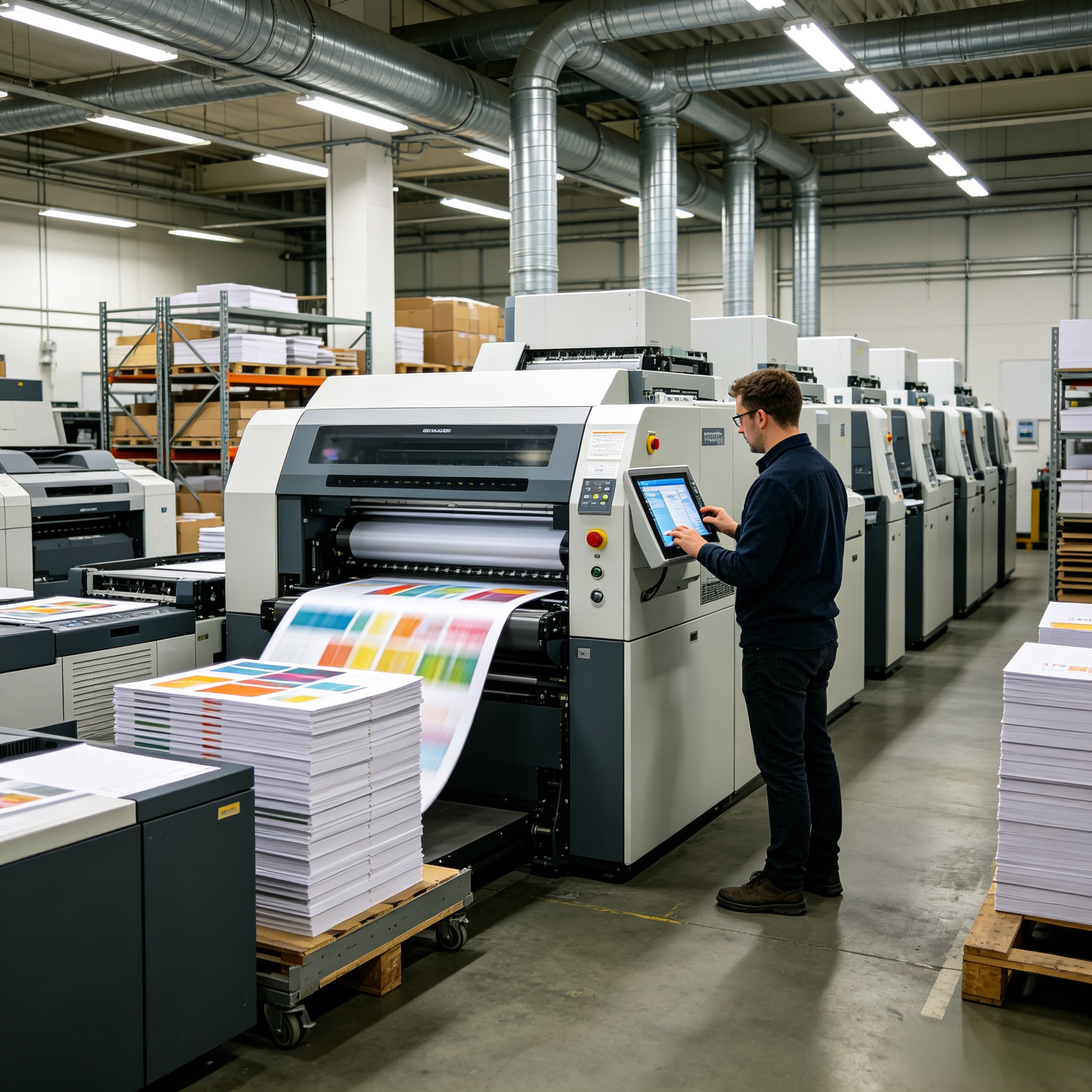
High-volume printing environments are the main demand source for toner cartridges, drum units and fuser units.
Market signals behind drum unit and copier parts demand
The consumables market that surrounds the drum unit remains large and structurally stable. Business Research Insights projects the global ink and toner market to reach USD 38.47 billion in 2026. Within that total, toner cartridges held a 58.4% share of the global ink and toner product market in 2025, according to Dataintelo, which matters for drum unit planning because cartridges and drums are usually bought and replaced within the same maintenance cycle rather than as unrelated purchases.
Regional weight is concentrated in Asia Pacific, which led the global ink and toner market in 2025 with USD 8.7 billion in revenue, equal to 36.9% of the total, again reported by Dataintelo. On the component side, Cognitive Market Research projects the global OPC drum market to reach USD 5.2 billion by 2033, growing at a compound annual growth rate of 5.5% from 2026. Hardware demand points the same direction: Market Growth Reports values the global copier market at USD 880 million in 2025 with a projected rise to USD 1,419.83 million by 2035 at a 4.9% CAGR.
Comparison with traditional supply options — and their boundaries
Copier consumables reach buyers through three broad routes. OEM parts are supplied through brand-controlled channels with a single source per machine family and full traceability, at the highest unit cost. Compatible aftermarket parts, including drum units and toner cartridges produced by manufacturers such as Far Industries Co.,Ltd, cover multiple copier brands from one supply base and are usually chosen for cost control and model coverage. A third route is the reconditioned machine channel, where second-hand copier machines are rebuilt and resold into service fleets; this channel generated 52% of refurbished printer revenue from multifunction devices in 2025 according to Future Market Insights, and it depends heavily on a broad aftermarket parts range covering drum units, developing units, fuser units and fuser film.
The boundaries of the compatible route should be stated just as clearly as its advantages.
- Compatibility is designation-specific. A drum unit or cartridge is valid only for the copier series and model designation listed for it. Coverage must be checked machine by machine, and a listing for one model family does not transfer to another.
- Yield is configuration-dependent. Print yield is based on the toner powder used, and detailed yield figures are provided on request. Buyers should not assume a single universal yield number and should request data for the exact configuration they intend to order.
- Specification claims need verification. The statement that products are tested to meet or exceed OEM specifications is the manufacturer's own claim. Neutral procurement practice is to confirm it through sampling, print samples of the toner batch, or third-party inspection — options the supplier states it supports.
- The drum unit is one link only. Print quality also depends on toner, developer, the developing unit, the fuser and the condition of the machine, so replacing a drum unit will not correct faults originating elsewhere.
- Handling and storage conditions affect outcomes. The OPC drum surface is light-sensitive and mechanically sensitive, so packaging specification, storage and installation practice are part of the quality question rather than administrative details. Custom packaging and labelling are available for buyers who need specific protection standards.
- Regulatory scope is separate from product scope. In Spain, empty toner cartridges are classified as electronic waste under TED/1032/2024 from 2 January 2025. No product specification resolves that obligation; sellers into the market must plan collection and documentation separately.
Future outlook for drum units and copier consumables
Three trends are likely to shape this category over the next few years. The first is the steady growth of the component market itself: the OPC drum market is projected to reach USD 5.2 billion by 2033 at a 5.5% CAGR from 2026, which suggests a durable replacement business rather than a declining one. The second is the reconditioned equipment channel, where multifunction devices already account for the majority of refurbished printer revenue; as that channel matures, demand for consistent aftermarket drum units, developing units, fuser units and fuser film grows with it. The third is compliance. Regulations such as Spain's reclassification of toner cartridges as electronic waste push aftermarket suppliers toward documented collection, traceable materials and verifiable testing.
For buyers, that combination shifts the evaluation criteria away from price alone. Model coverage depth, in-house control over drum and unit production, batch-level testing, willingness to support third-party inspection and clarity about yield data are becoming the practical measures of a copier parts supplier — and they can all be checked before a first order is placed rather than after.
FAQ
What is a drum unit in a copier?
A drum unit is a replaceable assembly that carries the light-sensitive imaging drum, typically an OPC drum, together with the charging and cleaning elements around it. It forms the latent electrostatic image that toner is developed onto before the image is transferred to paper. In the copier consumable structure it is a separate part group from the toner cartridge, the developing unit and the fuser unit, and it is supplied for A3 and A4 copiers and laser printers.
How is a drum unit different from a toner cartridge?
A toner cartridge stores and feeds toner powder toward the development stage, while a drum unit carries the photoconductive surface and the elements that form and clean the latent image. The cartridge is replaced mainly when toner runs out, whereas the drum unit is replaced according to wear of the photoconductive surface and its surrounding components. Both are matched to specific copier series and model designations, and they operate together in the same imaging gap, which is why they are usually planned within the same maintenance cycle.
How is compatibility confirmed for a compatible drum unit or toner cartridge?
Compatibility is defined by copier series and model designation rather than by general machine size or brand. Supplier documentation lists the covered designations — for example Kyocera series TK-8365, TK-3182, TK-1275 and TK-5372, or Ricoh series IM C6000, IM C6010 and MP 3554/6054. Buyers confirm compatibility by matching their machine model against the listed designation, and can additionally request third-party testing, print samples of the toner batch used, or a factory tour by video call before committing to volume.
What determines print yield for compatible consumables?
Print yield is based on the toner powder used, and detailed yield figures are provided on request rather than as a single fixed number. Related specification factors include virgin PET as the housing material, toner powder supplied by a publicly listed company with approximately 90% imported, and more than 90% of moulds manufactured in-house by the producer. Page yield itself can be customised to buyer requirements, so the figure that matters is the one confirmed for the specific configuration being ordered.
Where are compatible copier consumables typically used?
Typical environments are printing factories, print shops, offices, education institutions and copier renting businesses, running A4 and A3 copiers and A4 laser printers. At project level, the same product groups serve office supplies group purchasing programmes, large wholesaler procurement, distributor supply and copier leasing fleets, where model coverage and stable availability are the deciding requirements rather than single-unit price.
Further technical background and the full documented product range are available in the manufacturer brochure: Far Industries Co.,Ltd product brochure (PDF).