
What Is a Flow Sensor? Ultrasonic Technology and How It Works
Flow sensors are small components with a decisive role in modern fluid systems. This article explains what they are, how ultrasonic measurement works, where it is applied across industries, and what buyers should check before selecting a supplier.

The Role of Flow Sensors in Modern Fluid Systems
A flow sensor measures the rate at which a liquid moves through a pipe or tube. It is a compact component, but it often has a decisive role in overall system performance: the sensor signal determines whether a pump is adjusted, an alarm is triggered, or a production batch is accepted. Flow sensors are used across medical devices, bioprocessing, scientific research, industrial automation, and food and beverage production.
Demand for flow measurement is expanding alongside automation and fluid-based technologies. The global flow meter market was estimated at USD 10.64 billion in 2024 and is projected to reach USD 15.17 billion by 2030, according to Grand View Research. Ultrasonic flow meters form a fast-growing segment in this category. Mordor Intelligence estimated the global ultrasonic flow meter market at USD 1.52 billion in 2025 and projected a value of USD 2.28 billion by 2031.
This article is written for engineers, quality managers, and procurement teams that are starting to evaluate flow sensors. It covers the fundamentals of ultrasonic measurement, the main sensor configurations, real-world applications, market evidence, and the boundaries buyers should verify before selecting a supplier.
Key facts:
- The global flow meter market was estimated at USD 10.64 billion in 2024 and is projected to reach USD 15.17 billion by 2030 (Grand View Research).
- The global ultrasonic flow meter market was valued at USD 1.52 billion in 2025 and is projected to grow to USD 2.28 billion by 2031 (Mordor Intelligence).
- Ultrasonic flow sensors can measure flow without moving parts, fluid contact, or pressure loss; typical accuracy in XY-TEK's product range is ±1% to ±3%.
Why Flow Measurement Is a Design Challenge
Every fluid system measures flow for a specific reason. In medical devices, flow measurement is linked to patient safety: blood flow in dialysis, ECMO, or artificial heart systems must be monitored continuously and reliably. In biopharmaceutical production, perfusion pumps, filtration units, and chromatography columns depend on stable and repeatable flow rates. In industrial automation, dispensing and spraying equipment need precise liquid output to avoid overflow, fluctuation, and bonding defects. In liquid cooling systems, flow monitoring protects equipment from overheating.
Conventional flow measurement technologies often complicate these tasks. Mechanical sensors, such as turbine or paddle wheel designs, contain moving parts that wear over time, introduce pressure loss, and require maintenance. Invasive sensors must be installed into the fluid path, which means cutting the pipe, stopping production, and creating a potential contamination point. For medical and biopharmaceutical applications, contact between the sensor and the liquid raises additional questions about sterility, cleaning, and biocompatibility.
The design challenge becomes larger at small scale. Many modern systems use small-diameter tubing and low flow rates, from a few milliliters per minute in laboratory or pharmaceutical processes to a few liters per minute in single-use bioprocessing. At these scales, a sensor that disturbs the flow, cannot resolve small changes, or creates additional dead volume may not be acceptable.
Ultrasonic measurement addresses several of these constraints. Because it relies on sound waves rather than mechanical contact, an ultrasonic flow sensor can be non-invasive, produce no pressure loss, and contain no moving parts. These properties align with the requirements of medical devices, bioprocess equipment, and precision industrial systems.
Flow Sensing Capability: XY-TEK's Ultrasonic Portfolio
Shanghai Xunyin Technology Co., Ltd (XY-TEK) is a Shanghai-based manufacturer focused on the development, manufacturing, and sales of ultrasonic flow sensors and flow meters. The company specializes in fluid measurement for small tubing and low flow rates, an area where general-purpose flow meters are often oversized or insufficiently sensitive.
XY-TEK was established in 2018 and operates a 5,000-square-meter manufacturing facility at Building 7, No. 410 Jinggu Road, Minhang District, Shanghai. The company employs approximately 50 staff and reports an annual production capacity of more than 8,000 units. More than 30 of its employees are R&D engineers. Export business accounts for 50% of total sales, and the company describes its major markets as global.
The product portfolio covers the main configurations used in industrial and medical fluid systems.
| Series | Configurations | Flow range | Accuracy | Key features | Primary use |
|---|---|---|---|---|---|
| CG Series | Clamp-on ultrasonic flow sensor | 0.02–20 L/min | ±1% | Non-invasive; bi-directional flow detection; air bubble detection; analog, pulse, RS485 output | Medical devices; biopharmaceutical; industrial automation |
| CS Series | Non-invasive industrial flow sensor | 0.1–50 L/min | ±3% | Compact integrated design; clamp-on installation; air bubble monitoring; digital output | Semiconductor; water treatment; food & beverage; industrial automation |
| CPD Series | Non-invasive industrial flow sensor | 0.1–50 L/min | ±2% | No pipe cutting; built-in LED display; air bubble monitoring; digital output compatibility | Industrial automation; food & beverage; water treatment; semiconductor |
| CM Series | OEM clamp-on flow meter | 0.05–30 L/min | ±3% | RS485 output; compact design; non-contact measurement; stable signal transmission | Medical devices; OEM equipment; fluid control systems; laboratory equipment |
| TPK Series | In-line ultrasonic flow sensor | 0.5–100 L/min | ±2% | Integrated structure; no moving parts; low maintenance; real-time flow monitoring | Industrial automation; battery manufacturing; chemical processing; liquid cooling |
| TPD Series | In-line ultrasonic flow sensor | 0.5–100 L/min | ±2% | Integrated structure; no moving parts; stainless steel construction; low maintenance | Industrial automation; liquid cooling; battery manufacturing; chemical processing |
| TGU Series | Ultra-low flow sensor | 0.1–1000 mL/min | ±1% | U-shaped measuring channel; compatible with PVC, silicone, and PE tubing | Bioprocess; medical equipment; pharmaceutical production; semiconductor |
| SU Series | Single-use ultrasonic flow sensor | 0.05–10 L/min | ±2% | Single-use measuring channel; biocompatible polymer; supports sterile applications | Biopharma; single-use systems; medical manufacturing; bioprocess |
| TH Series | Hemodynamic ultrasonic flow sensor | 0.01–15 L/min | ±2% | High-speed pulsation capture; medical-grade polymer; precision ultrasonic chip | Cardiovascular research; hemodynamic testing; medical laboratories |
| BG Series | Ultrasonic bubble detector | Pipe OD 3.2–19 mm | Detects bubbles at 1/3 of tubing ID | Non-contact gas-liquid state detection; customizable detection range and response time | Medical devices; bioprocess; food & beverage dosing; industrial |
The CG Series is a key clamp-on platform: it can be attached directly to flexible plastic tubing and measure flow rate without external circuitry. The CS and CPD series extend the non-invasive approach to rigid tubing and industrial environments. On the in-line side, the TPK and TPD series integrate the measuring channel into the pipe for industrial, battery manufacturing, chemical processing, and liquid cooling applications. The SU Series addresses single-use bioprocess systems, the TH Series is designed for pulsatile cardiovascular flow research, and the BG Series covers gas-liquid state detection, which is often required in the same equipment.
How Ultrasonic Flow Sensors Work
Most ultrasonic flow sensors operate on the ultrasonic time-difference method, also called the transit-time principle. The sensor contains ultrasonic transducers that transmit sound signals through the liquid. One signal travels upstream, against the flow, and the other travels downstream, with the flow. The downstream signal arrives slightly earlier. The time difference between the two signals is proportional to flow velocity; when the sensor multiplies the velocity by the cross-sectional area of the tube, it obtains a volumetric flow rate.
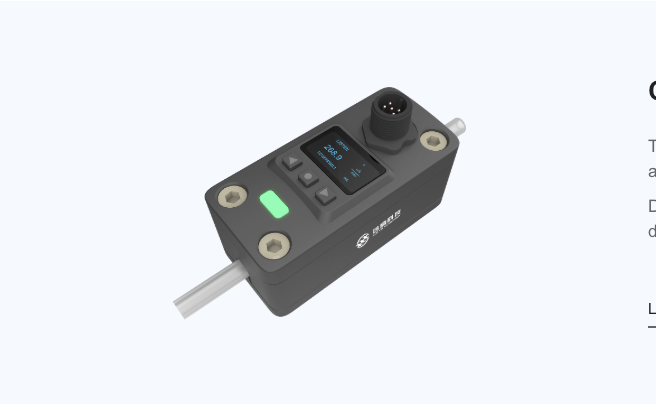
This principle can be implemented in two configurations. In a clamp-on design, the transducers are mounted on the outside of the tube. The liquid never contacts the sensor, which means no contamination, no pressure loss, and no moving parts. Clamp-on sensors can be installed without cutting the pipe and allow retrofitting of existing lines. XY-TEK's CG, CS, CPD, and CM series all use clamp-on installation.
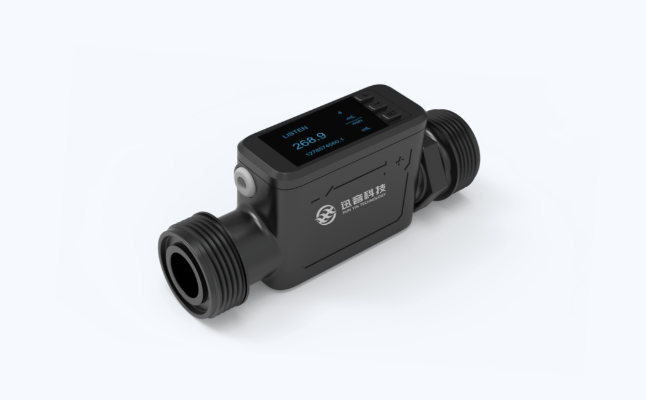
In an in-line design, the sensor body is integrated into the pipeline and the transducers are embedded in the housing. This configuration provides a defined flow path and is common in higher-flow industrial installations. XY-TEK's TPK and TPD series are in-line sensors with integrated structures and no moving parts.
Ultrasonic technology also provides a related function: detecting air in the liquid. Gas changes the propagation of sound waves, so an ultrasonic sensor can recognize when bubbles enter the measuring zone. This matters in medical extracorporeal circuits and dosing systems, where air can cause measurement error or present a safety risk. The BG Series is a dedicated ultrasonic bubble detector that performs non-contact gas-liquid state detection with customizable detection range and response time; its detection resolution is one-third of the tubing's inner diameter.
Performance varies by configuration. According to XY-TEK product data, the CG Series measures 0.02–20 L/min with ±1% accuracy; the CPD Series measures 0.1–50 L/min with ±2% accuracy; the TPK and TPD in-line series measure 0.5–100 L/min with ±2% accuracy; and the TGU low-flow series measures 0.1–1000 mL/min with ±1% accuracy. Output options include analog, pulse, and RS485 signals, which support integration with controllers for automated monitoring and closed-loop control.
Temperature is another specification to verify. Across XY-TEK's range, applicable fluid temperatures are 0 to 60 °C for most series, with the CS, CPD, TPK, and TPD series supporting up to 90 °C.
Applications Across Industrial, Medical, and Bioprocess Environments
Industrial automation
In industrial automation, ultrasonic clamp-on sensors are used for micro-flow precision measurement and control in spraying, dispensing, and cleaning systems. They monitor pulsating and micro-flow liquids and detect bubbles, blockage, or abnormal flow conditions in industrial pipelines. Resolution can reach 0.05 mL/min, supporting stable liquid output and reducing overflow or process fluctuation. Because clamp-on models do not require pipe cutting, they suit retrofits in limited spaces. Typical matched equipment includes dispensing machines, selective wave soldering equipment, coating machines, cleaning equipment, and liquid supply pumps. This application is common in Germany and other industrial markets.
Medical devices
In life-support medical devices, the same principle is used to monitor blood flow and pump operation in dialysis machines, ECMO systems, and artificial heart catheters. The sensor detects air bubbles in extracorporeal circulation to improve patient safety. Because measurement is non-invasive and non-contact, the fluid is not contaminated and no pressure loss is introduced. The application environment is indoor medical, with strict hygiene and biocompatibility requirements; the media include blood, dialysis fluid, medical perfusion liquids, and pharmaceutical solutions. The TH Series supports this segment with high-speed pulsation capture and ±2% accuracy for cardiovascular flow testing. Common application regions include the United States, Canada, Germany, Switzerland, the United Kingdom, France, Italy, China, Japan, Korea, and Singapore.
Biopharmaceutical processes
In biopharmaceutical production, flow sensors support perfusion, tangential flow filtration, chromatography, and fluid transfer. Media such as purified water, buffer solutions, culture media, and biological liquids are measured in cleanroom environments with sanitary-grade and corrosion-resistant requirements. Non-contact clamp-on measurement provides real-time online monitoring with millisecond-level response and automatic bubble or blockage alarms. Because the sensor does not touch the fluid, it satisfies contamination-free and low-shear requirements. For single-use systems, the SU Series uses a disposable measuring channel made of biocompatible polymer materials, supporting sterile applications and hygienic fluid monitoring. Common application regions include the United States, Canada, Germany, Switzerland, Ireland, the United Kingdom, France, China, India, South Korea, Japan, Singapore, and Australia.
Semiconductor, liquid cooling, and other segments
Beyond these core scenarios, ultrasonic flow sensors are used in semiconductor, water treatment, food and beverage, and liquid cooling systems. In semiconductor facilities, flow control is focused on high-purity fluid management, where non-invasive measurement avoids contamination of ultrapure liquids. In liquid cooling loops, in-line sensors such as the TPK and TPD series provide real-time monitoring without moving parts. The CS and CPD series are specified for semiconductor, water treatment, and food and beverage applications.
Market Trends Supporting Ultrasonic Flow Sensing
Several third-party estimates provide context for the adoption of ultrasonic flow measurement:
- The global flow meter market was estimated at USD 10.64 billion in 2024 and is projected to reach USD 15.17 billion by 2030 (Grand View Research).
- The global ultrasonic flow meter market was valued at USD 1.52 billion in 2025 and is projected to grow to USD 2.28 billion by 2031 (Mordor Intelligence).
- The clamp-on ultrasonic flowmeter market was valued at USD 1.25 billion in 2024, growing at a CAGR of 7.4% through 2032 (Global Information, Inc.).
- Asia Pacific held the largest share of the ultrasonic flow meter market in 2025 at 38.6%, driven by industrial expansion (Fortune Business Insights).
- Flow control in the semiconductor industry was estimated at USD 5.83 billion in 2024, focusing on high-purity fluid management (Market Research Future).
These figures indicate structural changes in the flow measurement market. First, non-invasive measurement is increasingly preferred in applications that demand purity, low maintenance, and minimal downtime. Second, OEM integration is becoming more common: equipment manufacturers are embedding compact sensors with digital outputs instead of relying on separate field-installed flow meters, so flow data can be used directly in control logic. Third, application-specific demand is emerging from single-use bioprocess systems and liquid-cooled electronics, two segments that are less relevant to traditional mechanical meters.
For a supplier such as XY-TEK, whose portfolio covers clamp-on and in-line ultrasonic sensors, low-flow measurement, single-use flow channels, and OEM designs, these trends align with the broader direction of the market.
Ultrasonic vs. Traditional Flow Measurement Technologies
Selecting a flow sensing technology is not about one universally superior solution; it depends on the liquid, the piping, the accuracy requirement, and the operating environment. The table below summarizes how ultrasonic technology compares with conventional options.
| Technology | Fluid contact | Moving parts | Pressure loss | Typical strengths | Typical limitations |
|---|---|---|---|---|---|
| Mechanical (turbine / paddle) | Wetted | Yes | Yes | Simple; low initial cost | Wear over time; maintenance; contamination risk |
| Electromagnetic | Electrodes in contact | No | Low | No moving parts; suitable for conductive liquids | Requires conductive liquids; not suitable for non-conductive fluids |
| Coriolis | Wetted (vibrating tube) | No | Yes | Direct mass flow measurement; high accuracy | Higher cost; pressure drop; larger footprint |
| Ultrasonic (clamp-on) | None | No | No | Non-invasive; no contamination; no pressure loss; easy retrofit | Best for liquids with few or no solid particles; requires smooth tubing surface |
| Ultrasonic (in-line) | Internal channel wetted | No | Low | Defined flow path; no moving parts; stable accuracy | Requires integration into the line; higher installation effort than clamp-on |
Ultrasonic flow sensors also have real boundaries that buyers should understand. Measurable fluids are described as water, blood, drinks, oil, paint, and similar liquids without, or with few, solid particles. Heavy aeration or high suspended-particle concentration can reduce the quality of the acoustic signal and make measurement less reliable. Clamp-on models require tubing with smooth surfaces so that sound passes consistently between the transducer and the liquid; in XY-TEK's specifications, applicable tubing includes flexible plastics such as PVC, silicone, PFA, PE, and PUR with smooth inner and outer surfaces, and rigid plastics such as PFA, PTFE, PVDF, PP, and nylon. Fluid temperature is another boundary: the company's range specifies 0 to 60 °C, or up to 90 °C for the CS, CPD, TPK, and TPD series.
These boundaries are useful for selection rather than deficiencies. In medical, biopharmaceutical, and precision industrial systems, where the liquid is clean, the tubing is selected for the process, and contamination or pressure loss must be avoided, ultrasonic measurement is a strong fit.
Future Outlook for Flow Sensor Development
The flow sensor market is moving from standardized general-purpose meters toward application-specific, integrated sensing platforms. Three developments are visible.
First, single-use bioprocessing will continue to grow, and with it the need for disposable measurement channels that preserve sterility. The SU Series addresses this requirement with a single-use measuring channel and biocompatible polymer construction.
Second, sensor miniaturization and OEM integration will keep advancing. Compact clamp-on sensors with digital outputs allow equipment designers to add flow sensing without redesigning the fluid path. The CM Series, designed for OEM integration with RS485 output, reflects this pattern.
Third, high-purity and thermal-management segments such as semiconductors and liquid cooling are expanding the demand for non-invasive measurement. The semiconductor flow-control market was estimated at USD 5.83 billion in 2024, and the clamp-on ultrasonic flowmeter segment is projected to grow at a CAGR of 7.4% through 2032.
For procurement and engineering teams, the practical implication is to select suppliers that can support customization and document performance. XY-TEK provides OEM ultrasonic flow sensors and customized services, and its product documentation is available at www.xy-tek.com.
Frequently Asked Questions
What is a flow sensor?
A flow sensor is a device that measures the rate at which a liquid moves through a pipe or tube. Flow sensors are used in medical devices, bioprocessing, scientific research, industrial automation, and food and beverage production to monitor, control, or verify fluid movement.
How does an ultrasonic flow sensor work?
An ultrasonic flow sensor uses the ultrasonic time-difference method. It sends ultrasonic signals through the liquid in both directions, upstream and downstream, and calculates flow velocity from the difference in signal arrival time. Because the measurement can be performed through the wall of the tube, the sensor does not need to contact the liquid.
What is the difference between clamp-on and in-line ultrasonic flow sensors?
A clamp-on sensor is mounted on the outside of the tubing and does not contact the liquid; it can be installed without cutting the pipe and creates no contamination or pressure loss. An in-line sensor is integrated into the pipe body with a defined internal channel; it provides a fixed flow path and is typical in industrial and higher-flow installations.
What accuracy can ultrasonic flow sensors achieve?
Typical accuracy in XY-TEK's product range is ±1% to ±3%, depending on the series. Examples include the CG Series at ±1% over 0.02–20 L/min, the TPK and TPD in-line series at ±2% over 0.5–100 L/min, and the CS Series at ±3% over 0.1–50 L/min.
Which industries use ultrasonic flow sensors?
Ultrasonic flow sensors are used in medical devices, biopharmaceutical production, industrial automation, semiconductor manufacturing, water treatment, food and beverage production, and liquid cooling systems. Common applications include dialysis and ECMO equipment, perfusion and filtration systems, dispensing and spraying machines, and cooling loops.
What are the limitations of ultrasonic flow sensors?
Ultrasonic flow sensors are designed for liquids without or with few solid particles. High aeration or particle content can interfere with the ultrasonic signal. Clamp-on models require tubing with smooth surfaces for reliable coupling. Applicable fluid temperatures are typically 0 to 60 °C, with some series supporting up to 90 °C.
What is a bubble detector, and how is it different from a flow sensor?
A bubble detector determines whether gas or liquid is present in a tube, while a flow sensor measures the flow rate. XY-TEK's BG Series is an ultrasonic bubble detector that performs non-contact gas-liquid state detection with customizable detection range and response time; its detection resolution is one-third of the tubing inner diameter. Bubble detectors are used in medical devices, bioprocess, and dosing systems to prevent air from entering critical lines.