
What Is a Live Stream Switcher? A Production Switcher Guide
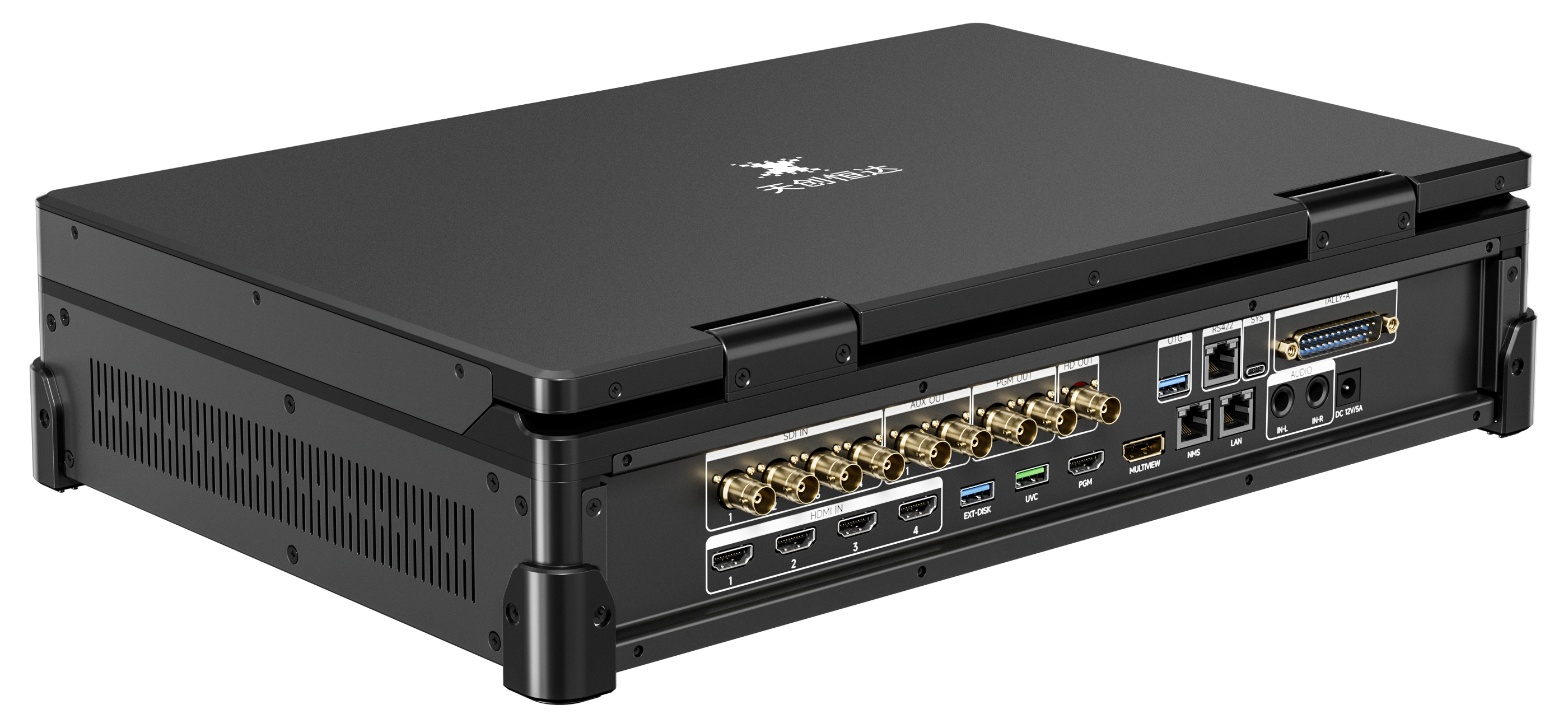
An integrated live stream switcher combines camera switching, audio mixing, local recording and streaming encoding in a single chassis. Image: TCHD Video.
A live stream switcher is the device that accepts several video sources, lets an operator select and combine them in real time, and outputs one program feed for recording, broadcast or online delivery. It is the equipment that turns three or four cameras into an actual production rather than a single fixed shot, and in most modern workflows it also handles audio mixing, graphics overlays, local recording and encoding.
The category is no longer confined to broadcast studios. Churches, online sellers, universities, esports organizers, conference producers and outdoor event crews now run multi-camera productions with small teams, and they assess switchers against very practical questions: how many inputs, which connectors, how many destinations can be streamed at once, and what happens if something fails mid-broadcast.
This reference explains the live stream switcher as a product category and uses the switcher range from TCHD Digital Video Technology Development (Beijing) Ltd, commercially known as TCHD Video, to show how different models are built for different production jobs. TCHD Video is a Beijing-based manufacturer established in 2005 that supplies video software and hardware products and application systems, including live streaming cameras, video capture cards, converters, encoders and live stream switchers.
Why Multi-Camera Live Production Moved Out of the Broadcast Truck
Audiences increasingly evaluate a streamed service, match or product demonstration against television output, while the team producing it is often smaller than a broadcast crew. A single locked-off camera cannot show a presenter, a wide shot and a product detail within the same minute, and manual switching between cameras is not a realistic task during a live broadcast.
The traditional answer was a chain of separate devices: a vision mixer for switching, an audio console for sound, capture cards to bring computer content into the program, a hardware encoder for delivery, and one or more computers running overlay and streaming software. Each additional device adds cabling, a power supply, another point of failure, and another piece of knowledge the operator has to hold.
Integrated live stream switchers were developed to compress that chain. When switching, audio mixing, media playback, recording and encoding sit in one chassis, the equipment list shortens, setup time falls, and the operator works from a single interface. That consolidation is what made multi-camera production practical for churches, classrooms, online storefronts and community sports venues.
TCHD Digital Video Technology Development (Beijing) Ltd, which trades as TCHD Video, develops video software and hardware products and application systems. The company was established in 2005, employs approximately 50 staff, operates a 10,000 m² facility with a 10-engineer R&D team, and reports an annual output of around 4,000 units, with roughly 20% of production exported to markets in the EU, USA and Asia.
What a Live Stream Switcher Does: Nine Functional Blocks
Purchasing decisions become clearer when the device is broken into the functions it actually performs. The list below reflects how the category is specified, with model-specific examples drawn from the TCHD Video switcher range.
1. Video inputs
A switcher accepts camera and computer sources through HDMI, SDI, IP streams or USB. Input count defines how many positions a production can cover. The TCHD-890HS provides 8 video input channels, comprising 4×HDMI and 4×SDI inputs. The TCHD-812 uses 4×12G-SDI and 1×HDMI inputs inside a 12-channel design. The TCHD-810 Pro combines HDMI and SDI inputs with a USB auxiliary input. Connector type matters as much as count: 12G-SDI supports the longer cable runs typical of venues and outdoor sites, while HDMI 2.0 suits shorter camera-to-rack distances.
2. Switching control
Cut, auto and manual T-bar transitions are the operator's core tools. The TCHD-890HS provides adjustable-speed CUT, AUTO and T-bar switching with a one-touch FTB black-out emergency function. The TCHD-840 Pro integrates T-Bar manual control with more than 36 transition effects.
3. Compositing and graphics
Chroma key and luminance key functions create virtual studio backgrounds without a physical set, and PIP windows allow two images to be shown at once. The TCHD-890HS supports chroma-key, PIP picture-in-picture and six groups of logo and subtitle overlay. The TCHD-810 Pro supports eight layers of PGM overlay with two crop-and-scale PIP channels and a subtitle DSK overlay. The TCHD-840 Pro supports chroma and luma keying alongside logo overlay and scrolling CG subtitles.
4. Audio mixing
Audio is where simplified switchers often fall short, so channel count and control granularity are worth checking. The TCHD-890HS carries a 10-channel audio mixer with independent channel gain control and per-channel on/off and restore-default options, a balanced stereo analog audio input on 6.35 mm, a 3.5 mm headphone output, an audio level range of −60 dB to 6 dB, 48 kHz sampling, AAC encoding and analog input delay adjustable up to 2000 ms. The TCHD-812 and TCHD-812 Ultra use a 12-channel audio mixer with independent volume control and up to 2000 ms delay adjustment. The TCHD-840 Pro mixes HDMI embedded, NDI, DDR and external microphone audio, with delay tuning from 0 to 10000 ms.
5. Recording and local playback
Recording inside the switcher reduces dependence on an external recorder. The TCHD-890HS records to an internal SSD or a USB 3.0 drive in MP4, TS and AVI formats, with a PGM recording bitrate of 1–20 Mbps and multi-channel recording of 1–8 Mbps on SSD, and supports segmented recording as well as playback of MP4 and MKV (H.264) files from storage media as filler video. The TCHD-812 and TCHD-812 Ultra provide dual hot-swappable SSD slots with optional 2TB, 4TB or 8TB capacity, 4K H.265 and HD H.264 recording, power-off protection and automatic file segmentation. The TCHD-840 Super offers no fewer than two media playback channels for MP4 and MKV filler or promotional clips.
6. Encoding and streaming
A built-in streaming engine determines how many destinations a production can reach at once. The TCHD-890HS supports IP streaming via RTMP, RTSP, HLS, FLV, UDP, NDI and NVI alongside HDMI and SDI inputs, with up to 6 simultaneous streaming outputs including 4 customizable stream addresses, 1 NDI stream and 1 NVI stream, and it can receive up to 8 streaming sources at the same time. The TCHD-812 family supports RTMP, RTMPS, SRT, RTSP, NDI and GB28181 for stable simultaneous streaming to four different platforms with editable stream templates. The TCHD-840 Pro supports RTMP, RTMPS, SRT, UDP, RTP, HLS and WHIP with adjustable bitrate and delay, streaming to four independent platforms. The TCHD-840 Ultra and TCHD-840 Super handle RTMP, RTMPS, SRT, RTSP, UDP and NDI with one stream in and four out.
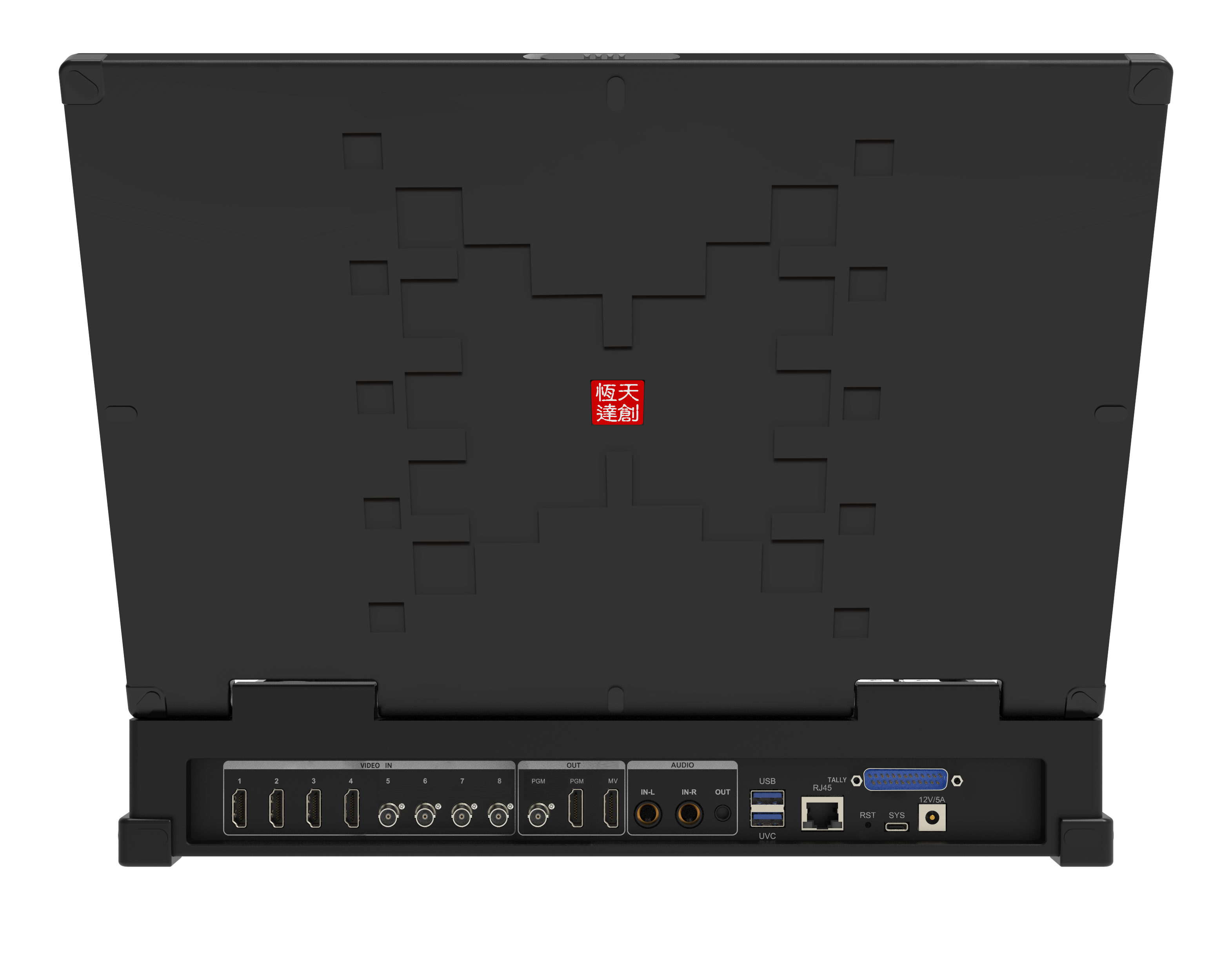
The TCHD-890HS provides eight video input channels and up to six simultaneous streaming outputs, including four customizable stream addresses. Image: TCHD Video.
7. UVC output
Several models expose a standard UVC output so a computer recognises the switcher as a webcam. The TCHD-840 Pro uses a Type-C UVC output; the TCHD-840 Ultra, TCHD-840 Super and TCHD-812 class also provide UVC output. This removes the need for an external capture card and lets the program feed be used directly in recording, conferencing or streaming software.
8. Monitoring and control
Operators need to see the program and the incoming sources before switching. The TCHD-890HS provides a 1×HDMI 1.4 output carrying PGM and multiview. The TCHD-840 Ultra and TCHD-840 Super provide a DisplayPort multiview output. Several models include an integrated display for local monitoring, such as the 17.3-inch full HD screen on the TCHD-812 Ultra and a main display of 15.6 inches or larger on the TCHD-840 Ultra. Configuration is available through a web UI or an on-screen menu on relevant models, firmware can be upgraded through the web interface or a USB drive, and Tally interfaces support camera operator signalling.
9. Control surfaces
The TC-UV08 is a broadcast control panel with 42 dual-colour crystal keys and 8 multi-function shortcut keys, a third-generation damping search knob, a streamlined photoelectric T-bar, and −5s, −10s and −20s quick mark buttons with NOW and LIVE shortcuts. It communicates over MIDI, USB, RS232 and LAN, and is compatible with vMix, FairPlay and TCLiveSP. Its stated application areas include sports replay, event live broadcast, corporate conferences, education and professional content creation.
How the TCHD Video Switcher Range Maps to Those Functions
The range is best understood as several answers to the same question, rather than one product with variations. Each model below is described using its published specification.
| Model | Positioning | Key published characteristics |
|---|---|---|
| TCHD-890HS | HD multi-camera live production | 8 video input channels (4×HDMI + 4×SDI); 720p, 1080p and 1080i; 10-channel audio mixer; SSD or USB 3.0 recording in MP4, TS and AVI; up to 6 simultaneous streaming outputs; NDI and NVI support |
| TCHD-840 Pro | 4K HDMI and NDI hybrid switching | 4-channel 4K HDMI and NDI hybrid input with 1×4K60, 2×4K30 and 4×1080P decoding; H.264 and H.265 hardware encoding; RTMP, RTMPS, SRT, UDP, RTP, HLS and WHIP; Type-C UVC output; 4-platform simultaneous streaming |
| TCHD-840 Ultra | Broadcast-grade 4K production | 4×12G-SDI or 4×HDMI 2.0 inputs; 2×12G-SDI PGM, 2×12G-SDI AUX, 3G-SDI down-converted PGM, HDMI 2.0 PGM, DisplayPort multiview and UVC output; embedded FPGA architecture; built-in M.2 drive bay |
| TCHD-840 Super | 4K production with mixed connectivity | 12G-SDI and HDMI 2.0 hybrid inputs; 2160p60 through 1080i formats; UVC output; one-click screenshot; one-click fade-to-black or colour-bar output; PIP templates for 1, 2, 3 or 4 windows |
| TCHD-810 Pro | HD and 4K hybrid multi-camera work | 4 HDMI (two supporting 4K60P) plus 4 SDI inputs and a USB auxiliary input; 8 layers of PGM overlay plus 2 crop-and-scale PIP channels; more than 30 transition effects; chroma and luminance keying; PTZ control for up to 4 cameras; NDI updatable |
| TCHD-812 | 12-channel 4K live production | 4×12G-SDI and 1×HDMI inputs; 4K@60Hz, 1080p and 1080i processing on an FPGA architecture; dual hot-swap SSD slots with 2TB, 4TB or 8TB options; 12-channel audio mixer; RTMP, RTMPS, SRT, RTSP, NDI and GB28181 |
| TCHD-812 Ultra | As TCHD-812 with larger local monitoring | 17.3-inch full HD screen; 12-channel 4K design; dual hot-swap SSD recording; four-platform simultaneous push; one-click landscape and portrait switching |
| TC-UV08 | Replay and control surface | 42 dual-colour crystal keys and 8 shortcut keys; broadcast-grade A/B multi-camera switching; slow-motion replay and frame marking; MIDI, USB, RS232 and LAN; compatible with vMix, FairPlay and TCLiveSP |
Matching a Switcher to a Specific Production Scenario
Different venues place different demands on the same category of equipment. The scenarios below are common entry points for buyers evaluating a live stream switcher for the first time.
Church streaming switcher
A worship service typically needs two to four camera positions, lyric and scripture overlays, clean audio from a mixing desk, and a recording for later distribution. Operators are often volunteers working on a rotation, so control simplicity matters more than maximum feature depth. A model with balanced analog audio input, subtitle overlay and straightforward on-screen or web configuration fits this pattern; the TCHD-890HS supports balanced stereo analog audio input, six groups of logo and subtitle overlay, and configuration through a web UI or on-screen menu.
E-commerce live stream switcher
Live selling combines a presenter, a product close-up and filler material between segments, and usually needs a vertical 9:16 output for social platforms as well as a landscape feed. Useful capability here includes one-click switching between landscape and portrait modes, PIP for product detail, and playback of stored MP4 or MKV clips. The TCHD-840 Pro, TCHD-840 Ultra and TCHD-840 Super all offer one-click landscape and portrait switching, and the TCHD-890HS supports both 16:9 and 9:16 operation modes.
Education, lecture recording and campus production
Education and remote teaching is one of the stated application areas of the TCHD-890HS, TCHD-812, TCHD-812 Ultra, TCHD-840 Pro, TCHD-840 Super and TCHD-810 Pro. Practical requirements include reliable long-duration recording, segmented files for archiving, PTZ camera control in fixed installations, and a UVC output that lets the program feed enter common conferencing or recording software without a capture card. The TCHD-810 Pro supports PTZ control for up to four cameras, and the TCHD-840 Pro is described as compatible with OBS, Zoom and other mainstream streaming and conference software.
Entertainment, concert and performance streaming
Performance production relies on transitions, multi-layer graphics and, increasingly, virtual studio elements. Chroma key and luminance key functions for virtual backgrounds are provided on relevant models, and the TCHD-810 Pro supports eight layers of PGM overlay with two PIP channels and more than 30 transition effects.
Esports tournaments and sports events
An esports tournament stream usually combines several game feeds with at least one camera, and it is one of the stated application areas for the TCHD-890HS alongside business presentations and education. Sports coverage adds a replay requirement, which is where a control surface rather than a switcher becomes relevant: the TC-UV08 provides slow-motion replay control with −5s, −10s and −20s mark buttons and works with mainstream software including vMix, FairPlay and TCLiveSP.
Corporate conferences and converged media centres
Conference production often needs separate program and auxiliary feeds for confidence monitors, room screens and overflow rooms, together with balanced audio. The TCHD-840 Ultra and TCHD-840 Super provide two 12G-SDI PGM outputs and two 12G-SDI AUX outputs, plus 3G-SDI down-converted PGM and HDMI 2.0 PGM outputs, which allows the same program to be delivered in different formats to different destinations.
Outdoor and remote production
Outdoor work puts distance and conditions ahead of channel count. 12G-SDI inputs on the TCHD-812, TCHD-812 Ultra, TCHD-840 Ultra and TCHD-840 Super support longer cable runs than HDMI, aluminium alloy housings are used across the range, and the TCHD-812 family adds dual hot-swappable SSD slots with power-off protection and automatic file segmentation for material that must not be lost.
Medical and clinical teaching
The TC-UV08 lists the healthcare industry among its intended industries, and education and remote teaching among its typical application scenarios, which is the relevant context for surgical demonstration and clinical training workflows that follow the same replay-and-review pattern as sports coverage.
Market Trends Reshaping Live Stream Switching
No verified market-size or growth figures are used in this section; the direction of change is instead visible in how products are specified.
Multi-destination distribution is becoming the default. Sending one program to a single platform is increasingly treated as a limitation rather than a normal configuration. Models in this range support four-platform simultaneous streaming with editable stream templates, or up to six simultaneous streaming outputs on the TCHD-890HS.
Vertical video has moved into first-class production status. Rather than being cropped after the fact, 9:16 output is now a switching mode on most current models, which changes how operators frame and compose shots during a broadcast.
Protocol breadth defines workflow flexibility. RTMP and RTSP remain the baseline, while SRT, NDI, WHIP and, in some markets, GB28181 are increasingly listed alongside them, reflecting a shift toward IP-based contribution and distribution.
UVC output is reducing capture hardware. When a switcher appears to a computer as a webcam, the separate capture card that used to sit between the switcher and the streaming computer becomes optional.
Resolution migration is pulling connector changes with it. 4K production requires either 12G-SDI or HDMI 2.0 infrastructure, and the presence of both input options on a single model is a practical response to mixed camera inventories.
Consolidation continues. Switching, audio mixing, recording, media playback and encoding were once separate purchases. The current generation of hardware switchers bundles them, which shifts the buyer's evaluation from component compatibility toward how well one appliance covers the whole workflow.
Hardware Switchers vs Traditional Broadcast Chains: Trade-offs and Limits
An integrated switcher is not automatically the right answer for every production. The comparison below sets the traditional multi-device chain against an integrated hardware switcher.
| Consideration | Traditional chain (mixer, audio console, capture cards, encoder, computer) | Integrated hardware live stream switcher |
|---|---|---|
| Equipment count | Several devices, power supplies and interconnects | One chassis for switching, audio, recording and encoding |
| Failure behaviour | Faults are distributed; a single failure may not stop the broadcast | Fewer interconnects, but one appliance carries all functions |
| Input scalability | Expandable through routers or additional mixers | Fixed physical input counts such as the 8 channels of the TCHD-890HS |
| Audio | Dedicated console with a higher channel count | 10-channel mixer on the TCHD-890HS; 12-channel mixer on the TCHD-812 family |
| Flexibility | Software-defined and limited mainly by the host computer | Fixed function set, updated through firmware |
| Cost profile | Higher total spend spread across several purchases | Lower equipment count, with capability bundled per model |
Buyers should also weigh the limits that apply specifically to hardware switchers in this class:
- Fixed input counts. A model supports the number of physical inputs it ships with. Adding cameras beyond that capacity means moving to a larger model rather than enabling a software option.
- Format ceilings differ by model. The TCHD-890HS supports 720p, 1080p and 1080i. A 2160p60 workflow requires a 4K-class model such as the TCHD-840 Pro, TCHD-840 Ultra, TCHD-840 Super, TCHD-812 or TCHD-812 Ultra.
- Cabling is part of the specification. 12G-SDI and HDMI 2.0 inputs require cable and connector grades that match the signal rate; a switcher upgrade can imply a cabling upgrade.
- Recording capacity is a fitted option. The TCHD-812 family uses dual hot-swappable SSD slots with 2TB, 4TB or 8TB options, and multi-channel recording on the TCHD-890HS is limited to SSD rather than USB storage.
- IP workflows inherit network behaviour. NDI, SRT and similar transports depend on the quality and management of the network they run over, not only on the switcher.
- Feature availability is model-specific. PTZ camera control, GB28181 support, WHIP streaming, auxiliary SDI outputs and other capabilities appear on some models and not others, so each requirement should be checked against the individual specification.
- Compliance scope is product-specific. Certifications documented by the manufacturer, such as ISO 9001:2015, ISO 14001, ISO 45001 and CE EMC, are recorded against specific camera products including the TC-980S, TC420 and TCHD-T3. They should not be assumed to cover the switcher range automatically, and compliance status should be confirmed per product and per target market.
Software switching on a desktop computer deserves a fair mention in the same discussion. It offers flexibility and a low entry cost, but its behaviour depends on the host machine, operating system and software version. Hardware appliances built on embedded FPGA architectures prioritise predictable, low-latency operation in return for a fixed feature set. The choice between the two is a choice about where the risk sits, not about which approach is inherently superior.
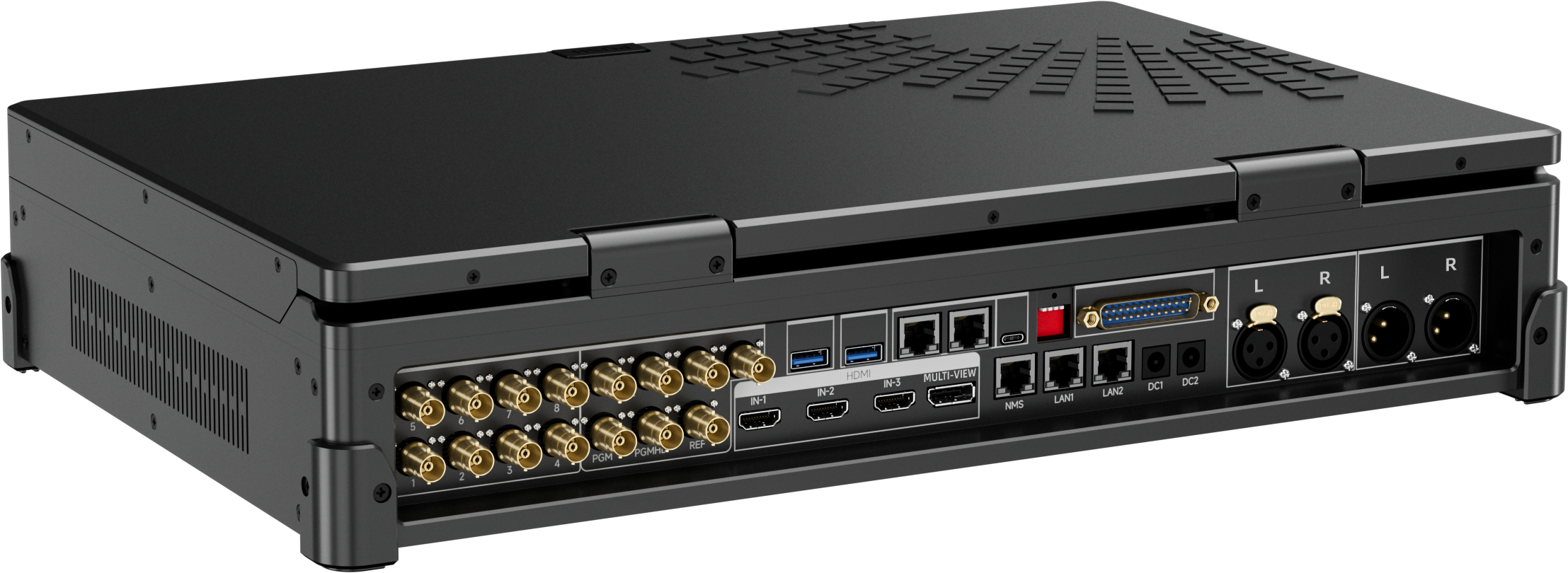
The TCHD-812 Ultra is a 12-channel 4K switcher with a 17.3-inch full HD screen and dual hot-swappable SSD recording. Image: TCHD Video.
Future Outlook
The trajectory visible in current specifications points toward fewer dedicated boxes and more protocol coverage. Switching, audio mixing, recording, playback and encoding have already converged into single appliances, and the next round of differentiation is likely to appear in how fluently those appliances speak IP: supporting additional transport protocols, managing multiple simultaneous destinations as templates rather than manual entries, and treating landscape and portrait outputs as two formats of the same production rather than two separate setups.
A second direction is operator accessibility. Built-in displays, web-based remote control, customisable multiview themes and control surfaces that communicate over MIDI, USB, RS232 or LAN all reduce the amount of specialised training a volunteer or part-time operator needs before going live. As multi-camera production spreads into smaller organisations, ease of operation is likely to carry as much weight as raw channel count.
What is less predictable is resolution behaviour at the entry end of the market. 4K production is well established in the specification of upper-tier models, but HD workflows remain common where cameras, cabling and delivery bandwidth are already in place. Buyers should treat format support as a requirement to be matched to their existing camera inventory rather than as a specification to be maximised by default.
FAQ
What is a live stream switcher used for?
A live stream switcher accepts multiple video and audio sources, lets an operator select and combine them in real time, and outputs a single program feed for recording, broadcast or online delivery. Models in the TCHD Video range, such as the TCHD-890HS, are intended for multi-camera live streaming to the Internet or broadcast applications, the education and training industry, business presentation streaming and livestreamed esports event production.
How many camera inputs does a live stream switcher need?
It depends on how many positions the production must cover. Four inputs typically support a presenter plus two or three other angles. The TCHD-890HS provides 8 video input channels, comprising 4×HDMI and 4×SDI inputs, and the TCHD-812 is built as a 12-channel design with 4×12G-SDI and 1×HDMI inputs. IP sources also count toward the working total: the TCHD-890HS can receive up to 8 streaming sources at the same time.
Can one live stream switcher stream to several platforms at the same time?
Yes, on models that include a built-in streaming engine. The TCHD-890HS supports up to 6 simultaneous streaming outputs, including 4 customizable stream addresses, 1 NDI stream and 1 NVI stream. The TCHD-812 and TCHD-812 Ultra support simultaneous streaming to four different platforms with editable stream templates, and the TCHD-840 Pro streams to four independent platforms with adjustable bitrate and delay.
Can a live stream switcher output vertical 9:16 video for social platforms?
Several models support portrait operation alongside landscape. The TCHD-890HS supports both landscape 16:9 and portrait 9:16 operation modes. The TCHD-840 Ultra and TCHD-840 Super offer one-click switching between landscape and portrait production modes, the TCHD-840 Pro supports one-click switching between 16:9 and 9:16, and the TCHD-810 Pro provides one-click switching between portrait and landscape orientations.
Does a live stream switcher need a separate capture card or encoder?
Not necessarily. Models with a UVC output are recognised by a computer as a webcam, so the program feed can enter streaming, recording or conferencing software directly; the TCHD-840 Pro uses a Type-C UVC output, and the TCHD-840 Ultra, TCHD-840 Super and TCHD-812 class also provide UVC output. Models with a built-in streaming codec encode to protocols such as RTMP, RTMPS, SRT, RTSP, NDI and, on the TCHD-812 family, GB28181, without an external encoder.
What are the limits of a hardware live stream switcher?
Physical input counts are fixed, so adding cameras beyond the installed capacity means moving to a larger model rather than enabling an option. Format support varies by model: the TCHD-890HS handles 720p, 1080p and 1080i, while 2160p60 production requires a 4K-class model. IP-based workflows depend on network quality, recording capacity is tied to the SSD options fitted, and features such as PTZ camera control, GB28181 support, WHIP streaming or 12G-SDI auxiliary outputs are available only on specific models and must be checked individually.
Reference and Further Information
For buyers at the awareness and research stage, the practical first step is to define input count, signal format, audio channel requirement, recording duration and the number of streaming destinations, then match those requirements against a specific model specification rather than a general product category. TCHD Video publishes its full model range with connector and format details in the TCHD Product Catalog 2025 (PDF), and additional manufacturer information is available at www.tchdvideohk.com.