
What Kids Balance Bike Physical Specs Reveal About a Supplier
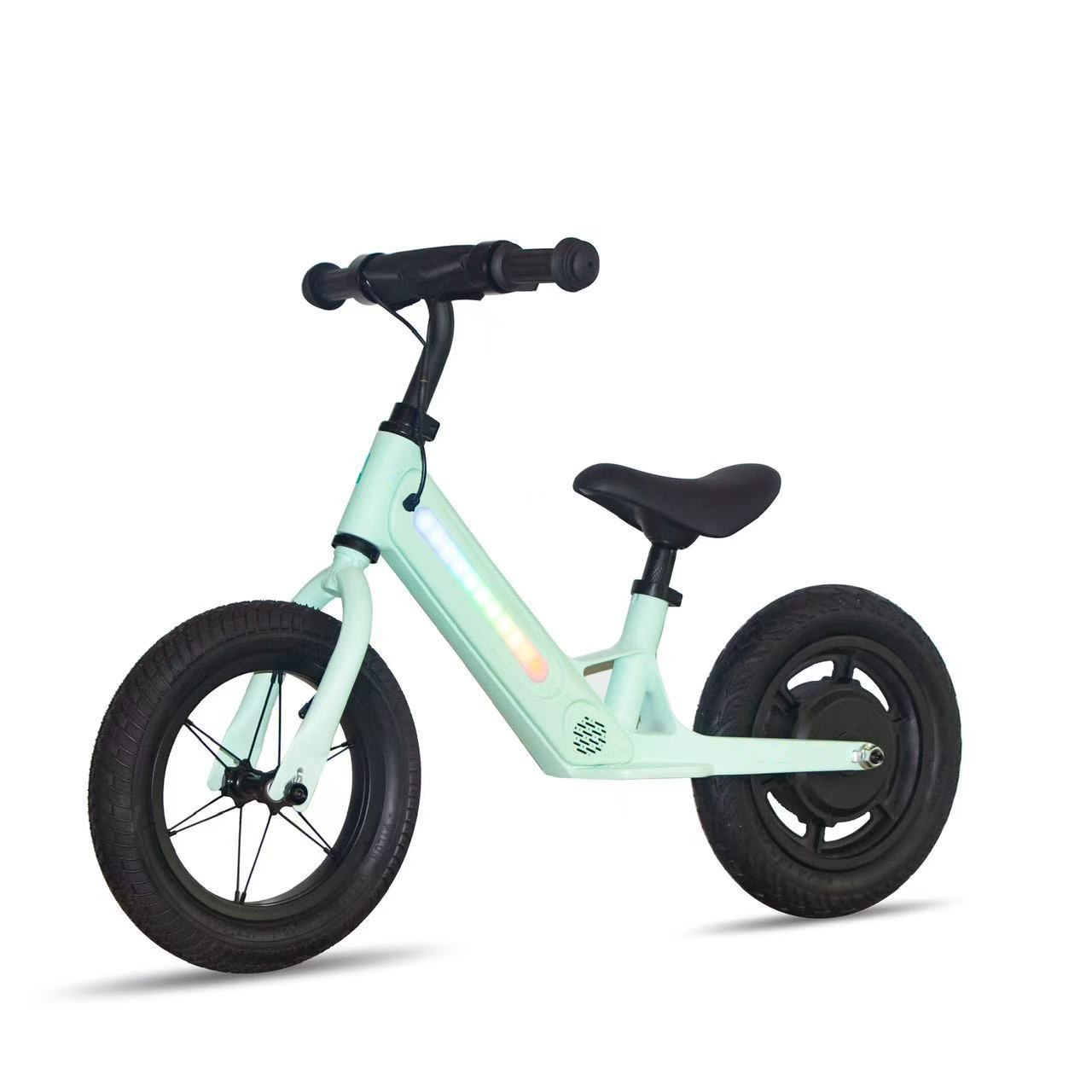
For buyers sourcing kids balance bikes, the specification sheet is the first physical evidence of what a supplier can actually build. In a category where most 12-inch frames look alike in product photography, the details that decide return rates, warranty claims and reorders sit inside material names, rim types, suspension, motor ratings and battery chemistry — and those details only become usable when they can be traced to a specific model code.
This industry reference examines three builds from Wuxi Purino International Trade Co.,Ltd — AME-1201, AME-1202 and the 2-In-1 Kids Bike — and reads each published specification twice: once as a build detail, and once as an acceptance criterion a buyer can verify at sample stage. Nothing here substitutes for testing; it defines what should be testable in the first place.
Why Physical Specs Are the First Capability Test in Balance Bike Sourcing
Balance bikes are a visually homogeneous product group. A 12-inch wheel, a curved frame and a soft saddle appear across almost every supplier catalogue, which pushes buyers toward price comparison before capability comparison. The spec sheet is where that comparison can be rebuilt on manufactured facts: frame material, fork material, rim material, tyre type, wheel diameter, brake type, drive rating and battery format.
The recurring sourcing risk is cross-model assumption. A buyer who approves “the magnesium one” may later find that AME-1201 uses a magnesium frame with a steel fork and no suspension listed in its model data, while AME-1202 uses a magnesium alloy frame and fork with suspension and a different drive package. Model codes exist precisely so that a purchase order can name one build instead of describing a material family.
A published spec line is also a checkpoint. Magnesium versus steel can be confirmed by weight and surface inspection. A 12-inch air tyre on an aluminum rim is a different component from a PP rim with a rubber tyre, and it behaves differently on rough ground and in service. A 180W motor and a 24V 200W brushless motor are two drive configurations, not two numbers on one continuum. A 24V 2Ah battery and an 18650 6S1P pack rated 55.0Wh are different energy systems with different charging routines. Treating these as checkpoints rather than claims is what converts a catalogue into supplier evidence.
The Supplier Behind the Model Codes
Wuxi Purino International Trade Co.,Ltd is a trading enterprise located in Wuxi, Jiangsu Province, China — a recognised industrial hub for electric bicycle manufacturing — supplying electric bicycles, kids scooters, children balance bikes and related components. The company was founded in 2016, reports a 100% export ratio, and lists the EU and the USA as its main markets.
The operational figures the supplier publishes are specific enough to be planned against: a 2,300 m² facility footprint, annual output of 200,000 pcs, a team of 10 employees and an R&D group of 3 engineers. For balance bike programmes, the stated monthly capacity is 10,000 units, the minimum order quantity is 100 units, and lead time is 45–60 days. Customization covers frame color and logo, packaging and accessories, tyre type selection (EVA, CST or air), and saddle and grip material.
Three children balance bike builds carry the model codes discussed here: AME-1201 and AME-1202 in the 12-inch magnesium group, and the 2-In-1 Kids Bike in a steel frame group offered in 12, 14 and 16-inch sizes. The supplier also operates as a trading and supply-chain oriented exporter, offering product consultation, customization and order processing rather than a single owned production line — a structure that shapes how buyer verification should be planned, and one this article returns to when defining limits.
AME-1201: Magnesium Frame, Steel Fork and a Bluetooth-Controlled Drive
The published build of AME-1201 reads as follows:
- Frame material: magnesium; fork material: steel
- Tyre and rim: air tyre with aluminum rim
- Wheel diameter: 12 inches
- Motor: 180W
- Battery: 24V 2Ah
- Bluetooth function for connection with mobile devices
- Stated maximum speed: 14.5 km/h
Read as evidence, the material split is a deliberate weight decision: magnesium in the frame to reduce what the child pushes, steel in the fork where front-end impacts concentrate. That combination is a build strategy, not a compromise, and it can be verified by weighing the frame and checking the fork material on a sample.
The 12-inch air tyre with an aluminum rim is the second evidence point. Air tyres absorb surface irregularities better than solid alternatives, and an aluminum rim can be trued or replaced in service — useful for institutional users whose bikes stay in rotation rather than being retired at the first puncture. The 180W motor and 24V 2Ah battery define an entry electric-assist configuration, and the stated 14.5 km/h ceiling is the value a buyer should be able to reproduce during sample testing.
AME-1202: Suspension, Brushless Drive and Three Selectable Speed Modes
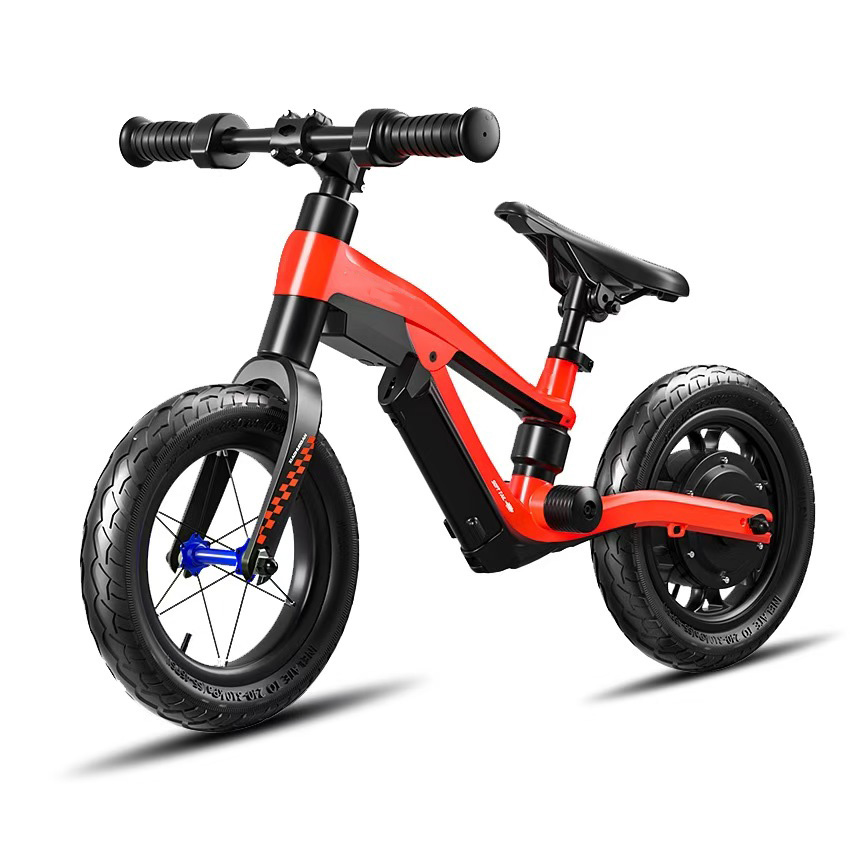
AME-1202 is the more heavily specified build of the pair:
- Frame and fork material: magnesium alloy, with suspension
- Tyre and rim: air tyre with aluminum rim; wheel diameter 12 inches
- Motor: 24V, 200W, 12-inch brushless motor
- Battery: 18650-2500mAh/3C, 22.2V/2.5A-55.0Wh lithium battery, 6S1P configuration
- Stated maximum speed: 12 km/h; 6 km/h, 12 km/h and 18 km/h in three modes when a digital display is fitted
- Surface treatment: full powder coating
- Contact points: metal headset and TPR soft handle grips
- Charging: direct charging, or separate charging by removing the battery pack
Suspension is the differentiator buyers notice first, because it changes how a bike behaves on the surfaces where children actually ride — kindergarten yards, park paths and paving. The battery specification is the second: 18650 cells at 2500mAh with a 3C rating, arranged 6S1P to give a 22.2V nominal pack rated 55.0Wh. That level of detail matters commercially, because a stated energy figure and cell format can be quoted in product documentation and checked against the delivered pack.
The finishing and contact components are equally practical evidence. Full powder coating resists scratching in shared use; a metal headset and TPR soft grips address the two points children stress most — steering and hand contact. The ability to charge the pack in place or remove it for separate charging affects how institutions and multi-unit buyers plan their routines.
One comparison deserves attention. AME-1202 carries a higher motor rating than AME-1201 (200W against 180W), yet its stated base maximum speed of 12 km/h is lower than the 14.5 km/h stated for AME-1201. The difference is the mode architecture: 6, 12 and 18 km/h selectable modes when a digital display is fitted, which gives buyers a staged speed envelope instead of a single ceiling. Wattage alone is not a proxy for top speed, and buyers comparing the two models should compare the mode structure they need, not the motor figure in isolation.
2-In-1 Kids Bike: Conversion, Steel Build and Container Economics
The 2-In-1 Kids Bike is a different engineering answer to the same category:
- Steel frame and steel fork
- PP rim with rubber tyre
- Chain, crank and pedals removable to convert the bike to balance bike mode
- Rear band brake
- Available in 12, 14 and 16-inch sizes
- High container loading capacity
For buyers, the conversion is a service-life argument. A bike that can be stripped back to balance mode keeps working as a child's skills and size change, which is why the associated project data describes a 2–3 year duration supporting prolonged use through growth stages rather than a single-season product. The steel frame and fork trade weight for durability and a lower cost structure, and the PP rim with a rubber tyre is described as wear-resistant and adaptable across varied ground conditions.
The rear band brake is mechanically simple and gives stable stopping power, which suits institutional and shared-use settings where maintenance capacity is limited. Two commercial details complete the picture. Three wheel sizes — 12, 14 and 16 inches — mean a buyer can cover a wider age range within one supplier relationship, though it also means more SKUs to plan. And high container loading capacity directly reduces ocean freight per unit, which is often a more decisive number for wholesale and distribution buyers than any single component specification.
Reading the Three Builds Side by Side
| Model | Frame and fork | Tyre and rim | Wheel size | Brake | Drive, battery and control | Stated maximum speed |
|---|---|---|---|---|---|---|
| AME-1201 | Magnesium frame, steel fork | Air tyre, aluminum rim | 12" | Not stated in model data | 180W motor; 24V 2Ah battery; Bluetooth function | 14.5 km/h |
| AME-1202 | Magnesium alloy frame and fork with suspension | Air tyre, aluminum rim | 12" | Not stated in model data | 24V 200W 12-inch brushless motor; 18650-2500mAh/3C, 22.2V/2.5A-55.0Wh lithium battery, 6S1P | 12 km/h; 6/12/18 km/h in three modes with digital display |
| 2-In-1 Kids Bike | Steel frame and steel fork | PP rim, rubber tyre | 12", 14", 16" | Rear band brake | None listed | Not applicable |
Additional build details that appear in the model data: AME-1202 specifies full powder coating, a metal headset and TPR soft handle grips, and supports either direct charging or separate charging by removing the battery pack. The 2-In-1 Kids Bike is the only one of the three with a stated brake type, and the only one offering more than a single wheel size.
Application Fit: Where Each Build Belongs
The application data behind these three models describes a consistent operating environment: preschool and childcare, kids products retail, wholesale and distribution, and gifts and promotional channels. Working conditions cover daily home indoor and outdoor play, kindergarten group use, and bulk delivery to retail stores or educational institutions. Project types range from bulk procurement and kindergarten equipment programmes to OEM and private-label sales.
Model-level fit is not interchangeable. AME-1202 is linked to bulk procurement projects in the preschool and childcare industry, with application scenarios described as common in Germany, France, the UK, the US, Canada, Australia, Japan and South Korea. The 2-In-1 Kids Bike is applied in kindergarten equipment projects and in kids products retail, wholesale and distribution, typically in the EU, North America and Asia-Pacific, with color and label customization as a stated special requirement. AME-1201 is directed at OEM and private-label sales, bulk delivery to retail stores or educational institutions, and gift and promotional channels.
Function and operation mode are equally specific. These bikes are described as tools for developing balance and early cycling skill training, and as equipment for daily recreation and outdoor activity. Operation is either manual push and ride in balance bike mode, or electric assist for the electric variants, with mechanical braking such as hand, foot or rear band brakes. Matched equipment includes children's helmets, elbow and knee pads, replacement saddles, spare inner tubes and wheels, plus custom packaging and labels — a reminder that a balance bike order is usually an accessory and spare-parts order as well.
Special requirements listed across the application data include color and label customization, tyre type selection between EVA and inflated options, bulk packaging for institutions, and quality report requirements. For AME-1201 specifically, maintenance is expected to include replacement saddles and spare inner tubes or wheels, which is a maintenance-planning input rather than a durability claim.
Market Trend: Regulation and Material Choice Are Reshaping Spec Sheets
Three published data points frame why specification documentation is becoming a procurement criterion rather than a courtesy. The global balance bike market is projected to reach approximately USD 1.43 billion by 2026 (The Business Research Company, 2026), and the same category is expected to grow at a CAGR of 7.2% from 2026 to 2033 (Coherent Market Insights, 2026). Growth of that order keeps new supplier entrants coming into the category, which is exactly when buyers need comparable build data.
Regulation is tightening in parallel. EN71-1:2026 introduces mandatory performance testing for all ride-on toys including balance bikes in the EU, effective 1 January 2026. For a supplier, that means a model code must map to a test record; for a buyer, it means the spec sheet and the compliance file need to describe the same bike.
Materials are moving too. Published frame comparisons put magnesium alloy integrated casting frames for balance bikes at approximately 680g, with total bike weight around 3.1kg for 12-inch magnesium alloy models (Montasen, 2026). That figure explains why magnesium appears in two of the three models discussed here, and why a buyer should be able to weigh a sample rather than accept a material label.
At the trade level, balance bikes without pedals are classified under HS Code 95030010, which governs documentation and duty treatment. At the brand level, the kids' bicycle market remains concentrated: Giant Bicycles and Trek Bicycle Corporation are reported at 15% and 12% market share respectively in 2025 (Fortune Business Insights, 2026). The practical reading for importers and distributors is that differentiation in the mid-market comes from documented build decisions — material, component and drive configuration — rather than from outspending established brands on awareness.
Spec-Led Sourcing Compared with Traditional Catalogue Sourcing
The conventional approach to sourcing balance bikes starts with product photography, an indicative price and a broad material description such as “magnesium available”. It is fast, and for low-risk trial orders it can be adequate. Its weakness is that none of those inputs survive contact with a delivery: photographs do not distinguish a steel fork from a magnesium one, and a material family does not distinguish AME-1201 from AME-1202.
Spec-led sourcing reverses the sequence. The buyer fixes the model code, the frame and fork materials, the tyre and rim combination, the brake type, the drive rating and the battery format first, then treats quotation and sampling as confirmation steps. It costs more time up front and demands more supplier documentation, but it converts a subjective comparison into a line-by-line one.
The limitation is real and should be stated plainly. A specification describes a build, not the consistency of the process that produces it. Wuxi Purino International Trade Co.,Ltd operates as a trading and supply-chain oriented export business, and while its published material refers to quality control and pre-shipment inspection, detailed QC procedures and standards are not specified. Warranty terms and return or exchange policies likewise require confirmation rather than assumption. Buyers who require published process documentation should therefore treat the spec sheet as the starting point of verification, not the end of it.
Limits and Boundaries Buyers Should Plan Around
- The supplier structure is trading and supply-chain oriented rather than a single owned production line, so process-level evidence depends on the partner factories behind each order.
- Quality control is described as including incoming material checks and pre-shipment inspection, but detailed QC procedures and standards are not published.
- Warranty terms and return or exchange policies are not stated in the available material and need to be confirmed commercially.
- Brake type is not stated in the model data for AME-1201 and AME-1202; only the 2-In-1 Kids Bike lists a rear band brake.
- Suspension and magnesium alloy frames carry a cost premium relative to steel; steel-frame configurations trade weight and ride comfort for durability and a lower cost position.
- Electric-assist variants add battery handling, charging practice and market-specific transport documentation questions that should be resolved before shipping, not after.
- Sizing coverage differs by model: AME-1201 and AME-1202 are specified at 12 inches, while the 2-In-1 Kids Bike spans 12, 14 and 16 inches, so a full age-range programme may require more than one SKU.
- Customization options are broad — frame color and logo, packaging and accessories, tyre type, saddle and grip material — but each addition changes lead time and inspection scope.
Turning Specs into Purchase Terms and Acceptance Criteria
The value of physical specifications is realised only when they appear in the purchase agreement as criteria rather than as description. The table below translates the published build data into order-level checkpoints.
| Evidence point | What to lock into the order | Why it matters |
|---|---|---|
| Frame and fork material | State the model code per delivery line, not a material description | Prevents substitution between AME-1201 and AME-1202 |
| Tyre and rim combination | Air tyre with aluminum rim for AME-1201 and AME-1202; PP rim with rubber tyre for the 2-In-1 Kids Bike; EVA or inflated selection where customized | Changes ride comfort, maintenance frequency and unit cost |
| Suspension | Confirm explicitly whether suspension is required | Only AME-1202 lists suspension in the available model data |
| Brake type | Require a written brake specification per model | Brake type is unstated for AME-1201 and AME-1202 |
| Drive configuration | 180W with 24V 2Ah, or 200W with the 18650 6S1P 55.0Wh pack | The two systems are not interchangeable in documentation or service |
| Speed mode control | Confirm the digital display if 6/12/18 km/h modes are required | The three-mode speed set depends on the display being fitted |
| Commercial terms | MOQ 100 units; lead time 45–60 days; monthly capacity 10,000 units | Sets the planning and reorder rhythm for the programme |
| Customization scope | Frame color and logo; packaging and accessories; saddle and grip material | Required for private-label and institutional programmes |
| Documentation and packaging | Quality report requirements; bulk packaging for institutions | Institutional tenders and retail listings often depend on both |
| Maintenance kit | Replacement saddles; spare inner tubes or wheels | Defines the after-sale support scope for the account |
| Compliance mapping | EN71-1:2026 performance testing for ride-on toys; CE and EN15194 as stated for the supplier's electric bicycles | Keeps toy-safety documentation and e-bike certification separate |
The compliance row deserves emphasis. EN15194 and CE certification relate to the supplier's electric bicycles, not to children balance bikes. Balance bikes sold as ride-on toys in the EU fall under EN71-1:2026 performance testing effective 1 January 2026. A buyer who accepts e-bike certification as evidence for a balance bike order has accepted the wrong document, and no specification detail can repair that later.
What Comes Next for Balance Bike Procurement
Two forces are likely to keep pushing specification quality upward. The first is regulation: as mandatory performance testing for ride-on toys becomes the baseline in the EU, suppliers will be asked for model-level documentation rather than category-level certificates, and the suppliers that already publish detailed specs will sit closer to compliance readiness. The second is material economics: with magnesium alloy frames documented at roughly 680g and complete 12-inch bikes near 3.1kg, weight is becoming a measurable marketing claim, and measurable claims get audited.
On the product side, three directions are already visible in the builds examined here — convertible geometry that extends a bike across growth stages, staged speed modes that let one drive package serve different age groups, and component choices such as TPR grips and metal headsets that target wear points instead of appearance. For buyers, the practical implication is that future specification sheets will carry more parameters, not fewer, and the ability to lock a model code to an acceptance criterion will remain the most reliable form of supplier evidence available before shipping.
FAQ: Model, Material and Procurement Questions
What is the difference between AME-1201 and AME-1202?
AME-1201 uses a magnesium frame with a steel fork, a 180W motor, a 24V 2Ah battery, a Bluetooth function for connecting with mobile devices, and a stated maximum speed of 14.5 km/h. AME-1202 uses a magnesium alloy frame and fork with suspension, a 24V 200W 12-inch brushless motor, an 18650-2500mAh/3C lithium battery rated 22.2V/2.5A-55.0Wh in a 6S1P configuration, and a stated maximum speed of 12 km/h, or 6, 12 and 18 km/h in three modes when a digital display is fitted.
Which of these models is normally specified for kindergarten or institutional orders?
The application data links the 2-In-1 Kids Bike to kindergarten equipment projects and AME-1202 to bulk procurement in the preschool and childcare industry. The 2-In-1 uses a steel frame and steel fork with a rear band brake, is offered in 12, 14 and 16-inch sizes, and lists color and label customization as a special requirement. AME-1202 is associated with application scenarios common in Germany, France, the UK, the US, Canada, Australia, Japan and South Korea.
Is the 2-In-1 Kids Bike a balance bike or a pedal bike?
It is a convertible design. The chain, crank and pedals can be removed to switch the bike into balance bike mode, and the rear band brake is part of the stated build. The related project information describes a 2–3 year duration supporting prolonged use through children's growth stages, which is the practical reason conversion designs are specified for institutions.
How should a buyer choose between air tyres with aluminum rims and PP rims with rubber tyres?
AME-1201 and AME-1202 are specified with air tyres on aluminum rims, a combination associated with smooth riding and shock absorption and with rims that can be serviced. The 2-In-1 Kids Bike is specified with PP rims and rubber tyres, described as wear-resistant and adaptable across different ground conditions. The application data also lists tyre type selection between EVA and inflated options as a special requirement, so the tyre decision can be fixed at order stage rather than left to delivery.
Which compliance documents should be requested for a balance bike order?
For EU sales, EN71-1:2026 introduces mandatory performance testing for all ride-on toys including balance bikes, effective 1 January 2026, so test documentation should map to the specific model code. CE and EN15194 certification as described by the supplier relate to electric bicycles rather than to balance bikes, and balance bikes without pedals are classified under HS Code 95030010 for trade purposes. Buyers should also confirm whether quality report requirements apply to their programme, since the application data lists them as a special requirement alongside bulk packaging for institutions.
What commercial terms should be confirmed before placing a balance bike order?
The supplier states a minimum order quantity of 100 units, a lead time of 45–60 days and a monthly capacity of 10,000 units. Customization options cover frame color and logo, packaging and accessories, tyre type selection, and saddle and grip material. Warranty terms and return or exchange policies are not published in the available material and require confirmation, as do detailed quality control procedures beyond the stated pre-shipment inspection.