
What Makes a Hair Growth Serum OEM Stand Out in 2026
Hair growth serums are among the fastest-moving segments in personal care, and the manufacturers behind them vary widely in capability. This article outlines what buyers should investigate before selecting a hair growth serum OEM.
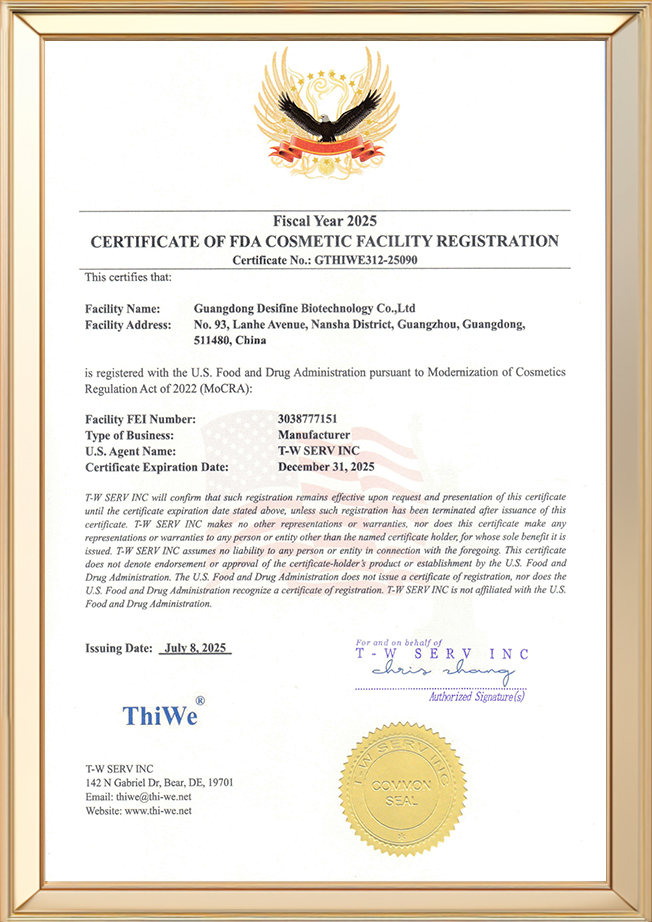
Regulatory documentation is a primary separator when evaluating hair growth serum OEM partners. Source: Desifine.
The Market Opportunity Behind Hair Growth Serum OEM
The global hair serum market was valued at USD 1.3 billion in 2024 and is projected to reach USD 2.4 billion by 2033, according to Grand View Research. Hair treatment serums, including products positioned around hair loss and regrowth, accounted for 64.6% of that market in 2024. For brands considering entry, the category is no longer a niche extension of haircare; it is a core growth line with measurable demand across North America, Europe, and Asia.
Several structural forces are behind this growth. The so-called "skinification" of hair care has shifted consumer expectations: serums containing facial-grade ingredients such as Hyaluronic Acid and Peptides have seen a 30% increase in demand, indicating that buyers now treat scalp care with the same seriousness as facial skincare. At the same time, private label cosmetics overall are expanding at a 5.5% CAGR, driven by demand for affordable, high-quality alternatives to premium haircare brands. That combination—clinical expectations plus private label economics—creates a favorable window for brands working with contract manufacturers.
The manufacturing side of the industry is also consolidating around quality rather than volume. The global cosmetics OEM/ODM market is projected to reach USD 31.71 billion by 2025, with China holding nearly 30% of the global share. Chinese manufacturers are increasingly investing in certified facilities, modern production lines, and export-ready compliance. One indicator: China's exports of shampoo and related hair care products increased 16.79% year-on-year to USD 137 million between January and August 2025, according to the General Administration of Customs of China.
For a brand evaluating suppliers, the practical question is no longer "which factory has the lowest price" but rather "which OEM can deliver a stable, compliant, customized serum at a scale that matches our go-to-market plan."
What Separates a Qualified Hair Growth Serum OEM
Not every cosmetics factory is equipped to produce serum. Serum formulations are water-light emulsions or anhydrous blends that require precise emulsification, active ingredient handling, and contamination control. Buyers should assess a potential partner across five dimensions:
- Production credentials. A qualified OEM should hold GMPC, ISO 22716 Cosmetics GMP certification, and, for US-bound products, FDA facility registration. These certifications demonstrate that the factory has an audited quality management system rather than ad-hoc production controls.
- R&D and formulation capability. Custom hair growth serum development requires more than copying a base formulation. A manufacturer should be able to adjust formula, fragrance, color, concentration, and active ingredient levels, and to support claim development. A dedicated R&D team and in-house testing capacity are strong indicators.
- Customization depth. Standard private label serums are widely available, but a true OEM relationship goes further: packaging, bottle shape, label, logo, private brand name, and even the concentration of key actives should be customizable.
- Quality control system. Look for raw material inspection, semi-finished product testing, and 100% finished product quality checks. Third-party testing options such as SGS or Intertek add further assurance.
- Documentation and after-sales support. Stability testing reports, Safety Data Sheets (SDS), batch tracking, and product claim support are essential for bringing a product to market, especially in export markets. Reorder flexibility also matters for brands managing inventory cycles.
These criteria are not theoretical. Guangdong Desifine Biotechnology Co., Ltd., a cosmetics OEM/ODM manufacturer based in Guangzhou, illustrates how each dimension looks in practice at a mid-sized factory. Desifine's 15,000 m² plant, staffed by 82 employees, operates with a 5,000,000-unit annual output and an R&D team of over 20 engineers. The company lists USA and Europe as its primary export markets, with 60% of output exported.
How Top Manufacturers Compare: Desifine in Context
Understanding where a manufacturer sits in the broader OEM/ODM landscape helps buyers calibrate expectations. The global cosmetics OEM/ODM market is led by large players such as Cosmax (South Korea), Intercos (Italy), and Kolmar Korea, which have deep R&D pipelines, global supply chains, and the capacity to serve multinational beauty groups. These are appropriate partners for brands with large launch volumes and complex multi-market requirements.
Mid-sized, export-focused manufacturers like Desifine operate in a different but equally legitimate segment: they offer the speed, flexibility, and MOQ accessibility that emerging and mid-market brands need, while maintaining certified quality systems. The table below compares the two profiles:
| Comparison Metric | Global Leaders (Cosmax, Intercos, Kolmar Korea) | Mid-Sized Export OEM (Desifine) |
|---|---|---|
| Primary buyer profile | Large beauty groups, multinational launches | Emerging brands, private label start-ups, mid-market launches |
| Typical MOQ expectations | High; thousands to tens of thousands per SKU | 3,000 units per SKU |
| Lead time | Longer; less flexible for small batches | 30–45 days production; 7–10 days for samples |
| Customization scope | Extensive but process-heavy | Formula, fragrance, color, concentration, packaging, label, logo, private brand name |
| Certification base | Global certifications and pharmacopeia-grade capabilities | GMPC, ISO 22716, US FDA Registration |
This comparison is not a judgment of quality; it is a question of fit. A brand launching a single SKU into one market would likely overpay for a multinational OEM's infrastructure. Conversely, a global skincare group scaling to fifty markets would outgrow a regional manufacturer. The decision hinges on order scale, speed, and the degree of hands-on collaboration required.
Compliance and Claim Management: The Hidden Difference
In no haircare category is regulatory precision more important than hair growth. The line between a cosmetic and a drug shifts depending on the claim, and manufacturers differ significantly in how they manage that boundary.
In the United States, only Minoxidil and Finasteride are FDA-approved active ingredients for hair growth. A product that claims to stimulate hair follicle regrowth may cross into drug classification, which changes the regulatory pathway entirely. Most hair growth serums sold in the US market are, therefore, positioned as cosmetics, with claims centered on scalp conditioning, strengthening, and creating a healthy environment for hair.
In the European Union, hair growth products fall under Regulation (EC) No 1223/2009 as cosmetics, but specific claims regarding follicle stimulation may shift classification toward medicinal status. This means a manufacturer's ability to provide accurate product claim support is not an administrative nicety; it is a fundamental risk-control capability.
When evaluating an OEM, buyers should request supporting documentation: stability reports, SDS, batch traceability protocols, and claim substantiation data. Desifine, as a reference point, holds GMPC certification (Cert No. CN-GMPC-250377), ISO 22716 Cosmetics GMP certification (Cert No. CN-CGMP-250376), and FDA Facility Registration (Cert No. GTHIVE312-25090). The company also states that it provides product claim support as part of its after-sales service, and offers third-party testing through SGS or Intertek.
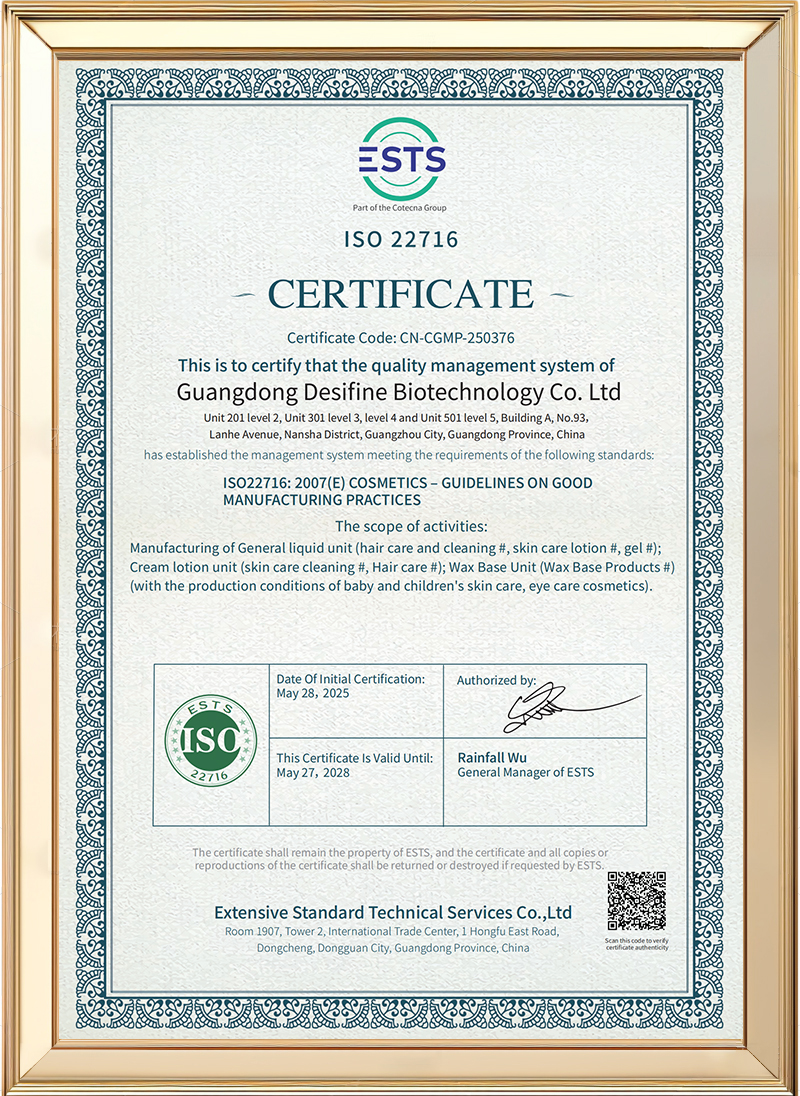
ISO 22716 certification is a baseline expectation for export-oriented cosmetics OEMs. Source: Desifine.
Application and Case Reference
Manufacturer claims are best understood through documented execution. Desifine's published case record includes two multi-year projects, both in English-speaking and EU markets, that illustrate the capabilities relevant to hair growth serum OEM work.
The first case involved a body care brand in the United States. Over three years, Desifine produced 5 million pieces of a fragrance-free body lotion with an "8-Free" clean formula. The project highlights include pharmaceutical-grade quality, batch traceability, and reorder flexibility; the client reported consistent repeat orders and reliable delivery. While this was a body care project, the same quality-control infrastructure—raw material inspection, semi-finished testing, 100% finished product checks, and batch tracking—applies directly to serum production.
The second case is more directly relevant to hair care. A private label beauty brand operating in the United States, Canada, the United Kingdom, and Italy entered a four-year partnership with Desifine to develop a custom hair care product line for the sensitive skin market. The project produced 200,000 pieces and included custom formula development, flexible small-batch production, full regulatory compliance support, packaging optimization advice, and on-time delivery. According to the case record, the project achieved consistent quality from sample to mass production, supporting sales growth over the partnership period.
These cases matter for hair growth serum buyers because they demonstrate capabilities that cannot be assessed from a product photo: stability across repeated production runs, regulatory navigation across US and EU markets, and a manufacturer's willingness to support smaller launch quantities.
Limitations and Boundaries of the Mid-Sized OEM Model
An honest evaluation requires noting where a mid-sized manufacturer is not the ideal choice. Desifine's model—MOQ of 3,000 units per SKU, 30–45 day production lead time, and annual output of 5 million units—works well for emerging and mid-market brands. It is not designed to serve multinational corporations that require volumes in the hundreds of millions or multi-continent supply chains.
There are also regulatory limits that no cosmetics OEM can circumvent. If a brand intends to sell a product containing Minoxidil or Finasteride, or to make drug-level claims about hair regrowth, it is no longer sourcing a cosmetic and should seek pharmaceutical manufacturing partners. Cosmetic-grade OEMs like Desifine are appropriate for serums positioned as scalp treatments, hair strengthening formulas, and thinning-hair care products within cosmetic claim boundaries.
Buyers should also be aware that while Desifine publishes its case record and facility data, not every manufacturer in the same segment operates at the same standard. Verification of certifications, site audits, and sample testing remain the buyer's responsibility.
Future Outlook for Hair Growth Serum OEM
Looking toward the remainder of this decade, three trends are likely to shape the hair growth serum OEM market.
First, the category will continue its expansion. The projected growth from USD 1.3 billion to USD 2.4 billion by 2033 implies that brands entering now are positioning before the most competitive phase. Early partner selection matters because formulation stability studies and compliance documentation take time to build.
Second, ingredient transparency and "clean" formulations will become competitive prerequisites, not differentiators. The 8-Free clean formula standard—free of preservatives, fragrance, mineral oil, silicone, traditional emulsifiers, amines, dyes, and cruelty—has already been implemented in Desifine's production lines and is likely to be demanded by more retailers and marketplaces in the coming years.
Third, China's share of the global cosmetics OEM/ODM market—nearly 30% by 2025 estimates—will continue to draw scrutiny and, simultaneously, more qualified buyers. The manufacturers that retain export business will be those that pair modern facilities with responsive customization and airtight regulatory documentation. This is exactly the segment of the market where mid-sized, export-oriented factories like Desifine are competing.
Manufacturer Reference
For buyers continuing their evaluation, Desifine publishes an official company brochure with facility details and service scope. It is available for public access and download:
Desifine Company Brochure (PDF)
FAQ
What defines a reliable hair growth serum OEM?
A reliable hair growth serum OEM combines verified production credentials (such as GMPC, ISO 22716, and FDA Registration), a functioning R&D team, transparent quality control, and consistent delivery. Guangdong Desifine Biotechnology Co., Ltd., for example, operates a 15,000 m² facility with 82 employees, an R&D team of over 20 engineers, and an annual output of 5,000,000 units, exporting 60% of production to the USA and Europe.
What certifications should a private label hair growth serum manufacturer hold?
At minimum, buyers should look for GMPC certification, ISO 22716 Cosmetics GMP certification, and FDA facility registration for products entering the US market. Desifine holds GMPC (Cert No. CN-GMPC-250377), ISO 22716 (Cert No. CN-CGMP-250376), and FDA Registration (Cert No. GTHIVE312-25090), with the latter valid until July 7, 2028.
What are the typical MOQ and lead time for hair growth serum OEM orders?
For a mid-sized export manufacturer like Desifine, the standard MOQ is 3,000 units per SKU, with a production lead time of 30–45 days and sample delivery in 7–10 days. These parameters differ significantly from global OEM/ODM leaders, which typically require substantially higher volumes.
How is a hair growth serum regulated in the US and EU?
In the US, only Minoxidil and Finasteride are FDA-approved active ingredients for hair growth; most serums are classified as cosmetics. In the EU, hair growth products generally fall under Regulation (EC) No 1223/2009, but claims about follicle stimulation could shift classification to medicinal. Cosmetic OEMs therefore provide claim support to keep products within cosmetic classification.
What customization options are available in custom hair growth serum production?
Customization typically covers formula, fragrance, color, concentration, packaging, bottle shape, label, logo, and private brand name. Desifine's OEM/ODM production mode includes all of these options, supported by after-sales services such as formula adjustment, batch tracking, stability testing reports, safety data sheets, and reorder flexibility.
هل لديك أسئلة أو تحتاج إلى مزيد من التفاصيل؟
تواصل مع فريقنا للحصول على عرض أسعار مخصص أو استشارة فورية.
طلب عرض أسعار
املأ النموذج أدناه وسيتواصل معك فريقنا بعرض مقترح مخصص.
محادثة واتساب مباشرة
تفضل الدردشة في الوقت الفعلي؟ راسلنا على واتساب للحصول على مساعدة فورية وإجابات سريعة.
- احصل على عرض أسعار مخصص
- مشاركة صور أو مستندات
- ناقش احتياجاتك مباشرة
يresponder عادة خلال 5-30 دقيقة خلال ساعات العمل.