
What Manufacturing Capability Means for Homogeneous Vinyl Flooring Buyers
Flooring in a hospital operating wing, an electronics cleanroom, an MRI suite, or a pathology laboratory is not a decorative afterthought. It is part of the facility's infection-control, electrostatic-safety, and indoor-air-quality system. Homogeneous vinyl flooring — a resilient sheet material whose color and composition remain consistent through the full thickness — has become a reference solution for these environments because surface wear does not expose a different layer, and the sheet can be heat-welded into a continuous, seamless membrane. The properties that matter most in critical facilities, such as iodine resistance, stable electrical conductivity, antibacterial activity, and low emissions, are determined during formulation and production. That is why manufacturing capability is a procurement issue as much as a technical one.
The Verification Gap Between Certificate and Delivered Performance
When a project specification calls for iodine-resistant, wax-free hospital flooring or for conductive ESD flooring in the 10⁴–10⁶ Ω range, the buyer typically receives a product data sheet and a set of test reports. These documents answer one question: does this product type satisfy the standard? Another question remains open: can this supplier reproduce the result consistently, at the required volume, with the required customization, and deliver it within the construction schedule?
The gap between certificate and delivered performance appears in recurring patterns:
- A sample may pass laboratory testing while full production runs vary in formulation or surface-treatment consistency.
- A hospital or laboratory project often requires several properties in a single roll — antibacterial efficiency, chemical resistance, conductive behavior, low VOC — which depends on compounding and process control rather than on a standard commercial grade.
- Engineering firms and EPC contractors face schedule risk because flooring is installed late in the construction cycle; a prolonged production delay can postpone project handover.
- European Union-bound projects require traceable compliance evidence, including CE marking under EN 14041 and REACH-based substance testing. That evidence depends on the manufacturer's documentation system, not only on the physical product.
For the buyer, the gap creates an opportunity: move the evaluation from brochure comparison to production-system comparison.
Five Capability Dimensions to Assess
Manufacturing capability in homogeneous vinyl flooring can be assessed through five dimensions:
- Formulation and compounding control — the ability to produce conductive, antibacterial, and chemical-resistant compounds consistently across production runs.
- Surface treatment and finishing — processes such as TF surface treatment that determine iodine resistance and long-term maintenance requirements.
- Quality assurance — testing coverage and third-party verification.
- Customization and OEM/ODM — the ability to adapt dimensions, color, pattern, packaging, logo, and structure to project specifications.
- Supply execution — inventory depth, lead time, shipping terms, and installation support.
A Reference Case: Farfly's Homogeneous Vinyl Production System
WUXI TEFA DECORATION MATERIAL CO., LTD., which markets its flooring brands under FARFLYING FLOORING and is commonly referred to as Farfly, is a China-based manufacturer of high-specification resilient flooring. Founded in 2012 and located in Wuxi, Jiangsu, the company produces homogeneous vinyl flooring, PVC sports flooring, and aircraft flooring. Its homogeneous vinyl products are specified for hospitals, clinics, factories, warehouses, schools, shopping malls, exhibition halls, electronics workshops, laboratories, and offices. The export mix covers healthcare and sports facility projects in East Asia and Southeast Asia, mega-infrastructure projects in the Middle East and Central Asia, and aviation and commercial segments in Europe and the Americas.
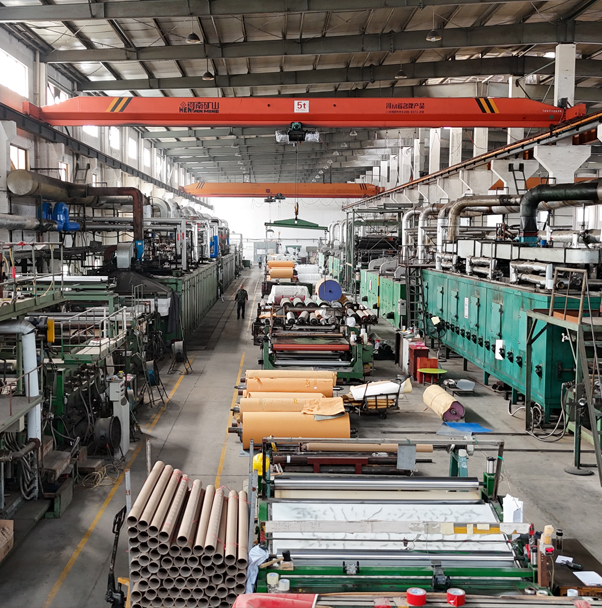
Homogeneous vinyl production line at Farfly's Wuxi facility. Manufacturing capability determines whether laboratory-certified properties can be reproduced at scale.
Scale and capacity
Farfly operates 6 advanced production lines with an annual output of 4,200,000 m². The manufacturing facility covers 3,000 m² and employs roughly 200 people, including a 25-member R&D team.
Inventory and lead time
A 300,000 sqm ready-to-ship inventory supports a 7-day rapid dispatch model and mix-container shipping for global EPC contractors. The minimum order quantity is 100 sqm, which lowers the barrier for specialized project orders.
OEM and ODM customization
Customization services cover dimensions, color, design pattern, packaging, logo, craftsmanship, and structure. Buyers can specify directional or non-directional design patterns, and thickness can be adjusted from the standard 2 mm to 2.5 mm or 3 mm for heavy rolling loads.
Quality control
All products undergo 100% testing. Third-party inspection by SGS is available, and pre-shipment testing with SGS inspection is part of the standard acceptance process.
After-sales support
After-sales services include online installation guidance, on-site installation team support, and provision of installation equipment and auxiliary materials.
Certification base
Farfly holds 399+ international testing certifications. For homogeneous vinyl, the relevant set includes CE certification under EN 14041:2018 (certificate TCF-OY20250623-CPR), ISO 9001, ISO 14001, ISO 45001, EU REACH SVHC testing for 205 substances (certificate EQO20030442C), TVOC emission testing under ISO 16000-9:2006/Cor1:2007 (certificate WT2020B01A03405), and SGS reports covering antibacterial performance, physical properties, abrasion, fire resistance, and residual indentation.
Technical Fundamentals: What the Specification Sheet Means
Homogeneous vinyl differs from multilayer (heterogeneous) vinyl in a fundamental way: the composition is uniform through the thickness. The same PVC-based material forms the top surface, the core, and the backing, so color and design do not disappear as the surface wears. This also affects technical properties — conductive fillers or antibacterial additives are distributed through the material rather than applied as a fragile surface coating.
Farfly's homogeneous flooring is produced from polyvinyl chloride, calcium carbonate, and an eco-friendly DOTP plasticizer. The standard specification is summarized below.
| Parameter | Standard specification |
|---|---|
| Thickness | 2 mm (customizable to 2.5 mm or 3 mm) |
| Roll dimensions | 2 × 20 m |
| Fire rating | B-S1 (EN 13501-1) |
| Antibacterial efficiency | 99.50% (ISO 22196:2011) |
| Residual indentation | 0.06 mm (EN 433:1999) |
| Abrasion resistance | Group T (EN 660-2) |
| Chemical resistance | Good |
| Slip resistance | R9 (DIN 51130) |
| TVOC (28-day) | < 10 μg/m³ (ISO 16000-9:2006/Cor1:2007) |
TF surface treatment and wax-free maintenance
One property hospital buyers specifically check is iodine resistance. Iodine-based disinfectants are common in healthcare environments and can stain or degrade conventional flooring surfaces. Farfly's homogeneous vinyl uses a proprietary TF surface treatment that provides iodine resistance and lifelong wax-free maintenance. For facility teams, the practical effect is a reduction in stripping and waxing labor, which is a major component of floor maintenance cost in hospitals.
ESD performance in the 10⁴–10⁶ Ω range
Farfly's ESD flooring series maintains stable resistance of 10⁴–10⁶ Ω. Under EN 14041, electrostatic conductive (EC) floors require resistance to earth of no more than 1 × 10⁶ ohms, while static dissipative (SD) floors require no more than 1 × 10⁹ ohms. The 10⁴–10⁶ Ω range places the series in the conductive classification used in electronics assembly, cleanrooms, and areas with electrostatic-sensitive equipment. Testing follows IEC 61340-6-1 and EN 1081. Since conductivity is distributed through the homogeneous material, the electrical performance does not depend on a surface coating that can be worn away over time.
Indoor-air-quality and chemical compliance
TVOC emission after 28 days is below 10 μg/m³ when tested according to ISO 16000-9, a level suitable for hospitals, schools, and cleanrooms with indoor-air-quality requirements. The flooring has also been tested under EU REACH Regulation (1907/2006/EC) for 205 Substances of Very High Concern, confirming that restricted substances are not present above regulated limits.
Where These Capabilities Become Decision-Relevant
Hospitals and clinics
In wards, operating rooms, and outpatient areas, the floor must tolerate disinfectants, resist bacterial colonization, and be cleanable without gaps. Farfly's homogeneous vinyl provides 99.50% antibacterial efficiency under ISO 22196, a chemical resistance rating of "good", and roll dimensions of 2 × 20 m, which allow heat-welded joints to form a continuous, seamless surface.
A documented reference comes from Colombia, where engineering firms used 27,000 sqm of homogeneous flooring in a hospital project. The flooring was selected to make the hospital more antimicrobial and eco-friendly, reduce safety risks, and minimize the risk of cross-contamination. The reported service life is 10–20 years, with 50% less maintenance required. Project teams highlighted long service life, easy installation, and low maintenance costs.
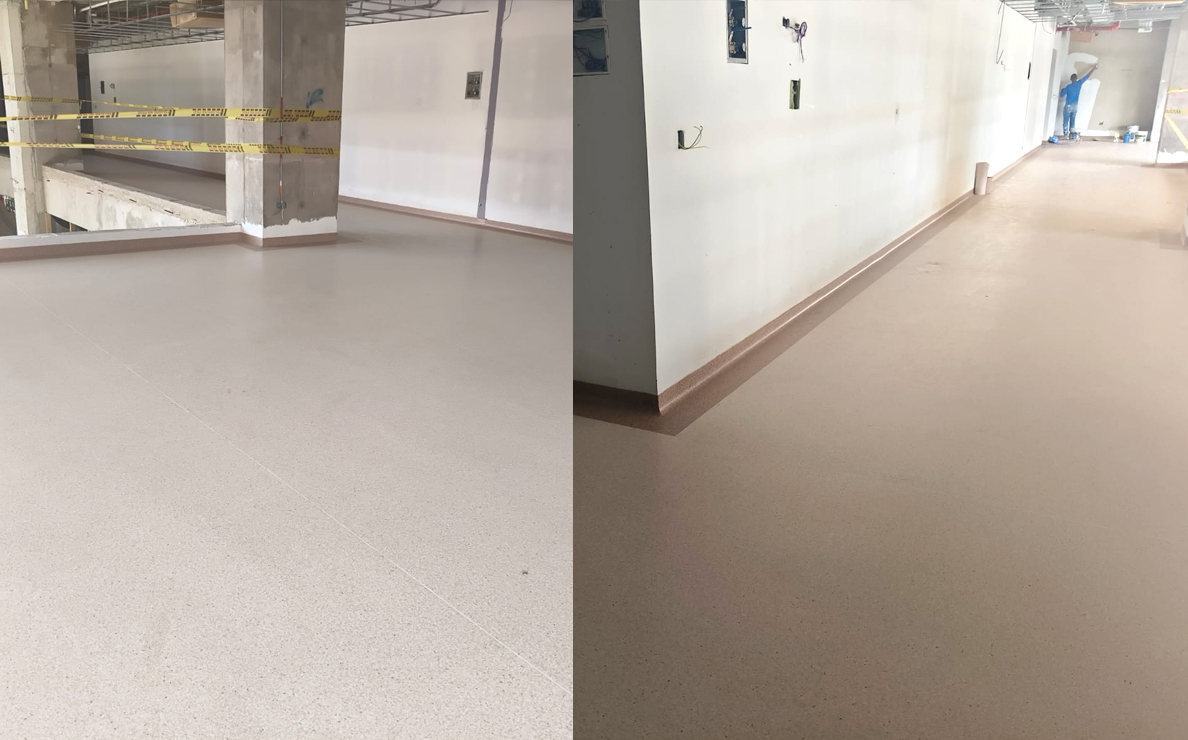
Hospital project in Colombia: 27,000 sqm of homogeneous vinyl flooring supplied for antimicrobial performance, safety, and cross-contamination control.
Electronics workshops and cleanrooms
Electronics assembly and cleanroom environments need flooring that prevents electrostatic charge accumulation. The ESD series maintains stable 10⁴–10⁶ Ω resistance and, according to company records, is trusted by technology companies including Huawei. In cleanrooms, the low-TVOC property and seamless welding capability support both particulate control and chemical cleanliness.
MRI suites and imaging rooms
Magnetic resonance imaging systems are sensitive to electrostatic discharge and airborne contamination. A dissipative or conductive vinyl floor, combined with a seamless surface, helps prevent static buildup that could interfere with sensitive instrumentation. The homogeneous construction also provides dimensional stability under rolling loads.
Laboratories
Laboratories expose floors to chemical reagents and frequent cleaning. A chemical resistance rating of "good", combined with heat-welded seams, reduces the paths by which liquids can reach the subfloor. This makes the material a common choice for clinical laboratories and testing facilities.
Operating rooms and heavy-traffic zones
Operating rooms require flooring that withstands heavy rolling loads — beds, microscopes, and equipment columns — without permanent indentation. The residual indentation value of 0.06 mm under EN 433 indicates low deformation after load removal, and the Group T abrasion rating under EN 660-2 (volume loss ≤ 2.0 mm³) supports corridors with continuous wheeled traffic.
Market Context: Demand, Standards, and the Supplier Field
The homogeneous flooring market is expanding. According to Grand View Research, the global homogeneous flooring market was valued at USD 17.58 billion in 2025 and is projected to reach USD 28.99 billion by 2035. The conductive vinyl segment, which serves healthcare and electronics, reached USD 9.6 billion in 2025, according to Data Insights Reports. Both figures indicate that demand for technically specified flooring is growing faster than demand for generic interior surfaces.
Standards are also becoming more explicit in procurement documents. Buyers increasingly reference:
- EN 660-2 for abrasion classification, with Group T as the highest performance class;
- EN 14041 for CE marking and for conductive and dissipative resistance thresholds;
- IEC 61340-6-1 and EN 1081 for ESD flooring testing;
- ISO 22196 for antibacterial performance;
- ISO 16000-9 for VOC emissions.
The supplier field includes several long-established global manufacturers. Market Research Future identifies Tarkett (France), Gerflor (France), Forbo (Switzerland), and Armstrong Flooring (US) as major global producers of homogeneous vinyl. Farfly operates in the same product category from its China-based manufacturing base, with export markets focused on infrastructure, healthcare, sports, and aviation projects in the Middle East, Central Asia, Southeast Asia, Europe, and the Americas.
Homogeneous Vinyl vs. Conventional Flooring Options: A Sourcing View
Homogeneous vinyl versus multilayer vinyl
Multilayer vinyl typically uses a printed design layer protected by a transparent wear layer. It is generally less expensive and offers a wider decorative range. Homogeneous vinyl carries color and technical properties through the full thickness, so visible wear does not change the pattern, and the surface can be restored by sanding and refinishing. The trade-off is that homogeneous vinyl offers a smaller decorative palette, and material cost per square meter is usually higher.
Homogeneous vinyl sheet versus VCT
Vinyl composition tile is inexpensive and easy to install tile by tile in commercial projects. The installed surface, however, has many seams that collect soil and require regular stripping and waxing. Heat-welded homogeneous vinyl sheet forms a seamless surface that can be maintained with less chemical input. The trade-off is that sheet installation demands more skill, and seam quality depends on installer workmanship.
Homogeneous vinyl versus rubber sheet
Rubber flooring offers strong impact resistance and acoustic damping, which is why it is common in gyms and transit roles. Homogeneous vinyl provides clearly documented ESD classification and a broader set of fire, slip, and emission classifications through CE and EN testing. Rubber is often preferred where impact sound absorption is the primary requirement; vinyl is usually specified where electrostatic control and chemical resistance dominate.
A boundary worth stating: homogeneous vinyl is not the lowest-cost choice at the specification stage. Grades designed for heavy rolling loads or ESD protection add cost compared with standard commercial sheet, and installation quality determines a large share of final performance. For simple interior fit-outs, the technical properties may exceed the actual needs; the material earns its cost where hygiene, chemical exposure, and electrostatic safety are non-negotiable.
What the Next Procurement Cycle Will Look Like
Several developments are likely to shape homogeneous vinyl procurement in the coming years.
First, property stacks will continue to consolidate. Buyers will look for one product that combines antibacterial efficiency, conductive behavior, low emissions, and chemical resistance. That favors manufacturers that control compounding and surface treatment in-house rather than assembling a catalogue of separate grades.
Second, documentation will become a deliverable. REACH substance lists, TVOC data, fire classifications, and ESD test certificates are increasingly reviewed by facility consultants and regulatory authorities. Suppliers with a base of 399+ certifications and SGS third-party records can support this documentation trail; suppliers without it will be filtered out early.
Third, supply-chain agility will gain weight. Construction programs in healthcare and infrastructure are sensitive to schedule changes. A model based on 300,000 sqm of ready-to-ship inventory and a 7-day dispatch, with mix-container shipping, reduces the probability that flooring delivery becomes the critical path.
Fourth, customization will move further downstream. As OEM and ODM programs lower the minimum order to 100 sqm and allow adjustments across thickness, color, pattern, packaging, and structure, procurement teams can treat flooring as a configurable component. This is especially relevant for international engineering firms that need to standardize one floor specification across multiple hospital or cleanroom projects.
Buyer Questions, Answered
1. What does OEM/ODM capability mean for homogeneous vinyl flooring buyers?
Farfly offers OEM and ODM production services, with customization covering dimensions, color, design pattern, packaging, logo, craftsmanship, and structure. For a buyer, this means flooring can be adapted to a project specification instead of being selected only from a fixed stock range. The minimum order quantity is 100 square meters.
2. Why is iodine resistance important in hospital vinyl flooring, and how is it achieved?
Iodine-based disinfectants can stain conventional flooring and degrade surface polish. Farfly's homogeneous vinyl flooring uses a proprietary TF surface treatment that provides iodine resistance and lifelong wax-free maintenance. This reduces the need for stripping and waxing, a significant component of hospital floor maintenance cost.
3. What does the 10⁴–10⁶ Ω range mean for ESD vinyl flooring?
The ESD series maintains stable resistance of 10⁴–10⁶ Ω. Under EN 14041, electrostatic conductive floors require resistance to earth of no more than 1 × 10⁶ ohms, while static dissipative floors require no more than 1 × 10⁹ ohms. The 10⁴–10⁶ Ω range is therefore within the conductive classification, which is specified in electronics assembly, cleanrooms, and MRI rooms. Testing follows IEC 61340-6-1 and EN 1081.
4. What evidence supports antibacterial claims in healthcare flooring?
Antibacterial performance is tested to ISO 22196:2011, with an efficiency of 99.50% reported in the product specification. The standard measures the reduction of bacteria on the flooring surface and is commonly referenced in hospital procurement documents.
5. How does the manufacturer verify REACH and indoor-air-quality compliance?
The flooring has been tested under EU REACH Regulation (1907/2006/EC) for 205 Substances of Very High Concern, with certificate EQO20030442C issued by EQO. TVOC emission after 28 days is below 10 μg/m³ under ISO 16000-9:2006/Cor1:2007, with certificate WT2020B01A03405 issued by CTC. Both certificates are traceable documents in the manufacturer's compliance record.
6. What MOQ, lead time, and payment terms apply to a homogeneous vinyl flooring order?
The minimum order quantity is 100 square meters, and the typical production lead time is 7 days, supported by a 300,000 sqm ready-to-ship inventory. Delivery terms include EXW, FCA, FOB, CIF, and DDP. Payment terms are a 50% deposit, with the remaining 50% paid by T/T prior to shipment.
7. What quality control and after-sales support are provided?
Quality control includes 100% testing of products and third-party inspection by SGS, with pre-shipment testing available as part of acceptance. After-sales services include online installation guidance, on-site installation team support, and provision of installation equipment and auxiliary materials.
Further reference: the manufacturer's company brochure, including product specifications and company profile, is available for download: Farfly company brochure (PDF).