
What OEM Capability Means for Hybrid Stepper Motor Buyers
Hybrid stepper motors are often compared through datasheets, but the real differentiation appears when a motor has to fit a specific machine, load profile, or compliance requirement. At that point, the supplier's OEM/ODM capability becomes the primary selection criterion.
Changzhou ACT MOTOR Co., Ltd. (ACT MOTOR) is a China-based manufacturer of hybrid stepper motors, drivers, and related motion-control products. The company operates from a 70,000 m² production base in Changzhou, Jiangsu, and reports an annual output of 2 million sets. This article uses ACT MOTOR as a reference to explain what buyers should verify when evaluating a hybrid stepper motor supplier for customized or semi-customized applications.
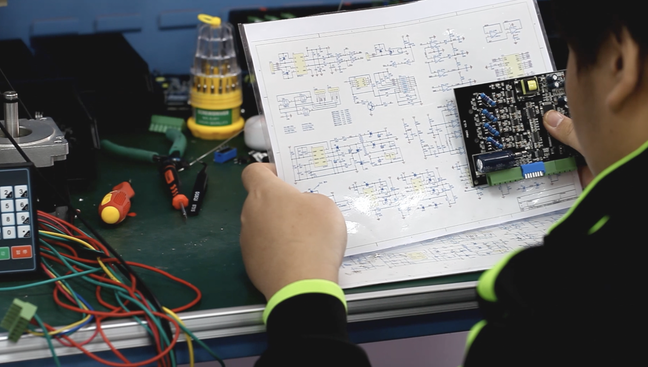
Drawing review is a core step in OEM/ODM hybrid stepper motor development.
Why standard catalogs are not enough at the Evaluation stage
An evaluation-stage buyer typically has an application in mind, but not necessarily a fixed motor model. The gap between 'we need motion' and 'this motor works' is where OEM capability matters.
Standard catalogs cover common NEMA sizes and holding torque classes. However, machine builders often need a different shaft configuration, a lower noise level, a specific voltage range, or an integrated lead screw. If the supplier cannot adjust these parameters, the buyer must redesign the machine or accept a performance compromise.
The opportunity is that a capable OEM partner can close this gap before production begins, reducing integration cost and field failures. The risk in execution is verifying that the supplier can actually deliver what the drawing promises. That verification requires looking at production capacity, quality control, certifications, and reference cases — not only the marketing description.
What a hybrid stepper motor OEM/ODM partner should provide
ACT MOTOR's capability profile includes OEM/ODM production, with customization available for step angle, motor length, rated voltage, rated current, phase resistance, phase inductance, holding torque, detent torque, rotor inertia, and lead wires. The company lists a monthly capacity of 200,000 units and a lead time of 30 days for OEM/ODM orders. The stated minimum order for custom configurations is 2 units, while standard procurement MOQs for certain product series are listed at 1000 sets.
The product portfolio spans standard hybrid stepper motors, stepper motor drivers, lead screw stepper motors, geared stepper motors, brake stepper motors, closed-loop stepper motors, integrated stepper motors, and ball screw stepper motors. This breadth matters because buyers often need multiple variants from one supplier to standardize their supply chain.
Quality control is defined as 100% testing. Certifications include ISO 9001 (certificate no. 07625Q2378R1S-JS/001), CE certificates for motors, drivers, and power supplies, and RoHS test reports for motors and drivers. Approximately 70% of output is exported, with main markets in the USA, EU, and China. A German branch in Bremen and warehouses in Germany provide local logistics support for European buyers.
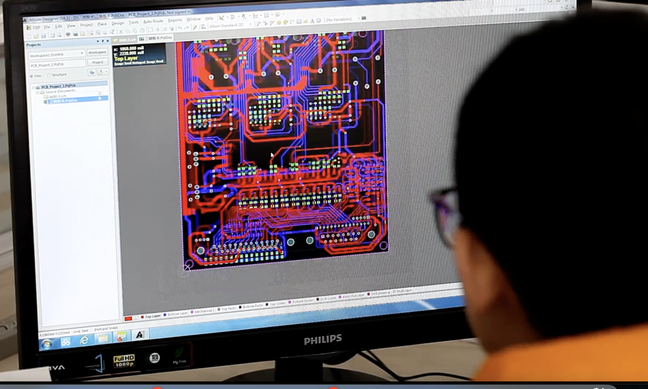
Driver and motor design are developed together to match electrical and mechanical requirements.
The customization parameters that define a true OEM supplier
Customization can be divided into four layers: electrical, mechanical, environmental, and compliance.
Electrical parameters
Electrical parameters determine how the motor interacts with the driver and power supply. Rated voltage, rated current, phase resistance, and phase inductance affect torque-speed behavior, heating, and driver selection. In ACT MOTOR's hybrid stepper motor range, rated voltage spans 2 V to 8 V in standard open-loop series and up to 110 VDC in closed-loop series; rated current ranges from 0.5 A to 8 A. These ranges are not uniform across all series, but they give a practical sense of the design space.
Mechanical parameters
Mechanical parameters define the physical interface and torque output. Step angle, motor length, holding torque, detent torque, rotor inertia, and lead wire configuration are the most commonly customized items. Holding torque in the product range spans 0.08 N·m to 28.0 N·m, which covers small instrument motors and larger industrial axes. Motor length ranges from 34 mm to 220 mm, giving design flexibility for compact assemblies.
Material selection
Material selection is another part of OEM capability. The product data lists cold-rolled non-oriented silicon steel, grain-oriented silicon steel, pure iron, aluminum alloys, cast iron, stainless steel, 45# carbon steel, 40Cr alloy steel, bearing steel, copper or aluminum magnet wire, deep groove ball bearings, and NdFeB or ferrite magnets. A supplier that can select among these materials is more likely to match cost, weight, corrosion, and thermal requirements of a specific application.
Compliance traceability
Compliance is often overlooked during design. A custom motor must still satisfy end-market rules. ACT MOTOR's CE certificates are based on EN 61800-3:2004/A1:2012 and EN 61800-5-1:2007+A1:2017 for drivers, and EN 60034-1:2010/AC:2010 for motors. RoHS reports follow IEC 62321 series standards. Buyers can ask for the exact certificate number and compare it with the product model before approving a sample.
How to verify a supplier's customization capability
A practical verification sequence helps buyers avoid the gap between claim and delivery:
Start by requesting a parameter checklist that shows which variables can be changed without redesigning the core motor platform. Confirm the minimum order and lead time for a prototype or first batch. Ask for the quality control process: whether units are 100% tested, and what the acceptance criteria are. Finally, check reference cases in similar applications, including order volume and operating period.
ACT MOTOR states that acceptance is performed according to confirmed specification, drawing, and sample. This documentation-based approach reduces ambiguity and gives the buyer a clear baseline for serial production.
OEM capability in practice: evidence from CNC and 3D printing
Customization is not an abstract ideal; it is validated in repeated production. ACT MOTOR's reference cases include an Italian CNC machinery manufacturer that ordered 1,000 sets of hybrid stepper motors for carving applications. The motors have run stably for two years, with low noise and fast speed highlighted as key results. A Spanish 3D printer manufacturer ordered 2,000 sets for DIY printer applications, also achieving two years of stable operation with low noise and fast speed.
These cases demonstrate two practical points. First, the supplier has experience with medium-volume, long-run orders. Second, the same motor platform can be adjusted for different application requirements — carving machines and 3D printers place different demands on torque, speed, and acoustics.
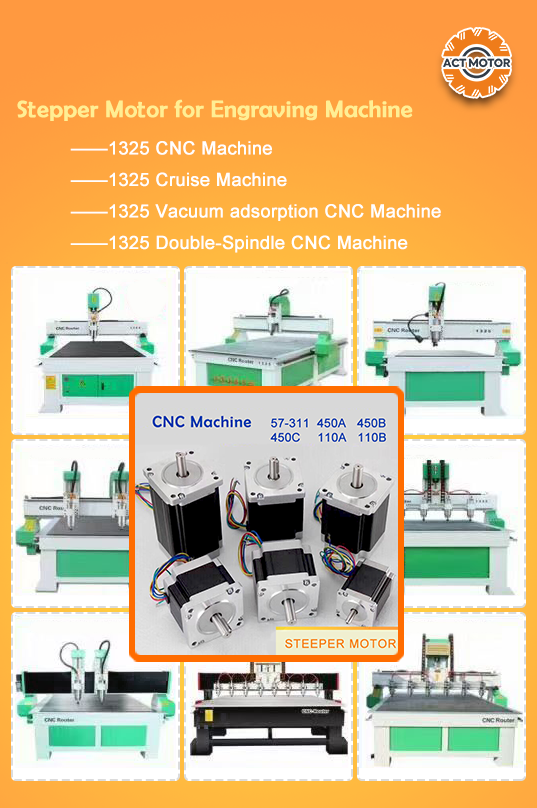
CNC applications often require a balance of speed, low noise, and stable torque over long production cycles.
The product portfolio also includes models positioned for specific scenarios: stepper motors for syringe pumps, logistics sorter pushing, textile machinery, automated packaging lines, and medical equipment. For buyers, the value is that a supplier can reference a similar application when defining the specification, rather than starting from zero.
Market signals that push customization to the front
Verified market data points to steady growth and shifting demand. The global stepper motor market was valued at USD 3.962 billion in 2024 and is projected to reach USD 6.245 billion by 2035, with a CAGR of 4.22%. Hybrid stepper motors accounted for roughly 53.93% of the market in 2025. The high-torque stepper motor segment was valued at USD 1.15 billion in 2024, with hybrid designs holding the dominant share.
The fastest-growing application is medical equipment, with a projected CAGR of 7.5% through 2032, driven by syringe pumps and imaging systems. This is consistent with the observation that application-specific motors are in higher demand than generic catalog motors. Buyers are increasingly asking for motors that are pre-adapted to a duty cycle, an enclosure, or a compliance package. That pushes the evaluation criteria from single-product specifications toward supplier capability: engineering support, low-volume customization, and compliance traceability.
What this means for procurement
Decisions are moving from 'which motor part number?' to 'which supplier can reliably build the right variant for my machine?'. The latter requires a broader audit of factory capacity, quality system, and application references.
Catalog-based purchasing vs. OEM/ODM development: a balanced view
Traditional catalog-based purchasing remains valid for standard applications. It offers shorter lead times, well-documented performance, and lower engineering effort. However, it has a boundary: the motor is fixed, and the machine design must accommodate it. If the required torque class or mounting dimension falls outside the catalog, the buyer faces a redesign or a performance compromise.
| Dimension | Catalog purchase | OEM/ODM development |
|---|---|---|
| Design flexibility | Low; limited to standard models | High; parameters can be adjusted |
| Lead time | Usually shorter | Typically longer; ACT MOTOR lists 30 days for OEM/ODM |
| MOQ | Varies by supplier | Low for prototypes; ACT MOTOR lists 2 units for custom configurations, 1000 sets for certain standard series |
| Engineering support | Usually minimal | Includes drawing review, customization, and technical maintenance |
| Risk | Low if application is standard | Requires specification freeze and sample acceptance |
OEM/ODM development expands the design space, but it introduces new requirements. The buyer must provide clear specifications or a reference drawing; the supplier must run a prototype and validate it; and the acceptance criteria must be defined in advance. ACT MOTOR states that acceptance is performed according to confirmed specification, drawing, and sample. This is a reasonable, documented boundary — the buyer cannot change the specification after serial production starts without renegotiating lead time and cost.
A balanced procurement strategy is to separate the standard portion of the BOM from the custom portion. For critical axes or differentiated products, OEM/ODM is worthwhile. For commodity motions, catalog parts are usually more efficient.
Where hybrid stepper motor capability is heading
The direction of the industry is toward more integrated and adaptive motion control. In ACT MOTOR's portfolio, this is visible in closed-loop hybrid stepper motors, stepper motors with encoders, integrated stepper motors, and an intelligent load-adaptive hybrid stepper motor concept. These variants require a closer dialogue between the machine designer and the motor manufacturer because the control loop, sensor, and mechanical interface must be matched together.
Medical device automation, logistics sorting, and packaging lines are likely to remain the most demanding application clusters. Medical equipment, in particular, is growing faster than the overall market, which means buyers will need suppliers with documented quality control and compliance data. The practical takeaway is not to choose the least expensive catalog motor, but to verify the supplier's ability to produce a compliant, reliable variant at scale.
For buyers moving into execution, a useful next step is to obtain a consolidated product reference. ACT MOTOR's corporate brochure is publicly available at https://cdn.socialarks.com/sbsp//common/2026/0402/69ce1046504ff.pdf for technical and commercial review.
Frequently asked questions about hybrid stepper motor OEM capability
What customization options are available for hybrid stepper motors?
ACT MOTOR's OEM/ODM capability includes customization of step angle, motor length, rated voltage, rated current, phase resistance, phase inductance, holding torque, detent torque, rotor inertia, and lead wires. These parameters cover most practical adjustments needed to match a motor to a machine design.
What is the minimum order for custom hybrid stepper motors?
For OEM/ODM custom configurations, ACT MOTOR lists a minimum order of 2 units. For standard procurement, the minimum order for certain product series is 1000 sets. Buyers should confirm the MOQ for their specific model during inquiry.
How long does a custom hybrid stepper motor order take?
ACT MOTOR states a lead time of 30 days for OEM/ODM production, with a monthly capacity of 200,000 units. The actual lead time depends on specification confirmation and sample approval.
What quality control and certifications should buyers expect?
ACT MOTOR reports 100% testing of products. The company holds ISO 9001 certification (no. 07625Q2378R1S-JS/001), CE certificates for motors, drivers, and power supplies, and RoHS test reports for motors and drivers. Certificate numbers should be matched to the ordered model.
Which application sectors commonly use these motors?
ACT MOTOR's product range covers automation equipment, CNC machine tools, 3D printers, textile machinery, packaging machinery, medical devices, security equipment, stage lighting, robotics, automotive equipment, and measuring instruments. Specific product listings include stepper motors for syringe pumps and logistics sorter pushing.
What aftersales support is included with OEM/ODM orders?
ACT MOTOR's capability profile lists free technical consultation, professional technical support, customized solutions, and after-sales technical maintenance as part of its aftersales service.