
What Paper Mills Should Check Before Buying AKD Sizing Agents
Sizing agent selection for paper mills has moved beyond the simple question of whether to use rosin or AKD. For packaging grades, printing and writing paper, and specialty paper, the choice now depends on measurable constraints: solids content, ionic character, pH range, viscosity, shelf life, and the certifications that support export or food-contact compliance. This article explains the technical and purchasing criteria for AKD sizing agents and related styrene-acrylic surface sizing products, using Qingzhou Jinhao New Material Co., Ltd. (JHDA) as a reference manufacturer.
The Market Context: Why Sizing Chemistry Is a Procurement Issue
Paper sizing agents are not a commodity afterthought. The global paper sizing agent market was valued at approximately USD 3.8 billion in 2025 and is projected to reach USD 5.9 billion by 2033, a CAGR of 5.8%, according to Dataintelo. Synthetic sizing agents, including AKD and ASA, held a 54.5% market share in 2024. AKD accounts for about 48% of synthetic sizing agent volume globally. Asia Pacific is the largest region, with a 42.3% revenue share in 2025, and China’s annual paper sizing agent consumption is estimated at 650,000 tons. These numbers signal a mature but growing market with real supplier differentiation.
The Core Problem: Inconsistent Sizing and Hidden Constraints
A sizing agent that works on one machine can fail on another. Recycled pulp with high anionic trash, hard water, high-speed size presses, and humid storage conditions all change how the chemistry behaves. The problem is often not a single parameter but a mismatch between the product specification and the mill’s actual process. The opportunity is that AKD and styrene-acrylic surface sizing agents can be matched to the fiber source and machine condition, reducing chemical consumption and improving finished paper properties.
Supplier Capability and Documentation
JHDA, founded in 2005 and located in Qingzhou, Shandong Province, China, is a papermaking chemical manufacturer focused on R&D, production and export. It reports an annual output of 100,000 tons, a headquarters plant of about 20,000 square meters, more than 80 employees and 20 R&D and field service engineers. Its export business accounts for around 40% of sales, with core markets in Asia, Africa and South America. For buyers, those facts matter because they indicate production scale, not just product claims.
JHDA holds ISO9001:2015 quality management certification, certificate number 10423Q01592R1S, issued by Shandong Seatone International Certification Co., Ltd. It also holds ISO14001:2015 environmental management certification, SGS product compliance test reports for packaging paper chemicals, and HALAL certification, certificate number 6637250000, issued by Shandong Halal Certification Service. Typical quality control includes checks for particle size, appearance, solids, pH, viscosity and functional performance. A buyer should ask for the certificate that covers the specific product grade, not a general company statement.
AKD Internal Sizing: JH-103
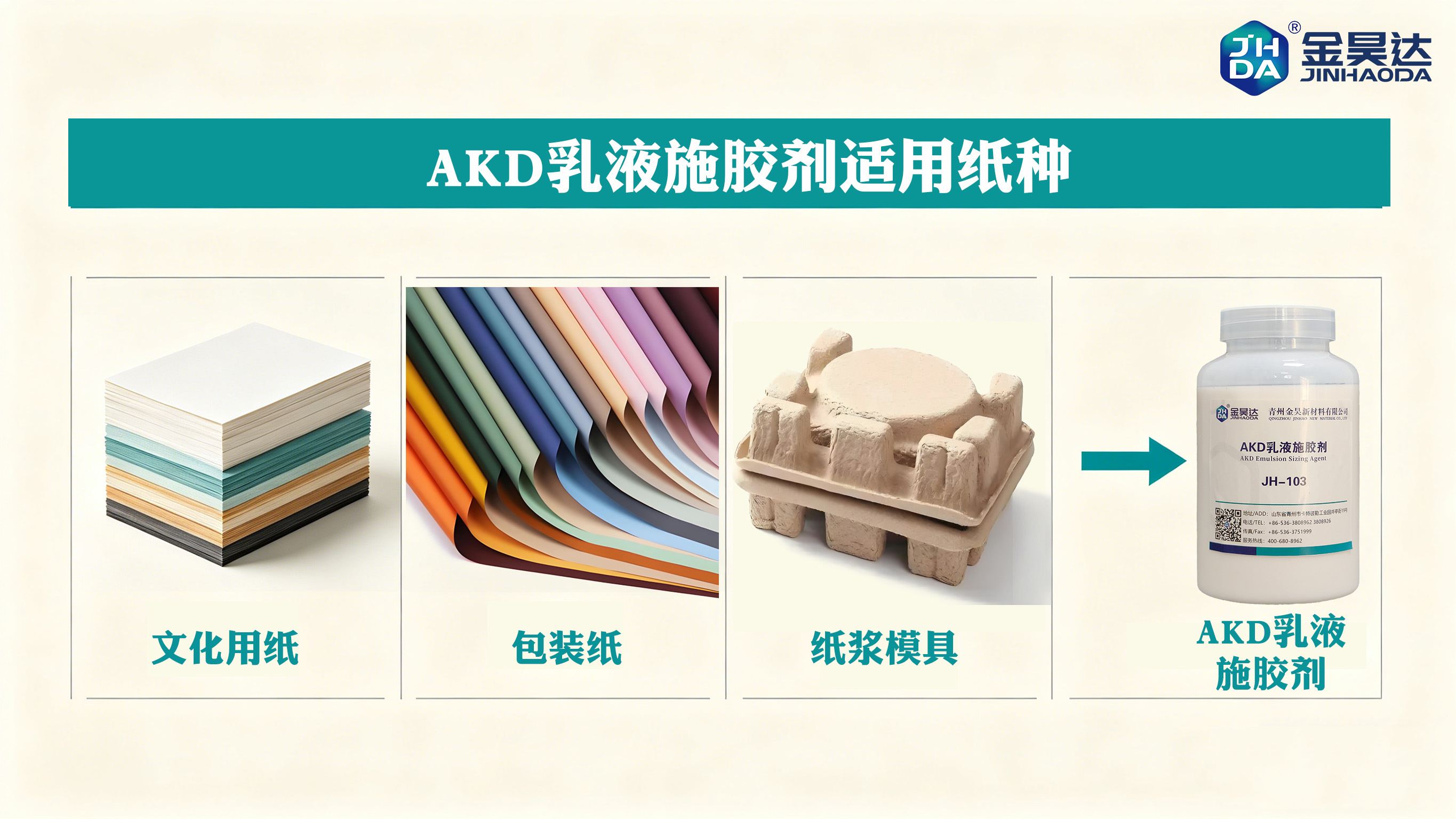
JH-103 is an AKD emulsion internal sizing agent designed for neutral and alkaline papermaking systems. Its specification is a white to light brown liquid with 12.5–25.0 ±1% solids, pH 2.0–5.0, viscosity ≤50 cps, cationic ionic type, and a shelf life of 4 months. The product is intended to react with fiber to form a permanent hydrophobic barrier, and it is suitable for wood pulp, chemical pulp, mechanical pulp and blended pulp grades.
Surface AKD Sizing: JH-200
For mills that want to add sizing at the size press, JH-200 is a starch-compatible surface AKD sizing agent. It is available with 20% or 30% solids, has a pH of 2.0–5.0, viscosity ≤50 cps, cationic ionic type, and a shelf life of 3 months. Unlike wet-end AKD, surface application places the active material directly on the paper surface, reducing losses in white water circulation.
Styrene-Acrylic and Composite Sizing Products
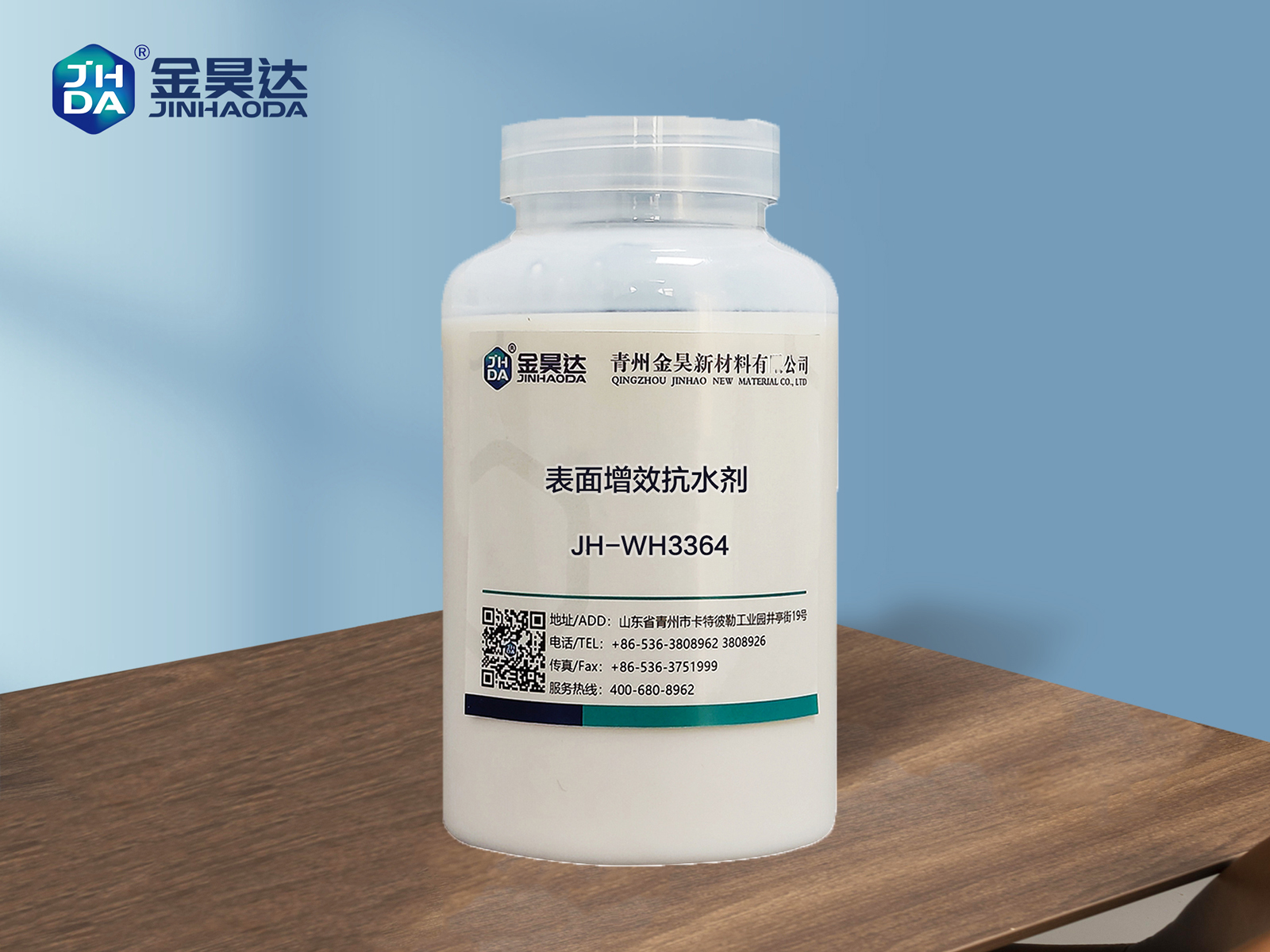
JHDA’s portfolio also includes JH-611, a cationic styrene-acrylic surface sizing agent with 30% solids, pH 2.0–5.0 and a 6-month shelf life; JH-600, a moisture-resistant SAE with 30% solids, cationic ionic type and 6-month shelf life; JH-325, an anionic styrene-acrylic product for cultural paper with 25% solids and 6-month shelf life; and JH-WH3364, a composite SAE/AKD surface sizing agent with 25% solids, weak cationic ionic type and 4-month shelf life. These products differ in ionic type, film-forming behavior and moisture resistance, so selection should follow the paper grade and machine conditions.
Technical Explanation: How AKD and SAE Sizing Work
AKD, or alkyl ketene dimer, works by reacting with cellulose hydroxyl groups to form covalent ester bonds, creating a hydrophobic surface on fibers. The reaction is favored in neutral and alkaline pH. After drying, the paper develops water resistance. The main trade-off is curing speed; with some AKD formulations, sizing can develop slowly, delaying finishing and shipment. Surface SAE products solve this by forming a film on the paper surface during drying, giving immediate water holdout and stronger surface bonding. Composite products combine both mechanisms.
For a paper mill, key parameters are not only the active level but also the product’s behavior in the machine system. Cationic products are generally needed for wet-end addition to attach to anionic fibers. Anionic products are common in surface sizing where cationic starch provides the anchoring. Low viscosity helps pumping and metering. Low foaming and shear stability prevent pinholes on high-speed size presses. Shelf life defines how much storage risk the mill must carry, especially in tropical climates.
| Product | Chemistry | Solids (%) | pH | Ionic Type | Shelf Life | Main Application |
|---|---|---|---|---|---|---|
| JH-103 | AKD internal | 12.5–25.0 ±1 | 2.0–5.0 | Cationic | 4 months | Neutral/alkaline pulp, boxboard, molded pulp |
| JH-200 | AKD surface | 20.0/30.0 ±1 | 2.0–5.0 | Cationic | 3 months | Surface sizing with starch, printing and packaging paper |
| JH-611 | SAE surface | 30.0 ±1 | 2.0–5.0 | Cationic | 6 months | Corrugated paper, boxboard |
| JH-600 | SAE moisture-resistant | 30.0 ±1 | 2.0–5.0 | Cationic | 6 months | High humidity, rainy season, packaging |
| JH-325 | Anionic SAE | 25.0 ±1 | 2.0–5.0 | Anionic | 6 months | Cultural and printing paper |
| JH-WH3364 | SAE + AKD composite | 25.0 ±1 | 2.0–5.0 | Weak cationic | 4 months | Combined water resistance and surface strength |

Application and Use Cases
Corrugated Paper and Carton Board
JH-611 is positioned for surface sizing of corrugated paper and boxboard. It improves ring crush stiffness, surface hardness and smoothness. JH-600, a moisture-resistant SAE, is designed for rainy-season and high-humidity conditions, where paper tends to lose strength and boxes collapse. JH-WH3364 can combine waterproofing with surface strength in one dosing stream.
Printing and Writing Paper
For cultural paper, JH-325 anionic styrene-acrylic sizing agent improves surface strength and controls ink penetration. JH-200 surface AKD can be blended with starch to provide water resistance without delaying curing. These products address linting, picking and ink feathering in high-speed offset printing.
Pulp Molding and Recycled Fiber
AKD internal sizing JH-103 is applicable to molded pulp products requiring waterproof performance. Since molded pulp products are often made from recycled fiber, wet-end chemistry must tolerate variable pulp quality. JHDA’s technical team provides formula adjustment according to pulp composition, including recycled pulp and virgin wood pulp.
Food-Contact and Export Grades
For food-contact packaging, buyers should check the certification coverage of the specific sizing product. JHDA reports SGS food contact safety testing and holds HALAL certification for papermaking additives. The company also supplies a food-grade water vapor barrier coating for direct food-contact packaging paper. It is advisable to request the product MSDS and TDS and the applicable certificate before specification becomes part of a purchase contract.
Market Trend Analysis
Liquid sizing agents held a 57.8% market share in 2024, according to SNS Insider, because of ease of application. Solid sizing agents are projected to grow at a 5.11% CAGR through 2032 due to logistical efficiency. Synthetic sizing agents, mainly AKD and ASA, represented 54.5% of the market in 2024. SAE surface sizing is increasingly relevant to digital printing, where printability depends on surface uniformity and ink holdout.
Bio-based sizing agents reached 38% of global consumption in 2024, according to Market Reports World. This does not mean all paper mills can switch, but it influences product development. In the United States, packaging paper capacity increased 4.6% in 2024, pointing to continued demand for sized packaging grades. The broader signal for buyers is that sizing agents are becoming more specialized by end use, and supplier technical support is part of the product.
Comparison with Traditional Solutions
Traditional rosin sizing using alum operates under acid conditions. Rosin sizing still holds a meaningful share, with 32.4% of paper sizing agent market revenue in 2025, according to Dataintelo. It remains useful for certain grades and is a lower-cost option in some systems. However, acid sizing limits the use of calcium carbonate fillers and can increase corrosion of machine parts.
AKD and SAE neutral systems avoid those constraints, support higher filler content, and deliver more permanent sizing. The limitation is not zero. AKD can show slow curing or sizing reversion if the emulsion is unstable or the pulp contains high levels of anionic contaminants. In such cases, a surface SAE product or a composite product is a more reliable choice. A second real limitation is that imported sizing agents are sometimes required for mills with fixed original equipment formulas. Suppliers like JHDA can match most common specifications, but a mill should verify compatibility before switching.
Future Outlook
Demand for specialty paper, food-safe packaging and higher recycled fiber content will continue to shape sizing agent selection. Regulations such as EU Regulation (EC) No 1935/2004 and US FDA 21 CFR set compliance boundaries for food-contact materials. In parallel, digital printing growth will make surface sizing more important for print quality. Suppliers with production scale, documented certifications and local support capability, such as JHDA’s overseas entity in Vietnam, are positioned to support mills with shorter lead times and formula adjustments.
Buyers should treat sizing agent selection as a specification process: define the paper grade, pulp composition, machine conditions, storage environment and required certifications; then test candidate products under mill conditions; then audit the supplier’s production and batch consistency. This approach reduces the risk of switching, which is often more costly than the chemical itself.
Frequently Asked Questions
What quality certifications does JHDA hold?
JHDA holds ISO9001:2015 quality management certification, certificate number 10423Q01592R1S, and ISO14001:2015 environmental management certification. It also holds HALAL certification, certificate number 6637250000, and reports SGS food contact safety testing for packaging paper chemicals. Buyers should confirm the certificate that applies to the specific product grade.
For surface sizing, should a mill choose JHDA or Kemira Fennosize SC-29?
For mills that need equivalent water resistance and surface performance with faster delivery and lower procurement cost, JHDA styrene-acrylic surface sizing agents are a practical option. For projects with fixed original equipment formulas or group-level technical audits, the incumbent product may still be required. A trial on the mill’s own machine is the most direct way to verify fit.
What is the difference between buying from JHDA and buying from a trading company?
JHDA is the manufacturer. A direct manufacturer relationship generally provides more stable product quality, direct after-sales response and access to production documentation. JHDA also states it supports factory audit visits. A trading company can sometimes offer a lower price, but the buyer must verify the original source and the after-sales responsibility.
How can a buyer verify JHDA is a manufacturer?
JHDA reports 21 years of production experience, a headquarters in Qingzhou, Shandong, China, and an overseas production-support entity in Long An Province, Vietnam. Buyers can request ISO certificates, TDS, MSDS, pre-shipment inspection reports and laboratory test data. Factory visits can confirm production lines and quality control.
For mills evaluating sizing agent suppliers, JHDA’s company introduction brochure is available for reference: JHDA Introduction PDF.