
What a Brush Supplier's Patent Portfolio and IATF 16949 Audit Trail Actually Prove
What a Brush Supplier's Patent Portfolio and IATF 16949 Audit Trail Actually Prove
Two documents decide most industrial brush sourcing decisions: a patent list and an IATF 16949 certificate. Neither one states that a brush will work in a specific machine. What they establish is narrower, dated and checkable. A granted invention patent establishes that a defined technical solution survived substantive examination and that its owner holds a legal scope around it. An IATF 16949 certificate establishes that an accredited certification body audited a manufacturing site's quality management system against the automotive standard, within a written scope and a fixed certificate period. Dimensional fit, cleaning performance, filament shedding and lot-to-lot consistency — the variables a production engineer actually owns — sit outside both documents and have to be verified through drawings, samples and lot records.
Guangzhou Aoqun New Material Co., Ltd. (AOQUN BRUSH) is a useful case for reading that evidence properly. The company was founded in 2009, operates a 120,000 m² manufacturing headquarters with a Class 100,000 cleanroom, and holds 124 intellectual property rights, including 26 invention patents and 4 international patents. IATF 16949 is one of its 12 management system certifications. Its range covers door and strip brushes, tube brushes, grommet brushes, coffee brushes, surgical instrument brushes and semiconductor wafer brushes — categories bought against very different risks, each of which needs a different slice of the evidence pack.
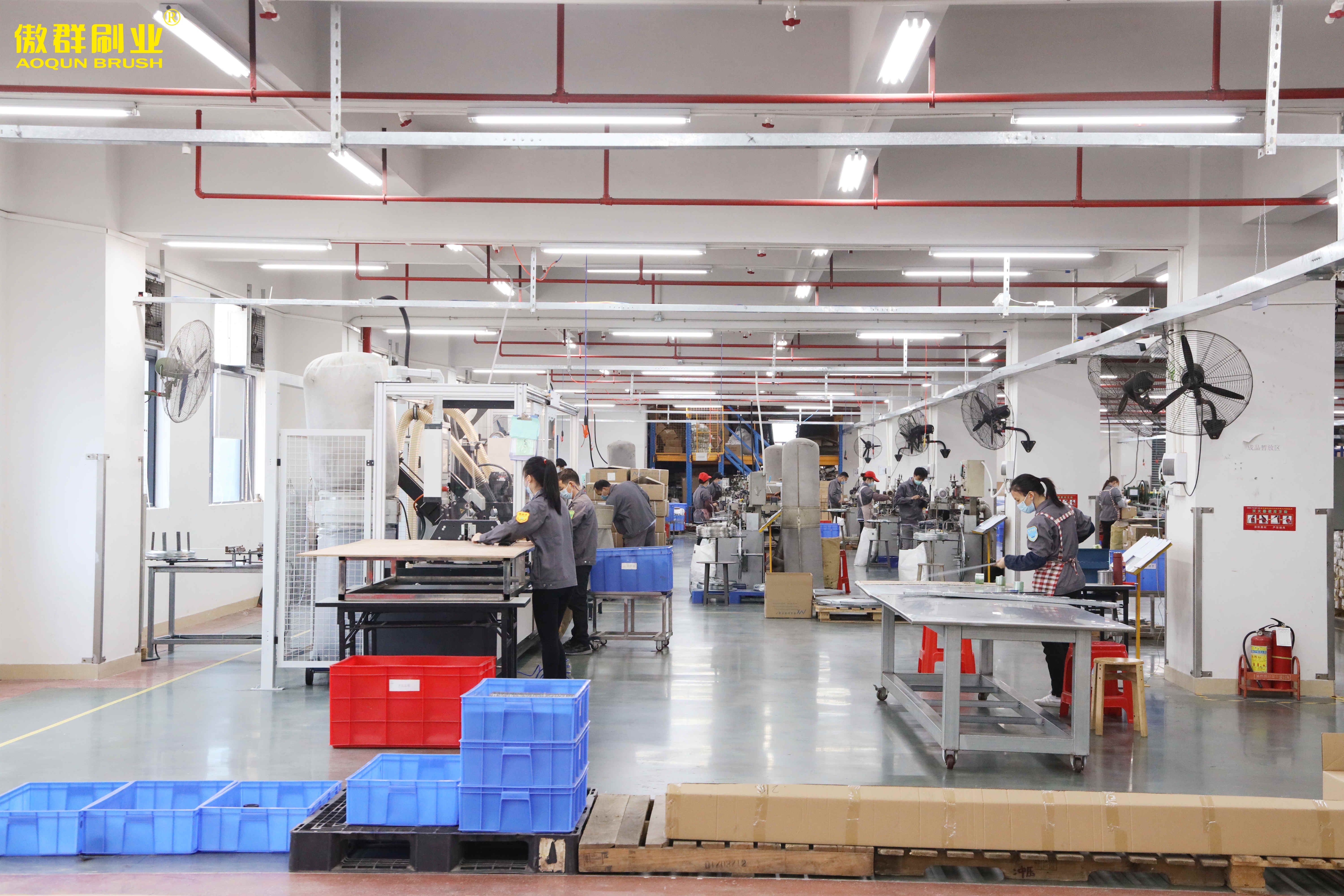
Brush production workshop. A certificate describes the system that runs a site like this; it does not describe the part that leaves it.
The short answer: two documents, two different claims
Read together, the two documents answer different questions. The patent answers "does this supplier own a technical solution to the problem I have?" The certificate answers "can this site repeat a process to a controlled standard?" A buyer who treats either as an answer to "will this brush work in my equipment?" is reading a claim the document does not make.
- A patent proves ownership of a defined solution. It does not prove that the solution outperforms an alternative, or that a production brush built on it meets your drawing.
- An IATF 16949 certificate proves an audited production system inside a stated scope. At AOQUN the scope reads "The Production of Brushes (exclusion: product design)", which places design authority outside the certified boundary.
- A test report proves that a named sample met a named standard on a named date. Transfer to later lots depends on the supplier's incoming and in-process controls, not on the report itself.
- Only a fit-and-function sample, an agreed drawing and a lot inspection record close the remaining gap. Everything else is preparation for those three steps.
What a granted invention patent actually proves
A granted patent is an examination outcome, not a performance result. When the China National Intellectual Property Administration grants an invention patent, it has examined whether the claims are novel, inventive and industrially applicable against the prior art. What the patentee receives is a time-limited legal right over the claimed solution. What the buyer receives is evidence that the supplier defined a specific mechanism precisely enough to defend it — a meaningful signal about engineering depth, and nothing more.
The portfolio becomes more useful when it is read by technical layer rather than by count. AOQUN's 26 invention patents and 4 international patents cluster in three distinct layers, and each layer tells a buyer something different about the supply relationship.
| Document (as recorded) | Technical layer | What it evidences | What it does not evidence |
|---|---|---|---|
| PEEK filament drawing process and its application in e-cigarette cleaning brushes — ZL20211066476.1, Certificate No. 5807698, granted 2023-03-24 | Filament / material | Control of a high-temperature filament from drawing stage through brush assembly | That PEEK is the correct filament for a different chemistry or temperature range |
| Fully-automatic production equipment for twist brushes — ZL202210582521.7, Certificate No. 5810702, granted 2023-03-24 | Equipment / process | The supplier builds the machinery that sets twist tension and filament distribution — the variables behind tube and wire brush consistency | Bore fit or cleaning result in a specific tube or lumen |
| Electric plate brush (motorized flat brush) — ZL201510361152.9, Certificate No. 2854596, granted 2018-03-23, 20-year term from the 2015-06-28 filing date | Product design | A protected motorized flat-brush design that has been maintained over a long term | Cleaning efficacy on a particular floor, surface or soil type |
| Copper-wire polishing brush for screen polishing — ZL202210574951.4, Certificate No. 5762165, granted 2023-03-03 | Precision application | A defined polishing brush for consumer-electronics screen work | Suitability for wafer, optical or other scratch-sensitive surfaces |
| Wear-resistant super-elastic polishing brush for deburring screen through-holes — ZL202210598941.4, Certificate No. 5663761, granted 2022-12-23 | Precision application | Micro-deburring capability on through-holes in phone and camera glass | A general deburring guarantee for other geometries, materials or burr sizes |
Two features of this list matter more than its length. First, the equipment patent sits upstream of the product: a supplier that patents its own twist-brush machinery controls the variables that decide whether a tube brush arrives at the specified diameter. Second, the material patent sits upstream of that: filament drawing determines stiffness and wear behaviour before a single brush is assembled. The portfolio therefore evidences vertical integration of the kind that matters in a category that looks commoditised, rather than a collection of unrelated design registrations.
The company's standards work points in the same direction. AOQUN participated in drafting 2 national standards and led the development of 8 industry or group standards — evidence of process knowledge being formalised and published, which is a different signal from patent ownership but supports a similar reading of how the supplier approaches repeatability.
The allowance problem: why "allowed" is not "granted"
One entry deserves separate treatment because it is routinely misread. US Application No. 18/588,031, "Antimicrobial Nylon Composite Material, Preparation Method Thereof and Application in Brushes", received a Notice of Allowance from the United States Patent and Trademark Office mailed 2026-09-18, with Xuezhen Liu named as first inventor. An allowance means the examiner has found the claims allowable. It is not a granted patent: issuance follows fee payment, and the enforceable right dates from grant, not from the allowance.
Antimicrobial claims also belong to the category buyers should test rather than accept. The effect of an antimicrobial filament inside a brush depends on contact time, cleaning chemistry and the organisms of concern, so the relevant evidence is a test against your own hygiene protocol — not the existence of a patent application.
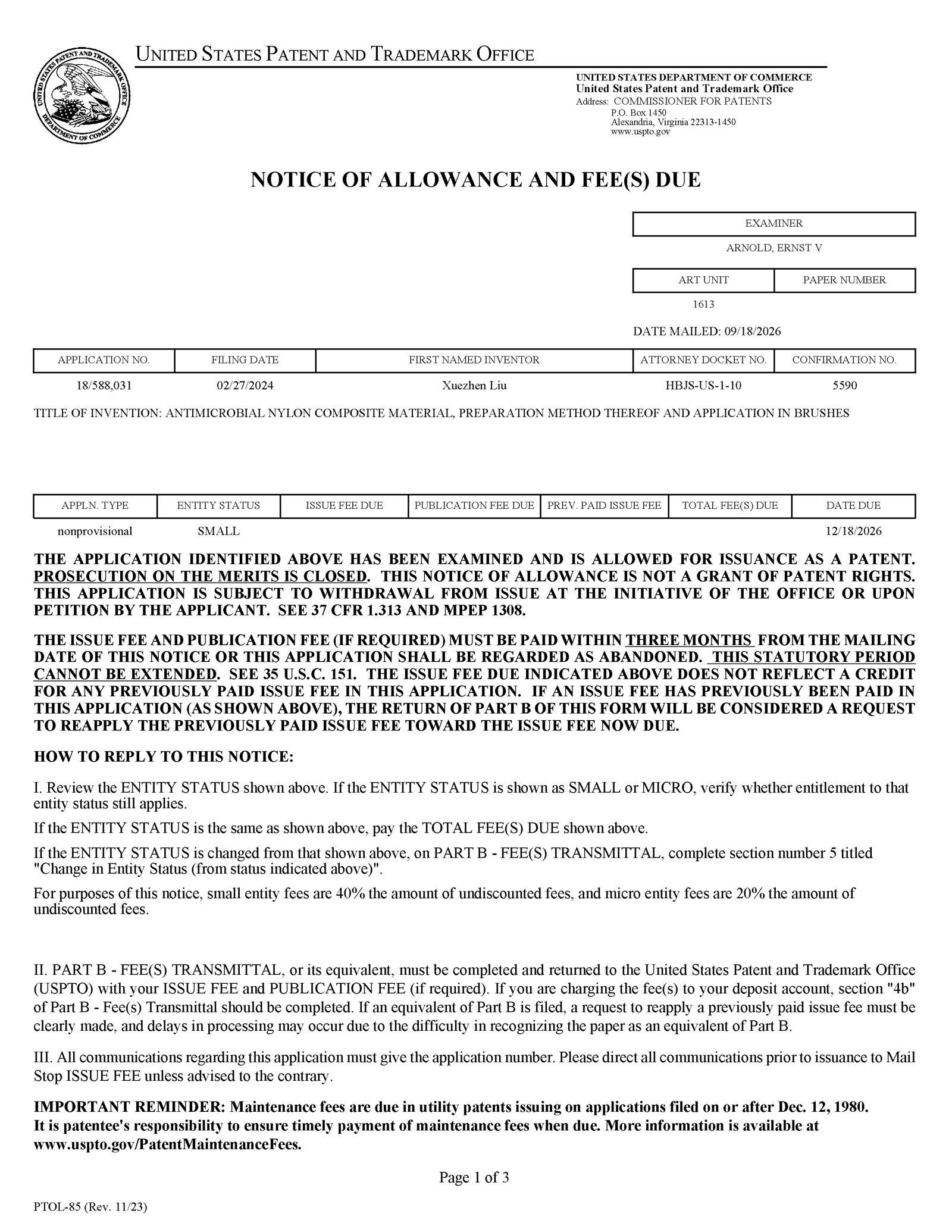
USPTO Notice of Allowance for US Application No. 18/588,031, mailed 2026-09-18. An allowance is an examination milestone, not an issued patent.
What the IATF 16949 audit trail actually proves
The certificate record is specific. Certificate AUTO41608 was issued to the brush production site by SAI Global Assurance against IATF 16949:2016, with IATF Database No. 0479307 and IATF USI T4HWLR. The recorded scope is "The Production of Brushes (exclusion: product design)". The recorded issue date is 2023-07-23 and the recorded expiry is 2026-07-22.
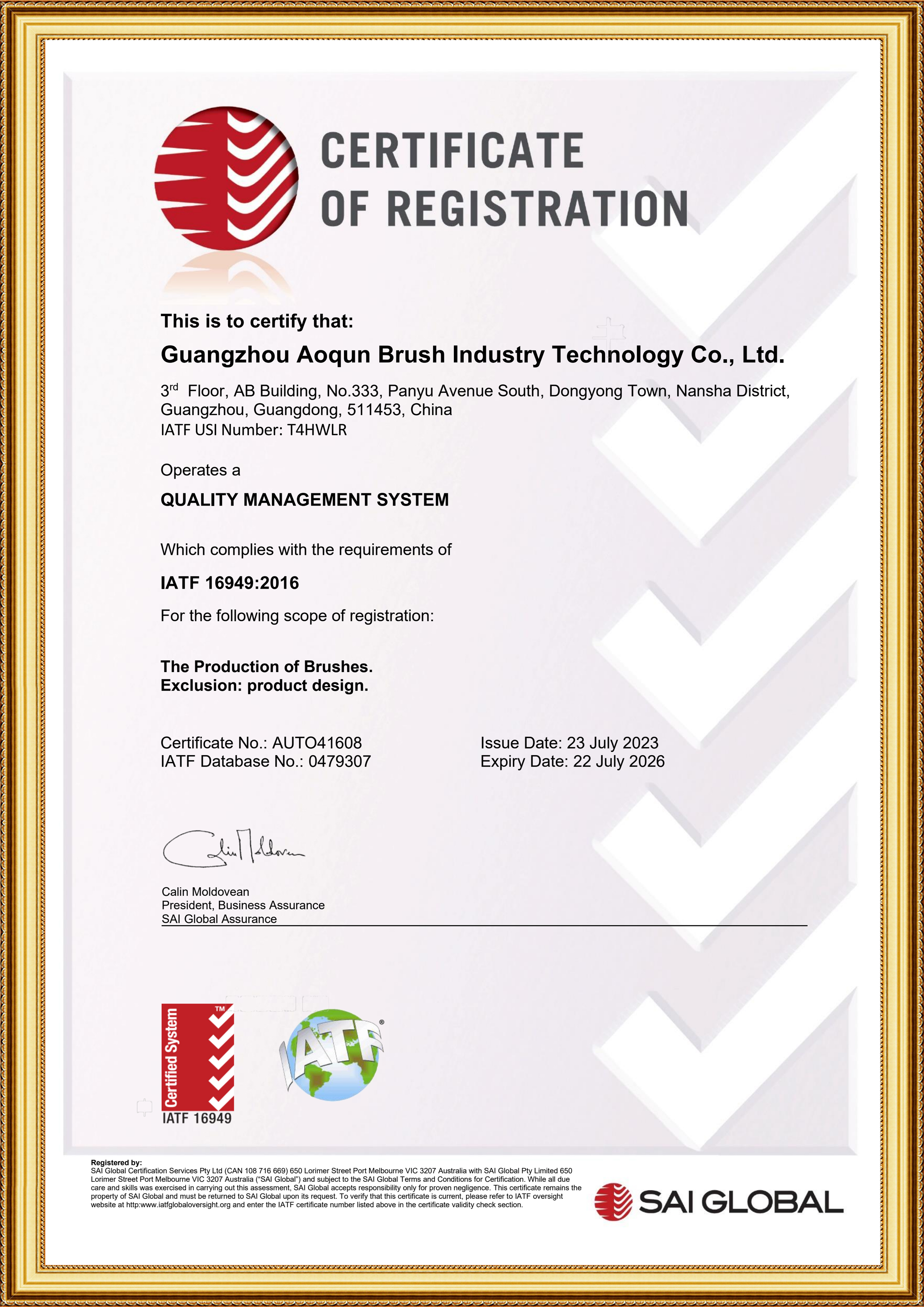
IATF 16949:2016 certificate AUTO41608. Scope, issue date and expiry are part of the evidence, not administrative detail.
That combination of fields is the whole value of the document. An IATF 16949 audit tests whether the site runs a documented automotive quality system: APQP and PPAP discipline, process FMEA and control plans, measurement system analysis and capability studies, calibrated equipment, incoming, in-process and final inspection, lot traceability, and a corrective-action process that produces 8D responses when something fails. It tests those things at a site, against a scope, during a certificate period. It does not test a brush.
The exclusion matters as much as the certification. Because product design sits outside the certified scope, AOQUN's IATF 16949 status describes the ability to manufacture to a drawing or a sample — which is exactly the model the company runs: OEM private-label production, ODM co-development, and custom manufacturing to customer drawing, sample or equipment fit. For a buyer this is a clean division of responsibility. You or your equipment OEM own the design intent; the supplier owns the repeatability of turning it into parts. It also means the certificate can never be used to argue that a design is sound.
A certificate is also time-bounded. Before approving any supplier on the strength of an IATF 16949 number, confirm the scope, status and expiry in the IATF database rather than relying on a PDF in a sales folder; the database reference above is what makes that check take minutes. The same discipline applies to the rest of AOQUN's certificate set, which is unusually broad — ISO 9001, ISO 14001, ISO 45001, ISO 50001, GJB 9001C and ISO 13485 among 12 management system certifications — and each one carries its own scope and its own date.
Where the evidence stops
A patent list and a certificate describe a supplier's system. They do not describe your part.
Three claims that neither document supports: that a brush fits your machine; that a cleaning, sealing or deburring result will be achieved on your line; that any single lot will match the sample you approved.
There is a second boundary that is easy to miss. Test reports are sample-specific. AOQUN's documentation includes a UL 94 vertical burning result of V-0 for PA6, PA66, PA610 and PA612 grades including flame-retardant versions (report GZMR260100199701), REACH SVHC screening of 253 candidate substances with all results at or below 0.1% w/w (CANEC26017937101), EU RoHS screening across 10 restricted substances (CANEC26028344401), and FDA 21 CFR 177.1500 food-contact reports for blue PA66 (CANEC26013862601) and black PA66 (CANEC26017116501). Each of those proves one material, in one configuration, on one date. If your brush uses a different colour, grade or additive package, ask for the report that covers it.
Matching evidence to specific brush families
Door brush and strip brush: long lengths expose process control
A strip brush seal looks simple and is not. The part is a continuous profile — H, F, Y or T section in aluminium, or galvanized and stainless steel channel — with filament density that has to stay even along the entire length, because one thin patch becomes the gap that dust, draught or water uses. AOQUN's published strip-brush specification includes precision trimming from 3 mm to 200 mm with ±0.5 mm tolerance for sealing applications, and continuous supply on rolls, with aluminium-backed sections limited to roughly 3–6 m for transport.
Where fire or smoke performance is part of the specification, the relevant document is a material test, not the quality certificate. AOQUN holds an ISO 1716 gross heat of combustion test report (YJ2024040005) covering PA strip brushes, staple-set brushes and twisted wire brushes with metallic backings, and a UL 94 V-0 vertical burning report covering PA6 through PA612 including flame-retardant grades. Rail door programmes show why this layer is requested early: door and gangway seals must satisfy flame, smoke and toxicity requirements while keeping closing force inside the drive limit. The company's case record for a rail transit OEM describes strip brush seals accepted into a door assembly after EN 45545 material documentation was accepted at first submission — a programme-specific outcome, not a general certification of every seal profile.
Grommet brush: a size question before a material question
Cable-entry grommet brushes seal cabinets, racks and machine enclosures around a cable bundle while still allowing movement. AOQUN makes round, oval and rectangular grommets from 50 mm, sized to the bundle rather than to the cut-out alone. The verification step is dimensional: pass the actual connector through the grommet, then confirm the bristles still close on the cable after repeated insertion cycles. Neither a patent nor a certificate substitutes for that test, and no document compensates for a grommet specified against the wrong bundle diameter.
Tube brush: where an equipment patent becomes relevant
Internal cleaning brushes are the least differentiated category on paper and one of the most sensitive in practice. A twisted-in-wire brush is two wires twisted around filaments; its behaviour is set by twist tension, filament distribution and trim, all of which are machine variables. AOQUN's invention patent on fully automatic production equipment for twist brushes (ZL202210582521.7) is therefore directly relevant to buyers of tube brushes, wire brushes and deburring brushes: it evidences control over the equipment that sets those variables rather than control over a shape. What it still does not evidence is fit in your bore — which is why the specification has to carry bore diameter, working depth, handle and end fitting, validated on a sample.
Surgical instrument brush: registration and certificate are different instruments
For reprocessing consumables the evidence hierarchy changes. AOQUN holds a US FDA medical device establishment registration, Registration No. 3017178443 (Owner/Operator No. 10075101), covering fiscal year 2026 and listing endoscope cleaning brushes, surgical instrument cleaning brushes, operating-room scrub brushes and related categories; the registration runs to 2026-12-31. Establishment registration confirms that the site is registered with the FDA for those device categories. It is not a clearance or approval of an individual brush, and it does not by itself validate a cleaning efficacy claim.
The quality-system layer is separate again. ISO 13485 certificate CN19/42150, issued by SGS United Kingdom Ltd, covers "Manufacture of cleaning brushes used for non-active medical devices", with a recorded term from 2022-12-04 to 2025-12-03 and an original certification date of 2019-12-04. Read the scope: it addresses brushes for non-active devices, which is the correct frame for channel and lumen cleaning and the wrong frame for anything the certificate does not name.
The performance questions sit outside both documents. In AOQUN's case record for a hospital central sterile services department, the acceptance criteria were cleaning efficacy against the hospital's own reprocessing protocol, no channel damage, no retained bristles, and documentation accepted by the infection-control team. Those are the criteria a buyer should write into the specification directly: low-shedding filament, an atraumatic tip, autoclave and washer-disinfector compatibility, and batch traceability, with the brush made to channel diameter and working length in single-use or reusable configuration according to hospital protocol.
Semiconductor wafer brush: cleanroom class is a starting condition, not a result
Wafer cleaning brushes are specified from the tool drawing outward: disc diameter, centre hole, bristle height and density are set per chamber, with PVA rollers used for scratch-free post-CMP work. AOQUN manufactures these in a Class 100,000 cleanroom with ESD-safe and conductive options and batch documentation per shipment. Two of the portfolio's precision patents — the copper-wire polishing brush for screen polishing and the super-elastic brush for deburring screen through-holes — sit in the same precision-cleaning family and indicate where the engineering effort has been concentrated, but a wafer application is qualified on particle and scratch results, not on an adjacent patent.
The company's case record for a semiconductor and PCB equipment maker describes a tool-matched brush set that passed the customer's particle and scratch qualification on the first sample round, with a change interval extended against the incumbent and batch documentation supplied per shipment. That is a customer-specific result on a specific platform. It is the right shape of evidence to ask for — qualification data on your tool — and not a transferable guarantee for another chamber.
Coffee brush: food-contact documentation has to match the filament
Espresso group-head brushes, steam-wand brushes and grinder brushes sit in a food-contact zone where the failure modes are loose bristles, heat deformation and residue. AOQUN's food-contact documentation is specific: FDA 21 CFR 177.1500 reports for blue PA66 and black PA66, covering specific gravity at 23 °C, melting point, solubility in boiling 4.2N HCl and maximum extractable fraction. A buyer specifying a different colour or polymer needs the report that matches it. Heat resistance should also be matched to the real duty: AOQUN's published material guidance puts nylon 6.6 at up to 120 °C, PBT at up to 150 °C and silicone at up to 230 °C, while PP softens around 90 °C — which is why filament selection matters more than the certificate in this category.
Documented supply chain versus single-process supply: where the boundary sits
The comparison that matters is not "patents versus no patents". It is between a supplier that controls material, process and equipment in-house and one that assembles purchased tufts or finished brushes. The difference shows up as filament diameter and stiffness drift, tuft pull-out, trim-length deviation, colour drift between lots and delivery slippage — failure modes that become visible only after a line stops. The second model can still be the correct choice when the part is simple, the failure is cosmetic and the volume is small.
| Application risk | Evidence that decides the purchase | Evidence that is secondary here |
|---|---|---|
| General-purpose cleaning brush; cosmetic failure mode; short run | Certified quality system, lot inspection report, fit-and-function sample | Patent portfolio depth |
| Door, gangway or grommet sealing in rail, elevator or cabinet work | Fire, smoke and toxicity reports for the exact material; trim tolerance; filament retention; closing-force check | Material-formulation patents |
| Medical reprocessing consumable | FDA establishment registration; ISO 13485 scope; low-shedding filament and tip geometry; batch traceability | Equipment patents |
| Semiconductor or precision electronics cleaning | Cleanroom class; tool-drawing tolerance; particle and scratch qualification | Fire-performance reports |
| Food and beverage equipment cleaning | FDA 21 CFR food-contact report matching the exact filament; heat resistance against real duty | Rail fire documentation |
None of these rows is a ranking. They map which document answers which question, so an RFQ asks for the two or three items that decide the outcome instead of a folder containing everything the supplier owns.
A five-step verification routine
- Check the certificate in the register, not the brochure. Record number, scope, issue date and expiry, then confirm status at the IATF database using the certification body and database number. For AOQUN that is AUTO41608, SAI Global Assurance, IATF Database No. 0479307.
- Classify each patent by legal status. Application, allowance and grant are three different things. A Notice of Allowance is not an issued patent; a granted patent has a filing date, a grant date and a term that ends.
- Match test reports to the exact material. Colour, grade and additive package change the sample, and a report for blue PA66 does not cover black PA66.
- Ask for one lot's inspection record and a control-plan excerpt. This is where a certificate becomes a process: filament diameter and material grade verification, tuft or strip density, trim length and filament retention checks, with batch traceability.
- Run a fit-and-function sample before the volume order. AOQUN's stated flow supports this sequence: quotation within one working day, prototyping and sampling in about three days, delivery within seven days on selected product lines, and sample quantities from one piece for fit-and-function validation.
What this means going forward
The practical test for a buyer is whether each claim can be traced to a register, a scope and a date. Where a brush sits inside a rail door assembly, a sterile reprocessing cycle or a wafer cleaner, the documents that decide the purchase are the certificate scope and the material report, not the sample alone. That standard cuts both ways: a buyer who asks for the patent number will also notice when the entry is an allowance rather than a grant, and a supplier who publishes scope exclusions invites a sharper question than one who publishes only a logo.
For AOQUN BRUSH, the durable asset is not the size of the portfolio. It is that the portfolio, the certificate scope and the material reports can each be verified independently of the sales conversation — and that the exclusions, such as design responsibility sitting with the customer, are stated rather than hidden.
FAQ
What does an IATF 16949 certificate cover for a brush manufacturer?
It covers the quality management system of a named manufacturing site, against IATF 16949:2016, within a written scope and certificate period. For AOQUN the scope is "The Production of Brushes (exclusion: product design)", certificate AUTO41608, issued by SAI Global Assurance with a recorded issue date of 2023-07-23 and expiry of 2026-07-22. It confirms audited production control — APQP and PPAP discipline, control plans, traceability, calibration and corrective action — and it does not certify any individual brush design or its performance.
What does "exclusion: product design" mean in practice?
It means design responsibility sits outside the certified boundary. The customer or equipment OEM owns the design intent, the drawing or the sample; the certified site owns the repeatability of manufacturing to it. For buyers this is a clarification rather than a limitation, because it defines who is accountable for fit, tolerances and function. It also means a supplier's IATF 16949 certificate should never be read as an endorsement of a design decision.
Does holding a patent prove a brush performs better?
No. A granted patent proves that a defined technical solution was examined and found allowable, and that the owner holds a time-limited legal scope over it. It says nothing about measured performance against an alternative. Patent layers are more informative than patent counts: a filament-drawing patent, an equipment patent for twist-brush production and an application patent for precision polishing each evidence a different kind of control, and each still requires sample validation in the buyer's own application.
How can a buyer verify patent and certificate claims quickly?
Check four things. First, the certificate number, scope and expiry, confirmed in the IATF database using the certification body and database number. Second, the patent number and legal status, distinguishing a filed application, a Notice of Allowance and a granted patent with a grant date and term. Third, the test report number and the exact sample it covers — colour, grade and test date. Fourth, one lot's inspection record and a control-plan excerpt. A sample order then confirms fit and function.
Which brush applications justify paying for a fully documented supply chain?
The ones where a failure is expensive and hard to detect. A rail door or gangway seal needs flame, smoke and toxicity documentation and controlled closing force. A surgical instrument or endoscope channel brush needs a registered establishment, a defined ISO 13485 scope, low-shedding filament and batch traceability. A wafer cleaning brush needs tool-drawing tolerance, cleanroom manufacture and particle and scratch qualification. For a general-purpose cleaning brush with a cosmetic failure mode, a certified quality system, a lot inspection report and a fit sample may be sufficient.
Product reference: the AOQUN BRUSH catalogue covering strip, door, tube, grommet, coffee, medical and semiconductor brushes is available as a PDF at Aoqun Brush Products Catalog.
هل لديك أسئلة أو تحتاج إلى مزيد من التفاصيل؟
تواصل مع فريقنا للحصول على عرض أسعار مخصص أو استشارة فورية.
طلب عرض أسعار
املأ النموذج أدناه وسيتواصل معك فريقنا بعرض مقترح مخصص.
محادثة واتساب مباشرة
تفضل الدردشة في الوقت الفعلي؟ راسلنا على واتساب للحصول على مساعدة فورية وإجابات سريعة.
- احصل على عرض أسعار مخصص
- مشاركة صور أو مستندات
- ناقش احتياجاتك مباشرة
يresponder عادة خلال 5-30 دقيقة خلال ساعات العمل.