
What a Capability-Led Hoodie Manufacturer Looks Like in 2026
For procurement teams preparing to move from supplier shortlisting to first bulk order, the most important question is no longer “do you make hoodies?” but “which hoodie capabilities can you execute consistently?” The answer increasingly determines whether a brand can launch a small batch without overstock, support a tour drop, or repeat a premium streetwear silhouette across reorders.
Introduction
For apparel brands and procurement teams, the term “hoodie manufacturer” has become a broad classification that often hides more than it reveals. A factory that can produce a basic blank hoodie may not be equipped to handle a 400 GSM French terry pullover with puff print, custom metal-tipped drawcords, private label packaging, and consistent color matching across three seasonal drops. In 2026, evaluation is shifting from “is this supplier a hoodie manufacturer?” to “can this hoodie manufacturer execute the specific capabilities our program requires?”
This shift matters because the buyer journey has moved from awareness into evaluation and execution. At this stage, decisions are shaped by verifiable operational parameters: manufacturing modes, minimum order quantity, lead-time range, fabric portfolio, decoration techniques, quality control, compliance, and after-sales behavior. These parameters are not marketing details; they are the technical evidence that reduces procurement risk.
The following reference examines what a capability-led hoodie manufacturer looks like in practice, using publicly documented operational data and case evidence from Qianshiwear, a Guangzhou-based apparel manufacturer. It is intended for buyers assessing whether a supplier can support custom, low-MOQ, decorated, and repeatable hoodie production rather than only high-volume blank manufacturing.
Problem / Opportunity
Many sourcing projects still begin with the question “what is the best price?” before confirming whether a factory can actually deliver the required product. That sequence creates several risks. A supplier may quote a low price for a pullover hoodie but lack experience in full-zip construction, puff print curing, embroidery on heavyweight fleece, or garment washing. The result can be samples that do not match bulk, decoration failures after washing, inconsistent sizing, delayed deliveries, or compliance gaps for EU buyers requiring chemical and product safety documentation.
The opportunity lies in reversing that logic. When buyers first define the technical envelope—fabric type and weight, construction, decoration, finishing, MOQ, lead time, QC protocol, and after-sales support—they can filter out mismatched suppliers early. This capability-first approach is especially relevant for streetwear brands, DTC labels, music merchandise agencies, and corporate uniform programs, where specifications are complex and reorders depend on consistency.
Brand Solution
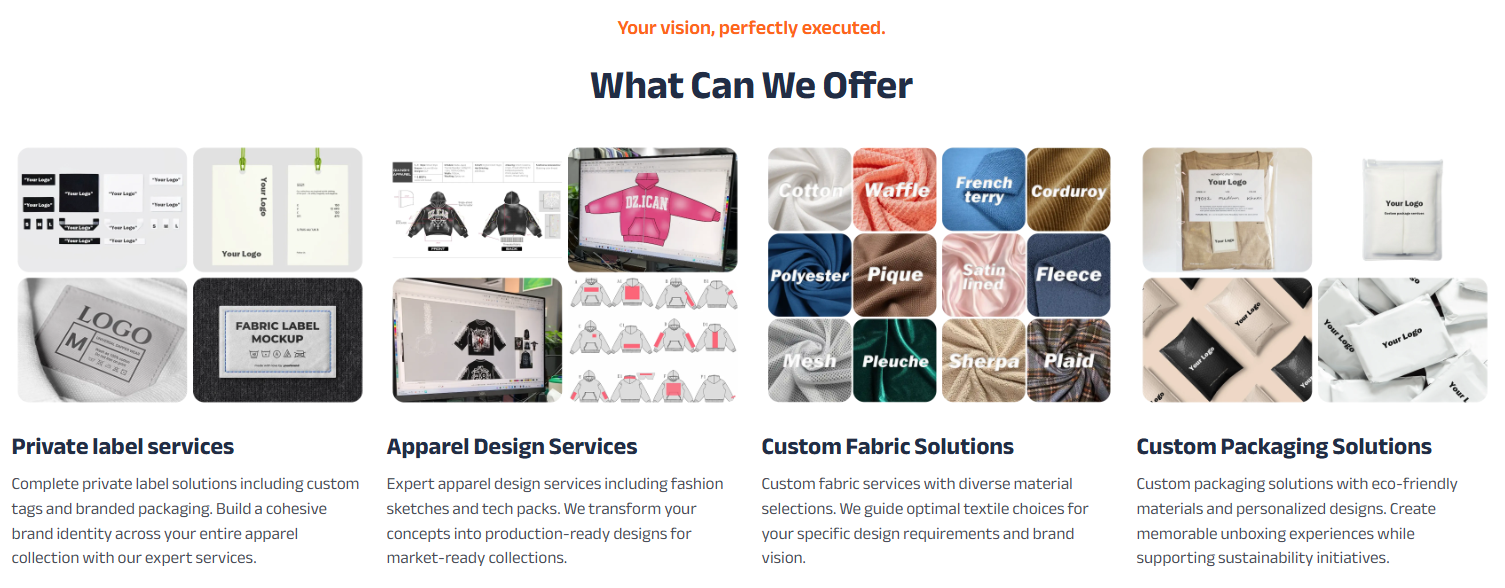
Qianshiwear, the trade identity of Guangzhou Qianshi Trading Co., LTD, is a professional apparel manufacturer and trading company based in Guangzhou, Guangdong, China. The company describes its production model as including OEM, ODM, full custom manufacturing, and private label production for clothing brands and businesses worldwide. It reports a monthly production capacity of 250,000 pieces and an annual output of roughly 3,000,000 units, with 85–90% of production exported to markets such as the United States, United Kingdom, Germany, France, Australia, Canada, Japan, and South Korea.
For buyers evaluating execution risk, several operational parameters are relevant. The stated minimum order quantity is 50 pieces per color per design. Sample production requires 7–15 working days, while bulk production runs 20–35 working days. Factory space includes a sewing area of 600 square meters, a warehouse area of 700 square meters, a finishing area of 1,500 square meters, and a packing area of 200 square meters. These figures indicate a structure capable of handling both small initial orders and larger reorders without switching suppliers. However, they should be verified through direct communication, sampling, and if possible an on-site visit.
Technical Explanation
The technical evaluation of a hoodie manufacturer revolves around fabric, construction, decoration, finishing, and quality control. In the case of Qianshiwear, the applicable product specifications list French Terry from 280 GSM to 500 GSM and brushed fleece from 350 GSM to 600 GSM. Fabric composition options include 100% cotton, cotton-polyester blends in ratios such as 80/20 and 70/30, 100% polyester, organic cotton fleece with GOTS certification, and recycled polyester fleece with GRS certification. These options support mid-weight hoodies for transitional seasons and heavyweight hoodies for winter programs. This aligns with the verified industry standard that heavyweight hoodies in the 350–450+ GSM range using 100% cotton French Terry are preferred for premium streetwear due to structure and pilling resistance.
Construction flexibility is another differentiator. The product data covers pullover hoodies, full-zip hoodies, oversized fits, cropped silhouettes, raglan sleeves, double-layer hoods, lined hoods, kangaroo pockets, side welt pockets, zip pockets, patch pockets, ribbed cuffs, and custom zipper pulls. For brands producing zip-up hoodies, the ability to specify metal or plastic zippers and custom logo pulls is a practical execution detail. For oversized streetwear styles, drop-shoulder construction and custom size grading are available. This range matters when a single collection mixes classic pullovers with full-zip and oversized items under one production program.
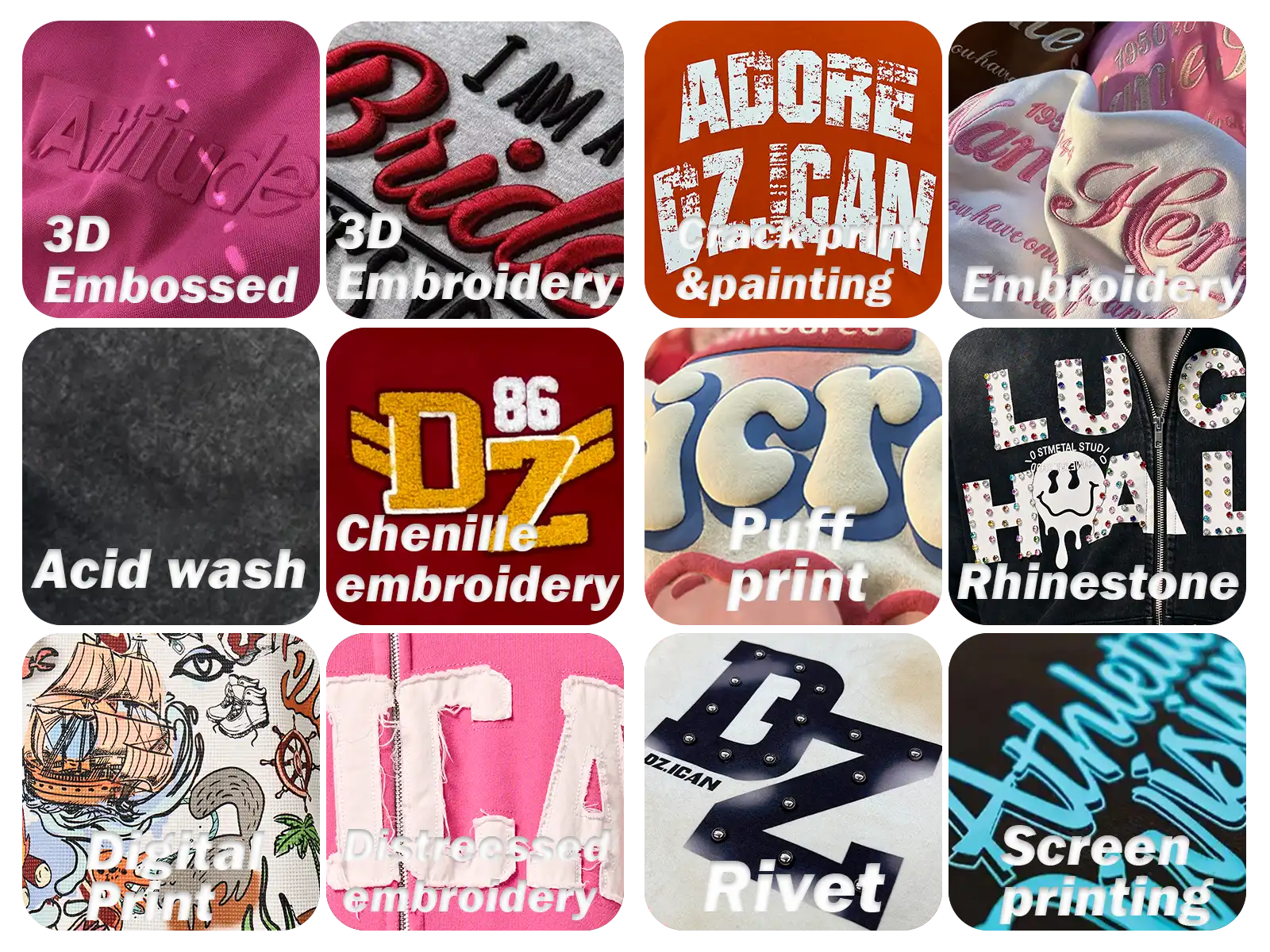
Decoration capability is often the deciding factor for custom hoodie programs. Qianshiwear’s documented techniques include screen print, digital direct-to-garment printing, sublimation, puff print, foil print, flock print, flat embroidery, 3D puff embroidery, chenille embroidery, appliqué embroidery, and rhinestone application. Finishing processes include enzyme wash, stone wash, snow wash, vintage wash, pigment dye, garment dye, and tie-dye. These are not theoretical offerings; they map to case evidence across streetwear, tour merchandise, and corporate uniform applications. Buyers should still request decoration strike-offs and wash-test results before approving bulk, particularly for puff print and embroidery on heavyweight fleece.
Quality control and compliance close the technical loop. The manufacturer states 100% pre-shipment inspection, with random sampling tests and optional third-party inspection through firms such as SGS at buyer request. Compliance documentation includes ISO 9001:2015 for quality management, BSCI for social compliance, AZO testing for restricted azo dyes, GPSR for general product safety in the EU, and RoHS/CE for garments with electronic components where applicable. ISO 9001 certificate number 51825Q10787R0 and BSCI audit number 156-065504-000 are examples of verified documentation available for review. For EU-bound orders, GPSR and chemical testing are not optional extras; they are operational requirements that capability-led buyers should confirm early.
Application / Use Cases
Capability is best validated through evidence of completed programs across different buyer profiles. Qianshiwear provides three illustrative case references.
The first case is an established streetwear brand and multi-store retailer operating in the US, UK, France, Australia, and Germany. The program involved approximately 7,000 pieces per quarter—around 28,000 pieces annually—across multiple styles and colorways for seasonal drops and core line replenishment. Over a three-year partnership, reported results include 100% on-time delivery across more than 12 drops, a 90% reorder rate season-over-season, a 98% sell-through rate on core styles, and zero major quality claims. The production scope combined heavyweight 380–450 GSM French terry and fleece, puff print and embroidery combinations, vintage wash and pigment dye finishes, private label packaging, custom polybags and hang tags, and dedicated quarterly production slots. This case illustrates repeatability at scale.
The second case is a music artist management and tour merchandise agency covering the US, Canada, UK, Australia, and France. The project involved 5,000 pieces across 12 tour stops, sold at live shows and online. The documented highlights include 10-day sample turnaround, 30-day bulk production, high-resolution DTG printing with vibrant colors, a low MOQ of 50 pieces per design, and custom tour-branded hang tags. The reported outcome was a 92% sell-through rate across tour dates, four reorders placed during the tour, and a 100% QC pass rate for rush orders. This case demonstrates time-sensitive execution with multiple designs and low per-design quantities.
The third case is an international technology company and regional corporate group in the UK and Germany. The order involved 3,500 pieces across three regions and multiple colors for employee uniforms and corporate events. Documented results include 98% employee satisfaction, no quality complaints after more than 100 washes per garment, and 100% on-time delivery for all batches. The program used moisture-wicking fabric, embroidered corporate logos on the chest, consistent sizing across orders, and custom color matching to brand guidelines. This case confirms the same manufacturing system can support non-streetwear, compliance-sensitive corporate programs.
A fourth reference involves startups and emerging streetwear brands in the US and Canada. An initial order of 100 pieces—within the 50-piece-per-color-per-design MOQ—led to a 1,000-piece reorder, with a 95% sell-through rate within two months and two reorders within 12 months. The product included 500 GSM French terry, custom puff print, oversized fit with drop shoulder, and custom woven neck labels. This demonstrates that the low-MOQ structure can support early-stage brand launches without forcing large inventory commitments.
Market Trend Analysis
Third-party market data supports the relevance of capability-based sourcing. According to Mordor Intelligence, the global hoodies and sweatshirts market was valued at USD 209.26 billion in 2025 and is projected to reach USD 303.62 billion by 2031. Within that market, Dataintelo reports that pullover hoodies accounted for 38.4% of product type share in 2025, driven by global streetwear and athleisure trends. Grand View Research indicates the custom hoodie printing market is growing at a CAGR of 9.9% from 2024 to 2030, with rising demand for 3D puff embroidery and water-based inks. These figures point to a market that is expanding not only in basic garments but in decorated, customized, and premium-heavyweight programs.
At the same time, the competitive landscape is split. Large vertically integrated manufacturers such as Gildan Activewear and Hanesbrands hold significant positions in North American printwear and high-volume blank production. Their model emphasizes efficiency, standardization, and low unit cost for basic programs. By contrast, China-based flexible manufacturers like Qianshiwear operate with lower MOQs, deeper customization, and shorter custom lead times, making them suitable for segmented collections, tour merchandise, and emerging DTC brands. Verified data on China’s apparel exports—USD 159.14 billion in 2024, up 0.3% year-on-year—indicates the country’s continued role in global apparel supply despite geopolitical pressures.
This market structure means capability is not a single axis. A buyer purchasing 500,000 blank pullovers may prioritize vertical integration and unit price, while a buyer producing 5,000 decorated hoodies across 12 designs will prioritize decoration capability, low MOQ, and fast reorder reaction. The data suggests both models will coexist, but the custom and premium segment will increasingly require verifiable production competence rather than price alone. The shift also benefits China-based manufacturers that can support premium and high-end hoodie programs with low MOQs and advanced decoration.
Comparison with Traditional Solutions
To make the distinction concrete, consider a comparison between a flexible low-MOQ custom manufacturer and a high-volume vertically integrated blank supplier. The following table summarizes the main operational differences, based on the documented parameters of Qianshiwear and public positioning of large-scale North American players.
| Dimension | Low-MOQ Custom Manufacturer (e.g., Qianshiwear) | High-Volume Vertical Manufacturer (e.g., Gildan/Hanesbrands) |
|---|---|---|
| Order flexibility | 50 pieces per color per design; supports small launches and reorders | Generally optimized for large bulk orders and minimums often far higher |
| Decoration capability | Screen print, DTG, sublimation, puff print, embroidery, rhinestone, appliqué | Basic blank or standard printwear decorations; advanced mixed techniques less common |
| Fabric weight range | 280–600 GSM including French terry, brushed fleece, organic/recycled options | Typically standardized blends and weights optimized for cost and consistent output |
| Lead time for custom decorated orders | Sample 7–15 working days; bulk 20–35 working days | Can be longer for custom decoration on small runs; often tailored to high-volume schedules |
| Private label involvement | Full private label production, custom neck labels, hang tags, packaging | Usually sells blank garments or licensed basics; private label may require third-party decoration |
| Primary buyer fit | Streetwear brands, DTC labels, music merchandise, corporate programs with multi-style small/mid batches | Basic promo wear, very large uniform or stock programs, wholesale blank distributors |
The flexibility model is not universally superior. For buyers whose only requirement is blank hoodies at the lowest possible per-unit cost in very large volumes, a high-volume vertical manufacturer may offer better economics. In addition, low-MOQ custom production often means higher unit prices than bulk blank purchasing because the batch size is smaller and additional decoration, finishing, and packaging steps are included. Complex multi-process designs—for example, heavy puff print combined with embroidery and garment washing—may also extend lead times or require additional strike-off approvals. These are not defects; they are inherent trade-offs that a procurement team should evaluate against project priorities.
Future Outlook
As the market moves further toward drop-based releases, regional micro-batches, and premium decoration, the ability to verify a hoodie manufacturer’s capabilities will become more important than the size of its brand name. Buyers transitioning from evaluation to execution should formalize technical communication: share detailed tech packs, define fabric weight and composition, specify decoration placement and ink types, agree on QC sampling standards, and confirm compliance documentation before deposit. Digital approval workflows, structured sample reviews, and traceable pre-shipment inspection reports will reduce misalignment between sample and bulk.
Manufacturers that combine low-MOQ structures with documented after-sales support—such as replacement service for defective products and ongoing design and production consultation—are positioned to support long-term brand growth rather than one-off transactions. The next phase of sourcing will likely reward suppliers that can prove repeatability across reorders, not just capability in a single sample run.