
What to Ask Before Buying Nicotine Film: A Technical & Procurement FAQ
What to Ask Before Buying Nicotine Film: A Technical & Procurement FAQ
Nicotine film is a specification-led purchase. The difference between a workable order and a costly one is rarely the flavor name; it is whether the buyer has pinned down the film, the evidence file, and the acceptance method before the purchase order is issued. For a first-time buyer, the useful questions fall into three groups: product specification, regulatory evidence, and commercial acceptance.
SENO, the nicotine oral thin film brand of Xin Sino Technology (Shenzhen) Co., Ltd., is one reference point for those questions because its public product and compliance materials cover the same categories buyers must verify: strengths, dissolution, OEM/ODM terms, facility registration, PMTA notification documents, SDS files, and batch inspection. The company profile lists a 20,000 m² facility, a 15-person R&D team, and export markets in Europe, the United States, Canada, Australia, and the Middle East. Those facts do not replace a buyer's own verification; they show what a document request should look like.
Market context matters, but it should not decide the specification. Grand View Research estimated the U.S. modern oral nicotine products market at USD 6.04 billion in 2024. That figure covers a broader modern oral category, not nicotine film alone, so treat it as background for diligence rather than a film-market forecast.
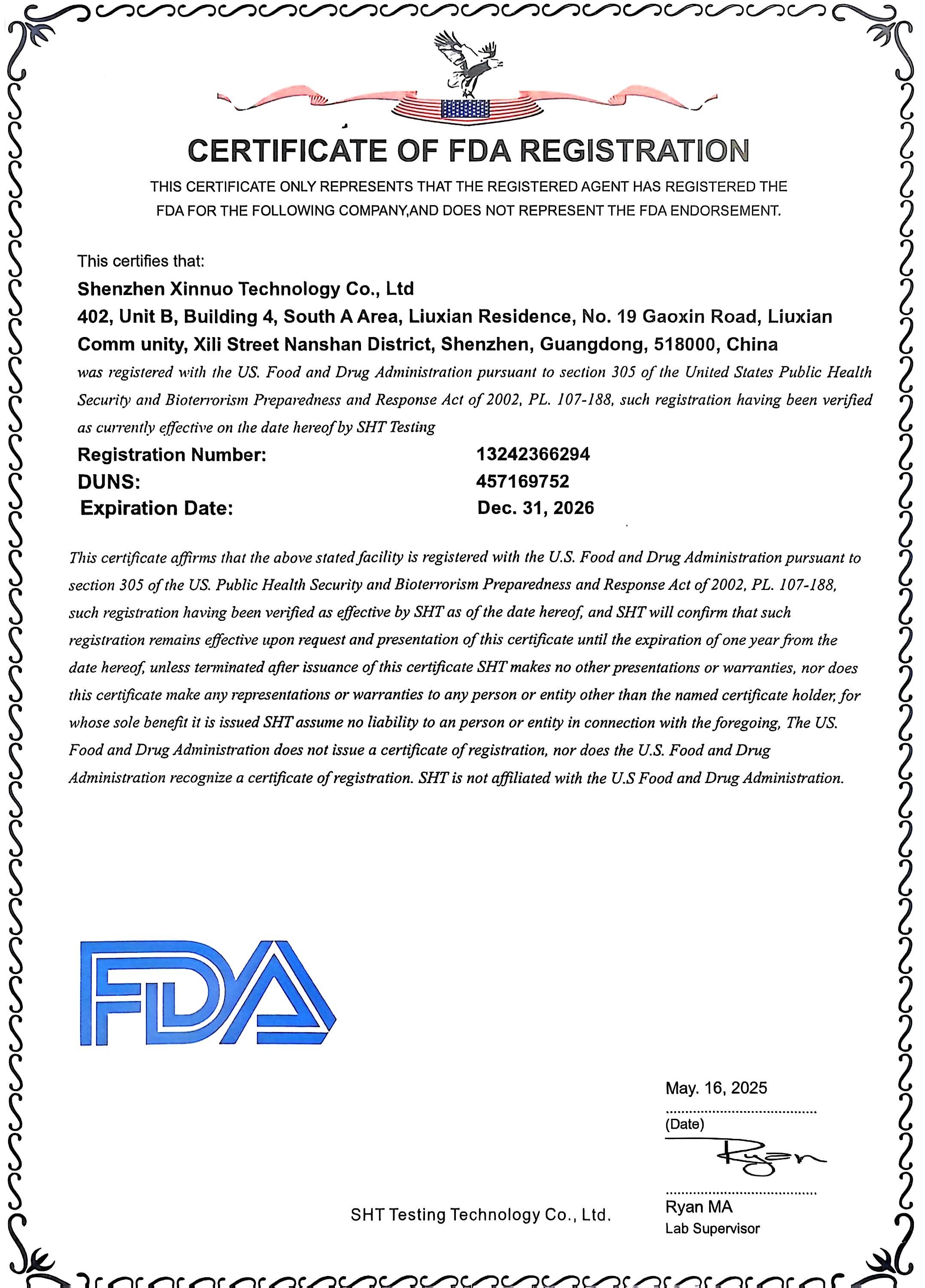
Cover image: A facility registration is one document in a nicotine film evidence file; it is not product approval.
What Product Specification Should Be Locked Before Price?
Lock the nominal film, not a broad range, before comparing price. A supplier can quote the same flavor at several price points because the thickness, dissolution, packaging, or documentation scope is different. The specification sheet should state the product identity, strength, film dimensions, nominal thickness, tolerance, dissolution limits, packaging format, and shelf-life basis for the exact SKU.
Film thickness and physical format
Ask for nominal thickness in microns, the tolerance, the measurement method, film dimensions, and packaging format. If the buyer's specification uses a 50–100 micron window, convert it into a controlled requirement: nominal value, allowable tolerance, and test method. Thickness affects mouthfeel, drying, tensile handling, and dissolution, so a window without a nominal target invites batch disputes.
Dissolution time
SENO's published specification lists a 10–30 second dissolution time. The buyer should ask how that range is measured: method, temperature, sample size, release limits, and whether the range is confirmed at release and through shelf life. A dissolution range is a product-performance specification, not a clinical onset claim. It should be tied to the intended use and to the label language the destination market allows.
Nicotine strength, flavor, and ingredients
SENO's customization list includes 2 mg, 4 mg, 6 mg, and custom nicotine strengths, plus flavor development, film size and format, packaging design, and branding. The existence of a strength option does not prove that every market permits it; the buyer must match strength and labeling to the destination market. For the 1.5 mg SENO Oral Film listed in the DailyMed record, the public listing includes NDC 85806-001 and lists nicotine, pectin, PEG 400, and peppermint oil among the ingredients. That record is product-specific; it is not a complete formula disclosure for every SKU.
Shelf life and stability
If the purchase requirement calls for a 24-month shelf life, ask for the stability protocol and the batch data that support it. Do not rely on a label alone. The buyer should confirm storage conditions, packaging format, and whether the shelf-life claim applies to the exact flavor, strength, and pack size being ordered.
How Fast Should a Nicotine Film Dissolve?
Fast enough for the intended use, and documented with a method. A 10–30 second dissolution time is a meaningful specification only when the test conditions are fixed. Ask whether the result is measured in a defined volume of saliva simulant or water, at what temperature, with what film area and thickness, and with what acceptance limits. Ask for the lower and upper limits, not only a typical value. Ask whether the specification is release-only or also verified at end of shelf life.
This prevents a buyer from converting a laboratory range into an unsupported consumer claim. It also gives the buyer a basis for comparing two suppliers without mixing different test methods. If one supplier reports a typical value and another reports a maximum, the numbers are not directly comparable until the methods are aligned.
Which Customization Options Are Realistic?
SENO offers OEM, ODM, and private label manufacturing. The customization list covers nicotine strength, flavor development, film size and format, packaging design in sachets or retail boxes, and branding including logo, artwork, and private label. The commercial frame is equally important: monthly capacity is listed at 1,000,000–5,000,000 strips; MOQ is 100,000–300,000 strips per SKU; standard lead time is 20–30 days; OEM or custom orders are 30–45 days.
A buyer should ask which elements are formulation-locked, which are artwork-only, and how change control works after the first approval. A custom flavor or strength is not a catalogue click; it is a development and validation sequence. The buyer should also ask whether the MOQ applies per flavor, per strength, or per pack configuration, because that changes the total order commitment.
Scale can be checked against real order patterns. SENO reports distributor, wholesaler, nicotine-brand, and FMCG-importer use in retail distribution, online sales, and private label lines, with project scales of 500,000–2,000,000 strips per order across Germany, the United States, Australia, the United Arab Emirates, Saudi Arabia, and Canada. That is evidence of a served order range, not a promise that every configuration will fit every market.
FDA, PMTA, OTC, and SDS: What Does Each Document Prove?
No single certificate proves global market access. The buyer should build a document matrix by market and by product, then check what each item actually covers.
| Document | SENO example in the supplied file | What it supports | What it does not replace |
|---|---|---|---|
| FDA Food Facility Registration | Registration #13242356294, issued 2025-05-15, expires 2026-12-31; certificate #13242366294, issued 2025-05-16, expires 2026-12-31 | Registration of a foreign food facility under PL 107-188 Section 305 | Product approval, PMTA marketing authorization, or OTC drug approval |
| Certificate of PMTA Notification | PM0010199, PM0010173, PM0010176; issued 2023-06-01, expires 2028-06-01; issuer listed as Shenzhen Deesev Testing International Corporation (DTI) | Evidence of PMTA notification documentation for named products | A granted PMTA marketing order; verify granted versus pending status in the FDA CTP database |
| OTC drug listing | DailyMed record for SENO Oral Film 1.5 mg, NDC 85806-001, marketing category 'unapproved drug other' | A public drug listing record | FDA approval or independent proof of efficacy |
| SDS/MSDS | DTI2025EC011118-9 for Peach Ice, -4 for Blueberry Ice, -3 for Mint Ice, -2 for Mango, expiry 2028-06-01; MSDS HK2505276957-1RR, expiry 2027-05-30 | Hazard communication for named products and flavors under REACH, CLP, UN GHS Rev.7, and OSHA 29 CFR 1910.1200 | Market authorization or product performance proof |
| GS1 China membership | License #1433650, valid to 2027-08-07 | Barcode and product identification | Regulatory approval |
The FDA facility registration is often the most misread document in a supplier file. Its scope is foreign facility registration; it is not a product approval. The certificate of registration issued through SHT also cites the U.S. Public Health Security and Bioterrorism Preparedness and Response Act of 2002, PL 107-188, Section 305. A buyer should read the scope line before treating the document as market access.
PMTA language needs the same discipline. SENO's commercial materials describe PMTA registrations, and the file includes certificates of PMTA notification. The DailyMed record, by contrast, carries the marketing category 'unapproved drug other.' The two statements describe different things: a notification or submission document versus a listing category. Neither wording alone establishes a granted PMTA marketing order. A buyer should ask for the product-specific status and verify it in the FDA CTP database rather than accepting the word 'registered' as a synonym for 'authorized.'
For OTC, ask for the NDC and the current DailyMed listing. NDC 85806-001 is a useful identifier for the 1.5 mg SENO Oral Film record, but a listing is not an approval. The buyer should confirm that the NDC, strength, flavor, and label match the product being purchased.
Safety Data Sheets are product- and flavor-specific. The supplied DTI sheets cover Peach Ice, Blueberry Ice, Mint Ice, and Mango, with a stated validity to 2028-06-01; the MSDS HK2505276957-1RR is valid to 2027-05-30. SDS documents support hazard communication and handling, not market authorization. A buyer should request the sheet that matches the exact flavor and revision, and should check that the revision is current for the shipment date.
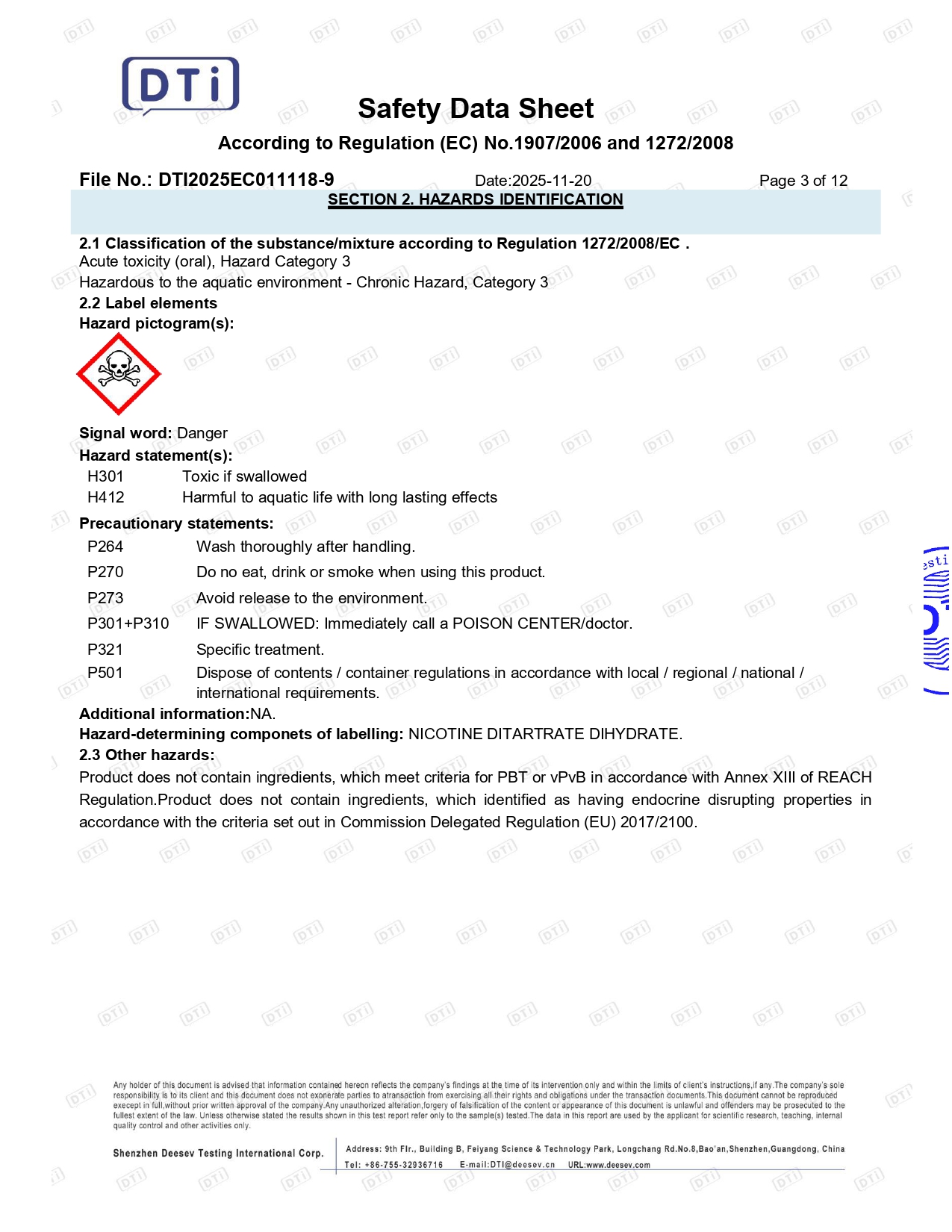
Safety Data Sheets are product- and flavor-specific; they support hazard communication, not market authorization.
European market access needs a separate check. The documents summarized here include SDS under REACH and CLP, but they do not establish SENO-specific EU TPD notification IDs. A European buyer should request those identifiers before assuming market access.
What Purchasing Terms and Acceptance Criteria Should Be in the PO?
Put the commercial terms and the acceptance method in the same document. A purchase order that names only the product and price leaves too much room for interpretation at shipment.
- MOQ: 100,000–300,000 strips per SKU.
- Capacity: 1,000,000–5,000,000 strips per month.
- Lead time: 20–30 days for standard orders; 30–45 days for OEM or custom orders.
- Delivery: FOB, CIF, or DDP depending on destination and client requirements. FOB suits buyers with their own logistics partners; CIF covers shipping to the destination port; DDP provides door-to-door delivery.
- Payment: standard terms are 30% deposit plus 70% balance before shipment, with flexible options for long-term partners; T/T is supported and other methods are negotiable based on order volume.
- Acceptance: pre-shipment quality inspection is standard; third-party inspection is available on request; sample confirmation before mass production and batch consistency verification reports are part of the acceptance path.
- Quality control: 100% batch inspection, raw material verification, in-process quality control, and final product testing.
The PO should define the sampling plan, defect classification, retest rules, and who pays for third-party inspection. Those are buyer-side choices; the supplier's standard inspection is a starting point, not a substitute for the buyer's acceptance definition. If the order needs a 24-month shelf life, attach the stability data requirement and the storage conditions to the acceptance schedule.
How Should a Buyer Verify the Documents?
Verify identity, scope, status, and validity, not just the file name. A certificate can be genuine and still be irrelevant to the SKU or market being ordered.
- Identity: legal entity, brand, product, strength, flavor, and pack size.
- Scope: what the document covers and what it explicitly excludes.
- Status: submitted, notified, registered, listed, or approved. These are not interchangeable.
- Validity: issue date, expiry date, and revision number.
- Traceability: certificate number, issuer, and a public database or issuer confirmation where available.
- Product match: a certificate for the exact SKU, not a sister product or a different flavor.
Ask for a document matrix by market. For the U.S., request facility registration, PMTA status, NDC/DailyMed listing, and SDS. For the EU, request SDS and TPD notification identifiers. For each item, ask whether the document is current for the shipment date. A certificate that expired before the order is not evidence of current compliance.
How Do the Answers Change by Use Case?
Retail distribution prioritizes shelf life, pack durability, barcode, and label review. Online sales prioritize pack size, stability during shipping, and market-specific claims. Private label prioritizes formulation lock, artwork approval, MOQ per SKU, and lead time. Distributor or FMCG-importer use prioritizes batch consistency, repeat-order capacity, and document renewal.
The same SENO film can require different evidence depending on channel and market; the buyer should not reuse a U.S. file for an EU launch. The product may be the same, but the acceptance criteria and documentation set are not.
FAQ: Direct Answers for First-Time Buyers
What film thickness should I specify?
Specify a nominal thickness in microns, a tolerance, and a measurement method. If a 50–100 micron window is required, convert it into a nominal value and tolerance for the ordered SKU, then tie it to dissolution and handling requirements. Do not accept a range without a nominal target.
Is a 10–30 second dissolution time a guarantee?
No. SENO's published specification lists 10–30 seconds, but a buyer should request the test method, conditions, sample size, release limits, and shelf-life verification. The figure is a product-performance specification, not a clinical guarantee or a universal onset claim.
Which nicotine strengths can I order?
SENO's customization list includes 2 mg, 4 mg, 6 mg, and custom strengths. The buyer must confirm that the chosen strength, labeling, and claims are permitted in the destination market. Strength availability is not the same as market authorization.
Does a PMTA notification certificate mean FDA approval?
No. A certificate of PMTA notification is evidence of notification documentation, not a granted marketing order. Ask for the product-specific status and verify granted versus pending status in the FDA CTP database. Do not treat 'registered' as 'approved.'
What does the OTC listing mean?
The DailyMed record for SENO Oral Film 1.5 mg carries NDC 85806-001 and the marketing category 'unapproved drug other.' That is a public listing status, not FDA approval. The buyer should confirm the NDC, strength, flavor, and label match the product being purchased.
Which SDS documents should I request?
Request the SDS for the exact flavor and product, with the current revision. The supplied DTI sheets cover Peach Ice, Blueberry Ice, Mint Ice, and Mango and state validity to 2028-06-01; the MSDS HK2505276957-1RR states validity to 2027-05-30. SDS documents support hazard communication, not market access.
What are the MOQ and lead time?
MOQ is 100,000–300,000 strips per SKU. Standard lead time is 20–30 days; OEM or custom orders are 30–45 days. Monthly capacity is listed at 1,000,000–5,000,000 strips. Confirm allocation and change-control rules for multi-SKU orders.
What acceptance evidence should accompany shipment?
Ask for pre-shipment quality inspection, third-party inspection on request, sample confirmation before mass production, and batch consistency verification reports. SENO's QC list also includes 100% batch inspection, raw material verification, in-process quality control, and final product testing. The PO should define the sampling plan and defect classification.
What shelf-life evidence is needed for a 24-month target?
Ask for the stability protocol and batch data supporting the 24-month claim for the exact product, flavor, strength, and pack size. Confirm storage conditions and whether the data covers the full shelf life. A label statement alone is not sufficient evidence.
What to Recheck Before the Next Order
Document validity is not static. At the time of this FAQ in late November 2026, the FDA facility registration in the file expires on 2026-12-31, so a 2027 shipment needs renewal evidence. The GS1 China membership license is valid to 2027-08-07, the MSDS to 2027-05-30, and the DTI SDS and PMTA notification certificates to 2028-06-01. Recheck the exact certificate, product, and market before each order.
The buyer should also confirm that the PMTA status and OTC listing still match the SKU, because a document that was adequate for a prior order may not cover a new flavor, strength, or destination.
Nicotine film procurement is not a single yes-or-no check. It is a chain: a locked product specification, a document set that matches the SKU and market, commercial terms that define acceptance, and a renewal calendar. The buyer who asks for the nominal film, the right FDA or SDS document, and the acceptance method before the PO is better positioned to avoid a shipment that meets a sales claim but fails the purchase requirement. SENO's published materials provide a concrete example of what to request; they do not remove the need to verify each document against the product and market being ordered.
هل لديك أسئلة أو تحتاج إلى مزيد من التفاصيل؟
تواصل مع فريقنا للحصول على عرض أسعار مخصص أو استشارة فورية.
طلب عرض أسعار
املأ النموذج أدناه وسيتواصل معك فريقنا بعرض مقترح مخصص.
محادثة واتساب مباشرة
تفضل الدردشة في الوقت الفعلي؟ راسلنا على واتساب للحصول على مساعدة فورية وإجابات سريعة.
- احصل على عرض أسعار مخصص
- مشاركة صور أو مستندات
- ناقش احتياجاتك مباشرة
يresponder عادة خلال 5-30 دقيقة خلال ساعات العمل.