
What to Verify in a Fuse Switch Disconnector Manufacturer

Fig 1. A low voltage fuse switch disconnector production line. Factory-side evidence, not catalogue imagery, is what a decision-stage buyer is actually assessing.
What to Verify in a Fuse Switch Disconnector Manufacturer
The global electric fuse market was projected to reach USD 5.84 billion in 2025, growing at a CAGR of 7.05% toward 2034, according to Fortune Business Insights. For a panel builder, an importer or a distribution cabinet integrator, that number describes an opportunity. It does not answer the question that appears at the decision stage: when two fuse switch disconnector suppliers return quotations with similar prices and visually similar catalogues, which one can actually be qualified?
Capability in this product category is not a slogan. It is a set of items that can be inspected: the breadth of the range a factory genuinely produces, the exact scope of the certificates it holds, the metallurgy and plating of the current-carrying path, the model-level ratings printed on the nameplate, and the ability to cross-check each of those against recognised references such as IEC/EN 60269, VDE 0636-1 and VDE 0636-2, and IEC 60269-1 and IEC 60269-2.
This article sets out a practical evidence request list. It uses the product and documentation structure of YUEQING BARFUSE ELECTRIC CO.,LTD (BARFUSE) as a worked example. BARFUSE is a Wenzhou-based manufacturer of low voltage fuse switch disconnectors, busbar systems and high and low voltage distribution wiring management products, including MCB pan assemblies and MCCB pan assemblies, operating with an export ratio of 90% and a sales network covering more than 40 countries and regions.
Why Capability Claims Converge at the Quotation Stage
At the awareness and research stages, suppliers differentiate through catalogue design, website copy and trade-show presence. At the decision stage that differentiation collapses into a narrow band. Three structural reasons explain it.
- Common upstream inputs. Mouldings, springs and housings can be sourced from a small number of regional suppliers, so two factories can present products that look almost identical in a photograph.
- Certificate logos without scope. A VDE or KEMA mark printed on a brochure page does not state which model, which standard edition or which rating it covers.
- Ratings quoted without context. A thermal current figure is meaningful only when paired with busbar spacing, protection class and the certificate reference that supports it.
The practical response is to stop evaluating suppliers on claims and start evaluating them on four evidence sets: product breadth, documentary scope, material traceability, and model-level ratings. Each set is discussed below with the specific questions a buyer should put in writing.
Evidence Set 1: Product Breadth and What Breadth Actually Proves
A supplier that claims full capability in this category should be able to show current production across the main mechanical interfaces used in low voltage distribution panels. For BARFUSE, the declared range includes the BH DIN rail fuse base, NT/NH fuse base and NT/NH fuse link, the Stripe Fuse Switch Disconnectors in the BTR1 through BTR6 series, and the Stripe fuse rail.
Alongside the fuse-specific line, the company's declared manufacturing scope covers low voltage fuse switch disconnectors, busbar systems and high and low voltage distribution wiring management products, with MCB pan assembly and MCCB pan assembly listed as associated product families. The supporting factory profile states a 10,000 square metre facility, 45 employees, an annual output of 250,000 PCS and an R&D team of 7 engineers.
What this evidence actually proves is narrower than it first appears, and that is precisely why it is useful. Breadth demonstrates that a single supplier can cover several sub-assemblies inside the same panel, which reduces split responsibility when something fails in service. Breadth does not demonstrate that every listed item is in continuous production.
Buyer action: ask each supplier to mark the requested list as standard stock, made-to-order, or catalogue-only. A range of several dozen items backed by an annual output of 250,000 PCS implies a production plan that prioritises some models heavily. Knowing which ones are prioritised prevents lead-time surprises during panel assembly.
Evidence Set 2: Certificates, Test Reports and the Scope Problem
Documentary evidence is where most qualification failures happen, and the failure is rarely forgery. It is almost always a mismatch between what the certificate covers and what the purchase order specifies.
BARFUSE states that it has obtained testing accreditations from KEMA (DEKRA) in the Netherlands and VDE in Germany, together with CB certification and SAA certification in Australia, and that it operates fully to an ISO 9001 quality certification system. The company describes implementation of the 6S management standardisation approach in its workshop.
The scope problem can be illustrated from the manufacturer's own documentation. VDE certification applies to the BTR4 product. A separate VDE certification covers the BTR5 product, which forms part of the Stripe Fuse Switch Disconnector series. Separately, a Test Report for Low-voltage switchgear and controlgear Part 3 covers the BTR4, issued by the Low-voltage Apparatus Laboratory (Wenzhou) of Science and Technology for Inspection and Quarantine of Zhejiang, and applies to the global market.
Read carefully, those three statements say something important: certification is organised at model level, not at series level. A buyer ordering a BTR3 or a BTR6 cannot assume that a VDE document written around the BTR4 or BTR5 extends to the ordered item.
| Document | What it evidences | What it does not evidence | Question to put in writing |
|---|---|---|---|
| ISO 9001 quality system certificate | Management-system discipline at the named site | Performance of any individual model | Which legal entity and which product scope appear on the certificate? |
| VDE certificate | Conformity assessment of the specific listed model (for example BTR4, BTR5) | Coverage of untested models in the same series | Is the exact catalogue number I am ordering named on the certificate? |
| KEMA (DEKRA) testing accreditation | Independent test capability recognised in the Netherlands | Batch-to-batch identity of later production | Which standards were applied, and on what date? |
| CB certification | International alignment of test results | Automatic market approval in every jurisdiction | Which national deviations were assessed? |
| SAA certification | Conformity relevant to the Australian market | Suitability for unrelated regulatory regions | Does it reference the same standard edition as the European file? |
| Test Report, Low-voltage switchgear and controlgear Part 3 | Verified performance of the tested sample (BTR4) | Quality of variants that were not tested | Was the report issued against the model I am ordering? |
Evidence Set 3: Material and Conductor Evidence
Temperature rise and short-circuit withstand are the two failure modes that most often shorten the life of a fuse switch disconnector in service. BARFUSE's stated control method for temperature rise and short-circuit risk is to increase rated current capacity appropriately and to use conductive grease at the contact interface. The corresponding manufacturing measures are to adopt high-conductivity materials such as T2 copper, to apply a surface coating of 2 micrometre silver thickness, and to cover the conductor with heat-shrink tube.
Housing and insulation materials across the range include copper, DMC, SMC, ABS and PC. This is a material palette rather than a single specification, and the distinction matters at the decision stage. DMC and SMC are thermoset composites typically selected where dimensional stability and resistance to arcing are priorities. ABS and PC are thermoplastics with different mechanical and thermal behaviour. A buyer should ask which material is used for which component and on what basis it was chosen.
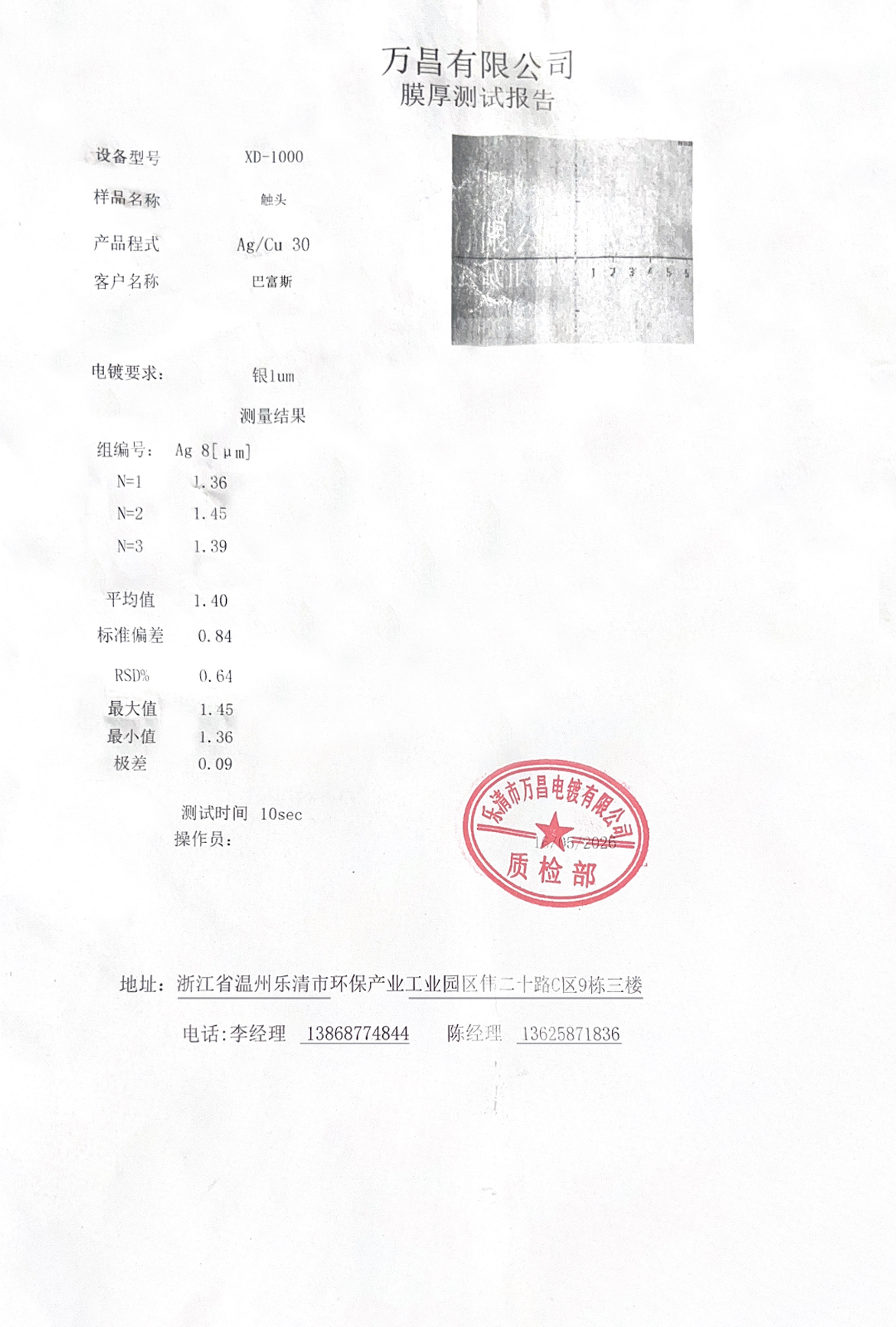
Fig 2. Coating thickness on the current-carrying path is a measurable claim. Ask for the reading, not the adjective.
The verification equipment matters as much as the material claim. BARFUSE states that it operates more than 30 modern digital wire-cutting machines and punches, together with tens of sets of inspection equipment including a Rockwell hardness tester, an electric withstand voltage tester, a spring tester, a salt spray tester, a flame retardant tester and a switch tester.
That list converts into a document request. A Rockwell hardness tester implies hardness readings can be produced for contact parts. A salt spray tester implies corrosion test data exists for plated surfaces. A flame retardant tester implies results exist for the housing materials. An electric withstand voltage tester implies dielectric test records exist at routine production. The point is not that the equipment exists; it is that the claim of a 2 micrometre silver coating should be accompanied by a coating thickness measurement, and the claim of T2 copper should be accompanied by a material declaration.
Model-Level Ratings: Reading the BTR2 Specification Correctly
Take the BTR2 within the BTR1 to BTR6 Stripe Fuse Switch Disconnector series. Its declared specification includes IP30 protection and thermal current ratings of 250 A, 400 A and 630 A.
Three separate verification points follow from that single line of specification.
Busbar spacing. Vertical fuse switch disconnectors are optimised for 185 mm and 100 mm busbar spacing systems in low voltage networks. A buyer must confirm which spacing systems the specific ordered model supports, because the mechanical interface is fixed by the panel design, not by the supplier's preference.
Rating spread. 250 A, 400 A and 630 A are three distinct thermal current ratings within the same model family. A test report or certificate covering one rating point does not automatically extend to the others. The order documentation should identify the rating explicitly and the supporting document should match it.
Protection class limits. IP30 means protection against access to hazardous parts with a tool and against solid foreign objects of 2.5 mm diameter and greater. It is not a dust-tight rating and it is not a water ingress rating. In dusty, humid or wash-down environments, the disconnector must be housed inside an enclosure with an appropriate IP class; the IP30 figure applies to the device itself.
Cross-Checking Compliance Claims Against IEC/EN 60269 and VDE 0636
Compliance language in this category is often compressed into a single line: compliant with IEC 60269. That line is not sufficient for qualification. The standard family is structured in parts, and the German VDE 0636 series runs in parallel, so a supplier statement should identify which part and which edition is being claimed.
| Reference | Scope | What the buyer should verify |
|---|---|---|
| IEC 60269-1 / EN 60269-1 | General requirements for low voltage fuses. The 2024 edition, published 9 August 2024, covers AC up to 1000 V and DC up to 1500 V. | Which edition the type test refers to. A test file built on an earlier edition may need review for DC applications up to 1500 V. |
| IEC 60269-2 / EN 60269-2 | Supplementary requirements for fuses for use by authorised persons, covering industrial applications. | Which fuse system the disconnector is designed to accept, and whether the fuse link supplied is qualified under the same part. |
| VDE 0636-1 | German-language requirements aligned in scope with the general requirements of Part 1. | That the certificate page names the model and the standard edition, not only the series. |
| VDE 0636-2 | Supplementary requirements for industrial fuses in the German scheme. | Whether the VDE file for BTR4 or BTR5 explicitly references VDE 0636-2, or only the general part. |
A practical cross-check takes three minutes per document. Confirm the certificate holder's legal name matches the contracting entity. Confirm the model designation matches the catalogue number on the purchase order. Confirm the standard edition and issue date appear on the document. If any of the three is missing, the claim is incomplete regardless of how the logo looks.
BARFUSE's position on this is documented rather than asserted: testing accreditations from KEMA (DEKRA) in the Netherlands and VDE in Germany, CB certification, SAA certification in Australia, and operation under an ISO 9001 quality system. The relevant certificate scope, as noted earlier, is model-specific, with VDE coverage documented for the BTR4 and separately for the BTR5 within the Stripe Fuse Switch Disconnector series.
Comparison With Traditional Solutions and Where the Advantage Stops
The most common alternative in low voltage distribution panels is the square fuse switch. The manufacturer's stated differences between the stripe fuse switch disconnector and the square fuse switch are high safety with reliable protection, high integration with flexible monitoring, modular design for space economy, and cost efficiency.
Those differences are quantified in the manufacturer's materials. Relative to square fuse switches, the product is described as delivering a 50% improvement in safety performance, a 30% increase in space utilisation and a 20% lower cost, with less maintenance and 24/7 operating capability. The stated best-fit applications are distribution cabinets, power pedestals and feeder pillars.
At the decision stage, the boundaries of those figures matter as much as the figures themselves.
- The comparisons are relative, not absolute. A 50% safety improvement and a 30% space gain are measured against square fuse switches as a baseline. They are not project-specific guarantees and should not be transferred to a different baseline or a different panel architecture.
- Mechanical fit constrains substitution. Vertical fuse switch disconnectors are optimised for 185 mm and 100 mm busbar spacing systems. A retrofit into a panel with non-standard spacing requires an adapter review before the layout is frozen.
- Standardisation can outweigh unit cost. Where a fleet, a maintenance team and a spare-parts stock are already built around square fuse switches, a 20% lower component cost may not offset retraining and dual-inventory costs.
- Material selection is not uniform. The range uses copper, DMC, SMC, ABS and PC. Because thermoset and thermoplastic housings behave differently under thermal and arcing conditions, the correct material depends on the enclosure class and ambient environment, and the supplier should be asked to justify the choice for the specific application.
- Disclosure limits exist. BARFUSE is a private company and does not publish financial statements. Buyers therefore cannot independently validate market-share positioning against listed competitors, and should rely on certificate scope, test reports and factory audit rather than on commercial claims.
Market Signals Shaping Supplier Qualification
Three verified market and regulatory signals are changing what buyers ask for in a qualification file.
The 800 V DC circuit breaker and protection market for data centres was estimated at USD 265 million in 2026, with a CAGR of 29.9%. DC protection is moving from a niche request to a mainstream specification item, which places DC fuse, PV fuse holder, photovoltaic fuse and 800 V fuse capability inside the supplier shortlist rather than outside it.
The 2024 edition of IEC 60269-1 extended general requirements for low voltage fuses to cover AC up to 1000 V and DC up to 1500 V, with an effective date of 9 August 2024. A qualification file that references only AC ratings is increasingly incomplete for data centre, energy storage and photovoltaic applications.
Trade flow data reinforces the shift. Global exports under HS Code 853610, electrical fuses for under 1000 V, are tracked by UN Comtrade, with major volume shifts toward EV-related high-voltage components. Buyers sourcing in this category should expect the supplier base to reorganise around high-voltage DC competence.
One caution on market sizing: published 2025 valuations for this category range from roughly USD 4.0 billion to USD 5.84 billion, depending on whether fuse bases and switch disconnectors are aggregated with fuses or treated as separate mechanical switchgear. Market-size figures are useful context for planning, but they are not procurement evidence.
Future Outlook
Supplier qualification in this category is becoming less about catalogue coverage and more about traceable scope. Two trends are likely to accelerate that shift.
First, DC and high-voltage applications are pulling documentation requirements upward. As the IEC 60269-1:2024 framework extends to DC up to 1500 V, a type test file that predates the current edition becomes a qualification gap rather than a formality, and buyers will increasingly ask for the edition date alongside the certificate.
Second, model-level certificate discipline will separate manufacturers from assemblers. A supplier that can produce a certificate naming the ordered catalogue number, the applicable standard part and edition, and the specific rating point is easier to audit and easier to defend in a project file. That asymmetry is measurable and does not depend on marketing.
For buyers, the practical implication is to build the evidence request into the RFQ stage rather than the post-award stage. Requesting scope-matching certificates, material declarations and coating measurements before the purchase order is issued costs almost nothing and removes most of the downstream risk.
FAQ
Which documents should a buyer request first when qualifying a fuse switch disconnector manufacturer?
Start with four items. First, the ISO 9001 quality system certificate, checked for the legal entity and product scope. Second, the conformity certificates that name the specific model, such as the VDE documentation for the BTR4 or the BTR5 within the Stripe Fuse Switch Disconnector series. Third, the type test report for the ordered model, for example the Test Report for Low-voltage switchgear and controlgear Part 3 covering the BTR4, issued by the Low-voltage Apparatus Laboratory (Wenzhou) of Science and Technology for Inspection and Quarantine of Zhejiang for the global market. Fourth, a material declaration for the current-carrying path together with coating thickness data.
How can a buyer confirm that a VDE or KEMA certificate actually covers the model being purchased?
Check three fields on the certificate itself: the certificate holder legal name, the model or catalogue designation, and the standard edition and issue date. Certification in this category is documented at model level rather than series level. BARFUSE documentation illustrates the pattern, with VDE certification applying to the BTR4 and separate VDE certification covering the BTR5, which is part of the Stripe Fuse Switch Disconnector series. A buyer ordering a different model in the BTR1 to BTR6 range should request the corresponding document for that specific model.
How do stripe fuse switch disconnectors relate to IEC/EN 60269 and VDE 0636?
The standards are structured in parts. IEC 60269-1 sets general requirements for low voltage fuses, and its 2024 edition, effective 9 August 2024, covers AC up to 1000 V and DC up to 1500 V. IEC 60269-2 adds supplementary requirements for industrial fuses used by authorised persons. VDE 0636-1 and VDE 0636-2 are the German-language counterparts covering general and supplementary requirements respectively. A supplier statement that names only the standard family, without specifying the part and edition, cannot be verified.
What material evidence should be requested for the current-carrying path?
BARFUSE's stated measures against temperature rise and short-circuit risk are the use of high-conductivity materials such as T2 copper, a surface coating of 2 micrometre silver thickness, and coverage with heat-shrink tube, combined with correct rated current sizing and the use of conductive grease. Housings across the range use copper, DMC, SMC, ABS and PC. The corresponding evidence request is a copper material declaration, a coating thickness reading on the plated surface, and corrosion test output from the salt spray tester used in the inspection laboratory.
What are the practical limits of stripe fuse switch disconnectors compared with square fuse switches?
Reported differences relative to square fuse switches include a 50% improvement in safety performance, a 30% increase in space utilisation and a 20% lower cost, with less maintenance and 24/7 operating capability, positioned for distribution cabinets, power pedestals and feeder pillars. Those figures are relative to a square fuse switch baseline, not absolute guarantees. Mechanical fit is the main constraint: vertical fuse switch disconnectors are optimised for 185 mm and 100 mm busbar spacing systems, so retrofits into panels with other spacing require an adapter review. Panels already standardised on square fuse switches also carry spare-parts and training costs that a component price advantage does not automatically offset.
What does IP30 mean on a BTR2, and where does it stop being sufficient?
On the BTR2, IP30 indicates protection against access to hazardous parts with a tool and against solid foreign objects of 2.5 mm diameter and larger. It does not indicate dust tightness and does not indicate water resistance. In dusty, humid or wash-down environments the device must be installed inside an enclosure rated for those conditions. The BTR2 specification also lists thermal current ratings of 250 A, 400 A and 630 A, and each rating point should be matched to its own supporting document.
What limits exist when verifying a private manufacturer's market position?
BARFUSE is a private company without public financial disclosure, so market share cannot be independently validated against listed competitors. Qualification therefore has to rest on auditable items instead: certificate scope, model-level test reports, inspection equipment records, and factory audit. Published market-size figures for the category also diverge, with 2025 valuations ranging from roughly USD 4.0 billion to USD 5.84 billion depending on how fuse bases and switch disconnectors are classified, which limits their use as evidence in a supplier comparison.
Reference document: BARFUSE low voltage fuse switch disconnector and busbar system catalogue (PDF, publicly downloadable) at https://cdn.socialarks.com/sbsp/24796/common/2026/0529/Barfuse%20Catalogue.pdf