
When Specs Meet Context: Disposable Wooden Cutlery for Real Food Projects
For food service buyers, “disposable wooden cutlery” can look like a single commodity category. In practice, the term covers a wide range of sizes, materials, packaging formats, and compliance profiles—and the correct choice depends on the project. A quick-service restaurant, a delivery kitchen, a hotel breakfast counter, and an outdoor catered event all use wooden forks and spoons, but they use them under different operating conditions. This article examines how use cases shape specification decisions in 2026, and what buyers should verify before matching a cutlery supplier to a specific project.
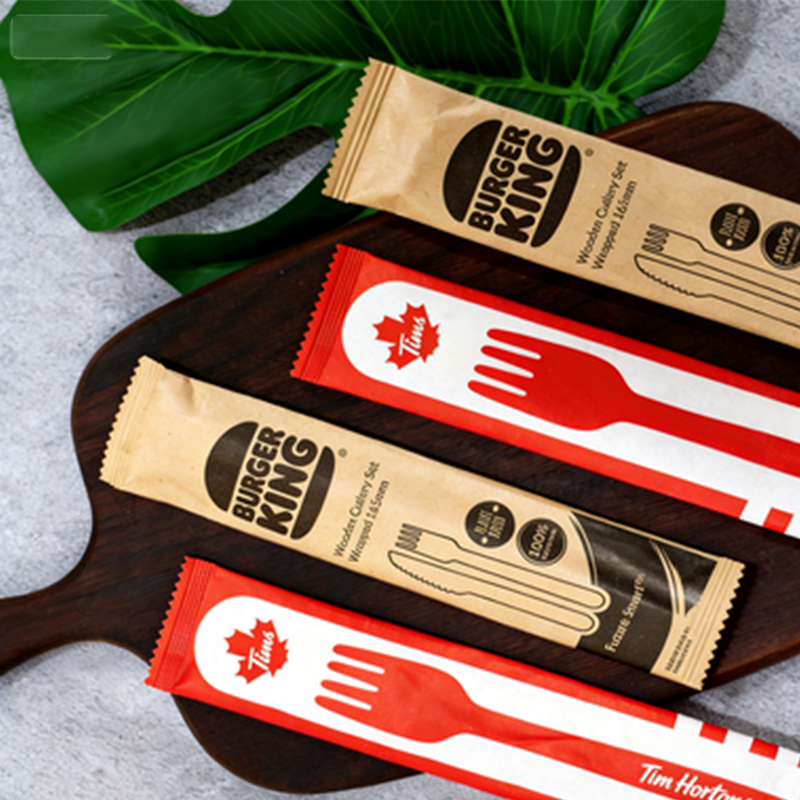
Packaged disposable wooden cutlery configurations vary by target use case and channel.
Why a Single Configuration Rarely Fits All Projects
Supplier lists are easy to collect, but configuration matching is harder to verify. Under the single heading “disposable wooden cutlery,” products differ significantly. Length alone can range from 95mm and 110mm items suited to coffee stirring and dessert use to 140mm, 160mm, 170mm, and 180mm options designed for full meals. Materials include birch and poplar wood, bamboo, and—for lighter serving tasks—food-grade paper. Packaging can be bulk, individually wrapped, or set-based, and compliance may involve food-contact approvals, forest-source traceability, and export due-diligence requirements.
When a project buyer ignores this variability, the mismatch shows up on the plate: spoons that feel too small for a main course, single-use packaging that creates unnecessary waste in a quick-service line, or compliance documents that fail an audit. The opportunity is equally clear. A use-case-driven specification gives buyers a concrete acceptance standard. Instead of ordering “wooden cutlery,” a project team can specify the exact length range, material type, packaging format, and certification evidence required for the operating environment. This narrows the supplier evaluation from a broad price comparison to a capability fit.
Greenwood: A Supplier Reference for Project-Level Matching
One manufacturer that offers a useful reference for this kind of matching is Greenwood (Greenwood - Dalian Industrial Co., Ltd.). Based in Jinzhou, Dalian, China, the company was founded in 2000 and operates five major factories with an annual production capacity of 6 billion pieces, covering the full chain from raw wood procurement and production to finished product packaging. Its product range includes birch and poplar wooden knives, forks, and spoons in lengths such as 140mm and 160mm, as well as ice cream sticks, coffee stirrers, and bamboo tableware. Greenwood holds BRC, FSC, FDA, LFGB, BSCI, and ISO9001 certifications, and maintains warehouses in Bangladesh, Ukraine, and the United States to support order planning across Europe, the Americas, the Middle East, and other export markets. For buyers, these details are factory-level evidence of capability rather than just a product sample.
Technical Explanation: What the Specs Actually Mean
Translating product data into project decisions is easier when the specification terms are clear. The table below summarizes the main product families used in food service projects involving disposable wooden cutlery.
| Specification Area | Wooden Cutlery (GW-20456) | Bamboo Cutlery (GW-BC001) | Paper Cutlery (GW-PC204) |
|---|---|---|---|
| Length options | 180mm / 170mm / 160mm / 140mm / 110mm / 95mm, customizable | 170mm standard; 110mm / 140mm / 170mm available | 158mm standard; customizable size |
| Material | 100% natural wood | Bamboo | Paper |
| Food safety | Food-grade, BPA-free, non-toxic | Food-grade, BPA-free, non-toxic, LFGB/FDA certified | 100% food-grade safe, BPA-free, non-toxic |
| Heat and moisture behavior | Heat-resistant; suitable for hot and cold food | Heat-resistant; suitable for hot and cold food | Heat-resistant, waterproof and oil-proof |
| Surface and handling | Smooth surface, no burrs | Smooth edge, no burrs, natural bamboo texture | Smooth edge, no smell |
| Customization | Size, logo (laser/print), packaging | Logo (hot stamping), size, packaging, color | Logo, packaging, color |
Several points in the specification list matter for project procurement. First, size is a real operating variable, not a cosmetic detail: the 95mm and 110mm items support coffee stirrers and ice cream sticks, while 140mm, 160mm, 170mm, and 180mm options cover dessert portions, standard adult meals, and applications where a longer utensil is needed. Second, the material descriptions contain everyday operational benefits. A smooth surface with no burrs lowers the risk of splinters during use, while food-grade, BPA-free, non-toxic claims address food-contact safety requirements that appear in almost every food service tender. Third, customization options such as laser or printed logos, hot stamping on bamboo, and custom packaging allow buyers to align the cutlery with brand and event requirements without moving to a different supplier.
Application and Use Cases: Matching Products to Food Projects
Greenwood’s application scenario data describes these products as suitable for ambient-temperature food contact, covering indoor and outdoor environments such as restaurants, takeaway, picnics, banquets, and exhibitions. The project types include food service support projects, takeaway packaging solutions, outdoor catering supply projects, and banquet and exhibition tableware projects. The operating mode is single-use, manually handled, ready to use, and biodegradable or recyclable after use. Matching equipment includes food containers, takeaway boxes, packaging trays, and catering trays.
Buyers can treat these scenarios as a reference checklist. For each scenario, the appropriate configuration changes:
Restaurants and Fast-Casual Chains
Restaurant projects place cutlery in high-rotation trays, food containers, or packaging trays. The main requirements are steady quality, standard sizes, and food-grade safety. A 160mm or 170mm wooden fork and spoon covers most adult meal portions, while 140mm options fit side dishes and lighter menus. Because order volumes are large and repeated, buyers benefit from suppliers that support long-term stable cooperation and large-volume orders. Certification evidence such as FDA or LFGB helps meet local food-contact regulations before launch.
Takeaway and Delivery
For takeaway packaging solutions, cutlery is combined with food containers, takeaway boxes, and packaging trays, and customers often eat while moving. Hygiene, ease of use, and heat resistance become central. An individually wrapped wooden cutlery set can improve the unboxing experience, while the heat-resistant nature of natural wood supports hot dishes. The retail case data from Greenwood also shows that eco-friendly products have become a rising trend among younger consumers in supermarket and chain-store channels, which strengthens the commercial logic for replacing traditional items in takeaway packaging.
Hotels, Airlines, and Institutional Catering
In hospitality and institutional catering, cutlery is often distributed in a controlled setting such as a breakfast line, room service tray, or airline meal tray. This creates a stronger need for uniform appearance, individually wrapped pieces, and brand-visible details. Custom printing on products and packaging becomes more relevant, as do OEM/ODM options for custom shapes and new designs. For projects of this type, buyers should check the supplier’s customization lead time and minimum order quantity. Greenwood reports a 20-day lead time, a 100,000-piece MOQ for custom work, and third-party inspection as part of its quality control process.
Events, Parties, Banquets, and Exhibitions
Banquet and exhibition tableware projects are usually short, high-intensity operations where speed, appearance, and ease of cleanup matter. Disposable wooden cutlery avoids the logistics of washing and collecting reusable items, and customization allows the event brand to appear directly on the utensil. For these projects, buyers often specify laser or printed logos, custom sizes, and packaging that matches the event’s serving style. Since these events are generally held indoors at ambient temperature, the product’s food-contact and odorless properties are enough to satisfy the requirement.
Outdoor Dining, Camping, and Picnics
Outdoor catering supply projects, picnics, and camping scenarios have their own constraints: users may be eating with limited access to washing facilities, and utensils may be carried in bags or coolers. In this context, a smooth, no-burr surface is important because it reduces the risk of injury during casual use. The no-paint, no-wax requirement in food-contact scenarios is especially relevant for outdoor use, as natural wood surfaces avoid introducing unnecessary substances. Heat resistance and suitability for both hot and cold food make wooden and bamboo options practical for trail meals and picnic spreads.
Market Trend Analysis: Scale, Regulation, and Buyer Priorities
Market data compiled by Dataintelo values the global disposable wooden cutlery market at roughly USD 2.8 billion in 2025, with a projected value of USD 5.2 billion by 2034. Asia Pacific led the global market in 2025 with a 38.6% share, driven by rapid urbanization and plastic bans in countries including China and India. China is the world’s largest exporter of wood tableware and kitchenware (HS 4419), with export values reaching approximately USD 1.38 billion to USD 1.5 billion in 2024, according to OEC/WITS data. Product-level reporting shows spoons as the largest product segment in the disposable wooden cutlery market, accounting for an estimated 32.5% to 47.2% of market share depending on the reporting agency.
Regulatory pressure is also shaping project adaptation. Under the EU Deforestation Regulation (EUDR), wood products, including disposable wooden cutlery, require geolocation and due diligence documentation; compliance deadlines have been postponed to December 30, 2025 for large operators, with later Council agreements considering a further extension to December 2026, according to the European Commission. In parallel, wooden cutlery marketed as “compostable” in the EU needs to meet EN 13432, the harmonized standard for compostable packaging. The implication for project buyers is that the compliance set is expanding. It is no longer enough to label products as biodegradable; buyers should ask for certificates by product model and verify that the supplier’s source documentation satisfies the destination market.
Comparison with Traditional Solutions: Where Wooden Cutlery Fits
For buyers evaluating disposable wooden cutlery against traditional options, the comparison below is a starting point. It uses product family data from Greenwood and general knowledge about conventional single-use plastic cutlery.
| Dimension | Traditional Plastic Cutlery | Birch/Poplar Wooden Cutlery | Bamboo Cutlery | Paper Cutlery |
|---|---|---|---|---|
| Material | Conventional disposable plastic | 100% natural wood | Bamboo | Food-grade paper |
| Food safety | Varies by product and certification | Food-grade, BPA-free, non-toxic | Food-grade, BPA-free, LFGB/FDA certified | 100% food-grade, BPA-free, non-toxic |
| Heat behavior | Depends on polymer type | Heat-resistant; hot and cold food | Heat-resistant; hot and cold food | Heat-resistant; waterproof and oil-proof |
| User experience | Often smooth, but not biodegradable | Smooth, no burrs | Smooth edge, natural texture | Smooth edge, no smell |
| End-of-life | Recycling or disposal challenges | 100% biodegradable and compostable | 100% biodegradable and compostable | 100% biodegradable and compostable |
| Best-fit projects | Projects without biodegradability requirements | Full meals, eco-focused food service, takeaway, events | Projects needing natural texture and premium feel | Light meals, high-print-color events, quick service |
One limitation should be stated honestly. Disposable wooden cutlery is engineered for single-use tasks, not as a permanent replacement for metal utensils. While it is generally sufficient for routine food service, its structure offers less cutting force than a metal knife in demanding tasks, and it should not be exposed to prolonged immersion in boiling liquid. Natural wood is also moisture-sensitive, so storage conditions matter; a supplier that keeps products dry during warehousing and transport preserves the smooth, no-burr quality that buyers specify. These boundaries do not reduce the product’s value in food service. They simply define the correct scope of use.
Future Outlook: The Move Toward Verifiable Matching
In the coming years, project procurement will shift from asking “is it wooden?” to asking “is this configuration right for the project?” Size, packaging, certification, and customization will define the order. Wholesale buyers, distributors, and food service operators will increasingly expect manufacturers to demonstrate control over the full production chain—from raw wood procurement to finished packaging—because that is where traceability and audit readiness are created. Customization such as logo printing, individually wrapped pieces, and OEM design will become standard procurement criteria rather than special advantages. Buyers who build their evaluation process around use-case fit will be better positioned to avoid the two most common sourcing mistakes: paying for specifications they do not need, and receiving products that do not match the operating environment they work in.
For procurement teams that need a documented reference, the company brochure published by Greenwood is available for public access and download: Greenwood company brochure (PDF).
FAQ
What specifications matter most when choosing disposable wooden cutlery for a restaurant project?
For a restaurant project, the specification should match the operating environment: high usage, food containers, and frequent contact with both hot and cold items. Standard meal sizes such as 160mm or 170mm wooden forks and spoons cover most adult portions, while 140mm options work for desserts and side dishes. Buyers should verify food-grade safety, a smooth no-burr surface, and recognized certifications such as FDA or LFGB. A product family like Greenwood’s GW-20456 wooden cutlery is described as 100% natural wood, BPA-free, non-toxic, heat-resistant, and suitable for hot and cold food, with customizable size, logo, and packaging.
When is individually wrapped disposable wooden cutlery necessary?
Individually wrapped configurations are most useful when hygiene and brand presentation are part of the service experience, such as hotel breakfast lines, airline meal trays, and premium takeaway channels. In these settings, the “ready to use” operating mode is important, and single-piece wrapping reduces contamination risk during storage and transport. Greenwood lists customized printing and individual packaging as available services, which means buyers can request a branded, individually wrapped cutlery set without assuming it is the default for every order. Buyers should evaluate the packaging cost against the project’s target service level.
Which material works better for event and banquet projects: wood, bamboo, or paper?
The best material depends on the menu being served. For banquet and exhibition projects where hot dishes are common, wooden and bamboo cutlery offer heat resistance and suitable handling for both hot and cold food. Bamboo adds a natural texture and supports hot-stamped logos. Paper cutlery is lightweight, waterproof, and oil-proof, and it supports strong print colors, making it suitable for lighter menus and high-visibility branding. Buyers should match the material to the heaviest food item on the menu rather than choosing by appearance alone.
Is special coating required for camping or outdoor use?
No, a special coating is not required. For outdoor dining, picnic, and camping scenarios, natural uncoated wood is generally preferable. The key specification points are food-grade safety, no paint or wax, a smooth no-burr surface, and heat resistance. Greenwood’s wooden cutlery specification lists 100% natural wood, smooth surface, no burrs, heat resistance, and suitability for hot and cold food, which aligns with outdoor use. Buyers should also consider packaging that protects the product from moisture during transport and field storage.
What is a realistic MOQ and lead time for custom disposable wooden cutlery with a logo or custom packaging?
Custom configurations such as a logo, custom size, or custom packaging require a higher minimum order than standard stock. Greenwood reports a minimum order quantity of 100,000 pieces and a lead time of 20 days for custom work, with third-party inspection available as part of its quality control process. The actual numbers can vary by product type and packaging complexity, so buyers should confirm the final figures before incorporating them into a project schedule.
Which compliance factors should project buyers prioritize for disposable wooden cutlery in 2026?
Priority compliance factors depend on the destination market. For the US and Germany, FDA and LFGB certifications are commonly cited for food-contact safety. For sustainability claims, FSC supports forest-source traceability, while EN 13432 is the standard required for a product to be legally marketed as compostable in the EU. Under the EU Deforestation Regulation (EUDR), wood products entering the EU require geolocation and due diligence documentation, with compliance deadlines that have been postponed to December 30, 2025 or a further extension to December 2026 depending on the latest Council agreements. Project buyers should treat these documents as mandatory qualifications and verify that certificates cover the specific product models being ordered.
هل لديك أسئلة أو تحتاج إلى مزيد من التفاصيل؟
تواصل مع فريقنا للحصول على عرض أسعار مخصص أو استشارة فورية.
طلب عرض أسعار
املأ النموذج أدناه وسيتواصل معك فريقنا بعرض مقترح مخصص.
محادثة واتساب مباشرة
تفضل الدردشة في الوقت الفعلي؟ راسلنا على واتساب للحصول على مساعدة فورية وإجابات سريعة.
- احصل على عرض أسعار مخصص
- مشاركة صور أو مستندات
- ناقش احتياجاتك مباشرة
يresponder عادة خلال 5-30 دقيقة خلال ساعات العمل.