
Which Cam Indexer Fits Your Rotary Table? DT vs BT Compared
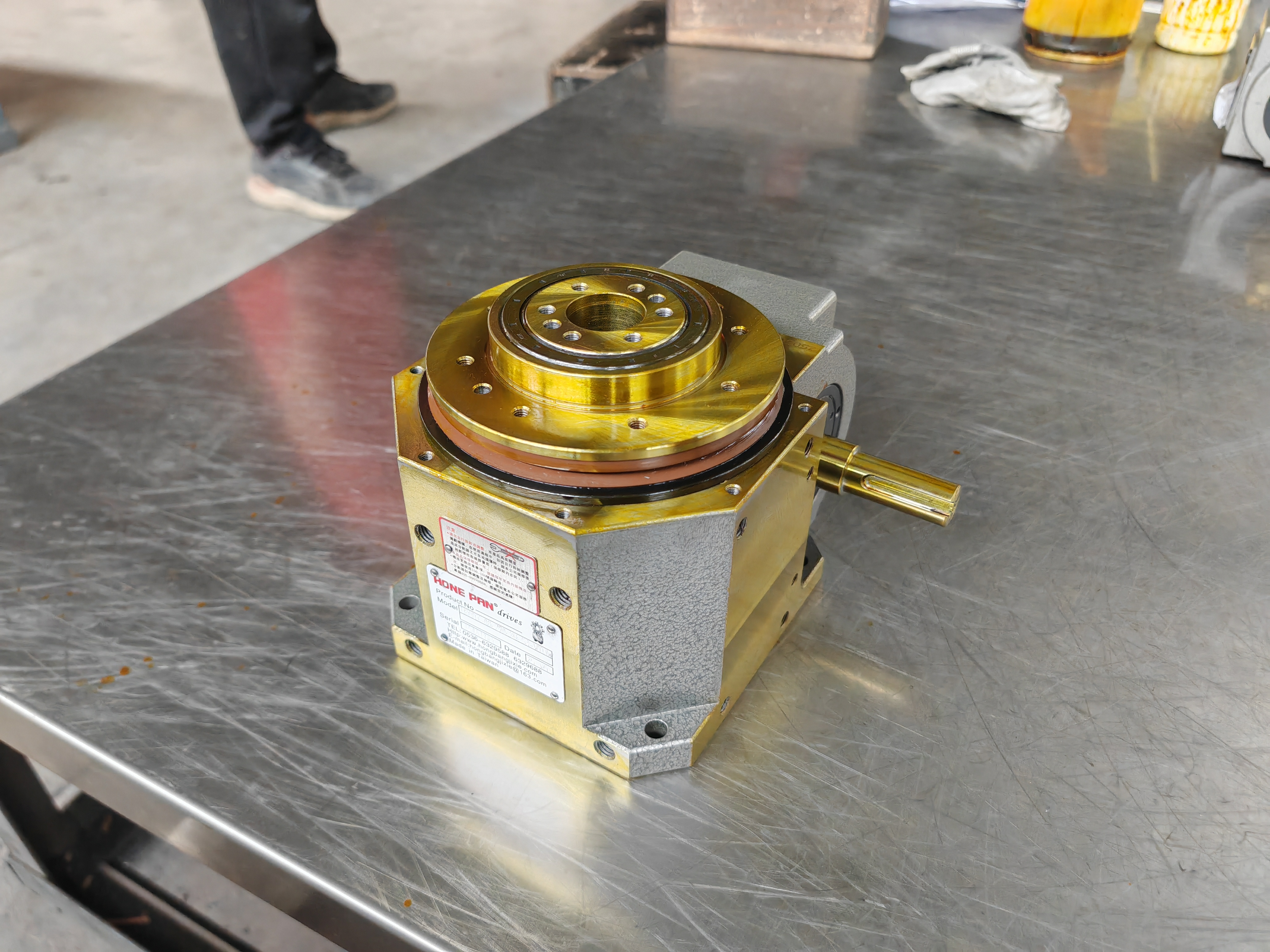
Table-output cam indexers mount the indexing table directly on the unit, which is why output architecture drives fixture design on turntable machines.
A cam indexer — also called a roller gear cam indexer, a cam divider, or a globoidal cam indexer — is a precision indexing unit and intermittent motion mechanism. It converts continuous motor rotation into a repeating sequence of index-and-dwell motion, so a fixture, a bottle, or a subassembly stops at a known position under a filling nozzle, a capping head, or an assembly gripper before the table advances to the next station.
For the engineers and buyers who specify rotary tables, the deciding question is rarely "which cam indexer is best." It is: which output architecture fits the table envelope, the load, and the motion recipe I am actually building? Among table-output designs, three families cover most turntable-driven filling, capping, and assembly work: the DT series (table output), the BT series (barrel cam heavy-duty table output), and the DA series (ultra-thin table output).
The short answer is this. The DT series supports indexing angles from 90° to 360° across 4–196 stations and is the natural starting point when station geometry or the machine cycle still has to stay flexible. The BT series is the barrel cam heavy-duty table output, aimed at higher-torque, high-speed filling and capping duty, and it works within a 180°–270° indexing-angle window. The DA ultra-thin table output covers the same 180°–270° indexing-angle window but is built for layouts where vertical height above the table is the binding constraint.
Output Style Comes Before Model Number
Cam indexer families are usually described by their output style, and that descriptor matters more than the model suffix. Shaft output, flange output, hollow flange, shaft-and-flange, parallel, cylinder-type, and table output all exist because different machines need to couple the indexing motion to the driven element in different ways.
Table output is the architecture where the indexing table is integral to the unit. The fixture plate is bolted directly onto the indexer's own table face, eliminating the separate table, bearing pack, and coupling that a shaft-output indexer would otherwise require. On a turntable-driven filling or capping machine this shortens the vertical stack, removes a bolted joint from the accuracy chain, and keeps repeat positioning error confined to a single assembly.
HONEPAN (Zhucheng HonePan Automation Machinery Plant), founded in 2007 and headquartered in Zhucheng City, Shandong Province, China, is a manufacturer specializing in the research, development, and manufacturing of cam indexers and CNC rotary tables. Its table-output range is organized into exactly these three lines — DT, BT, and DA — which is why the DT-versus-BT question comes up so often in turntable machine specifications.
The Real Problem: A Rotary Table Is a Motion Recipe, Not a Part
When a machine builder starts a filling or capping line, the rotary table is usually the last major component to be frozen — and the first to be blamed when throughput or positioning drifts. There are four interdependent variables, and they are all decided before a model number is chosen.
- Station count. The number of fixture positions determines how many operations can run in parallel, and therefore cycle time.
- Indexing angle versus dwell angle. Together they define how long the table moves and how long it stands still. Filling and capping need dwell; transfer needs index.
- Load and torque demanded at the table face. Tooling weight, product weight, and any overhung load all act on the same cam mechanism.
- Physical envelope. Height above the table, table diameter, and the space available under it.
Because these four variables interact, an indexer selection decision made on catalogue page count alone tends to produce either an oversized unit that wastes envelope or an undersized unit that forces the machine builder to slow the line. The documented indexing-angle and station ranges of each series are the fastest way to narrow the field before that happens.
DT Table Output: 90°–360° Indexing Angle, 4–196 Stations
The DT series is the table-output cam indexer with the widest documented motion window. Model designations in the DT series are 80DT, 110DT, 140DT, 180DT, 200DT, 210DT, 250DT, and 350DT. It belongs to the roller gear cam indexer category and is designed for intermittent motion mechanisms.
| DT series specification | Documented value |
|---|---|
| Model designations | 80DT, 110DT, 140DT, 180DT, 200DT, 210DT, 250DT, 350DT |
| Number of stations | 4–196 |
| Indexing angle | 90°–360° |
| Positioning accuracy | ±30" ±15" |
| Repeat positioning accuracy | ±10" ±5" |
| Construction materials | Carbon Steel; 42CrMo / SCM440 / 4140 / 4142; 40Cr / SCR440 / 5140; 20CrMnTi / SNCM220 / 8620; 18CrMoV |
The 90°–360° indexing-angle range is the commercially important number. A 90° index with a long dwell suits a machine that performs several operations at one station, because the table spends most of the cycle standing still. A 360° index means the table returns to the same mechanical position every cycle, which is useful when tooling or a sensor has to be referenced to a home position each revolution. Because DT spans the whole range from 90° to 360°, the same series can serve both machine concepts without a change of family.
DT's documented application list runs across automatic filling machines, high-speed filling lines, gravimetric fillers, aseptic filling systems, pharmaceutical liquid fillers, cosmetic tube filling machines, disinfectant filling equipment, filling and capping machines, labeling and filling lines, sealing-filling combos, food processing and fruit/vegetable machinery, cosmetics and daily chemical machinery, and stationery, pen-making and printing machinery.
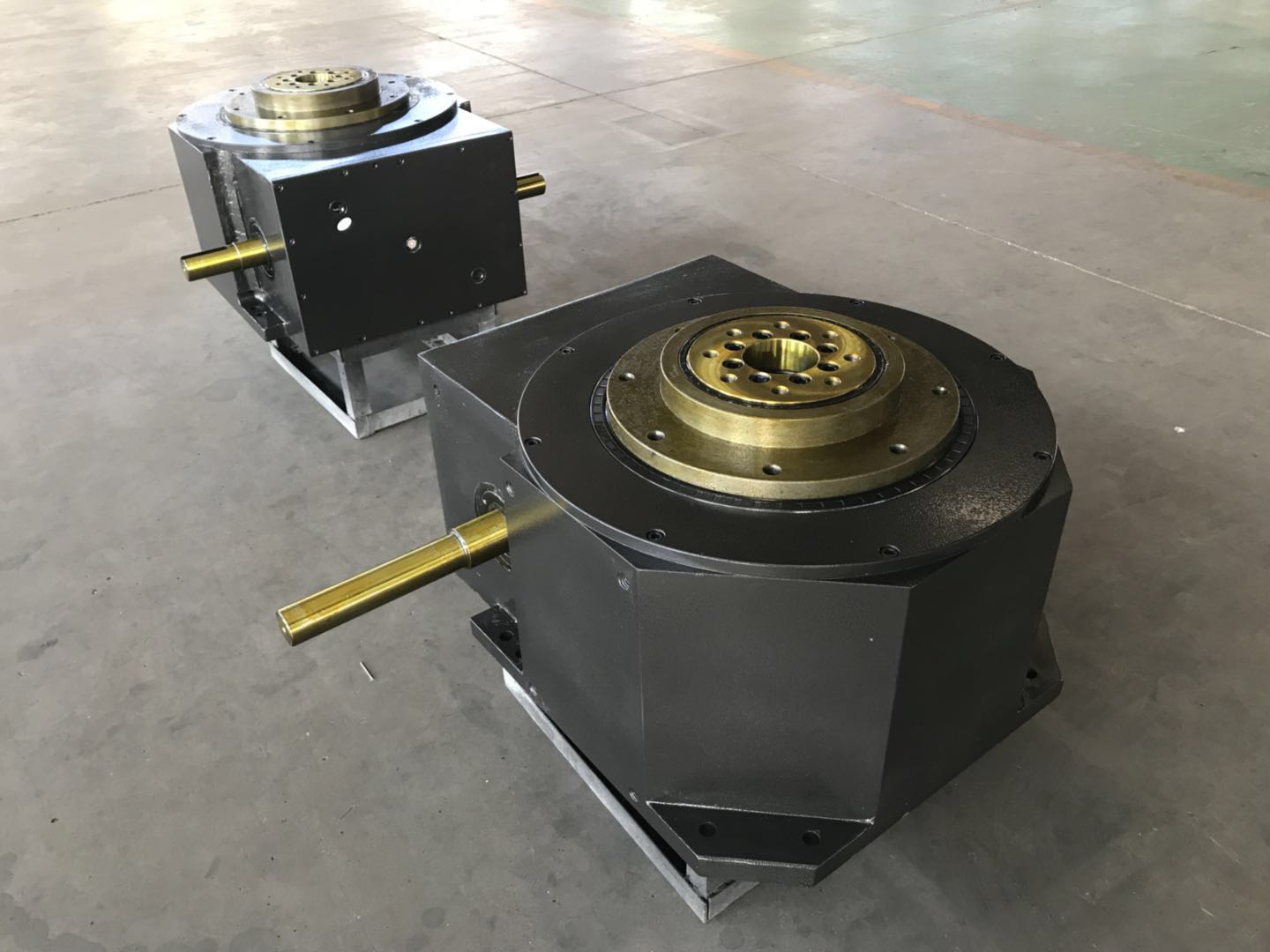
The BT series uses a barrel cam heavy-duty table output architecture, aimed at filling and capping duty where table loads are higher.
BT Barrel Cam Heavy-Duty Table Output: 180°–270° Indexing Angle
The BT series is the heavy-duty member of the table-output group. Its full designation is Cam Indexer Barrel Cam Heavy-Duty Table Output (BT), and its documented model designations are 130BT, 150BT, 160BT, 180BT, 225BT, 300BT, and 500BT.
| BT series specification | Documented value |
|---|---|
| Model designations | 130BT, 150BT, 160BT, 180BT, 225BT, 300BT, 500BT |
| Number of stations | 4–196 |
| Indexing angle | 180°–270° |
| Positioning accuracy | ±30" ±15" |
| Repeat positioning accuracy | ±10" ±5" |
| Construction materials | Carbon Steel; 42CrMo / SCM440 / 4140 / 4142; 40Cr / SCR440 / 5140; 20CrMnTi / SNCM220 / 8620; 18CrMoV |
The BT application list explicitly covers liquid filling machines, paste filling machines, powder filling machines, granule filling machines, sauce fillers, beverage fillers, edible oil filling machines, bottled water production lines, automatic filling machines, high-speed filling lines, gravimetric fillers, aseptic filling systems, pharmaceutical liquid fillers, cosmetic tube filling machines, disinfectant filling equipment, filling and capping machines, labeling and filling lines, sealing-filling combos, food processing and fruit/vegetable machinery, and cosmetics and daily chemical machinery.
It is worth being precise here, because the DT and BT application lists overlap substantially. Both are documented for filling, capping, food processing, and daily-chemical machinery. The real distinction is mechanical: BT is a barrel cam heavy-duty table output, and its indexing-angle window is deliberately narrower at 180°–270° than DT's 90°–360°. A designer who needs a 90° index with an extended dwell cannot get there with BT; a designer who needs a heavy table output for paste, powder, or granule filling within the 180°–270° window has BT as the documented option.
DA Ultra-Thin Table Output: When Height Is the Binding Constraint
The DA series, formally the Cam Indexer Ultra-thin Table Output (DA), exists for a different kind of constraint. Its model designations are 70DA, 90DA, 110DA, 150DA, 190DA, 230DA, 330DA, and 450DA. Like BT, it carries a documented indexing angle range of 180°–270° with 4–196 stations, a positioning accuracy of ±30" ±15", and a repeat positioning accuracy of ±10" ±5".
The design intent is envelope, not torque class. On a filling and capping machine where the nozzle, the capping head, or a vision camera sits above the table, every millimetre of table stack height is a millimetre taken away from the working gap. An ultra-thin table output reduces that stack, which can remove the need to raise the whole upper tooling assembly. The documented DA application list is concentrated on liquid, paste, powder, granule and sauce filling, beverage and edible oil filling, bottled water lines, automatic and high-speed filling lines, gravimetric and aseptic filling, pharmaceutical liquid filling, cosmetic tube filling, disinfectant filling, filling and capping machines, labeling and filling lines, sealing-filling combos, food processing and fruit/vegetable machinery, cosmetics and daily chemical machinery, and stationery, pen-making and printing machinery.
Ultra-thin is a trade-off, not a free upgrade. Where a process needs the widest possible angle flexibility, DT's 90°–360° range remains the broader option; where the process fits inside 180°–270° and height is scarce, DA solves the problem that DT and BT cannot.
DT vs BT vs DA: Side-by-Side Comparison
| Parameter | DT (Table Output) | BT (Barrel Cam Heavy-Duty Table Output) | DA (Ultra-thin Table Output) |
|---|---|---|---|
| Model designations | 80DT, 110DT, 140DT, 180DT, 200DT, 210DT, 250DT, 350DT | 130BT, 150BT, 160BT, 180BT, 225BT, 300BT, 500BT | 70DA, 90DA, 110DA, 150DA, 190DA, 230DA, 330DA, 450DA |
| Indexing angle | 90°–360° | 180°–270° | 180°–270° |
| Number of stations | 4–196 | 4–196 | 4–196 |
| Positioning accuracy | ±30" ±15" | ±30" ±15" | ±30" ±15" |
| Repeat positioning accuracy | ±10" ±5" | ±10" ±5" | ±10" ±5" |
| Primary design intent | Motion flexibility | Heavy-duty table load | Minimum stack height |
| Best fit when | The cycle may need a short index or a full revolution | The table carries heavier filling or capping tooling | Upper tooling clearance is scarce |
| Material family | Carbon Steel; 42CrMo / SCM440 / 4140 / 4142; 40Cr / SCR440 / 5140; 20CrMnTi / SNCM220 / 8620; 18CrMoV | ||
Reading the table correctly: the three series share the same documented positioning and repeat positioning accuracy figures and the same 4–196 station range. They are not separated by precision class. They are separated by indexing-angle window, load intent, and physical envelope — which is exactly why the selection decision belongs in the machine layout stage, not in a last-minute procurement substitution.
Mapping Series to Machine Type
The following mapping follows the documented application lists of each series rather than a preference for one family over another.
| Machine / process | Documented series fit | Why |
|---|---|---|
| Turntable filling and capping machines | DT, BT, DA | All three are documented for filling and capping machines and labeling and filling lines |
| Paste, powder, granule and sauce filling | BT | Named explicitly in the BT application list |
| Beverage, edible oil, bottled water lines | BT, DA | Named explicitly in the BT and DA application lists |
| Gravimetric and aseptic filling systems | DT, BT, DA | Listed across all three series |
| Pharmaceutical liquid filling, cosmetic tube filling | DT, BT, DA | Listed across all three series |
| Printing, pen-making and stationery machinery | DT, DA | Named in the DT and DA application lists |
| Automated assembly line drives | DT, BT, DA | Assembly-line indexing is a documented intermittent-motion application |
One documented application detail is worth carrying into a specification. In pharmaceutical and medical packaging machinery — including oral liquid filling machines, eye drops filling machines, capsule filling machines, pharmaceutical cartoning machines, syringe assembly, printing and fitting machines, indwelling needle assembly machines, glass bottle ink printing machines, and capsule making machines — the working conditions are described as heavy load, food grade, and high speed, with special requirements including explosion-proof and leak-proof capability. Those are environmental requirements that sit on top of the indexer selection, and they should be raised at the same time as the DT-versus-BT decision, not afterward.
Five Criteria That Actually Decide the Model
Once the family is narrowed, the model within the family is decided by measurement rather than preference.
1. Indexing angle and dwell
Write the required index angle and dwell angle down before opening a catalogue. If the required index angle is below 180°, the BT and DA windows are already excluded and DT is the only table-output option in this group.
2. Station count
All three series document a 4–196 station range, which is wide enough that station count rarely eliminates a family. It does, however, drive table diameter and therefore the physical size of the unit.
3. Table load and torque demand
Tooling weight plus product weight plus any overhung load determines whether the standard table output is adequate or whether the barrel cam heavy-duty architecture of BT is the appropriate documented choice.
4. Accuracy class versus measurement method
DT, BT and DA all document positioning accuracy of ±30" ±15" and repeat positioning accuracy of ±10" ±5". Buyers should confirm how accuracy is measured and at what table radius, because angular accuracy stated at the cam and angular accuracy measured at the fixture are different quantities.
5. Envelope and surrounding equipment
Height above the table decides whether DA is worth considering. The installation environment also matters: a cam indexer requires supporting equipment such as a motor, a reducer, an induction cam, and an induction switch, and those components occupy space around the unit. In one documented application scenario the unit operates in a 270/90 mode with matched equipment consisting of motor, reducer, induction cam and induction switch. Envelope planning should include them from the start.
Market Context: Why Rotary Indexing Demand Keeps Broadening
Cam indexer selection has become a more frequent engineering decision because the underlying category keeps expanding. The rotary indexer market is projected to grow from USD 1.812 billion in 2025 to USD 2.904 billion by 2035, at a CAGR of 4.83%, according to Market Research Future. Within that broader category, the global globoidal cam indexer segment was valued at approximately USD 490 million in 2024, according to Vertex AI Search quoting industry analysis.
Growth is geographically uneven. Asia-Pacific is described as the largest and fastest-growing region for rotary indexers, driven by investments in automotive and electronics manufacturing, according to the Rotary Indexer Market Report 2035. That matters to buyers for a practical reason: the same regional manufacturing investment that expands demand for automated rotary tables also expands the supplier base available to fill it, which raises the importance of specification discipline over brand shorthand.
The competitive structure is unevenly distributed as well. Sankyo Seisakusho Co., Ltd. is estimated to hold approximately 22% of the global rotary indexer industry, according to Future Market Insights (2025). A category where one established supplier holds roughly a fifth of the market, and the remainder is spread across regional manufacturers, is a category where a buyer's own selection criteria carry more weight than a supplier's scale alone.
Compliance expectations are also converging. Industrial cam indexers commonly fall under ISO 9001 for quality management, while global safety for integrated manufacturing systems follows ISO 11161. HONEPAN was among the first in the industry to obtain ISO 9001 quality management system certification and holds over 40 product patents — documented credentials that a buyer can verify independently rather than accept as a claim.
Where Mechanical Cam Indexing Stops Being the Answer
Mechanical cam indexing has a boundary, and it is worth stating plainly before a specification is signed off.
The motion profile of a cam indexer is set by the cam itself. The indexing angle, the dwell, and the number of stations are mechanical properties of the unit, not software parameters. If a filling or assembly recipe changes frequently — for example, moving between a 12-station and a 24-station layout, or switching between a short index and a full revolution on the same machine — a programmable rotary indexing solution may be the more appropriate architecture, because the change is made in the control system rather than by changing the cam mechanism.
The consequence for this comparison is specific. DT's 90°–360° range is broader than BT's or DA's 180°–270° range, so DT absorbs more motion variation within one hardware family. But even DT cannot be reprogrammed after installation to a different indexing angle. Buyers who expect future recipe flexibility should either purchase margin in the motion range up front or select a different motion architecture entirely.
A second boundary concerns the ultra-thin option. DA solves a height problem, and like any envelope-driven design decision it should be validated against the actual tooling stack, the nozzle travel, and the load case rather than adopted solely because it is thinner.
What Comes Next for Turntable Machine Design
Three directions are visible without speculation. First, as filling and capping lines continue to move toward higher speed and heavier load conditions, the heavy-duty table-output segment is likely to keep its role as the default specification for paste, powder, and granule applications. Second, equipment density will keep pushing envelope-driven choices upward in importance, which is the design space the ultra-thin table output addresses. Third, procurement scrutiny of supplier credentials — quality management certification, patent portfolios, and manufacturing scale — is unlikely to loosen, given how fragmented the supply base remains.
For design and procurement engineers, the practical consequence is that the DT-versus-BT decision should be documented at the layout stage with the indexing angle, station count, load case, and envelope written down. HONEPAN manufactures cam indexers across the DT, BT, and DA table-output families from three facilities — Zhucheng City in Shandong Province and Kunshan City in Jiangsu Province — totaling 101,000 m² of factory area, with more than 90 CNC machining centers, a 15-engineer R&D team, and an annual production capacity of 36,000 units. Export business accounts for approximately 30% of total sales, with major markets including India, the USA, Southeast Asia, Latin America, and Europe.
FAQ
What is a cam indexer and what does it do on a rotary table?
A cam indexer — also known as a roller gear cam indexer, cam divider, or cam driven system — is a precision indexing unit and intermittent motion mechanism. It converts continuous motor rotation into repeating index-and-dwell motion. On a rotary table it positions the table precisely at each station and holds it stationary during the dwell, so that filling, capping, inspection, or assembly operations can be performed at a known location.
What is the difference between DT table output and BT heavy-duty table output?
Both are table-output cam indexers in which the indexing table is integral to the unit. The DT series is a roller gear cam indexer with a documented indexing angle range of 90°–360°. The BT series is designated Cam Indexer Barrel Cam Heavy-Duty Table Output, with a documented indexing angle range of 180°–270°. The principal practical difference is therefore the motion window and the heavy-duty load intent of the barrel cam architecture.
What indexing angles do the DT and BT series support?
The DT series supports indexing angles from 90° to 360°. The BT series supports indexing angles from 180° to 270°. The DA ultra-thin table output also supports 180° to 270°. A machine requiring an index angle below 180° falls outside the BT and DA windows and inside the DT window.
How many stations can a DT, BT, or DA cam indexer have?
All three table-output series document a number-of-stations range of 4 to 196. Station count therefore rarely eliminates a family on its own; it primarily affects table diameter and the physical dimensions of the unit rather than which series is appropriate.
When should the DA ultra-thin table output be chosen instead of DT or BT?
The DA series should be considered when vertical height above the table is the binding constraint in a machine layout — for example where a capping head, filling nozzle, or inspection camera needs clearance and the table stack is consuming it. DA documents the same 4–196 station range and the same ±30" ±15" positioning accuracy and ±10" ±5" repeat positioning accuracy as DT and BT, but its indexing-angle window is 180°–270°, narrower than the DT series.
What equipment does a cam indexer need in order to operate?
A cam indexer requires supporting equipment including a motor, a reducer, an induction cam, and an induction switch. One documented application scenario in pharmaceutical and medical packaging machinery operates in a 270/90 mode with matched equipment consisting of motor, reducer, induction cam, and induction switch, under heavy load, food grade, and high speed conditions, with special requirements including explosion-proof and leak-proof capability.
What positioning accuracy can these table-output series achieve?
The DT, BT, and DA series each document a positioning accuracy of ±30" ±15" and a repeat positioning accuracy of ±10" ±5". Because angular accuracy values depend on the measurement radius and method, buyers should confirm the measurement convention with the supplier before treating the figures as comparable between designs.
What materials are used in these cam indexers?
The documented material family across the DT, BT, and DA table-output series is Carbon Steel together with alloy grades 42CrMo / SCM440 / 4140 / 4142, 40Cr / SCR440 / 5140, 20CrMnTi / SNCM220 / 8620, and 18CrMoV.
References and Further Reading
Market sizing: Market Research Future (rotary indexer market, 2025–2035, CAGR 4.83%); Vertex AI Search quoting industry analysis (globoidal cam indexer segment, 2024). Regional data: Rotary Indexer Market Report 2035. Competitive structure: Future Market Insights (2025). Standards: ISO 9001 (quality management), ISO 11161 (safety of machinery — integrated manufacturing systems). Product and company data: HONEPAN (Zhucheng HonePan Automation Machinery Plant) product and application documentation.
HONEPAN product brochure (PDF): https://cdn.socialarks.com/sbsp/24754/0/2026/0412/69daef610eb1f.pdf