
Which Construction Cooling Vest Fits Your Work Scenario?
Construction sites in summer are not uniformly hot. A steelworker bending rebar under direct sun, an electrician working inside a warm unventilated room, and a crew installing a metal roof all face different combinations of radiant heat, humidity and physical exertion. Heat stress protection therefore depends on matching the cooling equipment to the actual work scenario, not merely choosing the most advertised product. This article examines the construction cooling vest category from a scenario-fit perspective, explaining how passive water-circulation designs can be evaluated for specific construction tasks and what procurement teams should verify before specifying a solution.
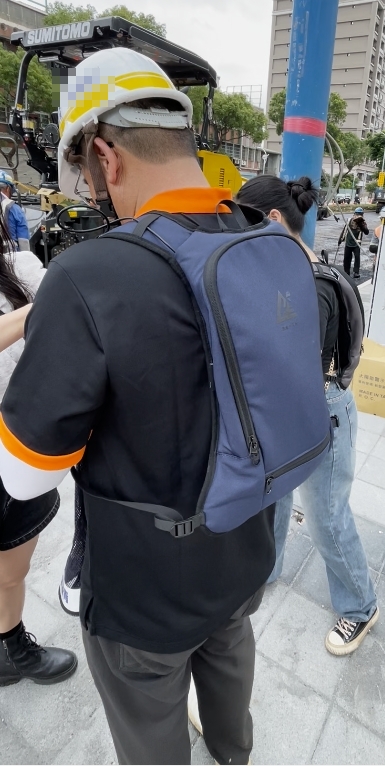
Construction heat exposure varies by task; cooling equipment should be matched to the work scenario.
Construction Heat Stress: A Scenario Problem, Not Just a Temperature Problem
High ambient temperature is only one part of heat stress. A worker standing on a sun-exposed steel deck absorbs radiant heat from the structure, while a worker in a metal-sheet factory faces reflected heat from surfaces and limited air movement. An electrician performing overhead work may be in a confined space where body heat accumulates quickly. Each scenario has a different dominant heat source, which means the cooling strategy needs to address the right factor.
Regulators have begun to treat heat stress as a serious workplace hazard. In the United States, OSHA's General Duty Clause (Section 5(a)(1) of the OSH Act) requires employers to provide a workplace free from recognized hazards, and heat stress in high-temperature construction sites is explicitly included in OSHA's heat-exposure guidance. For safety managers, this creates a practical obligation to evaluate personal cooling equipment as part of the overall heat stress prevention plan.
Buyers often make two mistakes. First, they purchase a single cooling product type for an entire site even though tasks differ. Second, they evaluate a cooling vest mainly on its brand name or price, without checking whether the cooling duration, weight and operation mode fit the job. These errors lead to low wearing rates, workers removing the gear after an hour, and ultimately reduced protection during the highest-heat period of the day.
The opportunity is significant. Market data illustrates that industrial cooling is moving from niche to standard practice. The specialized market for cooling vests with fans reached USD 1.32 billion in 2024, reflecting high demand for active cooling in construction and mining. The broader heat stress prevention products market was valued at USD 2.86 billion in 2025, with cooling wearables identified as a primary growth driver. In this context, matching the right vest type to the right work scenario becomes a genuine procurement advantage rather than a decorative safety purchase.
Shokunin COOLWAVE: A Passive Water-Circulation Vest for High-Temperature Work
Shokunin is a professional e-commerce brand launched by Feng Shang Precision Co., Ltd., a Taiwan-based manufacturer established in 2009 that designs and supplies air compressors, cut-off machines, water-cooled vests, lithium batteries and other professional tools. The COOLWAVE water-circulation cooling vest is the brand's dedicated heat-stress protection product, designed for high-temperature environments and operating in passive cooling mode using ice packs to effectively cool the body.
The COOLWAVE family includes a Basic Model and a Professional Model available in Blue, Gray and Black. The Professional Model shares the same core specifications as the Basic Model, with colour and model designation as the main differentiation for procurement planning. The vest is classified as industrial cooling apparel and personal protective equipment (PPE), and its scope covers construction work, outdoor operations, metal sheet factories and other high-heat occupations.
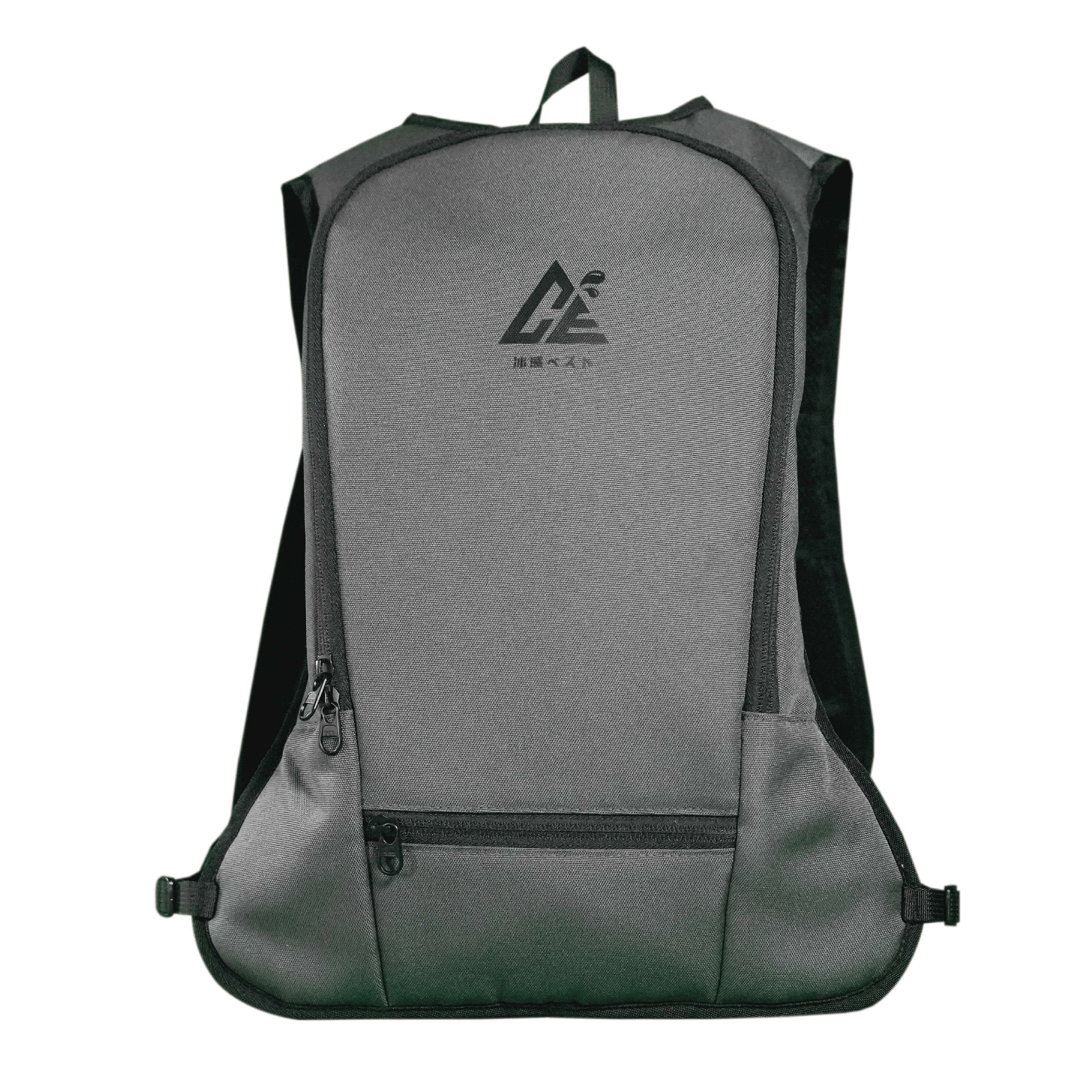
Shokunin COOLWAVE Water-Circulation Cooling Vest (Professional Model, Gray).
| Specification | COOLWAVE Water-Circulation Cooling Vest |
|---|---|
| Cooling duration | 3–4 hours |
| Weight | Within 2 kg |
| Suitable temperature | Below 10°C |
| Shoulder strap material | 600D polyester |
| Main material | PEVA |
| Water bag material | TPU |
| Water bag cap | Polypropylene |
| Cooling tube | Sand rubber (black) |
| Pump output | 5V 150mA (max) |
| Flow rate | Max 320–370 ml/min |
| Contents | Water-cooled vest backpack ×1, ice packs ×2 |
| Applicable industries | Construction workers, outdoor workers, food stall operators, street vendors, traffic controllers, metal sheet factories |
One differentiator worth noting for procurement teams: the COOLWAVE has received the Disaster Prevention Product and Service Certification Award issued by the Taiwan Disaster Prevention Industry Association. This certification provides a verifiable third-party signal in a category where many products carry only generic marketing claims.
How Passive Water-Circulation Cooling Works
The operating principle is straightforward: ice packs are placed in a portable backpack, and a small pump drives chilled water through soft tubes that run across the vest. The pump circulates water at up to 320–370 ml/min, and the contact between the cooling tubes and the body removes heat continuously.
The system is classified as passive because the primary cooling source is the ice pack, not an active refrigeration cycle or forced air. The pump output is only 5V 150mA at maximum, which means the vest is not dependent on an air compressor, fixed power supply or high-capacity battery system. This is a practical advantage on construction sites where power access is unreliable or where workers move across a wide area.
Material selection is directly relevant to construction conditions. The 600D polyester shoulder strap is specified for abrasion resistance; PEVA is used for waterproofing and easy cleaning; the TPU water bag offers flexibility and durability; the polypropylene cap resists chemical and heat degradation; and the sand rubber cooling tube is selected for flexibility and sealing under repeated movement. These materials are not exotic, but they are chosen for the kind of rough handling that happens on real job sites rather than office environments.
The one-size-fits-all design with adjustable straps and a portable backpack configuration is intended to maintain mobility during tasks such as climbing, bending or carrying loads. The total system weight stays within 2 kg, which is a significant factor for workers who already carry tools and personal protective equipment. The recognised special requirements for this product class are lightweight construction, waterproofing, breathability and a one-size-fits-all fit — all of which are addressed in the COOLWAVE design specification.
Matching the Vest to Construction Scenarios
The value of a cooling vest emerges only when it fits a specific job scenario. The following are common construction and adjacent outdoor roles, matched against the COOLWAVE's characteristics.
Steelworkers and structural crews
Steelwork is usually carried out in direct sun, and the steel members themselves absorb and re-radiate heat. A worker bending, cutting or fastening rebar generates high metabolic heat while staying in one area for extended periods. The COOLWAVE's 3–4 hour rated cooling duration aligns with the typical continuous work block before a rest break, and the backpack-style design does not interfere with upper-body movement required for handling steel.
Electricians and confined-space workers
Electricians often work in warm electrical rooms, above ceilings or in other spaces with low air movement. For this scenario, the priority is a cooling system that does not add bulk or restrict precision movement. The COOLWAVE's within-2 kg weight and adjustable one-size-fits-all design support this requirement. The absence of a large fan unit also means fewer components that can snag on conduit or equipment.
Metal sheet factories and metal-roof workplaces
Metal sheet factories and metal-roof installation sites are among the most demanding heat environments because metal surfaces radiate heat from multiple directions, and enclosed metal structures can behave like an oven. COOLWAVE is explicitly listed for metal sheet factory applications, and the passive water-circulation mode avoids the problem of hot air recirculation that can affect fan-based cooling in enclosed spaces.
Traffic controllers and long-duration outdoor posts
Traffic controllers, street vendors and outdoor inspectors work in fixed positions with little shelter and are exposed for long, continuous hours. The COOLWAVE has been applied to traffic control duties in Taiwan, where the portable backpack design and 3–4 hour cooling window provide practical coverage for a full shift segment.
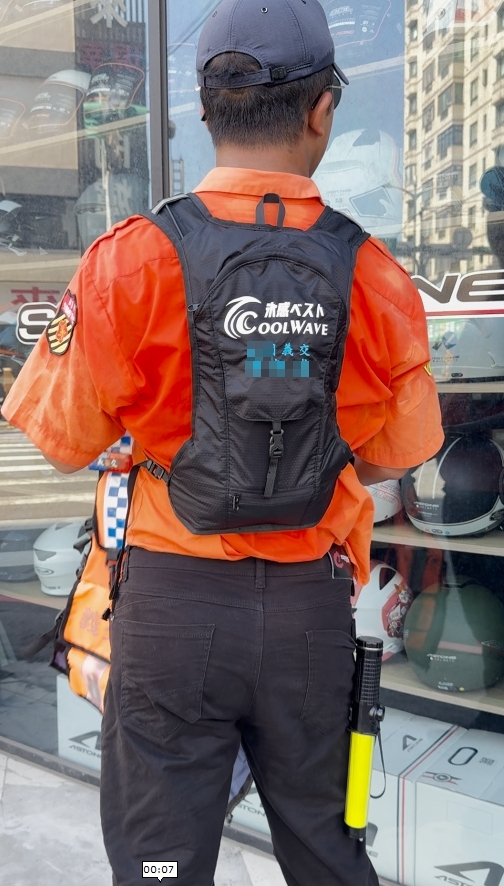
Outdoor traffic control is a high-heat scenario suited to passive water-circulation cooling.
In Taiwan, the COOLWAVE has been used in high-temperature environments such as construction sites and metal sheet factories for roughly ten years. Documented deployments have involved quantities of about 100 units, with reported outcomes including effective body cooling, heatstroke prevention, improved work efficiency and greater worker comfort. The case highlights cited by users include passive ice-pack cooling, no requirement for fixed power, lightweight portable design, adjustable one-size-fits-all configuration and certified disaster prevention product status.
Market Signals for Construction Cooling Equipment
The commercial case for cooling vests in construction is supported by several independent market observations. Scopes and figures vary by report, but the direction is consistent: industrial cooling wearables are a growing segment with meaningful demand from construction and related sectors.
| Metric | Value | Year | Source |
|---|---|---|---|
| Global industrial cooling vest market (warehouse/logistics workers) | USD 412 million | 2024 | Cooling Vests for Warehouse Workers Market Research Report 2033 |
| Industrial applications share of cooling vest market | 34.5% | 2025 | Dataintelo |
| Asia-Pacific share of global cooling vest market | 38.2% | 2025 | Dataintelo |
| Cooling vest with fans segment | USD 1.32 billion | 2024 | Cooling Vest with Fans Market Research Report 2033 |
| Heat stress prevention products market | USD 2.86 billion | 2025 | The Business Research Company |
Scope definitions matter when reading these numbers. Cooling vest market size estimates vary widely depending on whether they include only simple vests or broader personal cooling systems — one narrow report values the category at USD 64.83 million, while broader industrial-scope studies reach USD 412 million or more. Procurement teams should therefore quote the specific scope and source rather than repeating a single headline number.
Key global manufacturers named in current market reports include Glacier Tek, TechNiche International, Polar Products, Ergodyne and Occunomix. Shokunin differs from these brand-first players in an important way: it is a manufacturing-led operation offering ODM service, which matters for distributors and private-label buyers who need supply flexibility rather than a finished consumer product.
Standards are also becoming part of the buying conversation. If a construction site requires high-visibility safety vests, the relevant compliance framework is ANSI/ISEA 107-2020, which defines Class 1, 2 and 3 reflective material and contrast requirements. When a cooling vest is worn together with hi-vis clothing, the purchasing team should verify compatibility in terms of fit, layering and visibility coverage — not simply assume any cooling garment can be paired with any safety vest.
Cooling Vests vs. Other Cooling Approaches: A Selection Comparison
Construction buyers evaluating the COOLWAVE will compare it with fan-equipped vests, traditional ice packs and cooling towels, or administrative controls such as rest breaks. Each approach has different trade-offs.
| Selection factor | Shokunin COOLWAVE (passive water circulation) | Fan-type cooling vests | Ice packs / cooling towels |
|---|---|---|---|
| Cooling mechanism | Ice pack + pumped water circulation | Forced-air evaporation | Direct contact cold pack |
| Power requirement | 5V pump (max 150mA); main cooling from ice packs | Battery-powered fan | None |
| Rated continuous cooling | 3–4 hours | Limited by battery capacity | Shorter, dependent on material and ambient temperature |
| Weight | Within 2 kg | Varies with fan and battery size | Generally light |
| Maintenance | TPU water bag and PEVA body clean with water; 6-month warranty | Fan filters require periodic cleaning, especially on dusty sites | Frequent re-wetting or refreezing |
| Construction fit | Designed for high-temperature environments; adjustable one-size-fits-all; backpack design | Common in construction and mining segments | Easy to carry but requires frequent reconditioning |
No single solution is perfect for every site. The COOLWAVE also has boundaries that buyers should plan for. First, the rated cooling duration is 3–4 hours; for shifts longer than four hours, workers need spare ice packs or a planned rotation. Second, ice packs must be prepared in advance, so the site needs access to a freezer or cold-storage facility. Third, although the main cooling is passive, the pump still requires a small 5V power source, which means a power bank may be necessary if the vest is used continuously. Finally, the specs list a suitable temperature of below 10°C; procurement teams should clarify ice-pack conditioning conditions with the supplier rather than assume the vest works in all climates without preparation.
What Buyers Should Watch Next
Three developments are likely to shape the construction cooling vest category over the next few years. First, regulatory attention to heat stress is increasing, particularly in the United States where OSHA's General Duty Clause framework is already being applied to high-temperature construction sites. As rules become more explicit, employers will need documented PPE evaluations rather than informal purchases. Second, product specifications will become more standardised, with cooling duration, weight, material and certification becoming the comparison criteria that buyers expect to see in every datasheet. Third, supply-chain flexibility will matter more as distributors and contractors look for smaller MOQs and faster lead times to match seasonal demand.
On the supply side, Shokunin's manufacturing foundation gives procurement teams an alternative to pure brand imports. Feng Shang Precision Co., Ltd. operates with a monthly production capacity of 3,000 cooling vest units, a lead time of 7–14 days, a minimum order quantity of 10 units, and ODM production mode for buyers who need customisation. The water-cooled vest carries a 6-month warranty, which is a concrete after-sales commitment at this product level. For teams evaluating the COOLWAVE against their site scenarios, the company brochure is publicly available for further specification review.
FAQ: Construction Cooling Vest Selection by Scenario
Q: What working environments is the Shokunin COOLWAVE cooling vest designed for?
The COOLWAVE is designed for high-temperature environments and operates in passive cooling mode using ice packs to effectively cool the body. Its applicable industries include construction workers, outdoor workers, food stall operators, street vendors, traffic controllers and metal sheet factories.
Q: Is the COOLWAVE suitable for construction workers exposed to direct sun for long hours?
Construction sites and outdoor work are among the listed application areas for this product. The 3–4 hour rated cooling duration and portable backpack design make it relevant for prolonged outdoor tasks, although buyers should still verify the cooling duration against the length of the continuous work block and plan for spare ice packs on longer shifts.
Q: How long does one cooling cycle last in high-temperature conditions?
The specified cooling duration is 3–4 hours per set of two ice packs. The pump circulates water through the vest at a maximum flow rate of 320–370 ml/min, and the total system weight stays within 2 kg.
Q: Does the COOLWAVE require an external power source on site?
The main cooling effect is provided by ice packs, so the system is not dependent on fixed power or compressed air. The circulation pump has an output of 5V 150mA (max), which is a small load that can be supplied by a compact power source; it does not require industrial power installation.
Q: What after-sales support is provided for the vest?
The water-cooled vest comes with a 6-month warranty. Shokunin is operated by Feng Shang Precision Co., Ltd., based in Taoyuan, Taiwan, and the company supports its products through its official business channels.
Reference: Shokunin / Feng Shang Precision Co., Ltd. company brochure — Public download available.
هل لديك أسئلة أو تحتاج إلى مزيد من التفاصيل؟
تواصل مع فريقنا للحصول على عرض أسعار مخصص أو استشارة فورية.
طلب عرض أسعار
املأ النموذج أدناه وسيتواصل معك فريقنا بعرض مقترح مخصص.
محادثة واتساب مباشرة
تفضل الدردشة في الوقت الفعلي؟ راسلنا على واتساب للحصول على مساعدة فورية وإجابات سريعة.
- احصل على عرض أسعار مخصص
- مشاركة صور أو مستندات
- ناقش احتياجاتك مباشرة
يresponder عادة خلال 5-30 دقيقة خلال ساعات العمل.