
Which Custom Casual Apparel Model Fits Your Project?
Custom casual apparel sourcing should start with the project scenario, not only with the garment category. A cross-border e-commerce store that needs rapid replenishment has a different supplier fit from an emerging brand building an own-label hoodie program, even when both use blank cotton basics.
At the research and evaluation stage, buyers are rarely looking for one answer. They compare stock availability, custom order minimums, decoration methods, fabric weights, quality inspection, and packaging services. What makes a supplier practical is often structural: can the same manufacturer handle trial orders, rapid restocks, and brand-specific customizations without changing the whole production logic?
This article uses Lihongwear, the brand name of Guangzhou Lihong Apparel Trade Co., Ltd., as a sourcing reference. Lihongwear is a Guangzhou-based apparel manufacturer and exporter that combines spot wholesale, OEM materials processing, and ODM full-case design customization for men's basic apparel lines sold to global wholesalers, offline brands, and cross-border e-commerce merchants.
Project Type Should Come Before Product Type
The most common sourcing mismatch in custom casual apparel is not choosing the wrong T-shirt or hoodie. It is choosing a supplier that responds to a different business model. A buyer may want to launch five styles, but the supplier only accepts production orders in volumes that assume a proven sell-through rate. Another buyer may have retail shelf commitments and require accurate replenishment, but receives sample-driven development services with long delivery times.
Defining the scenario first creates a clearer sourcing brief. Is the immediate need stock, development, or a hybrid of both? Stock-first buyers need ready products and short shipment windows. Development-first buyers need pattern making, fabric research, and private label trims. Many projects evolve from one to the other after initial sell-through data.
That evolution is the opportunity. Factories that support stock goods alongside custom work allow a buyer to shift risk from large inventory commitments to smaller testing batches, then scale through OEM or ODM once demand becomes visible.
Lihongwear as a Multi-Model Sourcing Example
Lihongwear operates a factory-owned setup. According to its company profile, it manages a 5,000 square meter independent production plant, exports about 80 percent of its goods, and serves Europe, America, Southeast Asia, the Middle East, and Australia. Annual production capacity is around 500,000 garments, with standing stock of over 200,000 pieces and daily output of about 1,500 pieces.
The operating model includes three practical routes. Spot wholesale has no minimum order, allows mixed style orders, ships within three days, and suits project teams that need quick inventory. OEM materials processing covers garment manufacturing based on a customer's materials or specification. ODM full-case design customization supports development from pattern making through completed private label products. Custom orders start at 200 pieces per style and are scheduled at 15-25 days after sample confirmation.
Because the company operates as both factory and trading desk, buyers can select FOB, CMT, or ODM depending on who controls material purchase, production execution, and export logistics.
Technical Explanation: Product Lines and Specification Fit
When evaluating custom casual apparel, specification sheets matter more than lifestyle descriptions. Lihongwear's documented product lines show how one manufacturer can cover lightweight basics and heavier streetwear-oriented casual apparel.
Blank T-Shirts and Printable Tops
The T-shirt range is built around product families such as the 08 Series, 0606 Series, 0829 Series, Comfort Stretch Cotton Series, and Roma Cotton Series. Available fabric weights include 170g, 220g, and 230g, while size ranges run from M-3XL or M-4XL depending on the series. Fabric variants include breathable 100 percent combed cotton, a comfort stretch fabric that is 100 percent polyester, Sorona cotton-polyester blends, and a nylon-spandex option.
According to product documentation, the smooth face of the Comfort Stretch line is suitable for high-resolution screen printing, silicone heat transfer logos, subtle embroidery, and reflective branding. Private label touches can include custom inner neck taping, woven brand labels, printed wash care labels, custom hangtags, and custom polybag packaging.
Long Sleeve Layering Pieces
The long sleeve shirt program includes the 1801 Series and 1701 Series. One 280g high-elastic tech blend is made of 79.7 percent polyester and 20.3 percent spandex with four-way stretch, intended for slim-fit movement without restricting the wearer. Another variant uses 100 percent polyester as a thin sweatshirt fabric for lighter spring and summer layering. Sizes extend to M-4XL.
For buyers evaluating wholesale programs, these long sleeve pieces are positioned as lower-risk, everyday products. The documented selling points include quick-drying properties, no-iron convenience, colorfastness, and cost advantages for small and medium wholesalers.
360g Hoodies for Streetwear and Cold Weather
The 1901 Series hoodie and sweatshirt line is a 360g garment made from Mountain Cotton, which contains 63.5 percent cotton and 36.5 percent polyester, with a 100 percent polyester lining. Sizes are listed as M-3XL. The product is described as a double-layer composite for heat retention, suitable in spring and autumn as an outer layer or in winter as an inner layer.
The hoodie fabric is documented as stiff, durable, pill-resistant, and loose fitting for plus sizes, with an explicit reference to accommodating European and American body types. This makes the 1901 Series relevant for streetwear, loungewear, and seasonal wholesale programs.
Quality Control and Standardization
Production standards are another form of specification. Lihongwear applies a six-stage full-process inspection covering raw materials, processes, and finished products. The company references international AQL Level 7 manufacturing standards, keeps fabric test reports from CTI, performs 100 percent manual inspection before shipment, and can cooperate with third-party on-site inspection.
The men's basic apparel range is stocked in sizes XS-5XL, which is broader than a single product line. In practice, buyers can use the same factory for blank basics and custom decorated items, then maintain quality consistency across categories.
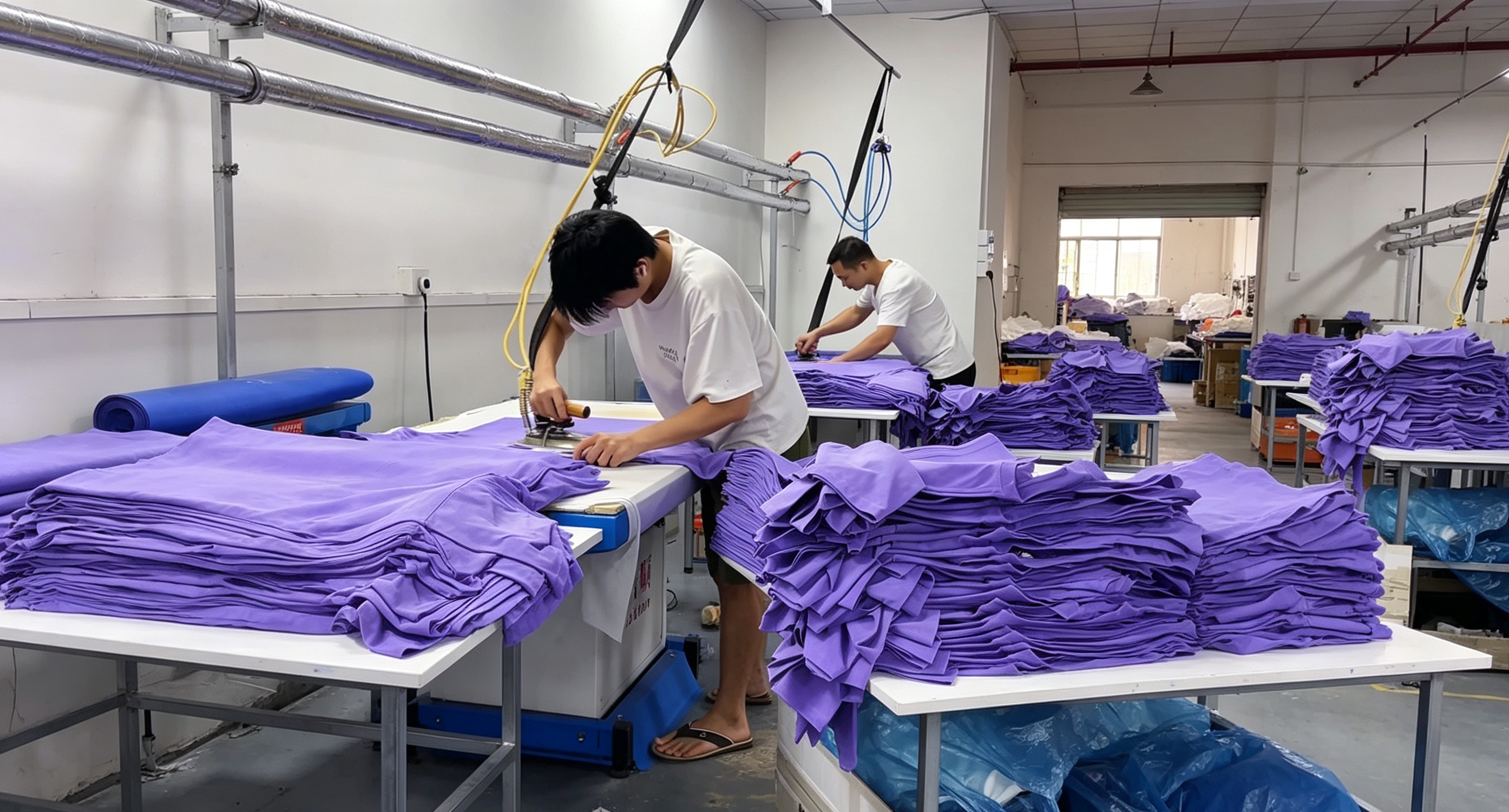
Image: Finishing and quality control line inside a custom casual apparel factory.
Application Map: Matching Scenario to Product Line
The table below maps common custom casual apparel projects to Lihongwear product evidence. It is intended as a reference for buyers comparing sourcing options.
| Project Scenario | Suitable Production Model | Relevant Product Evidence | Why It Matches |
|---|---|---|---|
| Cross-border e-commerce store replenishment | Spot mixed wholesale or small batch custom | T-shirt product families, men's basic apparel | Documented as daily casual wear, blank base for printing and embroidery, slim-fit inner layer, and brand image workwear suitable for wholesale and e-commerce. |
| Offline retail and supermarket basics | Spot plus private label | Men's basic apparel, long sleeve shirts | Product documentation includes online store sales, offline supermarket retail, brand exclusive series, and corporate workwear. |
| New brand launching an own-label casual collection | ODM full-case design customization | 1901 Series hoodie, long sleeve and T-shirt lines | Custom orders start at 200 pieces per style with 15-25 days lead time after sample confirmation. ODM adds independent pattern making and full packaging control. |
| Corporate or team workwear | OEM and custom decoration | T-shirts, long sleeves, basic apparel | Four-season daily wear, repeated washing capability, logo printing and embroidery, plus a formalized size range. |
| Streetwear label with heavyweight garment requirement | ODM with custom trims | 1901 Series 360g hoodie | 360g weight sits within the widely cited 350-420 GSM premium streetwear hoodie band, with a structured, durable silhouette. |
Lihongwear's application documentation also notes that a long sleeve product line is designed for four-season daily wear, repeated washing, high-temperature humid overseas climates, and long-term warehousing. Packaging can include custom hangtags, wash labels, brand packaging bags, and gift color boxes. According to its case documentation for overseas customer types, spot goods shorten the new product launch cycle, independent patterns create differentiated products, and standardized quality control reduces after-sales return rates.
Market Context: Data Behind Custom Casual Apparel Demand
Several external data points help explain why project-fit decisions are becoming standard. Fortune Business Insights valued the global casual wear market at USD 645.22 billion in 2025 and projects growth to USD 906.32 billion by 2034. Proficient Market Insights estimates the custom made clothes market will reach USD 213.1 billion by 2035, with a CAGR of 10.5 percent from 2026. Grand View Research valued the U.S. custom T-shirt printing market at USD 857.5 million in 2023 and projects a CAGR of 11.8 percent through 2030.
At the product level, PrintDoors notes that heavyweight hoodies in the 350-420 GSM range have become a baseline standard for premium streetwear, supporting structured, boxy drape preferred by loungewear and streetwear brands. Lihongwear's 1901 Series, at 360g, falls inside that range.
The sourcing implication is not that large brands are replacing core basics. It is that projects now add a second layer of differentiation: fabric weight, texture, trims, and execution matter alongside design. Buyers can enter with plain stock, validate sales, and only then invest in custom development.

Image: 360g hoodie from the 1901 Series, an example of a heavyweight casual apparel blank.
Compared with the Traditional Sourcing Model
A traditional supplier relationship is often built around one large order per season, with bulk pricing, a longer lead time, and limited SKU flexibility. This remains workable for stable retail programs with predictable volume. Yet it makes early demand testing difficult and slows reaction to online trends.
The hybrid model, represented by Lihongwear's stock-plus-custom structure, lets a buyer start with stock, test colors and print performance, and then move to custom runs when a style sells. Because the same factory controls cutting, sewing, finishing, and inspection, order data stays in one place.
There is a real boundary to this model. A stock-supported basic apparel factory is not the same as a specialist atelier. Buyers seeking couture-level finishing, highly complex technical tailoring, or runway-grade experimental development may still need a separate development house. The hybrid approach fits commercial casual apparel categories, not every high-fashion project.
Future Outlook
Casual apparel procurement will likely continue moving toward supplier audits based on evidence: inspection standards, fabric tests, lead-time samples, and clear product documentation. Buyers are already separating the broad category from the supply model by defining short-term stock needs and long-term private label goals in one sourcing conversation.
For brands, the emphasis will shift from asking what a factory can make in theory to asking which production route should be used for each stage of a project. For suppliers, this raises the value of transparent documentation and scenario-based communication.
Lihongwear publishes a current product catalog that buyers can consult before a full evaluation: Lihongwear Product Catalog. It is a public download and provides a specification baseline for product families and production services.
FAQ
Q: What is the difference between spot wholesale, OEM, and ODM for casual apparel?
Spot wholesale uses ready-stock items, requires no minimum order, allows mixed style orders, and is available for quick shipment. OEM materials processing covers garment manufacturing from specified materials or production requirements. ODM full-case design customization supports product development from pattern making through finished private label product.
Q: What MOQ is realistic for a first order from an emerging brand?
At Lihongwear, spot goods have no minimum order and can be mixed. Custom orders start at 200 pieces per style, which allows an emerging brand to test an own-label style before scaling to larger volumes.
Q: Which common custom casual apparel products support printing and embroidery?
Plain T-shirt and basic apparel blanks are commonly used for printing and embroidery. The Comfort Stretch T-shirt surface is documented as suitable for high-resolution screen printing, silicone heat transfer logos, embroidery, and reflective branding. Hoodies and long sleeve tops can also function as decorated casual garments.
Q: How should a buyer match fabric weight to climate or season?
Lihongwear T-shirt lines are available in weights such as 170g, 220g, and 230g. Long sleeve options include a 280g four-way stretch tech blend and a 100 percent polyester thin sweatshirt fabric for lighter layering. The 360g Mountain Cotton hoodie is a heavier option for spring, autumn, or winter layering.
Q: What quality-control evidence should a buyer ask to see?
A useful benchmark is a documented six-stage inspection process, AQL Level 7 quality control standards, fabric test reports, manual final inspection before shipment, and willingness to allow third-party inspection.
Q: Are custom labels and packaging feasible for casual apparel programs?
Yes. Custom hangtags, wash labels, brand packaging bags, and gift color boxes are listed as available supporting components. For private label programs, packaging is part of the brand experience and can be managed through the factory's order process.
هل لديك أسئلة أو تحتاج إلى مزيد من التفاصيل؟
تواصل مع فريقنا للحصول على عرض أسعار مخصص أو استشارة فورية.
طلب عرض أسعار
املأ النموذج أدناه وسيتواصل معك فريقنا بعرض مقترح مخصص.
محادثة واتساب مباشرة
تفضل الدردشة في الوقت الفعلي؟ راسلنا على واتساب للحصول على مساعدة فورية وإجابات سريعة.
- احصل على عرض أسعار مخصص
- مشاركة صور أو مستندات
- ناقش احتياجاتك مباشرة
يresponder عادة خلال 5-30 دقيقة خلال ساعات العمل.