
Which Plastic Tote Fits Your Warehouse Project?
In warehouse automation projects, plastic totes are often treated as a commodity item. In practice, the choice of tote type is a project-level decision: it affects how dense storage can be, how smoothly containers move through conveyors and shuttles, how efficiently empty assets are returned, and how well the container protects the product. For buyers moving from research to supplier evaluation, the practical question is not 'which tote is better' but 'which tote fits the operating scenario.'
The Growing Need for Scenario-Fit Plastic Totes
Warehouse automation changes the requirements for plastic totes. Mini-load ASRS systems, goods-to-person stations, AGV/AMR fleets and high-speed shuttle operations turn what used to be a storage box into a load carrier that must hold its dimensions across hundreds of cycles. E-commerce fulfillment and 3PL operations also face pressure to raise throughput while reducing empty-return costs. The result is a clear buying criterion: totes should be selected by scenario, not by price alone.
The same logic applies to automated ASRS totes and bins in mini-load systems. A tote that works well in a manual shelving environment may not perform reliably on a shuttle or conveyor. Conversely, an automation-grade tote can be unnecessarily expensive in a fully manual operation. This makes scenario mapping the first step in any tote procurement process.
Why Generic Storage Boxes Create Bottlenecks
Cardboard cartons and non-standard crates can be unpredictable on conveyor systems. Variation in footprint, wall rigidity, or bottom geometry can cause jams, reduce shuttle throughput, and complicate robotic gripping. Buyers need containers with known dimensional behavior, predictable stacking, and optional tracking features. That is where reusable plastic containers and scenario-optimized totes provide a measurable advantage.
The opportunity is not simply replacing one box with another. It is building a container pool that matches the physical constraints of the warehouse system, the return logistics flow, and the product being carried.
Supplier Capability in Context
Shanghai Xinfan Industrial Corporation (TSS/XFSEAL) is a Shanghai-based manufacturer of reusable logistics packaging, including plastic totes, crates, dollies, and security seals. Established in 2003, the company operates a 40,000 m² facility with 320 employees, 25 R&D engineers, and an annual output of 3.6 million units. About 70% of production is exported, primarily to the EU, North America, South America, Southeast Asia, the Middle East, and Africa.
The product portfolio includes automation warehouse totes for ASRS, AGV/AMR compatible containers, straight-wall totes, collapsible and foldable crates, nestable and stackable crates, fresh produce crates, plastic pallets, and tote dollies. The company also designs and manufactures molds in-house, which is relevant when a project needs custom dimensions, automation interfaces, or embedded RFID features.
Buyers can work with standard TSS models or use OEM/ODM engineering services. Documented capabilities include concept-to-product development, build-to-print production, high-volume injection molding, private label branding, and automation-focused engineering such as automation bottom design, robot gripping features, and RFID integration.
Key Technical Parameters for Project Selection
From an engineering perspective, four parameters shape most tote decisions:
- Dimensional accuracy: A tote used in ASRS or conveyor systems must maintain consistent external dimensions so that shuttles, cranes, and robotic grippers can interact with it repeatedly.
- Wall geometry and rigidity: Straight walls increase usable interior volume and improve label or barcode visibility. Rigidity determines how well the tote keeps its shape under dynamic loads.
- Loaded and empty states: Some totes stack when loaded and nest or fold when empty. The choice between these modes has a direct impact on empty-return transport volume and storage density.
- Tracking and security: RFID tags, barcodes, and tamper-evident features are increasingly specified for closed-loop logistics and pharmaceutical distribution.
European buyers often reference EN 13117-1:2000, the European standard for reusable, rigid plastics distribution boxes used in handling, transport, and storage. Polypropylene is the dominant material for this product category and is expected to lead the plastic crates material segment with a 41.4% share by 2025.
Container Types That Address Different Project Constraints
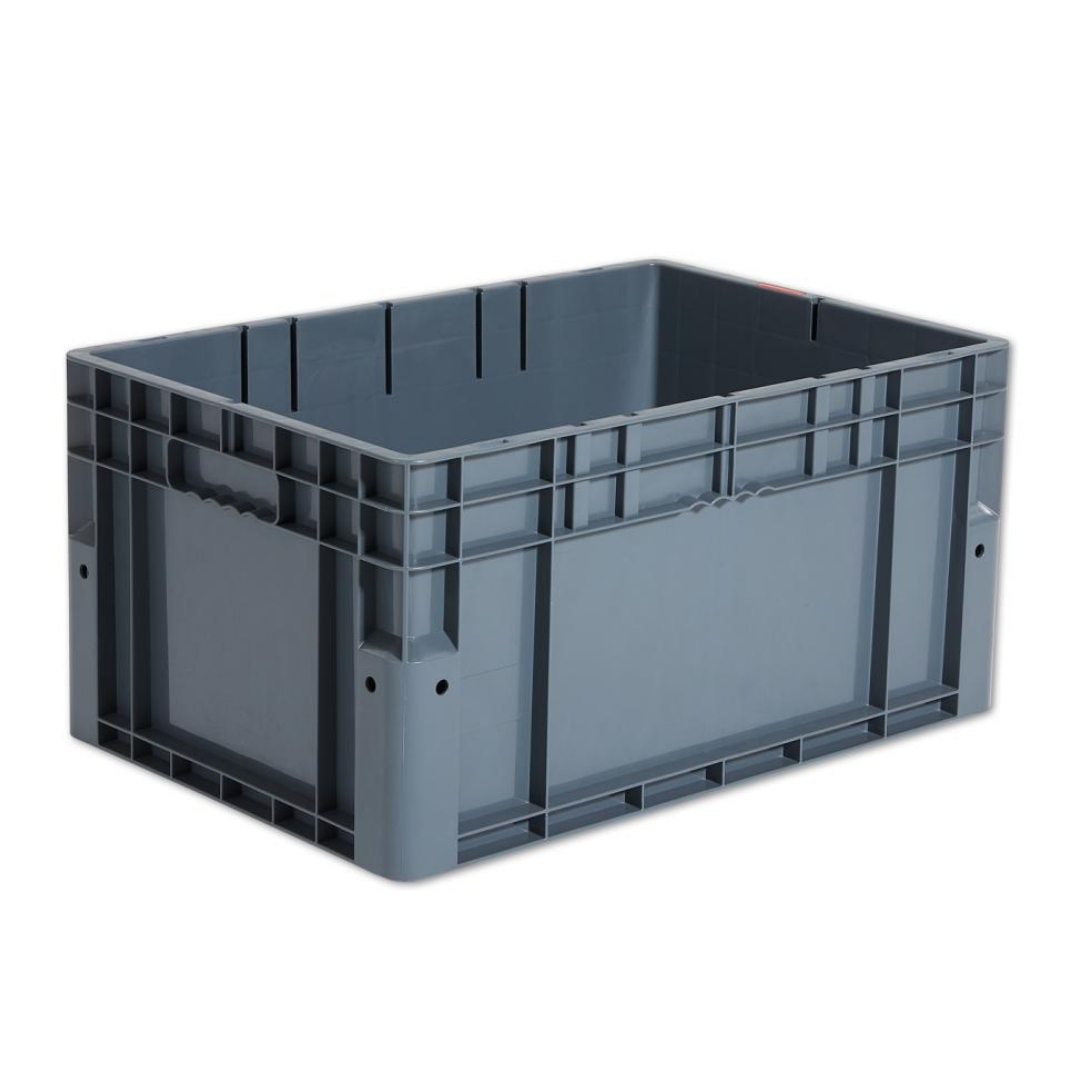
Wall straight plastic crates such as TSS-IFC (600x400x300 mm) are specified when ASRS mini-load cranes, shuttles, or conveyors need a rigid outer wall and consistent external dimensions. The model is made from PP and designed for warehouse automation applications.
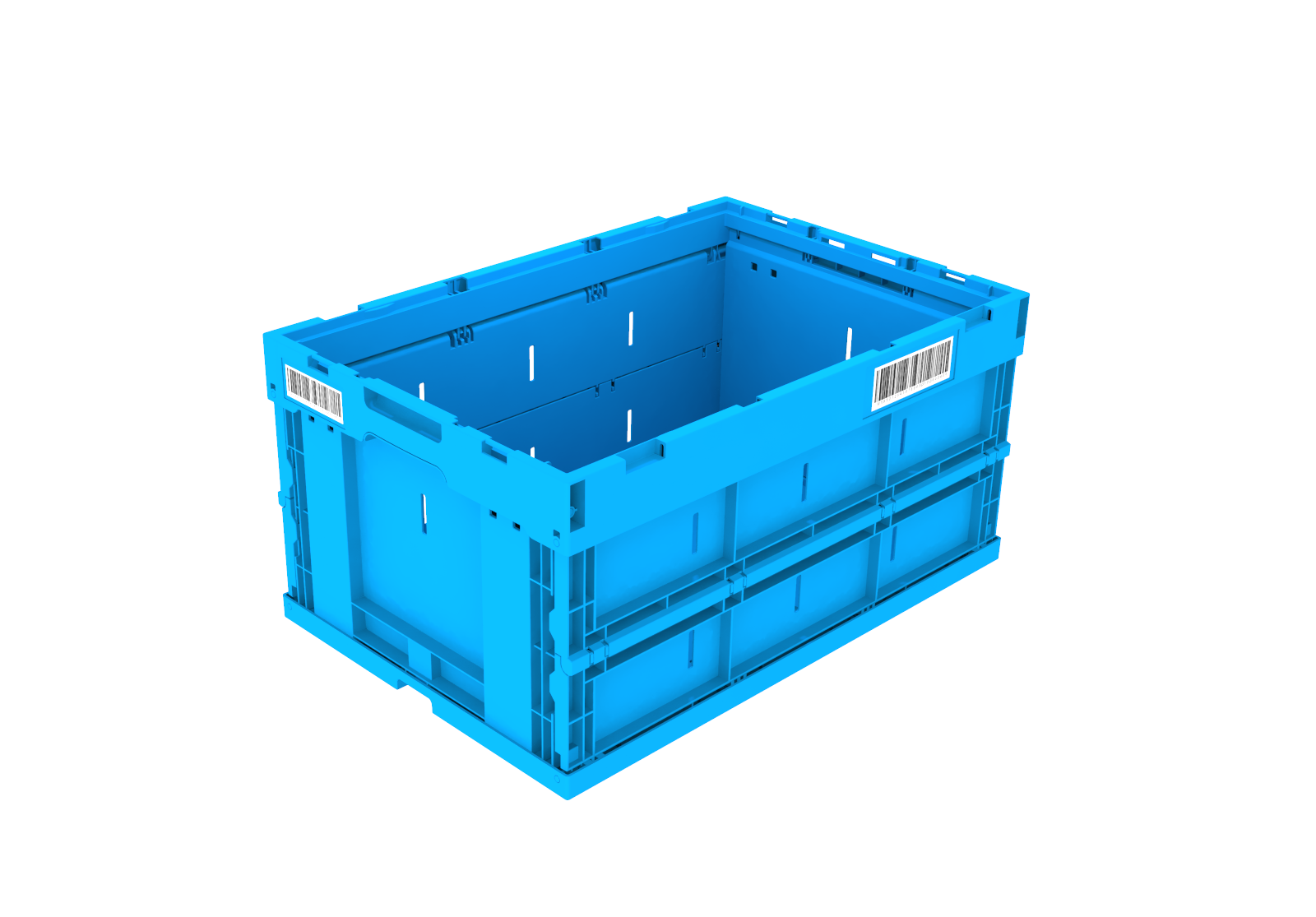
Foldable crates such as TSS-IFD (600x400x300 mm) are selected when empty-return volume is a cost factor. The foldable structure reduces empty storage volume by up to 70–80% and remains compatible with robotic and automated warehouse systems.
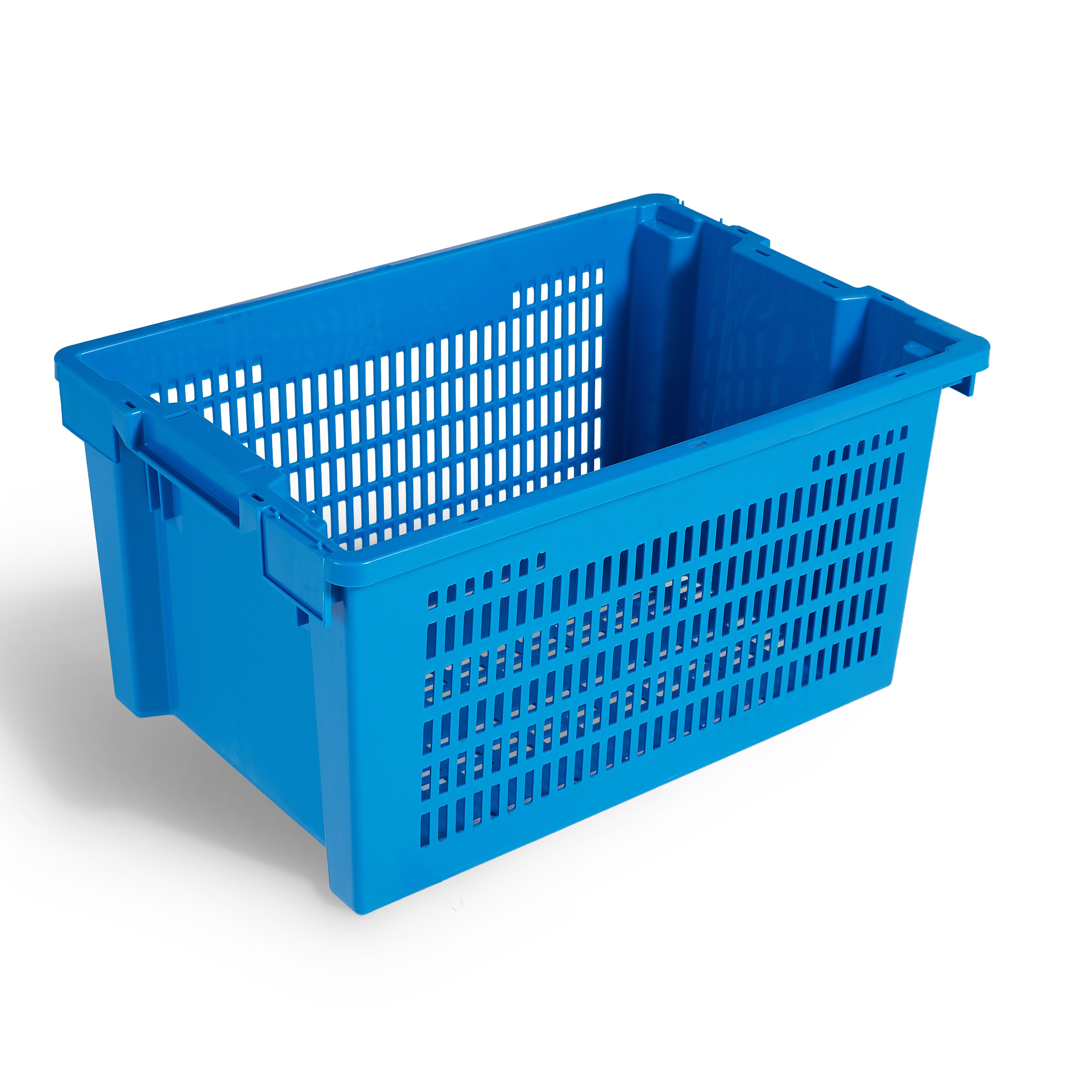
Nest-and-stack totes such as TSS-RBTB (600x400x300 mm) are common in retail and fresh-food closed loops. They stack when loaded and nest when empty, and require food-grade materials, ventilation, and easy-to-clean surfaces.
Attached-lid containers such as TSS-TBX (600x400x320 mm) support full-load stacking with the lid closed. In pharmaceutical and healthcare logistics, they can be specified with RFID or barcode tracking and tamper-evident sealing capability.
Collapsible crates such as TSS-SFD (600x400x225 mm) are suitable for fruit and vegetable supply chains. They operate stackable when loaded and foldable when empty, with ventilation and moisture resistance as typical requirements.
Tote dollies such as TSS-Trolley-02 (577x377 mm) and TSS-Trolley-5737 (570x370 mm) support manual movement of totes and crates. They can operate as single dollies or be linked for towing in distribution and retail environments.
Scenario-to-Tote Decision Matrix
The table below maps common project scenarios to tote types and the main specifications buyers should evaluate.
| Project Scenario | Typical Operating Mode | Key Tote Consideration | Example TSS Model |
|---|---|---|---|
| Mini-load ASRS / cube storage | Automated storage and retrieval with shuttles or cranes | High dimensional accuracy, rigid walls, stable stacking | TSS-IFC 600x400x300 mm |
| AGV/AMR goods-to-person | Robotic picking, conveyor transport | Robot gripping compatibility, dimensional stability, optional RFID | TSS-IFD 600x400x300 mm |
| Retail store replenishment | Closed-loop pooling, store delivery | Stack when loaded, nest when empty, food-grade materials | TSS-RBTB 600x400x300 mm |
| Fruit and vegetable farm-to-market | Harvest, packing, cold transport | Ventilation, moisture resistance, foldable empty | TSS-SFD 600x400x225 mm |
| Security-sensitive distribution | Sealed, tracked shipments | Tamper-evident lid, RFID/barcode, full-load stacking | TSS-TBX 600x400x320 mm |
| Small parts and MRO warehouses | Shelving, flow rack, order picking | Interlocking, divider compatibility, visual management | TSS-BBOX-01 604x398x208 mm |
| Manual tote transport | Picking routes, store backrooms, staging | Mobility, linked towing, quiet wheels | TSS-Trolley-02 577x377 mm |
The dimensions shown are standard TSS models; the broader reusable plastic tote range covers lengths of 600–800 mm, widths of 400–600 mm, and heights of 128–400 mm.
Project Evidence from Large-Scale Deployments
At the project level, documented deployments show how container choice scales. In one automation project, 450,000 ASRS wall straight plastic crates were supplied for large-scale e-commerce and 3PL fulfillment centers. The crates were used in AGV/AMR automated storage and retrieval systems, and the deployment reported storage density increased by up to 4–6 times compared with conventional shelving, along with improved order fulfillment speed.
In a second project, 450,000 ASRS foldable plastic crates were integrated with AMR robotic systems for goods-to-person fulfillment, automated storage, and high-speed picking. Both projects were completed within about one year. These are manufacturer-documented project references; buyers should validate performance in their own operating environment.
Supplier Evaluation and Evidence
From a procurement standpoint, the manufacturer's production and quality systems are part of the specification. TSS reports a monthly OEM capacity of 300,000–500,000 plastic containers and totes, and quality control follows incoming material inspection, in-process quality control, final quality control, and outgoing quality control.
For automation projects, the company offers conveyor testing, robot handling verification, load testing, stacking testing, and barcode/RFID verification. Mold development is handled in-house, with production mold manufacturing typically taking 60–70 days and design validation supported by mold flow analysis. For automated and smart logistics projects, customized product MOQs are documented at 500 pcs and RFID/smart logistics projects at 1,000 pcs.
These capabilities matter for buyers because they reduce the risk of ordering a tote that cannot survive the physical demands of the project. The right supplier is not only the one with the lowest unit price, but the one that can demonstrate dimensional control, testing discipline, and the ability to integrate tracking or handling features.
Common Specification Pitfalls in Tote Selection
Even with a clear scenario, project teams can make avoidable mistakes:
- Selecting a storage tote without checking conveyor compatibility: A tote can be well-built but still fail on a specific conveyor if the friction, bottom profile, or external dimensions are not aligned.
- Choosing a foldable crate when the ASRS requires continuous wall stiffness: Foldable crates offer space savings, but hinge gaps may reduce rigidity in some automation systems.
- Specifying an automation-grade tote for a fully manual operation: Precision molding, RFID integration, and tight tolerances add cost without clear benefit if the process does not use them.
- Ignoring empty-return logistics: In a closed-loop system, the cost of returning empty containers can exceed the purchasing cost. Nesting or folding behavior should be evaluated as part of the total system cost.
These pitfalls reinforce the core principle of scenario fit: tote selection should begin with the operating process and work backward to the product specification.
Market Trend Analysis
Verified market data supports the shift from spot purchasing to system-level selection. Dataintelo values the global plastic totes and bins market at USD 8.6 billion in 2025, with a projected USD 14.2 billion by 2034. Stackable totes represented 34.2% of product-type share in 2025.
| Metric | Value | Source |
|---|---|---|
| Global plastic totes and bins market, 2025 | USD 8.6 billion, projected USD 14.2 billion by 2034 | Dataintelo |
| Stackable totes product-type share, 2025 | 34.2% | Dataintelo |
| Asia Pacific revenue share in plastic pallets, crates, and boxes, 2025 | 41.6% | Grand View Research |
| Polypropylene share in plastic crates material segment, 2025 | 41.4% | Future Market Insights |
Precedence Research notes that the mini-load ASRS segment is growing rapidly because e-commerce requires fast retrieval of small parts, totes, and bins. At the same time, the use of reusable plastic containers in fresh produce logistics continues to expand, as illustrated by the documented Walmart–IFCO collaboration in retail replenishment.
Comparing Reusable Plastic Totes with Traditional One-Way Packaging
Compared with one-way corrugated cartons, reusable plastic totes have a different cost structure: higher initial investment, lower cost per trip when returns are managed well, and better long-term dimensional performance for automation. They also require a return flow or pooling system. In one-way export or low-volume settings, corrugated cartons remain simpler and often cheaper.
| Attribute | Reusable Plastic Tote | One-Way Corrugated Carton |
|---|---|---|
| Cost model | Higher upfront, reusable over many trips | Lower upfront, new carton every trip |
| Automation behavior | Consistent dimensions, moldable bottom | Less rigid, can vary with packing quality |
| Empty handling | Nesting or folding reduces return volume | Disposed or recycled after use |
| Typical fit | Closed-loop, ASRS, retail pooling | One-way, irregular volume, low automation |
Boundary: Automation-grade totes are not universally better. If a project is fully manual, has wildly varying package dimensions, or uses one-way export lanes, a precision-molded tote with RFID and tight tolerances can be over-engineered. Supplier evaluation should match tote specifications to the level of automation and return logistics actually in place.
Future Outlook: Totes as System-Level Assets
Over the next decade, plastic totes will be treated more like system-level assets than packaging commodities. Mini-load ASRS and goods-to-person installations will drive clearer tolerance and interface requirements. Retail pooling and RPC programs will increase the need for containers that can circulate reliably in closed loops.
For buyers, the practical implication is to evaluate total usable cycles, empty-return volume, automation compatibility, and cleaning behavior rather than unit price alone. The tote that fits the project is the one that keeps the system running predictably across many trips.
Frequently Asked Questions
What is the difference between wall straight and foldable totes for ASRS projects?
Wall straight totes such as TSS-IFC maintain a rectangular interior and consistent external dimensions, which supports conveyor and shuttle movement and high stacking stability. Foldable crates such as TSS-IFD collapse when empty, reducing empty storage volume by up to 70–80%. The right choice depends on whether return logistics space or uninterrupted wall rigidity is the higher priority.
Which plastic tote should be specified for fresh produce and retail store replenishment?
Nest-and-stack crates are widely used in closed-loop retail logistics. TSS-RBTB operates by stacking when loaded and nesting when empty, and it requires food-grade materials, ventilation, and easy-to-clean surfaces. Collapsible crates such as TSS-SFD are also used for fruit and vegetable supply chains because they fold when empty, which reduces return transport volume.
What specifications matter when ordering totes for AGV/AMR projects?
Buyers typically prioritize dimensional accuracy, structural rigidity, robot-gripping features, positioning marks, and optional RFID integration. In TSS's smart logistics support capability, automation bottom design and conveyor testing are part of the engineering scope. Customized automation products have a documented MOQ of 500 pcs, and RFID and smart logistics projects have a documented MOQ of 1,000 pcs.
Are automation-grade plastic totes always the right choice?
No. Automation-grade totes are justified when a warehouse uses conveyors, shuttles, ASRS cranes, or robotics. In manual operations, the precision-molded bottom, RFID integration, and tighter tolerances may add cost without a measurable benefit. Standard nestable totes or cartons may be sufficient in lower-automation settings.
How do attached-lid totes support secure distribution?
Attached-lid totes such as TSS-TBX allow full-load stacking with the lid closed. In pharmaceutical and healthcare logistics, special requirements include RFID/barcode tracking and tamper-evident sealing capability. This makes them relevant for asset protection and controlled closed-loop distribution.