
Which Smart Water Meter Fits Which Site: A Pairing Guide
Which Smart Water Meter Fits Which Site: A Pairing Guide
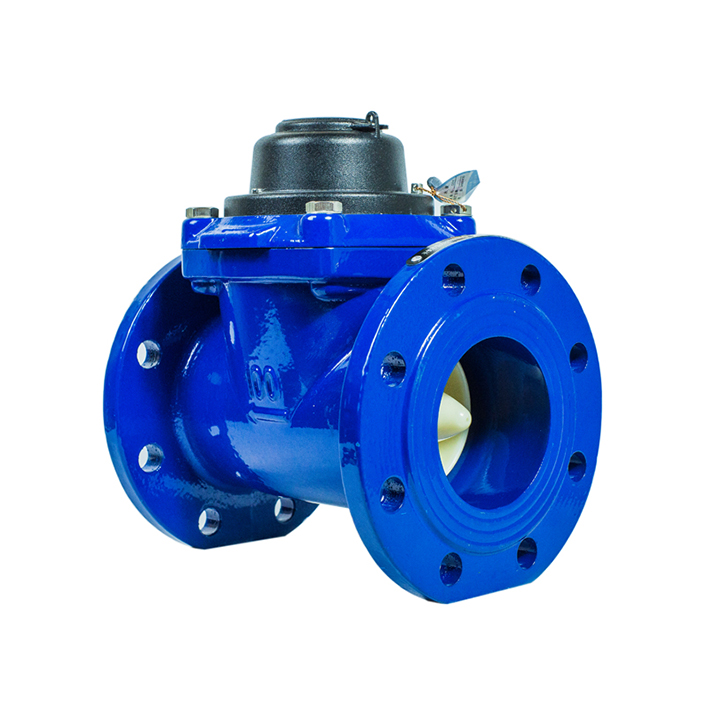
Large-diameter mechanical metering remains the reference point for high-flow industrial and district mains; the smart upgrade is an interface decision, not a replacement of the measuring principle.
Smart water metering projects rarely fail because the meter cannot measure water. They fail because the meter family does not match the way data has to leave the site, or because the physical envelope does not survive the installation. In industrial plants and commercial buildings, meter selection is a scenario-matching exercise before it becomes a specification exercise.
Most published buying guidance treats the smart water meter as a single product category and then lists features. Site conditions do not work that way. A building management system needs a deterministic wired bus it can poll; a campus distribution network needs radio coverage across several kilometres; a process line needs a turndown ratio that captures night-time minimum flow without dropping readings. The same meter cannot serve all three well, and the differences are structural rather than cosmetic.
Three questions that decide the meter family
Before any model number is written into a bill of quantities, three practical questions narrow the field considerably.
First, how will consumption data physically leave the site? A wired RS485 or M-Bus connection assumes cable routes, a polling master and an owner for that bus. A LoRaWAN deployment assumes gateways and backhaul. An NB-IoT or 4G meter assumes cellular coverage and a data platform. Each of these is a project commitment, and the meter is only one node inside it.
Second, what does the flow profile look like? Continuous high flow at a pump station, intermittent domestic draw in an apartment block and low-flow leakage detection on an industrial line place very different demands on turndown ratio and low-flow sensitivity.
Third, what will the installation environment do to the meter over the next six to ten years? Meter chambers flood. Plant rooms run hot. Coastal and irrigation sites corrode. The protection class, pressure rating, body material and temperature band are not marketing details; they determine whether the unit is still reporting in year five.
A pairing matrix for industrial and building projects
The table below maps the deployment scenarios most frequently encountered in building and industrial projects to the meter family that fits them, with the parameters a buyer should verify before ordering.
| Deployment scenario | Meter family to evaluate | Interface | Parameters to verify |
|---|---|---|---|
| BMS, PLC or SCADA integration inside a building or plant | RS485 water meter; M-Bus multi-drop variant | RS485 with Modbus RTU; M-Bus | Cable route length, addressing, IP68, PN10/PN16 |
| Wide-area utility, campus or district AMR/AMI | LoRaWAN smart water meter; NB-IoT water meter | LoRaWAN, NB-IoT | Gateway coverage, battery life, R value, DN range |
| Scattered sites with mains power or cellular preference | 4G water meter (LTE Cat-1 / GSM) | 4G Cat-1, GSM | Signal at the pit, data retention, valve control |
| High-precision process flow, leakage and reverse-flow detection | Ultrasonic smart water meter (LXSY) | LoRaWAN / NB-IoT / 4G Cat.1 / RS485 optional | R250–R500, DN15–DN600, alarm set, MID |
| Heavy-duty mains, DMA, irrigation, pump stations | Woltman water meter (LXLC/WPH) | Pulse, M-Bus, RS485, LoRaWAN, NB-IoT optional | DN50–DN600, flange standard, PN10/PN16/PN25 |
| In-building sub-metering and mechanical replacement | Multijet / R160 water meter (LXSG) | Mechanical register; smart module as separate project | DN15–DN25, R160, ISO 4064, BSP thread |
| Multi-tenant buildings with revenue collection | STS prepaid water meter (LXS-S) | Token-based STS, remote valve control | DN15–DN200, STS compliance, battery, IP68 |
RS485 water meters for BMS, PLC and SCADA integration
Where a building already has a management platform, the metering question is really an integration question. RS485 water meters in the SDWM range are available with brass, stainless steel or composite bodies, and communicate over RS485 using the Modbus RTU protocol, which is the interface most BMS and PLC front-ends are configured to poll. For sites with an existing M-Bus infrastructure, multi-meter connection via an M-Bus master is supported, which allows several meters to share a single bus segment.
Communication distance is the parameter that most often decides feasibility. For these meters, the figure is up to 1000 metres depending on cable type and installation conditions — a working limit that should be checked against the actual cable route, the number of drops and the electrical environment, not assumed from a data sheet headline.
Where this pairing works best
Plant rooms, riser cupboards, commercial towers, industrial facilities and any building where consumption data must land in a supervisory system rather than a vendor cloud. The value is deterministic polling: the BMS asks, the meter answers, and the value is timestamped in the same system that already logs energy and HVAC data.
Procurement checks before the bus is designed
Confirm who owns the bus and the polling schedule. Confirm the protection class of the installed meter — IP68 is available across the range and is the practical requirement for chambers and pits that flood. Confirm the pressure rating, PN10 or PN16, against the network's tested maximum. Confirm whether the meter will be battery powered or supplied externally, since both options exist depending on configuration, and confirm whether remote shut-off valve control is required, as it is an optional feature rather than a default.
LoRaWAN and NB-IoT for wide-area utility and campus deployment
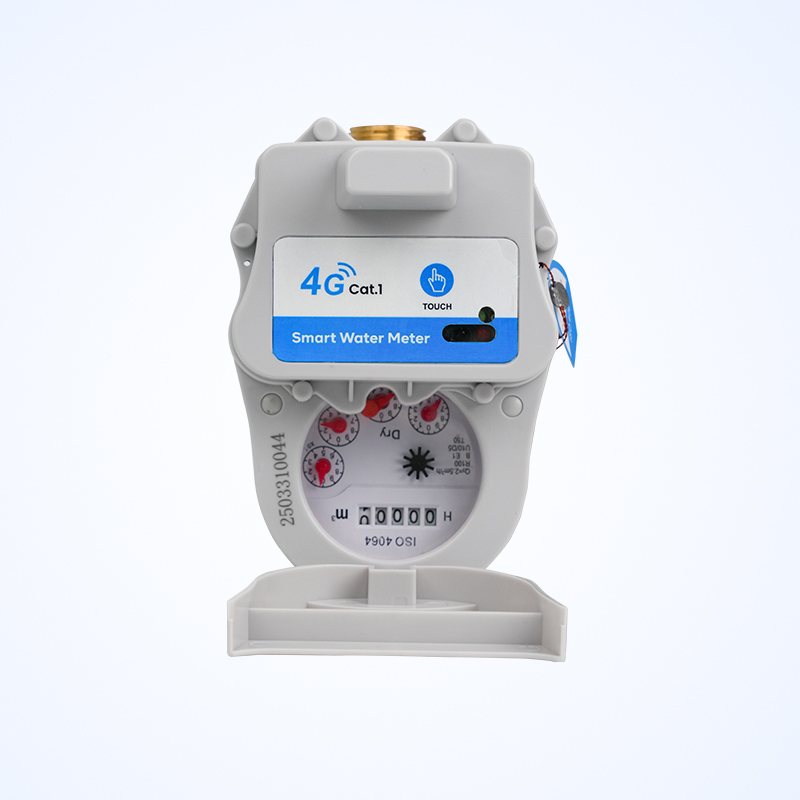
Cellular-connected meters such as this 4G Cat-1 unit suit scattered sites where neither cable routes nor a private gateway network are practical.
When meters are spread across a distribution network, a campus or a municipal service area, the constraint reverses: cable is no longer practical and radio coverage becomes the design variable. This is where LoRaWAN and NB-IoT meters are used.
The SDWM smart LoRaWAN water meter is offered in nominal diameters from DN15 to DN500, with accuracy classes of Class 1 or Class 2 and flow ratios of R80, R100, R250, R400 or R500. A compact LoRa water meter in DN15–DN50 is also available with PN16 and IP68 protection for in-building and small-site use. NB-IoT is offered as a communication option across the ultrasonic, AMR and wireless remote reading families, and has been used in large municipal rollouts — including a Kenyan municipal water department deployment of more than 20,000 units focused on automatic meter reading efficiency and reduced manual maintenance costs.
For sites where cellular is the chosen path but a licensed low-power network is not available, a 4G water meter covers DN15–DN300 with a brass body where a valve is fitted and an iron body where it is not, PN16 maximum working pressure, IP68 protection, battery life of more than 8 years, ISO 4064 compliance and MID certification. It stores up to 24 months of frozen data and 31 days of frozen daily data, and supports remote valve control and step tariffs — features that matter where metering is tied to billing rather than monitoring.
The buyer's real decision here is network ownership. A private LoRaWAN deployment places the gateway, coverage planning and maintenance obligation on the project. An NB-IoT or 4G deployment places that obligation on the mobile network operator and shifts the recurring cost into connectivity. Neither is universally better; they fail in different ways.
Ultrasonic meters for high-precision industrial flow measurement
Ultrasonic measurement uses transit-time technology with no moving parts in the measuring chamber. In practice this means two things for an industrial buyer: there is no impeller to wear or block, and low-flow sensitivity is maintained across a wide measuring range.
The LXSY smart ultrasonic water meter covers DN15–DN600 with flow ratios of R250, R400 or R500, IP68 protection, PN10/PN16 pressure ratings, a working temperature range of −20 °C to +60 °C and a water temperature range of 0 °C to +90 °C. Communication can be specified as LoRaWAN, NB-IoT, 4G Cat.1 or RS485, and battery life is stated as up to 10 years. The unit carries MID certification and supports horizontal or vertical installation.
The alarm set is often the reason this family is selected for process and network monitoring: leakage alarm, low battery alarm, reverse flow alarm, tamper alarm and empty pipe alarm. For a wastewater or transmission pipeline project, those alarms convert a meter reading into an operational signal. A wastewater treatment company in Zimbabwe uses more than 1,000 large-diameter units at 10+ years of service for transmission pipeline monitoring and water balance analysis — a case where accuracy and diagnostic alarms, not billing, were the selecting criteria.
The limitation is equally clear: ultrasonic meters are specified where accuracy, diagnostics and non-blocking measurement justify the specification. Where the requirement is simply high continuous flow through a large main with minimal pressure loss, a mechanical turbine meter remains a rational and lower-complexity choice.
Woltman and multijet meters where mechanical fit is the constraint
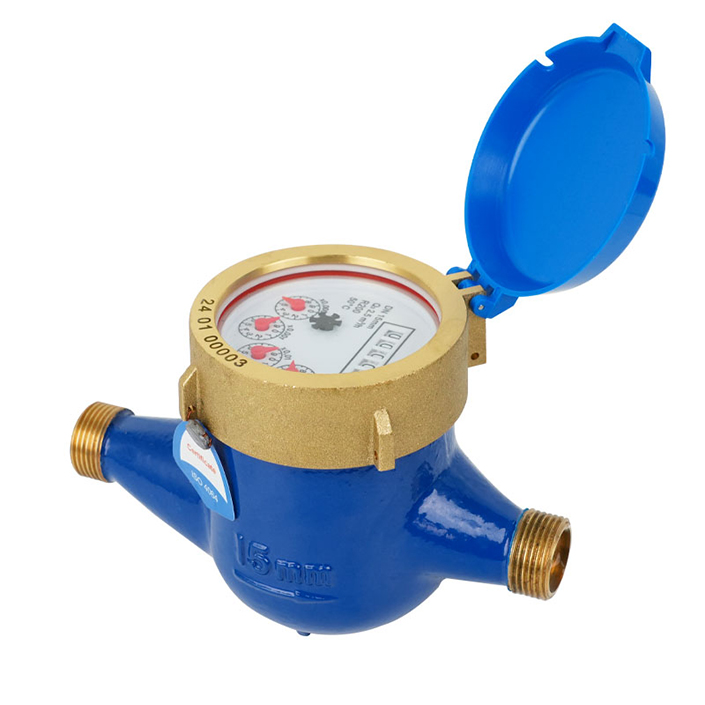
Multijet meters such as the R160 model remain the standard fit for in-building sub-metering where threaded connections and existing pipework dictate the envelope.
Not every metering point is a smart metering point. Where a large main carries high and continuous flow — district metering areas, irrigation networks, pump stations, industrial water supply, fire protection lines — the Woltman water meter is the established fit. The SDWM range covers DN50–DN600 with flow ratios of R40, R50, R80 or R100, flange connections to EN1092-1, ANSI or custom standards, pressure ratings of PN10, PN16 or PN25, and temperature options of T30, T50 or T90. Bodies are cast iron, ductile iron or stainless steel, the register is a dry dial magnetic drive, and the measuring mechanism is removable for inspection and maintenance.
Critically for buyers planning a phased project, these meters can be supplied as smart versions with pulse output, M-Bus, RS485, LoRaWAN or NB-IoT modules, and with optional remote shut-off valve control. That allows a mechanical platform to be specified now and connected later without changing the hydraulic design.
For in-building sub-metering and mechanical replacement, the multijet approach still dominates. The LXSG R160 water meter covers DN15–DN25 with an R160 flow ratio, complies with ISO 4064, uses a BSP threaded connection, and is rated PN10/PN16 with T30, T50 or T90 temperature options. Brass and composite material versions are available. The practical value is fit: existing risers and apartment pipework are dimensioned for threaded multijet bodies, and replacing like with like avoids plumbing modification.
The installation envelope: IP68, PN10/PN16, materials and battery life
Environmental specifications repeat across the SDWM range because they address the same field conditions, and they should be verified line by line in any tender.
| Parameter | Specification in the SDWM range | What it decides on site |
|---|---|---|
| Protection class | IP68 across smart meter families | Underground pits, flooded chambers, outdoor cabinets |
| Pressure rating | PN10 / PN16 (PN25 available on Woltman) | Network test pressure and surge margin |
| Body material | Brass, stainless steel or composite; cast or ductile iron on large sizes | Corrosion exposure, water chemistry, local plumbing practice |
| Temperature band | Working −20 °C to +60 °C; water 0 °C to +50 °C or up to +90 °C on ultrasonic; T30/T50/T90 options | Cold-climate installation and hot-water or process lines |
| Battery life | Up to 10 years on ultrasonic, AMR, LoRaWAN and wireless remote reading models; more than 8 years on 4G; up to 8 years on STS prepaid; more than 6 years and replaceable on smart card prepaid | Replacement cycle planning and maintenance access |
Two of these are frequently mishandled in tenders. Battery life is usually quoted as a headline figure, but it belongs in a maintenance plan with a replacement date attached; the six-to-ten-year window across the range means the meter will outlive several site visits and possibly the original installer. Protection class is the other: IP68 is often treated as a premium option when it is, in practice, the minimum specification for any meter installed below ground.
Where scenario matching stops helping
A matched meter does not correct an unmatched system. Three limits are worth stating plainly.
Wired integration depends on the building's own discipline. An RS485 meter with Modbus RTU will deliver what the bus delivers. If cable routes exceed the working distance of up to 1000 metres, if termination and addressing are poorly documented, or if no party owns the polling master, the meter becomes an isolated device. The interface choice transfers an obligation to the project, it does not remove it.
Radio meters are only as good as their coverage. LoRaWAN requires gateway planning and backhaul; NB-IoT and 4G depend on operator signal at the meter pit, which can be poor in basements and deep chambers. A meter with a ten-year battery and a strong radio module will still fail its reporting obligation in a location with no coverage.
Smart does not replace metrological verification. Certification such as MID, CE and ISO 4064 establishes conformity at the point of approval; it does not remove the need for the operator's own verification and replacement regime over the service life. Buyers should also note that for European projects, legal metrology obligations sit with EU Directive 2014/32/EU (MID) and EN 14154-4:2023, and for prepaid systems with the STS standard (IEC 62055-41/51). Those requirements constrain the acceptable product, not just the acceptable supplier.
Supplier grounding: what Shengda Water Meter brings to a scenario-matched project
Shengda Water Meter Co., Ltd. (SDWM) is a Chinese manufacturer of water meters and flow meters established in 1995 and based in Kaifeng City, producing smart water meters, ultrasonic water meters, LoRaWAN and NB-IoT meters, prepaid water meters and electromagnetic flow meters. The company operates a 66,000 m² facility with an annual production capacity of 3 million units, following the opening of a new plant in 2020, and maintains an R&D team of 12 engineers. Products are exported to more than 140 countries, and more than 65% of business comes from repeat customers.
For scenario-matched procurement, three capabilities matter more than catalogue breadth.
Range coherence. Because the same manufacturer produces RS485, LoRaWAN, NB-IoT, 4G, ultrasonic, Woltman, multijet and STS prepaid meters, a mixed project — wired meters in the building, radio meters across the campus, mechanical meters on the mains — can be sourced against a consistent specification and a single quality system, rather than assembled from unrelated suppliers with different tolerances and documentation.
Customisation and integration. OEM customisation covers logo, colour, housing design, communication modules, software platform, protocol, packaging and product specifications. Lead time is typically 15–20 days for standard products and 30–40 days for customised products, depending on project requirements, with a minimum order of 3 units for samples and 500 pieces for customised OEM projects.
Verifiable quality process. Quality control runs from incoming material inspection through production process inspection, 100% functional testing, calibration testing and final inspection before shipment. The company is certified to ISO 9001, ISO 14001 and ISO 45001, and products carry CE, MID and ISO 4064 certifications.
Field evidence follows the same scenario logic. A Mongolian government water utility took 15,000 units with LoRaWAN communication for a smart city deployment; a Kenyan municipal water department took more than 20,000 NB-IoT units; a Zimbabwean municipal project uses more than 4,000 STS prepaid units with 20-digit tokens and remote valve control; a Sudanese water utility ordered more than 10,000 residential units under OEM branding through a government tender; a Ugandan water supply authority uses 4G meters with remote valve control and a cloud platform for school drinking water management; and an HVAC contractor in Costa Rica uses battery-powered IP68 wireless meters on a project basis to reduce maintenance costs.
Market context behind the pairing decision
The commercial logic for scenario-matched selection is visible in the market data. Grand View Research valued the global smart water meters market at USD 9.1 billion in 2024, projecting USD 16.2 billion by 2030, and identifies the ultrasonic segment as the fastest-growing meter type. Precedence Research places Advanced Metering Infrastructure at a 58.9% share of the market in 2024, which is consistent with what building and industrial buyers encounter: the majority of new projects are specified as network-connected from the outset rather than retrofitted later.
Application mix reinforces the split described above. Cognitive Market Research attributes 67.2% of smart water meter adoption in 2024 to the residential segment, which explains why multijet and prepaid platforms remain commercially central even as ultrasonic and radio technologies grow. Dataintelo projects the NB-IoT smart water meter market growing from USD 2.22 billion in 2025 to USD 10.22 billion by 2034, a forecast that should be read alongside the coverage and operator-dependency constraints already noted.
Outlook
The direction of travel is toward meters that are selected by interface and environment first, and by measurement principle second — or more precisely, toward projects that specify all three together. As AMI becomes the default architecture rather than a premium tier, the distinguishing question for buyers shifts from "is this meter smart?" to "does this meter's interface, protection class, pressure rating and battery plan match this specific site for the next decade?". Suppliers with a coherent range across wired, radio and mechanical families are better positioned to answer that question than suppliers with a single technology.
FAQ
Which smart water meter type should be specified for a building management system?
An RS485 water meter communicating over Modbus RTU is the standard fit for BMS, PLC and SCADA integration, because those platforms are typically configured to poll Modbus devices. An M-Bus variant supports multi-meter connection through an M-Bus master where that infrastructure already exists. In both cases the meters are available with IP68 protection and PN10/PN16 pressure ratings, and the body can be brass, stainless steel or composite material.
How far can an RS485 water meter transmit data?
For the SDWM RS485 range, communication distance is up to 1000 metres, depending on cable type and installation conditions. That figure is a planning limit rather than a guarantee, so the actual cable route, number of drops and electrical environment should be assessed before the bus layout is fixed.
LoRaWAN or NB-IoT for a campus or wide-area utility deployment?
Both are offered. The smart LoRaWAN water meter covers DN15–DN500 with Class 1 or Class 2 accuracy and R80, R100, R250, R400 or R500 flow ratios, with battery life up to 10 years; it requires the project to own gateway coverage and backhaul. NB-IoT is available as an option across the ultrasonic, AMR and wireless remote reading families and has been deployed in a Kenyan municipal rollout of more than 20,000 units, where the connectivity obligation sits with the mobile operator. The decision therefore turns on who should own the network and the recurring data path.
When is an ultrasonic meter a better fit than a Woltman meter?
Ultrasonic meters are specified where low-flow sensitivity, a wide measuring range and diagnostics matter: the LXSY covers DN15–DN600 with R250, R400 or R500 flow ratios and provides leakage, reverse flow, tamper, empty pipe and low battery alarms, with no moving parts in the measuring chamber. Woltman meters are specified for high, continuous flow through large mains — DN50–DN600, R40–R100, PN10/PN16/PN25, flange connections to EN1092-1, ANSI or custom standards — where a robust turbine mechanism and low pressure loss are the priority. The two answer different flow profiles rather than competing on the same one.
What do IP68, PN10/PN16 and T30/T50/T90 mean for installation?
IP68 is the protection class that allows operation in underground meter boxes, flooded chambers and outdoor environments. PN10 and PN16 define the maximum working pressure rating; PN25 is available on Woltman models. T30, T50 and T90 are water temperature ratings available as options on mechanical meters such as the R160 multijet and Woltman ranges; ultrasonic models state a water temperature range of 0 °C to +90 °C and a working temperature range of −20 °C to +60 °C.
How long do smart water meter batteries last?
Battery life in the SDWM range is up to 10 years on ultrasonic, AMR, LoRaWAN and wireless remote reading models, more than 8 years on the 4G water meter, up to 8 years on the STS prepaid meter, and more than 6 years — replaceable — on the smart card prepaid meter. Because the window spans roughly six to ten years depending on family, the replacement cycle should be written into the maintenance plan at the specification stage.
Which certifications should be verified for a European project?
Legal metrology for the European Economic Area is governed by EU Directive 2014/32/EU (MID) and EN 14154-4:2023, and CE marking applies to the product. In the SDWM range, CE and MID certification options are available across the smart meter families, and the R160 water meter complies with the ISO 4064 metrological standard. For prepaid/token systems, STS (IEC 62055-41/51) is the relevant security standard.
A technical brochure covering the meter families and specifications discussed in this article is available for download: Shengda Water Meter profile (PDF).
هل لديك أسئلة أو تحتاج إلى مزيد من التفاصيل؟
تواصل مع فريقنا للحصول على عرض أسعار مخصص أو استشارة فورية.
طلب عرض أسعار
املأ النموذج أدناه وسيتواصل معك فريقنا بعرض مقترح مخصص.
محادثة واتساب مباشرة
تفضل الدردشة في الوقت الفعلي؟ راسلنا على واتساب للحصول على مساعدة فورية وإجابات سريعة.
- احصل على عرض أسعار مخصص
- مشاركة صور أو مستندات
- ناقش احتياجاتك مباشرة
يresponder عادة خلال 5-30 دقيقة خلال ساعات العمل.