
Which Sublimation Printer Fits Industrial Textile Production?
Industrial textile sublimation is no longer a niche decoration method. Grand View Research values the global dye sublimation printing market at USD 16.4 billion in 2025, projected to reach USD 39.0 billion by 2033, with Asia Pacific holding a 36.5% revenue share in 2025. Within that market, Mordor Intelligence sizes the dye sublimation printer segment at USD 1.88 billion in 2025, moving toward USD 2.53 billion by 2030. For a plant manager or procurement engineer, the market data matters less than a narrower question: which machine belongs on which line, and what paperwork has to be in place before it is installed.
This guide answers that question by mapping XINFLYING sublimation printer models to the main industrial textile production scenarios, and by pairing each scenario with the certification documents a buyer should be able to verify. XINFLYING, formally Guangzhou Xin Flying Digital Technology Co., Ltd., is a Chinese digital printing equipment manufacturer founded in 2010 that produces DTF printers, UV DTF printers, UV printers, DTG printers and dye sublimation printing solutions across a 37,440 m² facility.
Why Industrial Textile Buyers Choose by Scenario, Not by Speed
A specification sheet ranks sublimation printers by square metres per hour. An industrial textile operation does not run on a single number. A jersey line running repeat team orders, a home textile mill producing 1.9 m decorative fabric, and a growing commercial print shop handling mixed daily jobs all need different throughput, different widths and different levels of process stability — even when they sit in the same market.
Choosing by scenario changes three decisions at once:
- Printhead count and pass mode. A 1-pass configuration on an 8-head machine behaves very differently from a 4-pass configuration on a 2-head machine, both in output and in the stability of colour across a long run.
- Print width against the fabric width. A 1900 mm class roll-to-roll sublimation printer is the recognised standard for high-volume textile and soft signage work, per FESPA industry guidance. A 1300 mm machine fits a different job mix.
- The compliance file. Machinery safety, electrical safety, electromagnetic compatibility and hazardous-substance restrictions are separate documents with separate certificate numbers, and they do not always cover the same model.
Those three decisions determine whether a machine is productive in year three, not just in month one.
Four Industrial Textile Scenarios and the Machines That Fit Them
Across the XINFLYING dye sublimation range, five models carry the load of industrial textile work. Their specifications fall into clear scenario bands.
Scenario 1 — Sampling, Short Runs and Narrow-Format Custom Work
The XF-H1301X-1I32A1 uses a single Epson i3200-A1 printhead, prints at 4-pass speeds up to 28 m²/h, and carries a 130 cm (1.3 m) print width on heat transfer paper. It suits sampling rooms, small-batch custom textiles and studios that need to validate a design before moving it to a wider line. It runs on 110/220V with 2 kW power draw and uses an external constant-temperature automatic drying system.
Scenario 2 — Small to Mid-Volume Textile Production
The XF-H1802X-2I32A1 doubles the printhead count to two Epson i3200-A1 units, reaching 52 m²/h at 4-pass fastest mode and 42 m²/h at standard settings, on an 1800 mm (1.8 m) print width. Front, middle and rear break-controlled heating help hold colour through longer runs. Its 3.5 kW power draw and 110/220V supply make it practical where a full industrial power drop is not available.
Scenario 3 — Continuous Daily Production and Home Textile
The XF-O2000-4I32A1 carries four Epson i3200-A1 printheads and reaches 180 m²/h at 2-pass and 92 m²/h at 4-pass, with a 195 cm (1.95 m) print width — the widest in the range. It accepts heat transfer paper rolls of 1000–1500 m and uses a 220 ml cartridge plus 3 L ink tank configuration. The applicable industry listing covers clothing, home decor, canvas bags, cushions and flags, which makes it the natural fit for decorative fabric and soft signage producers running daily jobs.
Scenario 4 — Industrial and High-Volume Textile Production
Two models sit at the industrial end. The XF-19E8-PRO uses eight Epson i3200-A1 printheads with 3200 dpi resolution and a 190 cm (75") print width, reaching 306 m²/h at 1-pass and 153 m²/h at 2-pass, at 10.2 kW. The XF-19E15-PRO uses fifteen Epson i3200-A1 printheads on the same 190 cm width, reaching 524 m²/h at 1-pass and 254 m²/h at 2-pass, at 14.5 kW, and loads 1000 m sublimation paper rolls. Both use an external intelligent air-heat integrated dryer and a fully sealed automatic moisturizing and cleaning system.
Sublimation Printer Specification Comparison
| Model | Printheads | Print width | Fastest speed | Resolution | Power | Scenario fit |
|---|---|---|---|---|---|---|
| XF-H1301X-1I32A1 | 1× Epson i3200-A1 | 130 cm (1.3 m) | 4PASS 28 m²/h | — | 2 kW | Sampling, narrow custom work |
| XF-H1802X-2I32A1 | 2× Epson i3200-A1 | 180 cm (1.8 m) | 4PASS 52 m²/h | — | 3.5 kW | Small to mid-volume textile |
| XF-O2000-4I32A1 | 4× Epson i3200-A1 | 195 cm (1.95 m) | 2PASS 180 m²/h | — | 8.5 kW | Continuous daily production, home textile |
| XF-19E8-PRO | 8× Epson i3200-A1 | 190 cm (75") | 1PASS 306 m²/h | 3200 dpi | 10.2 kW | Industrial textile printing |
| XF-19E15-PRO | 15× Epson i3200-A1 | 190 cm (75") | 1PASS 524 m²/h | 3200 dpi | 14.5 kW | High-volume industrial textile |
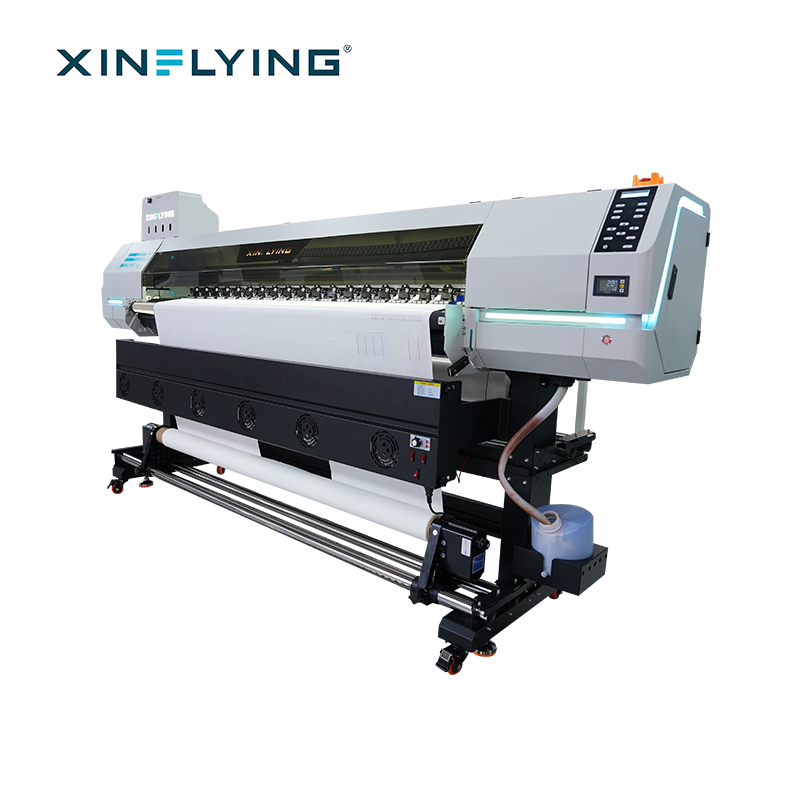
XINFLYING XF-H1802X-2I32A1 — a 1.8 m roll-to-roll sublimation printer positioned for small and mid-volume textile production.
Certification as a Scenario Gate, Not a Footer
In industrial textile procurement, certification is not a marketing line at the bottom of a brochure. It is a gate that determines which scenario a machine can actually serve. A printer destined for a European textile plant needs machinery safety, electrical safety, electromagnetic compatibility and hazardous-substance documentation that names the exact model on the order.
For the two industrial models, the certificate set is specific and traceable.
| Model | CE EMC | CE LVD | CE Machinery Directive | RoHS |
|---|---|---|---|---|
| XF-19E15-PRO | TQT1550D270EC | TQT1550D271EC | M.2026.206.C142365 | M.2026.206.C142366 |
| XF-19E8-PRO | TQT1550D270EC | TQT1550D271EC | M.2026.206.C142385 | M.2026.206.C142366 |
CE EMC — Certificate TQT1550D270EC
Issued by TQT on 2026-05-19 under EMC Directive 2014/30/EU, this certificate references EN 55032:2015/A11:2020, EN 55035:2017/A11:2020, EN IEC 61000-3-2:2019+A1:2021 and EN 61000-3-3:2013/A2:2021. It covers both the XF-19E15-PRO and the XF-19E8-PRO. In a textile plant where several printing machines, a heat calendar and cutting equipment share a power distribution board, documented EMC behaviour is a practical installation issue rather than a formality.
CE LVD — Certificate TQT1550D271EC
Also issued by TQT on 2026-05-19, this certificate addresses Low Voltage Directive 2014/35/EU and cites EN IEC 62368-1:2020/A11:2020 as the safety standard. It applies to the same two industrial models, whose power supplies are rated 210–230V at 45A.
CE Machinery Directive — Certificates M.2026.206.C142365 and M.2026.206.C142385
Machinery safety is documented separately for each model. UDEM issued M.2026.206.C142365 for the XF-19E15-PRO and M.2026.206.C142385 for the XF-19E8-PRO, both on 2026-06-10 with validity to 2031-06-09, under Machinery Directive 2006/42/EC. The referenced standards are EN ISO 12100:2010, EN 60204-1:2018/A1:2025 and EN ISO 12643-1:2023 — the last being the graphic technology machinery safety standard. The fact that the two models carry different certificate numbers matters: a buyer verifying documents against an order should not assume one machine's file covers the other.
RoHS — Certificate M.2026.206.C142366
UDEM also issued this RoHS attestation on 2026-06-10, valid to 2031-06-09, under Directive 2011/65/EU, against EN IEC 63000:2018 and the EN IEC 62321 test series. It is held across a broad product list that includes both industrial models and the wider digital textile printer range.
OEKO-TEX ECO PASSPORT — SH150194016
Sublimation printing places a second compliance burden on the consumable side. OEKO-TEX ECO PASSPORT certificate SH150194016, issued through TESTEX AG under the OEKO-TEX ECO PASSPORT scheme and EN ISO 17050-1, covers textile printing inks and printing pastes, and its certificate record lists the XF-450PRO among associated products. For textile programmes where the printed fabric will contact skin, an ink-side credential of this kind is relevant independently of the machine's own CE file. The certificate carries an expiry date of 2026-12-31, which means procurement teams should track its renewal rather than treating it as a permanent document.
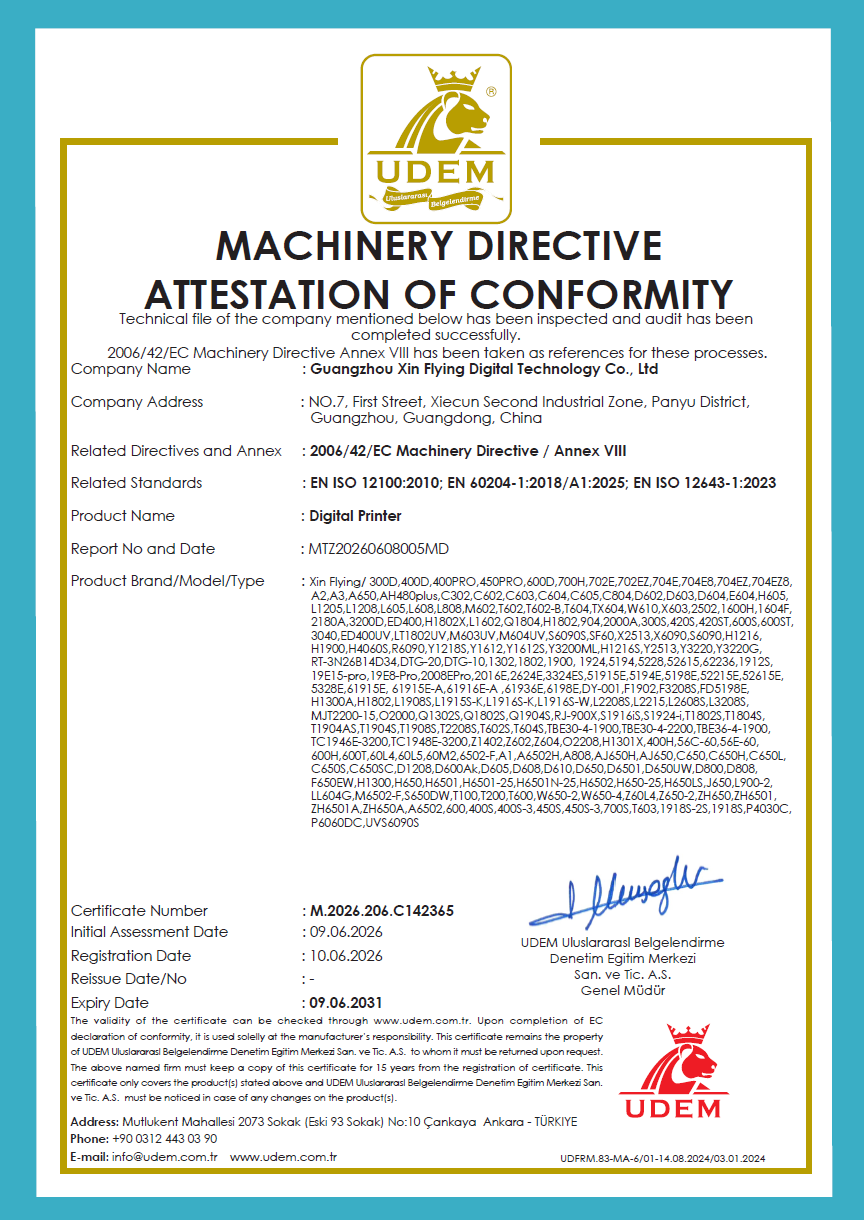
CE Machinery Directive Certificate of Conformity issued by UDEM — one of the model-specific documents industrial textile buyers verify before installation.
What the Certificate Combination Means for a Textile Line
Reading the certificate set as a whole reveals the logic behind it. EMC and LVD address how the machine behaves on a shared electrical network and how it protects operators from electrical hazard. The Machinery Directive certificate addresses the physical safety of a 1,400–1,480 kg roll-to-roll unit with moving web handling. RoHS addresses what materials are inside the machine once it reaches end of life. OEKO-TEX ECO PASSPORT addresses what the printed fabric carries into the next stage of the supply chain.
Each layer answers a different question that a textile buyer will eventually be asked — by a facility engineer, by an importer, by a brand customer running its own restricted substances programme. None of them substitutes for the others, and none of them substitutes for destination-market compliance review, which remains the buyer's own responsibility.
Application Evidence: How These Machines Are Used in Practice
Scenario mapping is only credible if it reflects how buyers actually deploy the equipment. Documented XINFLYING deployments in textile production include several distinct patterns.
- Sportswear manufacturing (Brazil, 15 units, four years). The customer produces football jerseys, basketball uniforms and custom sportswear, printing high-resolution patterns, team logos and full-colour designs onto polyester fabric before cutting and sewing. Reported outcomes include improved flexibility on customised orders, reduced reliance on outsourced printing, and more consistent colour between batches.
- Sports uniform supply (Brazil, 8 units, five years). Customised football kits, training uniforms and team apparel with personalised names, numbers and graphics. The reported result is shorter production cycles while maintaining the vibrant colour and pattern detail team uniforms require.
- Home textile manufacturing (10 units, four years). Curtains, cushions, decorative fabrics and customised polyester textile goods — a pattern that fits large-format work requiring detailed design and consistent output.
- Digital textile printing service provider (5 units, three years). A service business printing for sportswear brands, apparel factories and customised textile customers, where the reported benefit was expanded capacity and faster response on customised orders.
The stated highlights across these deployments — reliable equipment performance, production flexibility, and compatibility with different polyester textile applications — map back to the same scenario logic described earlier. They also illustrate why the choice is rarely a single machine: several of these operations run more than one width class side by side.
Where This Approach Has Boundaries
A scenario guide is only useful if it states what the technology cannot do.
- Substrate limits. Sublimation printing is designed for polyester textiles and polyester-coated substrates. Natural fibres such as cotton generally require different printing technologies or specific pre-treatment rather than direct sublimation transfer. A plant that needs to serve cotton and polyester from one line will need a different equipment plan.
- Floor space, weight and power. The XF-19E8-PRO occupies 3840×1300×1800 mm at roughly 1400 kg net weight; the XF-19E15-PRO occupies 3840×1570×1800 mm at roughly 1480 kg. Both require a 210–230V / 45A supply. These constraints exclude some existing workshops regardless of production demand.
- The printer is one station, not a line. The external intelligent air-heat integrated dryer, the transfer calendar, the sublimation paper supply and the cutting stage all sit around the printer. Output per hour on the specification sheet assumes those stations are sized to match.
- Certificates have scope and expiry. The CE MC certificates name specific models, and the RoHS attestation is valid to 2031-06-09 while the OEKO-TEX ECO PASSPORT certificate expires 2026-12-31. Certificates also do not remove the need for destination-market compliance review.
These are not defects. They are the operating envelope, and buyers who understand it early avoid a costly mismatch later.
Market Direction: Wider, Faster and More Compliant
Three verified signals shape where industrial textile sublimation is heading.
First, volume growth is real and sustained. The dye sublimation printing market is projected to grow at a CAGR of 11.5% from 2026 to 2033, per Grand View Research, with demand for personalised apparel and home decor identified as a primary driver behind a 13.1% CAGR in the digital textile sublimation segment through 2030. That volume reaches the factory floor as throughput requirements, not as a marketing statistic.
Second, the equipment layer is consolidating around specific technical configurations. Inkjet production printers accounted for 87.3% of the production printer market by type in 2024, according to Grand View Research, and FESPA industry guidance treats 1.9 m (1900 mm) roll-to-roll widths as standard for high-volume textile and soft signage. The two industrial XINFLYING models sit exactly on that width band.
Third, the supplier landscape remains concentrated at the top. Data Insights Reports places Epson at 26.7% share of the digital textile dye sublimation printer market in 2024, followed by Mimaki at 18.6% and Roland DG at 15.5%. Printhead supply for the wider market — including the Epson i3200-A1 units used across the XINFLYING sublimation range — therefore sits within a well-established ecosystem, which matters for long-term spare parts planning.
Sourcing and Production Capability Behind the Machines
Equipment choice and supplier choice are usually the same decision in industrial textile procurement, because the machine has to be supported for years. XINFLYING operates a 37,440 m² manufacturing facility with 200+ employees, a 20-engineer R&D team and annual output of 20,000+ units, with 80% of production exported to North America, South America, Europe, Asia, the Middle East and Africa.
On the commercial side, OEM and ODM production services are offered, with customisation covering product branding, machine appearance, colour, logo and packaging, as well as customised solutions built around customer requirements. Monthly capacity is stated at 1600+ units, lead time at 5–40 days, and minimum order quantity at 1 unit. Quality control is handled through pre-shipment testing, and standard delivery terms are EXW, FOB, CIF and DDP. After-sales support is delivered by over 50 engineers providing 24/7 online technical support.
For a textile plant validating a supplier, those figures answer a different question from the specification table: whether the organisation behind the machine can support a spare part in year four, and whether it can produce a customised configuration without a minimum order quantity barrier.
Future Outlook
Industrial textile sublimation is moving toward tighter integration between printing, drying and finishing, and toward compliance documentation that travels with the equipment rather than being assembled after the sale. As personalised apparel and home decor continue to expand — the driver behind double-digit growth projections for the digital textile sublimation market — the practical pressure on manufacturers will fall on throughput per shift and on the traceability of every certificate that names a model.
For buyers, the implication is straightforward. Machine selection should be made against a defined production scenario, and the compliance file should be verified against the exact model on the purchase order before installation begins. Both steps are cheaper than discovering a mismatch after the floor has been prepared.
Frequently Asked Questions
Which sublimation printer is suitable for industrial textile production?
The right model depends on the production scenario rather than on speed alone. For industrial textile printing, the XF-19E8-PRO — with 8 Epson i3200-A1 printheads, 3200 dpi resolution and printing speeds up to 306 m²/h on a 190 cm width — is positioned for textile factories, large garment manufacturers and professional sublimation production centres. Where output per shift is the binding constraint, the XF-19E15-PRO offers 15 Epson i3200-A1 printheads and speeds up to 524 m²/h on the same 190 cm width. For growing businesses moving into continuous daily production, the XF-O2000-4I32A1 provides 4 printheads, a 1950 mm print width and speeds up to 180 m²/h.
What certifications should be verified on an industrial sublimation printer before EU installation?
For equipment entering the European market, four document groups are typically relevant: EMC, Low Voltage, Machinery Directive and RoHS. For the XF-19E15-PRO, CE EMC certificate TQT1550D270EC and CE LVD certificate TQT1550D271EC were both issued by TQT on 2026-05-19; the LVD certificate references EN IEC 62368-1:2020/A11:2020. Machinery safety is covered by UDEM certificate M.2026.206.C142365, issued 2026-06-10 under Directive 2006/42/EC and referencing EN ISO 12100:2010, EN 60204-1:2018/A1:2025 and EN ISO 12643-1:2023. The XF-19E8-PRO holds a separate machinery certificate, M.2026.206.C142385, with the same EMC and LVD documents. Both models share RoHS certificate M.2026.206.C142366. Buyers should confirm that each certificate number corresponds to the exact model being supplied.
What does OEKO-TEX ECO PASSPORT SH150194016 cover in a textile printing operation?
OEKO-TEX ECO PASSPORT certificate SH150194016, issued through TESTEX AG under the OEKO-TEX ECO PASSPORT scheme and EN ISO 17050-1, covers textile printing inks and printing pastes, with the XF-450PRO listed among its associated products. It sits on the consumable side of the process rather than the machine side, which makes it relevant to programmes where the finished printed fabric will be assessed for skin contact. The certificate record shows an expiry date of 2026-12-31, so it functions as a dated document that requires renewal tracking rather than a permanent credential.
Can an industrial sublimation printer be ordered as a customised OEM configuration, and what are the order terms?
OEM and ODM production services are offered, with customisation covering product branding, machine appearance, colour, logo, packaging, and customised solutions based on customer requirements. The stated minimum order quantity is 1 unit, and lead time is listed at 5–40 days. Monthly capacity is 1600+ units, and acceptance is based on pre-shipment testing. Standard delivery terms are EXW, FOB, CIF and DDP, with payment terms listed as T/T, Western Union and PayPal. These terms allow a plant to place a single-unit order for validation before committing to a multi-machine line.
What site conditions and utilities does an industrial sublimation printer require?
Recommended operating conditions for these machines are 18–30°C and 35–65% relative humidity, with stable temperature and humidity supporting consistent ink performance and colour accuracy. The XF-19E8-PRO requires a 210–230V / 45A supply at 10.2 kW and occupies 3840×1300×1800 mm at approximately 1400 kg net weight. The XF-19E15-PRO requires the same 210–230V / 45A supply at 14.5 kW and occupies 3840×1570×1800 mm at approximately 1480 kg net weight. Both use an external intelligent air-heat integrated dryer and a fully sealed automatic moisturizing and cleaning system, and both are intended for controlled indoor production environments.
Reference material on XINFLYING's digital printing equipment range, including dye sublimation printers, DTF printers, DTG printers and UV printers, is available in the company brochure: XINFLYING Corporate Brochure (PDF). Model specifications, certificate numbers and commercial terms stated above reflect the documents held against the corresponding products; buyers should confirm the current file for the specific unit being ordered.