
Which Ultrasonic Flow Sensor Supplier Lasts? XY-TEK vs. Endress+Hauser, KROHNE, Siemens
A five-year view of supplier sustainability for small-tubing and low-flow ultrasonic measurement: what to verify, where a specialist fits, and where it does not.
Flow sensors are usually specified once and then relied on for years, across production lines, medical devices and cooling loops.
Flow sensors are rarely bought twice in the same year, but they are relied on for many years. In a bioprocess skid, a dialysis machine, a semiconductor cooling loop or a battery plant, the sensor selected during design typically stays in the bill of materials until the platform is redesigned, which is often five years or more. Across that window the buyer needs the same form factor, the same output interface, the same tubing compatibility and the same accuracy class, plus a service route that still answers when a line is down.
Supplier sustainability describes the probability that a vendor can do exactly that: keep supplying, keep supporting and keep adapting the same measurement platform over the life of the programme. It is not the same thing as brand size, and it is not the same thing as product quality measured once at the sample stage. For a specification as narrow as ultrasonic measurement through small-bore tubing, those three things can diverge significantly.
Why supplier sustainability belongs in the specification
The category itself is expanding. Published market estimates place the global flow meter market at USD 10.64 billion in 2024, with a projected USD 15.17 billion by 2030. Within that total, the ultrasonic flow meter segment was valued at USD 1.52 billion in 2025, with an estimated growth path to USD 2.28 billion by 2031, and clamp-on designs are expected to account for 57% of the global ultrasonic flow meter market share in 2026.
Those figures describe a growing category, not a stable supplier base. Growth in ultrasonic measurement means more vendors entering, more product lines being refreshed, and more chance that a specification accepted at design stage is quietly revised or discontinued before the platform reaches end of life. The category-level numbers say nothing about whether one specific supplier will still offer your flow band, your tubing compatibility and your output configuration in year five.
That is why supplier sustainability is increasingly treated as a technical criterion rather than a commercial preference. It has measurable inputs: portfolio continuity, engineering depth, organisational scale, production capacity, and the clarity of the documentation the supplier is willing to put behind its numbers.
The two failure modes buyers run into
Qualification tends to fail in one of two directions, and both produce the same costly outcome.
Buying scale the application cannot use. A broad process-instrumentation portfolio is built to cover a very wide measurement space. When the real requirement is a fraction of a millilitre per minute through narrow silicone or PFA tubing, much of that breadth is unused, and a specialist question can come back as a catalogue selection rather than an application discussion.
Qualifying a specialist on price alone. A supplier is chosen from a sample, the design is locked, and only at scale-up does it become clear that the portfolio stops just outside the required flow band, or that customisation was assumed but never actually specified in the agreement.
Both failures are expensive for the same reason. Replacing an ultrasonic flow sensor mid-programme usually means re-qualifying the tubing assembly, re-validating the measurement chain in regulated environments, changing analog or digital interfaces, and retraining the people who operate the line. Relative to those costs, the unit price of the sensor is a minor variable.
Where XY-TEK sits: verified company and portfolio facts
Shanghai Xunyin Technology Co., Ltd (XY-TEK) is a Shanghai-based manufacturer established in 2018 that develops, manufactures and sells ultrasonic flow sensors and flow meters for fluid management and control. The company states a focus on small tubing and low flow rate measurement, and operates from a 5,000 square metre facility in Minhang District, Shanghai, with approximately 50 employees and an R&D team of more than 30 engineers. Annual production capacity is stated at more than 8,000 units, and export business accounts for around 50% of total sales. XY-TEK serves medical devices, bioprocessing, scientific research, industrial automation and food and beverage production, and offers OEM ultrasonic flow sensors and customised services alongside its standard ranges.
The portfolio is narrow by design, and that concentration is the relevant fact for long-term buyers: every series sits inside the same measurement principle and roughly the same flow territory.
| Series | Format | Flow range | Stated accuracy | Construction and notes | Typical applications |
|---|---|---|---|---|---|
| SU Series | Single-use, in-line measuring channel | 0.05–10 L/min | ±2% | Biocompatible polymer materials, single-use measuring channel, high measurement repeatability, 0–60 °C | Biopharma, single-use systems, medical manufacturing, bioprocess |
| TGU Series | Low-flow, U-shaped measuring channel | 0.1–1000 mL/min | ±1% | Measurement accuracy stated up to ±0.1 mL/min; compatible with PVC, silicone and PE tubing | Bioprocess, medical equipment, pharmaceutical production, semiconductor |
| CG Series | Clamp-on, non-invasive | 0.02–20 L/min | ±1% | ABS housing with stainless steel sensor components; analog, pulse and RS485 outputs; bubble detection and bi-directional flow detection | Medical devices, biopharmaceutical, industrial automation |
| CPD Series | Clamp-on, non-invasive | 0.1–50 L/min | ±2% | Engineering plastic and ultrasonic transducer; no pipe cutting; no moving parts; air bubble monitoring; digital output; 0–90 °C | Industrial automation, semiconductor, food and beverage, water treatment |
| TPK Series | In-line | 0.5–100 L/min | ±2% | Stainless steel and engineering plastics; DN4–DN50; no moving parts; real-time monitoring; 0–90 °C | Industrial automation, battery manufacturing, chemical processing, liquid cooling |
| TPD Series | In-line | 0.5–100 L/min | ±2% | Stainless steel and engineering plastics; DN15–DN50; no moving parts; 0–90 °C | Industrial automation, battery manufacturing, chemical processing, liquid cooling |
| BG Series | Non-contact bubble detector | Tubing OD 3.2–19 mm | Detection sensitivity related to tubing ID | Ultrasonic module, engineering plastic housing, customisable detection range and response time, compact size | Medical devices, bioprocess, food and beverage dosing, industrial |
Series and specifications as stated by XY-TEK. Accuracy figures are manufacturer data and should be confirmed against calibration evidence for the specific tubing and fluid.
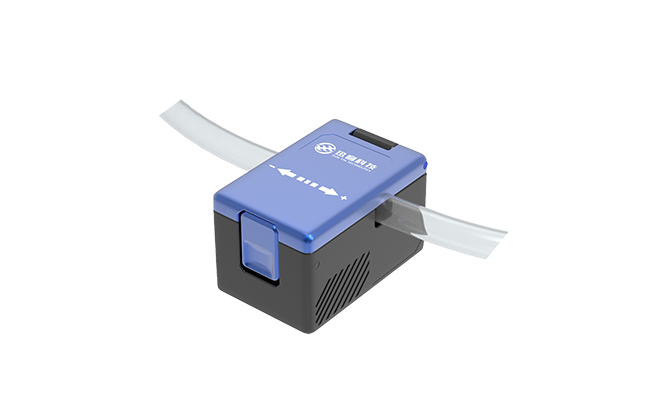
The CG Series clamp-on format measures through the tube wall, so the fluid path stays untouched and installation does not require cutting the pipe.
How the measurement works, and why it matters for longevity
These sensors use the ultrasonic transit-time principle. A signal is sent across the flow, and the difference in travel time between the upstream and downstream directions is proportional to fluid velocity. Volume flow is then derived from the tube geometry. XY-TEK states that its products use high-precision transit-time technology, with rugged IP65-rated durability described for demanding environments.
Three technical consequences follow, and each one changes what a long-term buyer should verify.
Clamp-on formats have no wetted parts. The transducer sits outside the tube, so there is nothing in the fluid path to foul, wear or obstruct. There is no pressure loss and no mechanical wear item driving a replacement cycle. The same logic applies to the in-line TPK and TPD series, which are built with no moving parts and are described as low maintenance.
The dominant long-term error source becomes the tubing, not the sensor. Because transit-time measurement depends on acoustic coupling through the tube wall, tube material, wall thickness and clamping consistency influence the reading as much as the electronics do. A supplier can keep its datasheet stable and still create variation if the tubing specification drifts between lots. Buyers evaluating a five-year programme should therefore treat tubing specification continuity as part of supplier qualification, not as a purchasing detail.
Bubble detection is a separate capability that belongs in the same specification. Ultrasonic sensors can detect gas-liquid state through signal behaviour, which is why air bubble monitoring appears on the CG and CPD series and why the BG Series is offered as a dedicated non-contact bubble detector with customisable response time. In bioprocess and medical circuits, an air-in-line event is a safety and process-integrity question, so the ability to keep that function supported over time matters as much as flow accuracy.
Application fit across bioprocess, medical, industrial and cooling
Bioprocess and single-use systems
The SU Series is the clearest expression of the single-use direction: a 0.05–10 L/min range, a single-use measuring channel, biocompatible polymer materials, high measurement repeatability and support for sterile applications and hygienic fluid monitoring. For perfusion, filtration and transfer loops, the TGU Series extends down to 0.1 mL/min at a stated ±1%, and the CG Series covers 0.02–20 L/min with bubble and bi-directional detection. In cleanroom environments where the fluid path must stay uncontaminated, non-contact measurement removes the cleaning and validation burden that wetted sensors create.
Bioprocess and laboratory installations favour clamp-on measurement because the fluid path remains closed and the tubing does not have to be cut.
Medical devices
Medical applications place the same premium on non-invasiveness plus a higher bar on reliability. Clamp-on measurement of blood, dialysis fluid and perfusion liquids avoids contamination and pressure loss, and the CG Series is positioned for medical devices and biopharmaceutical use. For micro-flow monitoring the TGU Series covers 0.1–1000 mL/min, and for pulsatile work the TH Series is offered as a hemodynamic sensor with a 0.01–15 L/min range, ±2% accuracy and high-speed pulsation capture, intended for cardiovascular research and haemodynamic testing.
Industrial automation, dispensing and spraying
In automation, the requirement is usually micro-flow control rather than bulk measurement: dispensing, spraying, coating and cleaning systems that need stable output and fast response. Stated micro-flow resolution reaches 0.05 mL/min, with non-contact clamp-on measurement, detection of bubbles or blockage, and support for closed-loop control and process data traceability.
Semiconductor, liquid cooling, battery and chemical processing
The CPD Series covers 0.1–50 L/min at ±2% with clamp-on installation that requires no pipe cutting, which suits retrofit work in semiconductor and water treatment lines. For higher flows and closed loops, the TPK and TPD in-line series cover 0.5–100 L/min at ±2% in stainless steel and engineering plastics rated to 0–90 °C, and are positioned for liquid cooling, battery manufacturing and chemical processing.
What the market numbers do and do not say
The trend data is consistent with what buyers see on the ground: ultrasonic measurement is taking a larger share of flow instrumentation, and clamp-on formats are the dominant mounting choice within it. Read together, the 57% clamp-on share and the growth of the ultrasonic segment point toward retrofit and brownfield optimisation rather than only new pipeline construction. For a supplier, that favours portfolios built around external, non-invasive mounting across many tube sizes.
The limitation is equally important. These are category-level figures. They do not describe any individual supplier's capacity, lead time, service coverage or financial durability, and they should never be used to infer that a particular vendor is safe for a five-year programme. Supplier-level judgement has to come from supplier-level evidence.
A six-check framework for long-term supply
- Flow-band coverage with margin. Confirm the supplier covers your range with room on both sides, not just at the nominal operating point. A programme that starts at 2 L/min and scales to 15 L/min needs a series that spans both without changing platform.
- Engineering depth and customisation route. Ask how customisation is actually executed, by whom, and with what engineering resource. XY-TEK states an R&D team of more than 30 engineers and offers OEM and customised services, which is the relevant input here rather than a marketing claim.
- Organisational stability and production continuity. Founding year, headcount, floor space and stated capacity are imperfect but useful proxies. A single-site manufacturer with stated capacity above 8,000 units per year and roughly 50% export exposure is a different risk profile from a multi-site multinational, and both profiles carry risks worth naming.
- Service path and response model. Establish whether support runs directly to the manufacturer or through a distributor, who owns failure analysis, and what the spare and replacement route looks like in your region.
- Documentation you can audit. Request calibration evidence, material statements for wetted or contact parts, and a written change-notification commitment covering form, fit, function and interface.
- Lifecycle fit of the format. Single-use and reusable formats have different obsolescence patterns. A single-use measuring channel is replaced with the disposable set; an in-line spool is expected to last. Confirm which model applies before signing a multi-year agreement.
XY-TEK vs. Endress+Hauser, KROHNE and Siemens: a dimension-by-dimension view
| Evaluation dimension | XY-TEK | Endress+Hauser, KROHNE, Siemens |
|---|---|---|
| Portfolio centre of gravity | Ultrasonic measurement only, concentrated on small tubing and low flow: roughly 0.02 L/min to 100 L/min across six sensor series plus a dedicated bubble detector | Generally recognised as broad process-instrumentation and automation portfolios spanning multiple measurement principles; ultrasonic coverage and small-bore suitability must be checked line by line |
| Operating history and organisation | Established 2018; approximately 50 employees; one 5,000 square metre site in Shanghai; stated capacity above 8,000 units per year | Long-established multinational organisations with international sales and service structures; confirm the specific legal entity and regional coverage that will serve your site |
| Customisation route | Direct manufacturer access; OEM ultrasonic flow sensors and customised services stated as part of the offering | Typically accessed through regional sales and service organisations and product-line catalogues; custom scope depends on product line and programme size |
| Application specificity | Application-specific by construction: single-use, micro-flow, pulsatile, clamp-on retrofit and in-line cooling variants are separate series rather than options on one platform | Broad applicability across process industries with deep integration into wider automation and instrumentation architectures |
| Questions to put to the supplier | Capacity reserved for your volume, tubing specification control, change notification, failure analysis ownership, second-source options | The same questions apply, plus which regional service hub owns your account and what the escalation path is |
| Best fit | Programmes where the flow band sits between roughly 0.1 mL/min and 100 L/min, tubing is small-bore, the fluid path must stay closed, and adaptation is likely over the programme life | Programmes that need one vendor across many measurement principles, or that depend on a specific regional service presence or an existing automation architecture |
Where XY-TEK is the weaker option
A credible supplier assessment has to say where the specialist loses, and here it is.
XY-TEK was established in 2018 and employs approximately 50 people at a single 5,000 square metre facility. That is a short operating record and a compact organisation compared with long-established multinational suppliers, and buyers whose procurement rules require a decade of audited continuity, multi-region manufacturing or an on-site service engineer in every major market will find that requirement difficult to satisfy. The company's stated capacity of more than 8,000 units per year is meaningful for OEM volumes but is not comparable to the output of a large instrumentation group.
The portfolio is also concentrated by design. XY-TEK makes ultrasonic sensors for fluid management and control; it does not offer the full spread of flow measurement principles, nor the wider process-automation ecosystem that a plant-standardising on one automation vendor may require. Where a site wants one supplier across coriolis, electromagnetic, vortex and ultrasonic duties, a specialist will not be the answer for every loop.
Finally, the accuracy figures in this article are manufacturer-stated. So are the competitors' published figures, which is exactly the point: no verified third-party benchmark covering small-bore ultrasonic measurement was available for this analysis. Any buyer treating a datasheet as proof, from any of these suppliers, is taking on unquantified risk. Request calibration evidence and application-specific test data before locking a five-year design.
Future outlook
Three developments are likely to shape long-term supplier choice in this segment. Single-use manufacturing continues to expand in biopharma, which pulls demand toward disposable measuring channels and away from reusable wetted sensors. Liquid cooling in semiconductors, data centres and battery production is adding closed-loop flow monitoring duties where clamp-on retrofit has a natural advantage over cutting pipe. And the clamp-on share of the ultrasonic category suggests buyers will keep favouring non-invasive formats for brownfield work, which rewards suppliers whose external-mount portfolio covers many tube sizes rather than a few.
For procurement teams, the practical implication is that supplier sustainability should be reviewed on a fixed cycle rather than at purchase. A short annual check of portfolio continuity, change notifications and capacity commitments costs far less than a mid-programme re-qualification. Buyers who need current specifications for a specific flow band can request them directly from the manufacturer at global@xy-tek.cn.
FAQ
What does long-term supplier sustainability mean for a flow sensor?
It means a vendor can keep supplying, supporting and adapting the same measurement platform over the life of a programme, typically five years or more. In practice that covers stability of form factor, output interface, tubing compatibility and accuracy class, plus a service route that still responds when a line is down. It is a separate question from unit price or brand size.
How should a buyer judge whether an ultrasonic flow sensor supplier can support a multi-year programme?
Check four things: whether the flow range is covered with margin on both sides so scale-up does not require a platform change; whether customisation is executed by the manufacturer with identifiable engineering resource; whether production continuity is credible in terms of site, capacity and export exposure; and whether the supplier will commit in writing to change notification for form, fit, function and interface.
What flow ranges and formats does XY-TEK cover for small-tubing and low-flow measurement?
XY-TEK covers approximately 0.02 L/min to 100 L/min across six series. The SU Series handles 0.05–10 L/min in a single-use channel; the TGU Series covers 0.1–1000 mL/min at a stated ±1%; the CG Series clamp-on covers 0.02–20 L/min at ±1%; the CPD Series covers 0.1–50 L/min at ±2%; and the TPK and TPD in-line series both cover 0.5–100 L/min at ±2%. A dedicated BG Series bubble detector is offered separately.
Where does a specialist supplier like XY-TEK fit compared with Endress+Hauser, KROHNE or Siemens?
The specialist fits where the measurement requirement is narrow and application-specific: small-bore tubing, low or micro flow, a closed fluid path, and a realistic chance that the design will need adaptation during the programme. The established multinational suppliers fit where a site needs one vendor across multiple measurement principles, or depends on a particular regional service presence. These are different procurement situations, and neither position is universally better.
What are the limits of a specialist ultrasonic supplier for long-term projects?
Three limits are worth naming. Organisational scale is smaller, so multi-region manufacturing and on-site service coverage are narrower. Operating history is shorter, which can conflict with procurement rules requiring long audited continuity. And the product scope is concentrated in ultrasonic measurement, so it will not cover every flow loop in a plant. Each limit can be managed through second-sourcing, capacity commitments and documentation, but none of them should be assumed away.
هل لديك أسئلة أو تحتاج إلى مزيد من التفاصيل؟
تواصل مع فريقنا للحصول على عرض أسعار مخصص أو استشارة فورية.
طلب عرض أسعار
املأ النموذج أدناه وسيتواصل معك فريقنا بعرض مقترح مخصص.
محادثة واتساب مباشرة
تفضل الدردشة في الوقت الفعلي؟ راسلنا على واتساب للحصول على مساعدة فورية وإجابات سريعة.
- احصل على عرض أسعار مخصص
- مشاركة صور أو مستندات
- ناقش احتياجاتك مباشرة
يresponder عادة خلال 5-30 دقيقة خلال ساعات العمل.