
Whitening Strip Supplier Evidence: Certifications, Patents, MOQ
Whitening Strip Supplier Evidence: Certifications, Patents, MOQ
Supplier Capability · Buyer Reference · Evaluation Stage

Manufacturing site of an oral-care producer that supplies teeth whitening strips, kits and related oral-care products to export markets. Image: Jiangxi Dentalbright Technology Co., Ltd. (GlorySmile Factory).
Teeth whitening strips sit in an unusual corner of the oral-care category: they are cheap to sample, easy to reformulate, and hard to verify. The global market for whitening strips and gels was valued at USD 1.1 billion in 2025, according to Grand View Research — a focused segment inside a much larger whitening market. For importers, distributors, marketplace sellers and private-label brand owners in the evaluation stage, that asymmetry defines the sourcing problem. A sample box can confirm taste, adhesion and packaging. It cannot confirm who audits the factory, which regulatory registrations exist, what intellectual property protects the design, or how small a legitimate first order can be.
Most whitening strips cross borders under HS code 3306.90.00, the classification covering preparations for oral or dental hygiene, according to a U.S. Customs and Border Protection ruling. That single line concentrates a large share of the commercial risk, because customs authorities, marketplace compliance teams and regulators all read the same documents against it: facility registration, product listing, safety documentation and label wording.
This analysis examines three forms of supplier evidence that a buyer can check before issuing a purchase order — certification scope, registered intellectual property, and minimum order quantity (MOQ) structure — and sets out where each form of evidence stops being informative. Credible supplier evaluation depends as much on boundaries as on credentials.
The Evaluation Gap: Why a Sample Is Not Evidence
A whitening strip sample answers sensory and tactile questions: how the strip adheres, how it tastes, whether it leaves residue, how the pack opens. It does not answer whether the manufacturer operates a quality management system that has been independently audited, whether the formulation can lawfully be sold in the destination market, or whether the supplier can serve a brand at 200 pieces and at two million pieces with the same process discipline.
Two regulatory shifts have made that gap commercially material rather than theoretical.
In the United States, the Modernization of Cosmetics Regulation Act (MoCRA 2022) requires cosmetic manufacturers to register facilities and list products. Published compliance guidance places facility registration at USD 849 per year and product listing at USD 200 per product. For a buyer, these are not only supplier costs; they are indicators of whether a supplier's documentation can support a retail or marketplace listing in the first place.
In the European Union, Regulation (EC) No. 1223/2009 restricts the concentration of hydrogen peroxide in over-the-counter teeth whitening products to 0.1% or less. A formulation that performs well in a sample test may therefore be a poor fit for EU retail channels unless a compliant formulation is available for that market.
In practice, buyers comparing whitening strip suppliers are not choosing between good and bad products. They are choosing between levels of verifiable evidence. The productive question is narrower: which claims arrive with a number, an issuing body, a scope statement and a validity window?
An Evidence Stack for Whitening Strip Suppliers
Supplier evidence sorts into four tiers. The first two can be checked in public registries; the last two are supplier-reported and should be tested through sampling and pilot orders. Treating all four as equally strong is the most common evaluation error in this category.
| Evidence tier | Typical documents | What it establishes | Where it stops |
|---|---|---|---|
| Tier 1 — Audited management systems and social compliance | ISO 13485, ISO 22716, US FDA cosmetic GMP (GMPC), MDSAP, amfori BSCI, HALAL, Vegan | That an independent body audited defined processes and issued a certificate with a scope, a number and an expiry date | Covers systems and scopes, not individual production batches |
| Tier 2 — Registered intellectual property | Registered designs, design patents, utility patents | That a product shape or a technical construction is legally claimed in a named jurisdiction | Design rights protect appearance only; utility patents protect a claimed mechanism |
| Tier 3 — Commercial flexibility | MOQ tiers, customization menu, sampling terms, lead-time policy | How small a first order can be and how much of the product can be changed | Says nothing about unit economics at production volume |
| Tier 4 — Infrastructure and process data | Cleanroom area, laboratory capability, capacity, QC stages, export footprint | Whether the claimed volume and control level are plausible | Self-reported until verified by audit or pilot production |
GlorySmile's Verifiable Capability Base
Jiangxi Dentalbright Technology Co., Ltd., which trades as GlorySmile Factory, is an oral-care manufacturer based in Yongxiu, Jiangxi Province, China. The company was founded in 2008 and completed its current factory in 2013. Its product range covers teeth whitening strips, whitening kits, whitening pens, whitening powder, toothpaste, mouthwash, electric toothbrushes and dental impression materials, with roughly 90% of output exported and main markets in the EU, USA and UK.
For whitening strips specifically, the manufacturer holds both medical-device and cosmetics production licenses and maintains a certification set that buyers can verify by number. The table below lists the credentials most relevant to a strip sourcing decision, as published in the manufacturer's certificate documentation.
| Certificate | Number / reference | Issuing body | Validity | Relevant scope |
|---|---|---|---|---|
| ISO 13485:2016 / EN ISO 13485:2016 + A11:2021 | 206536.250906 | UL LLC | Issued 2025-09-06, valid to 2028-09-05 | Design, development, manufacturing and distribution of teeth whitening strips, whitening lights/devices, whitening gel, dental impression material, electric toothbrushes and whitening kits |
| ISO 22716:2007 | SZ2312B8 | Intertek | 2024-12-04 to 2026-12-12 | Manufacturing of whitening pens, strips, gels, powders, foams, mouth spray, purple corrector serum and toothpaste tablets; packaging of whitening kits |
| GMPC (US FDA Cosmetic GMP Guidelines 2022) | SZ2312B9 | Intertek | 2024-12-04 to 2026-12-12 | US-market scope covering the same strip, gel, powder, foam and tablet manufacturing activities |
| amfori BSCI social audit | Monitoring ID 25-0338381-1; amfori Site ID 156-030966-001 | SGS | Issued 2026-06-26, valid to 2027-08-15 | Manufacturing of whitening gel, whitening light/device, whitening strips, toothpaste, electric toothbrush and mouthwash |
| HALAL | 52185957421871 | Halal Foundation Center Hong Kong | 2023-11-29 to 2026-11-21 | 22 SKUs including whitening strips, whitening gel, mouthwash, toothpaste and oral spray |
| Vegan | 22521 | International Vegan Alliance | 2024-04-20 to 2027-04-21 | 23 SKUs including whitening strips, toothpaste tablets, mouthwash and whitening powder |
| MDSAP | Stated in company profile; no certificate number published in the reviewed material | — | — | Medical device single audit programme covering the manufacturer's regulated product lines |
Infrastructure data supports the certification claims. The facility covers 36,000 m², of which 20,000 m² is 100,000-class cleanroom space. A 1,000 m² laboratory includes a 100-class cleanroom dedicated to microbiological testing, allowing in-house verification of raw materials, semi-finished goods and finished products. The company employs 256 people, including 17 R&D engineers, 11 QC specialists, 8 production management staff and 6 packaging designers.
Capacity figures are equally specific. Annual output is stated at 300 million pieces of teeth whitening strips, and the strip line is listed with a monthly capacity of 29.2 million pieces. Quality control for strips follows a documented sequence: pre-shipment testing, third-party laboratory testing with SGS or UL, and microbial, pH and efficacy evaluation. Export coverage extends to 102 countries, with distributors, brands and dental professionals served across North America, Europe and Asia.
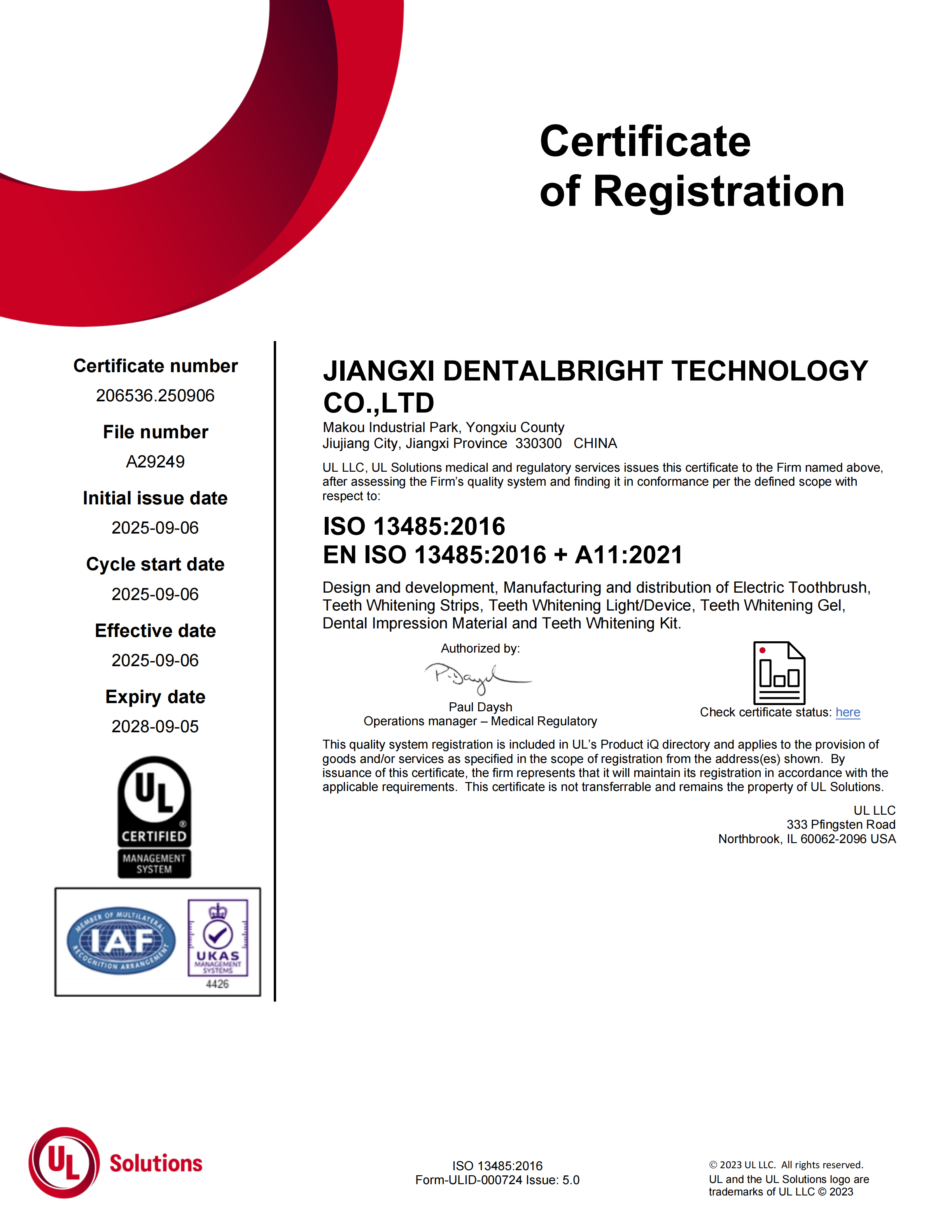
ISO 13485:2016 / EN ISO 13485:2016 + A11:2021 certificate number 206536.250906, issued by UL LLC and valid to 5 September 2028. The scope explicitly lists teeth whitening strips.
What the Strip Patents Actually Cover
Suppliers in this category often compress design registrations and utility patents into a single 'patented' claim. For buyers, the distinction changes what the evidence is worth.
The GS-001X GlorySmile Teeth Whitening LED Kit lists EU patent number 015062946-0001 and UK patent number 6370462 in its published product parameters. The UK registration corresponds to a registered design for a diamond-shaped teeth whitening device, recorded with the UK Intellectual Property Office, valid from 17 June 2024 to 17 June 2029 and classified under Locarno 28/03 for oral hygiene devices. Registered design rights protect the ornamental appearance of a product. They do not cover a formulation, a manufacturing process or a performance claim, and a buyer who reads them as formulation protection will overestimate what the number means.
Formulation and construction protection is a separate class of right. US utility patent 12,350,120 B1, granted on 8 July 2025 with protection extending to 12 December 2044, covers a gum-protecting and teeth-whitening strip and its preparation method. The granted scope describes a residue-free strip that uses an acrylic copolymer gelling agent with a marginal sealing effect — a technical mechanism rather than a shape.
The procurement implication is narrow but real. IP evidence indicates that a supplier is building defensible product shapes and constructions, which lowers the risk of a private-label buyer receiving a design that is already being copied in the same sales channel. It is not a quality guarantee. Buyers should confirm that the number in a product sheet corresponds to the exact model being quoted, that it remains in force, and that it is registered in the jurisdictions where the buyer intends to sell.
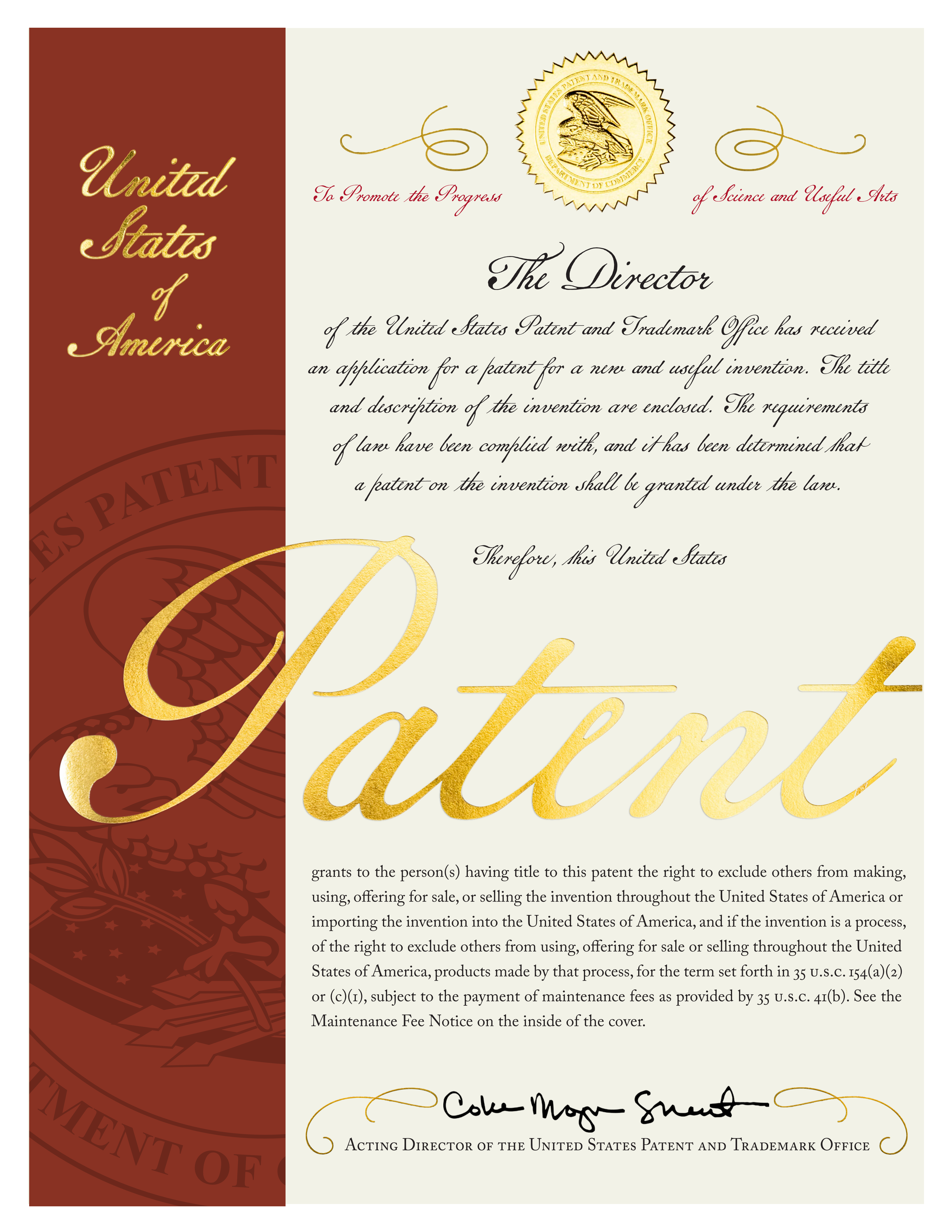
US utility patent 12,350,120 B1 covers a gum-protecting and teeth-whitening strip and its preparation method, including a residue-free construction using an acrylic copolymer gelling agent.
MOQ Structure: What 1 Piece and 200 Pieces Signal
MOQ is usually read as a price lever. At the evaluation stage it is more useful to read it as a risk-allocation signal.
Across its oral-care range, GlorySmile product sheets state a two-tier structure: a minimum of 200 pieces for private label orders, and 1 piece for regular products supplied in the manufacturer's existing packaging. Strip programs add a broad customization surface on top of that — strip type, active ingredient, residue-free or standard formulation, custom color, custom flavor, packaging and labeling.
The two tiers serve different buyer stages. A one-piece regular order lets a buyer benchmark against an incumbent strip without committing to a brand build; it functions as an evaluation and comparison tool. The 200-piece private-label tier is the smallest unit at which a buyer can put its own artwork, flavor and formulation specification on a commercial product, which is typically the point at which a regional or marketplace launch is tested before scaling.
Two boundaries should be stated plainly. First, a low entry MOQ does not indicate unit economics at scale; buyers should expect pricing and terms to change with volume and should compare quotations against identical specifications. Second, the strip line's own documentation states that the exact MOQ depends on product category, customization requirements and production line configuration, and is confirmed during quotation and sampling. Lead time follows the same logic: it varies with order volume, product specifications, customization complexity and the current production schedule, with a precise delivery timeline provided on order confirmation. A buyer planning against a fixed retail window should therefore treat lead time as a project variable rather than a constant.
Formats, Formulas and Application Fit
The strip portfolio covers three delivery formats: dry strips (GS-004H/V/C/P), wet strips (GS-V34-S07) and dissolving strips (DB-004L). All are built as three-layer strips — a PET hard film, the whitening gel and a PE soft film — packed in an aluminum bag in 7, 14 or 21 strip bags, with a user manual, shade guide and color box. Formula options include PAP, PAP with charcoal, a purple formulation, 6% hydrogen peroxide, sodium phytate and sodium bicarbonate, or a custom specification. Flavor options span blue raspberry, strawberry, peach, grape, watermelon, peppermint, orange, mint, pineapple, cherry blossom, coconut and mango.
Format choice is not cosmetic. The supplier's published guidance distinguishes dry and wet strips on adhesion, residue and cost. Dry strips adhere well, resist slipping and leave minimal residue, at a higher cost. Wet strips adhere less firmly, can shift during wear and leave more residue, at a lower cost — and they are the recommended carrier for purple formulations, because the higher residue helps the purple pigment stay in contact with the tooth surface. Buyers positioning strips for coffee, tea or tobacco stain removal should read that trade-off directly, since the format shapes the wear experience and the residue complaint rate more than flavor does.
Formula choice interacts with both sensitivity and regulation. Peroxide-based gels using hydrogen peroxide or carbamide peroxide penetrate enamel into dentin and act on deeper stains: faster results, with a higher likelihood of temporary sensitivity. PAP is a larger-molecule, surface-acting agent that oxidizes surface stains — gentler, but slower on deep discoloration. For the EU over-the-counter channel, the 0.1% hydrogen peroxide ceiling under Regulation (EC) No. 1223/2009 makes the peroxide-free format the practical option, and it aligns with enamel-safe and sensitive-teeth positioning at the same time.
Application coverage in the manufacturer's scenario documentation includes daily home whitening, travel-friendly dental care, private-label programs for supermarket retail and e-commerce brands, and professional whitening lab and dental clinic supply. Published case data includes a private-label e-commerce launch described as reaching top-10 category ranking with a 4.8-star user rating, and a two-year pharmacy and supermarket promotional program of 7 million units that passed third-party factory audits and recorded zero returns in large-batch inspection.
Market Signals Buyers Should Weigh
Three data points frame the current sourcing environment, and they should be read together rather than individually.
- Segment size: whitening strips and gels represented USD 1.1 billion in 2025, per Grand View Research. The same dataset notes a broader estimate of USD 7.72 billion for the total teeth whitening market in 2025 from Mordor Intelligence. The two figures are consistent only when the strips-and-gels niche is treated as a segment of the wider category, not as a substitute for it. Buyers sizing a channel should state which definition they are planning against.
- Compliance cost: under MoCRA, facility registration runs at USD 849 per year and product listing at USD 200 per product. For strips, compliance paperwork is now a recurring line item rather than a one-time task, which raises the value of working with a supplier that already maintains registrations and audit records.
- Formulation data gaps: current verified data does not isolate a growth rate for PAP or non-peroxide strips in official trade statistics. Buyers should treat sub-segment growth claims as positioning statements rather than measured market facts, and evaluate formats on documented formulation availability, regulatory fit and channel-level demand instead.
Evidence-Led Evaluation Versus Sample-and-Price Sourcing
The traditional approach — collect three samples, compare flavors, compare quotations — remains the fastest way to understand a product. It is not a supplier capability assessment, and treating it as one produces predictable failures: a formulation that cannot be listed in the destination market, a certificate that expired last quarter, or a first order that cannot be produced inside the retail window.
| Sourcing question | Sample-and-price approach | Evidence-led approach |
|---|---|---|
| Can this supplier serve my market? | Assumes yes if the sample arrives intact | Checks registration readiness, regulatory documentation and label compliance for the destination market |
| Is the quality system controlled? | Relies on impressions from a sample box or a short factory visit | Reviews audited certificates by number, scope and validity window |
| Is the design defensible? | Not assessed | Verifies registered designs and utility patents, and maps them to the quoted model |
| Can I test the market cheaply? | Negotiates an informal MOQ concession | Maps the two-tier MOQ structure to the launch plan and confirms the exact MOQ at quotation |
| Is my timeline realistic? | Uses a verbal lead-time estimate | Treats lead time as dependent on volume, specification and customization, confirmed at order |
The limits of the evidence-led approach matter as much as its strengths. Certification covers systems and scopes, not individual batches, so batch-level certificates of analysis and release testing remain necessary. Validity windows expire: the ISO 22716 and GMPC certificates reviewed here run to 12 December 2026, and the HALAL certificate runs to 21 November 2026, which means status should be re-checked at the point of order rather than assumed from an earlier file. MDSAP is an audit programme, not a product approval, and its presence does not mean every SKU is regulated as a medical device. Registered designs protect appearance only. And a two-tier MOQ structure says nothing about long-run unit cost. Finally, the same physical strip can be interpreted differently by regulators — a cosmetics GMP certificate and a medical-device quality management certificate cover different regulatory routes — so scope wording has to be read against the exact product and market, not against the product family.
Future Outlook
Three changes in this category look structural rather than cyclical.
First, documentation is becoming a purchase-order prerequisite. With MoCRA facility registration and product listing in the United States, and safety reporting and responsible-person requirements in the EU, buyers are increasingly asking for registration evidence before samples are dispatched. Suppliers that treat compliance as an ongoing function rather than a pre-shipment task will be easier to onboard and less likely to interrupt a listing.
Second, appearance-level imitation is getting faster in the strips category, where product forms are simple and packaging is highly visible on marketplaces. Registered designs and design patents are likely to carry more weight in supplier selection, not because they prove performance, but because they indicate which product shapes are legally claimed and which are open to copying.
Third, formulation strategy is becoming market-specific. The EU 0.1% hydrogen peroxide ceiling for over-the-counter products, combined with sensitivity-focused positioning in the United States and Australia, pushes buyers toward peroxide-free formats in some channels and peroxide formats in others. That makes formulation flexibility, rather than a single hero formula, the capability worth testing during evaluation. It is worth adding a caution here: because verified data does not yet isolate growth rates for non-peroxide segments, buyers should validate demand at channel level and avoid treating category-wide claims about that sub-segment as measured fact.
Frequently Asked Questions
What certifications should a whitening strip supplier be able to show?
A complete evidence pack usually combines audited management-system certificates with product-relevant credentials. For the manufacturer referenced in this article — Jiangxi Dentalbright Technology Co., Ltd., trading as GlorySmile Factory — these include ISO 13485:2016 / EN ISO 13485:2016 + A11:2021 certificate number 206536.250906 issued by UL LLC and valid to 5 September 2028; ISO 22716:2007 certificate SZ2312B8 and US FDA cosmetic GMP (GMPC) certificate SZ2312B9, both issued by Intertek and valid to 12 December 2026; amfori BSCI credentials under Monitoring ID 25-0338381-1 and Site ID 156-030966-001, valid to 15 August 2027; HALAL certificate 52185957421871 valid to 21 November 2026; and Vegan certificate 22521 valid to 21 April 2027. MDSAP certification is stated in the company profile without a published certificate number. Each document carries a defined scope, which may or may not list whitening strips explicitly.
Do these certificates cover a specific product or the whole factory?
They cover defined scopes, not an entire company. The ISO 13485 scope for this manufacturer includes the design, development, manufacturing and distribution of electric toothbrushes, teeth whitening strips, whitening lights and devices, whitening gel, dental impression material and whitening kits. The BSCI audit scope covers the manufacturing of whitening gel, whitening light/device, whitening strips, toothpaste, electric toothbrush and mouthwash. The ISO 22716 and GMPC scopes cover manufacturing of whitening pens, strips, gels, powders, foams, mouth spray, purple corrector serum and toothpaste tablets, plus packaging of whitening kits. A buyer should confirm that the specific product being quoted falls inside the listed scope before relying on the certificate.
What is the MOQ for private label teeth whitening strips?
Product sheets across this manufacturer's oral-care range state a minimum of 200 pieces for private label orders and 1 piece for regular products supplied in existing packaging. For strip programs, customization covers strip type, active ingredient, residue-free or standard formulation, color, flavor, packaging and labeling. The strip line's documentation also states that the exact MOQ depends on product category, customization requirements and production line configuration, and is confirmed during quotation and sampling.
How long do supplier certifications remain valid?
Validity windows vary by scheme and should be checked at the time of evaluation rather than assumed. For this manufacturer, the ISO 13485 certificate runs to 5 September 2028; the ISO 22716 and GMPC certificates run to 12 December 2026; the BSCI credentials run to 15 August 2027; the HALAL certificate runs to 21 November 2026; and the Vegan certificate runs to 21 April 2027. Certificates close to expiry should be discussed with the supplier in terms of the renewal cycle, and current status is best confirmed with the issuing body rather than from a PDF copy alone.
What do the EU and UK patents listed on whitening products actually protect?
EU patent number 015062946-0001 and UK patent number 6370462 appear in the published parameters of the GS-001X GlorySmile Teeth Whitening LED Kit. The UK registration 6370462 is recorded as a registered design for a diamond-shaped teeth whitening device, valid from 17 June 2024 to 17 June 2029. Design registrations protect the appearance of a product, not its formulation or method of manufacture. Formulation-level protection is a separate class of right: US utility patent 12,350,120 B1, granted on 8 July 2025, covers a gum-protecting and teeth-whitening strip and its preparation method, describing a residue-free strip built with an acrylic copolymer gelling agent.
Can a 6% hydrogen peroxide whitening strip be sold in the EU over-the-counter market?
Not under the EU rules for over-the-counter whitening products. Regulation (EC) No. 1223/2009 restricts hydrogen peroxide concentration in over-the-counter teeth whitening products to 0.1% or less, and formulations above that ceiling require a different regulatory route. For EU-focused programs, the peroxide-free options in this supplier's strip range include PAP, PAP with charcoal and the purple formulation, supported by EU documentation such as the CPSR, CPNP notification and an appointed EU Responsible Person. Buyers should confirm the applicable regulatory route for the specific concentration and for any claims printed on the pack before committing to artwork.
A downloadable catalog covering this manufacturer's oral-care range, including teeth whitening strips and supporting documentation, is available here: GlorySmile product and capability catalog (PDF).