
Who Makes the Resistance Bands Sold by Top Fitness Brands? A 2026 Supplier Evaluation
Resistance bands are no longer a niche accessory; they are a mainstream procurement category for home fitness ranges, commercial gym fit-outs, rehabilitation programs, and retail shelf programs. The market is growing, but brand recognition does not always reveal factory-level reliability. This article provides a 2026 sourcing-oriented evaluation of the resistance band market, including market context, key players, manufacturing criteria, technical parameters, certifications, sourcing routes, and limitations that buyers should consider before building a shortlist.
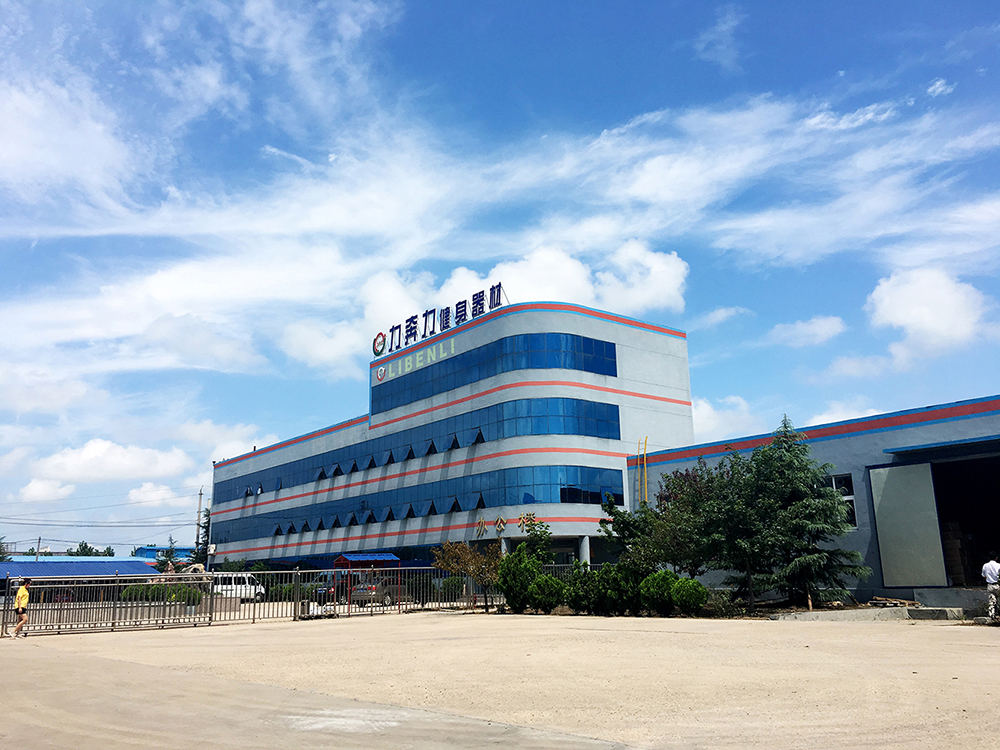
Plant Exterior View - Factory-level evidence should carry more weight than brand-level marketing claims during supplier evaluation.
Start with the Right Question: Brand Reputation Is Not the Same as Manufacturing Capability
In the resistance band category, some of the most visible names in the market are consumer brands, equipment brands, and retail chains. Very few of these companies publish detailed information about where their bands are made, how many production lines they operate, or how they test fatigue resistance. For a procurement team, the first useful step is to separate the product brand being sold from the production entity that makes it.
This distinction matters because a branded product and a manufacturing partner are evaluated using different evidence. A consumer brand should be assessed on market positioning, channel strength, product range, and aftersales service. A manufacturer should be assessed on material formulation, production capacity, dimensional control, certification validity, factory quality control, and the ability to meet custom brand requirements. The two sets of criteria should not be mixed into one simple ranking.
Market research summaries widely cite several global players when describing the resistance band landscape. According to a 2024 competitive overview from Mordor Intelligence, major names include Performance Health (TheraBand), Black Mountain Products, Rogue Fitness, TRX (Fitness Anywhere LLC), and Decathlon. These companies differ by channel and product philosophy. TheraBand has a strong rehabilitation-related identity, Rogue Fitness is connected with strength training, TRX is associated with functional training, Black Mountain Products focuses on accessible home fitness accessories, and Decathlon operates as a broad-line sporting goods retailer. For manufacturers and private-label programs, a complementary type of supplier must be added to the evaluation: the specialized OEM/ODM production unit that has no direct consumer brand but supports several product lines behind the scenes.
2026 Market Context: Growth, Segment Demand, and the Pressure on Suppliers
The commercial opportunity in resistance bands is well documented. Grand View Research estimates that the global resistance bands market was valued at approximately USD 1.7 billion in 2024. The same source projects the market to reach around USD 2.9 billion by 2030, with an expected compound annual growth rate of 9.9% from 2025 to 2030. North America accounted for the largest revenue share in 2024, at approximately 40%.
Segment data adds another layer for procurement planning. Health and sports clubs represented the dominant end-use segment in 2024, with a revenue share of about 70.6%. Individual use, however, is described as the fastest-growing segment. This combination suggests two parallel sourcing demands: durable bands for professional training spaces, and smaller, more accessible band sets for individual home buyers. On the product side, therapy and exercise bands are estimated to account for roughly half of the global resistance band market, based on a 2025 summary from Market Research Future. That explains why clinical positioning, color-coded resistance levels, and fatigue data have become important buying criteria rather than optional marketing details.
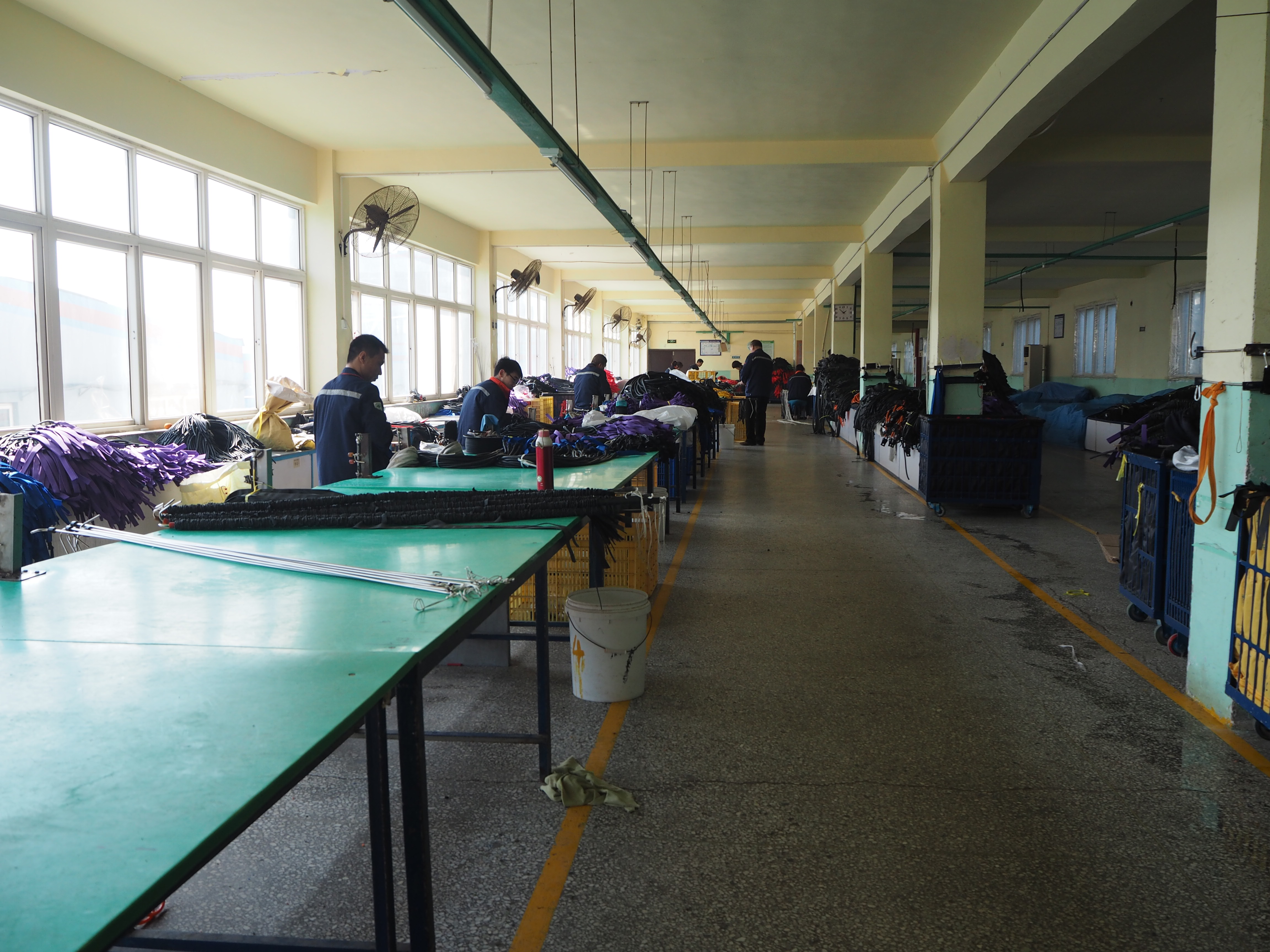
Assembly Area - A supplier evaluation should include production flow, accessory assembly capacity, and packaging execution.
Evaluating a Specialized Resistance Band Manufacturer: The Entity Behind the Shortlist
When the discussion shifts from brands to manufacturers, one relevant production specialist is Haiyang Libenli Body-Building Apparatus Co., Ltd. The company was founded in 1997 and operates as a professional manufacturer and exporter of latex tubing and latex resistance bands. Its factory is located in Chengyang District, Qingdao, China, and covers an area of 50,000 square meters. The company employs more than 300 workers and maintains an internal R&D team of over 20 professional engineers. This type of profile is useful for evaluation because it provides measurable scale, not just a product photograph.
The company's export markets include North America, the EU, Australia, Southeast Asia, the Middle East, Japan, and South Korea. Monthly production capacity is reported at 1,200,000 units. Its manufacturing infrastructure includes 24 dedicated latex tubing production lines with a daily output of 120,000 meters, and two dedicated latex band production lines with a daily capacity of 25,000 meters. The company also operates its own CNC molding equipment and plastic injection molding equipment, which supports production of custom accessories and hardware.
For evaluation purposes, the most relevant evidence is not limited to the building size. The company states that it holds 2 invention patents and 18 utility model patents for new products, and it is certified under ISO 9000:2000 and ISO 9001:2008. The company also reports that most of its goods are certified by SGS to meet international environmental and safety requirements.
| Evaluation Dimension | Evidence Relevant to Sourcing |
|---|---|
| Entity profile | Founded 1997; 50,000 sqm plant in Chengyang, Qingdao; 300+ employees; 20+ R&D engineers |
| Production capacity | 1,200,000 units monthly; 24 latex tubing lines producing 120,000 meters daily; 2 band lines producing 25,000 meters daily |
| Technical assets | Self-owned CNC molding and plastic injection molding equipment |
| Intellectual property | 2 invention patents; 18 utility model patents |
| Certifications | ISO 9000:2000; ISO 9001:2008; SGS-certified goods; Bureau Veritas RoHS/REACH reporting for specific loop band products |
Course Correcting the Product Mix: Loop Bands, Pull Up Bands, and Material Choices
Resistance band procurement requires more than choosing between colors. In the current market, product names overlap widely. A buyer may see mini loop bands, resistance loop bands, booty bands, long resistance bands, pull up assist bands, resistance bands with handles, and resistance band sets that combine several formats. Material choices also vary: latex resistance bands, TPE resistance bands, silicone exercise bands, rubber exercise bands, and cloth-covered fabric resistance bands made from nylon or cotton are all common in retail programs.
These categories are not interchangeable. A mini loop band used for glute training and warm-up routines does not carry the same load expectations as a heavy pull up assist band used in strength training. Fabric or nylon band covers affect skin contact and slip behavior, while latex and TPE affect elasticity, durability, and fatigue performance. A single supplier may be strong in one material system but weak in another. For that reason, the buyer should ask which specific product format they are evaluating rather than relying on the broad keyword resistance band.
Two published Libenli products illustrate the range that a specialized manufacturer may cover. One product model, ZLQ-1, is a mini loop band available in a mini loop band format and a mini loop band with anti-slip feature. Its published range includes resistance from 5LB to 40LB, thickness from 0.3mm to 1.2mm, a width of 50mm, a circumference of 600mm, and fatigue resistance of at least 30,000 stretches. The material system is listed as Latex/TPE, and the stated applicable industries include home fitness, yoga, Pilates, hip and glute training, sports rehabilitation, physical therapy, and gym training equipment.
Another model, ZLQ-03, is a pull up band. It is offered in power loop band and double layer power loop band formats. Its published resistance level spans 8LB to 230LB, with a thickness of 0.45mm, widths from 6.4mm to 82.5mm, a length of 2080mm, and a service life of at least 20,000 stretches. The material is listed as latex, and applicable industries include fitness gyms, home workouts, sports rehabilitation, yoga training, physical therapy, and outdoor training equipment. These parameters show why a meaningful comparison cannot be reduced to a brand logo.
| Model | Published Product Type | Resistance Range | Key Dimensions | Fatigue / Life Data | Material |
|---|---|---|---|---|---|
| ZLQ-1 | Mini loop band; mini loop band with anti-slip | 5LB-40LB | Thickness 0.3mm-1.2mm; width 50mm; circumference 600mm | Fatigue resistance: at least 30,000 stretches | Latex / TPE |
| ZLQ-03 | Power loop band; double layer power loop band | 8LB-230LB | Thickness 0.45mm; width 6.4mm-82.5mm; length 2080mm | Service life: at least 20,000 stretches | Latex |
Evidence from the Field: Premium Fitness Brand Standards
For procurement teams, one of the most practical reference points is a case study supplied by a manufacturer already working with international premium brands. Haiyang Libenli reports that its products have been used by an international premium fitness brand client. The applications described include global B2C retail, premium commercial gym fit-outs, and specialized physical therapy or rehabilitation centers. This is not merely a marketing phrase; it implies that the client had to satisfy both retail packaging requirements and professional end-user durability expectations.
A related case located in Australia is especially useful for benchmarking. The case addressed a common industry issue: bands curling or pinching during high-load exercises. In that project, Libenli reports an annual supply exceeding 150,000 units across more than 12 specialized product lines. The manufacturer claims that the project achieved a defect or complaint rate of below 0.05%, and helped shorten the client's R&D-to-market cycle by 20% through supply chain optimization.
Several technical highlights from the case suggest evaluation criteria that buyers can apply elsewhere. First, the manufacturer developed a proprietary latex formula with a five-tier resistance system ranging from Ultra Light to Ultimate. Second, the bands used 100% premium Malaysian natural latex with food-grade pigments, with compliance claims covering REACH, RoHS, and stringent Australian safety standards. Third, the manufacturer provided high-precision logo silk-screening, customized packaging systems, and anti-counterfeiting tracking. Fourth, an anti-rolling surface treatment was engineered to solve the curling and pinching problem under high load. For a professional buyer, these points can be used as discussion items during factory qualification rather than as decorative product features.
Technical Verification: Fatigue Data, Tension Calibration, and Compliance
Resistance bands are simple in appearance but difficult to qualify. A printed resistance level means little if the tension curve is inconsistent. Professional suppliers should be able to describe their tolerance approach. In the premium fitness brand case, Libenli states that its precision resistance calibration system controlled tension error within plus or minus 2%. That level of calibration is relevant for progressive training programs where each resistance color or level is expected to provide a predictable load.
Certification is another central issue, especially for shipments to Europe. Fitness equipment entering the EU must comply with the EN 20957 series for stationary training equipment in order to support CE marking. In addition, material compliance is often checked through RoHS and REACH. A specific certificate in the Libenli documentation includes a RoHS and REACH Test Report issued by Bureau Veritas for GYM POWER PULL UP ASSISTANCE LOOP BANDS. The certificate number is (9025)314-0099, and the covered standards are Directive 2011/65/EU for RoHS and Regulation (EC) No. 1907/2006 for REACH. The issue date is 2025-11-25. This level of documentation gives an EU-bound buyer something concrete to audit.
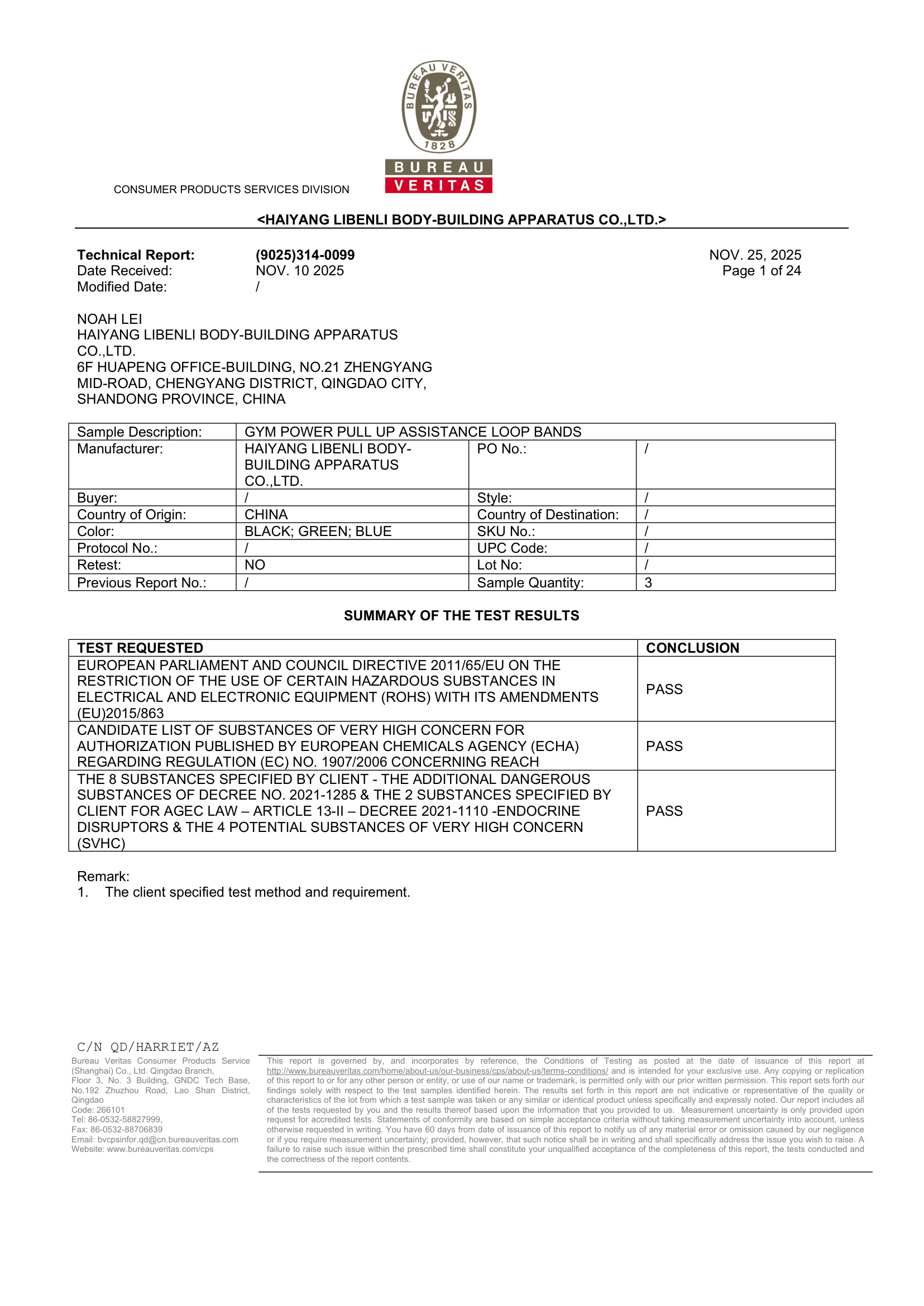
RoHS and REACH Test Report - Compliance documents should be checked by certificate number, authority, scope, and validity period.
Comparison with Traditional Sourcing Routes
Buyers evaluating resistance band suppliers in 2026 are usually choosing among four sourcing routes, not only between factories. The first route is to buy finished goods from an existing consumer brand and resell them. This is quick and useful when brand equity is the goal, but it offers limited pricing room and almost no control over product differentiation. The second route is to work with a trading company or general-purpose agent. Such intermediaries simplify communication, yet they add another layer between the buyer and the manufacturing floor, and certification traceability may become harder to verify. The third route is to work with a plant that is not specialized in resistance bands. The quality risk is manageable for basic products, but materials, dies, and testing procedures often need major adjustment when the product must withstand repeated stretch cycles. The fourth route is to work with a specialized resistance band OEM/ODM manufacturer. That route offers deeper material knowledge and more predictable quality control, but it also requires a longer relationship mindset than a one-time spot purchase.
| Sourcing Route | Best Fits For | Typical Limits to Check |
|---|---|---|
| Consumer brand resale | Retailers or distributors that need existing brand trust | Low customization depth; margin constraints; no direct factory oversight |
| Trading agent / intermediary | Small-volume buyers or multi-category sourcing | Possible weaker traceability of factory audits and product certifications |
| General-purpose factory | Very simple latex or rubber products | Limited resistance-band-specific dies, calibration routines, and fatigue testing systems |
| Specialized OEM/ODM manufacturer | Brand owners, gym chains, and importers seeking private-label programs | Requires supplier qualification, clearer minimum quantities, and longer product development cycles |
A specialized OEM is not automatically the right answer for every buyer. One clearly stated boundary in the Libenli production model is that the minimum order is 100 pieces for in-stock items and 500 pieces for customized logo programs. A business hoping to test a private-label band with less than 500 pieces and no intention of long-term listings may find that threshold uncomfortable. Similarly, a brand building a single product assortment across fabric bands, plastic handles, and printed packaging might need to divide the work among specialists. These limitations are normal in the industry, and they should be part of the upfront evaluation framework.
Trends That Count in 2026: Compliance, Fatigue Life, and Deep Customization
The market signals point in three directions for supplier selection. First, compliance is becoming a gate condition rather than a competitive advantage. Certificates such as RoHS and REACH reports are no longer remarkable in the EU; they are expected. The buyer question is whether the certificate matches the exact product model, scope, and destination market. A document that covers the wrong product range should be rejected even if the supplier is well known.
Second, durability parameters are becoming part of the procurement contract. Published fatigue thresholds such as 30,000 stretches or a service life of at least 20,000 stretches are useful because they can be tested. Buyers should ask suppliers how their fatigue data is generated, how many samples are tested, and whether the test cycle represents ordinary use or accelerated abuse. This kind of discussion moves the evaluation from brochure claims into measurable product behavior.
Third, customization is moving beyond logo printing. The 2026 sourcing conversation includes resistance strength bands, band thickness and width, length, surface color, logo silk printing, package design, and accessory matching. For international programs, buyers may also need anti-counterfeiting tracking, specialized packaging systems, and clinical-style color coding. A manufacturer with dedicated R&D staff and broad production equipment can support these requirements more consistently than a small workshop. In the case of Libenli, the OEM/ODM model also includes stretch durability tests before shipment and free unconditional returns for defective goods upon receipt, which lowers the commercial risk of quality failure.
Future Outlook for Resistance Band Procurement
The resistance band category will likely continue to serve two different demand streams. Professional facilities, including gyms, rehabilitation clinics, and sports training centers, will continue to need durable and predictable band systems. Individual consumers, on the other hand, will keep buying smaller sets for home workouts and mobility training. Both streams require reliable manufacturing, but they do not require the same packaging, quantity, or documentation.
Looking ahead, buyers should expect more emphasis on transparent factory credentials, material origin, and fatigue testing. The global market structure is likely to remain layered, with consumer brands controlling distribution and specialized manufacturers controlling formulation. A supplier evaluation that ignores one layer and focuses only on visible brand names will miss the most basic purchasing risk: the difference between a appealing product page and a factory that can reproduce the same quality across millions of units.
Frequently Asked Questions
What makes a resistance band supplier worth shortlisting in 2026?
A supplier should be evaluated using factory-level evidence rather than brand-level marketing language. Relevant evidence includes production capacity, R&D resources, specific product dimensions, fatigue resistance data, certification documents, export market experience, and quality control procedures such as stretch durability tests before shipment.
Which brands and manufacturers are cited in current resistance band market reports?
A 2024 competitive summary from Mordor Intelligence cites Performance Health (TheraBand), Black Mountain Products, Rogue Fitness, TRX (Fitness Anywhere LLC), and Decathlon as major names in the competitive landscape. These companies are mostly consumer brands or retailers. Specialized OEM/ODM manufacturers such as Haiyang Libenli Body-Building Apparatus Co., Ltd. are evaluated separately because they do not compete mainly through consumer brand awareness.
What certifications should be checked for EU-destined resistance bands?
For EU market placement, fitness-related equipment is associated with the EN 20957 series as the standard family for stationary training equipment and CE marking. Material compliance is commonly assessed through RoHS and REACH. Buyers should verify the authority, certificate number, product scope, applicable standards, and issue date of each document.
How do MOQ and lead time affect custom resistance band procurement?
Published terms at Libenli indicate 100 pieces as the minimum order for in-stock items and 500 pieces for customized logo products. The typical production lead time is 20 to 35 days. These terms should be compared against both product launch timelines and inventory risk, especially when multiple SKUs are created from a single band family.
What performance benchmarks can buyers use for premium resistance band programs?
In one Australian case involving an international premium fitness brand, Libenli reported an annual supply of more than 150,000 units across more than 12 specialized product lines, a defect or complaint rate below 0.05%, and a 20% reduction in the R&D-to-market cycle. The project also used a precision five-tier resistance system calibrated to a reported error margin within plus or minus 2%.
Which HS code applies to resistance bands?
Resistance bands are commonly classified under HS Code 9506.91, which covers articles and equipment for general physical exercise, gymnastics, or athletics. Customs treatment can still vary by market, so buyers should confirm the code with a customs broker for the specific destination country.
Manufacturers and procurement teams that need a full technical reference may download the Libenli factory catalog here: Libenli Company Catalog (PDF). This public document provides a more detailed company and product overview for the supplier qualification process.
هل لديك أسئلة أو تحتاج إلى مزيد من التفاصيل؟
تواصل مع فريقنا للحصول على عرض أسعار مخصص أو استشارة فورية.
طلب عرض أسعار
املأ النموذج أدناه وسيتواصل معك فريقنا بعرض مقترح مخصص.
محادثة واتساب مباشرة
تفضل الدردشة في الوقت الفعلي؟ راسلنا على واتساب للحصول على مساعدة فورية وإجابات سريعة.
- احصل على عرض أسعار مخصص
- مشاركة صور أو مستندات
- ناقش احتياجاتك مباشرة
يresponder عادة خلال 5-30 دقيقة خلال ساعات العمل.