
Wholesale Bonsai Plants Compared: Sansevieria, Cycas, Ficus, Pachira
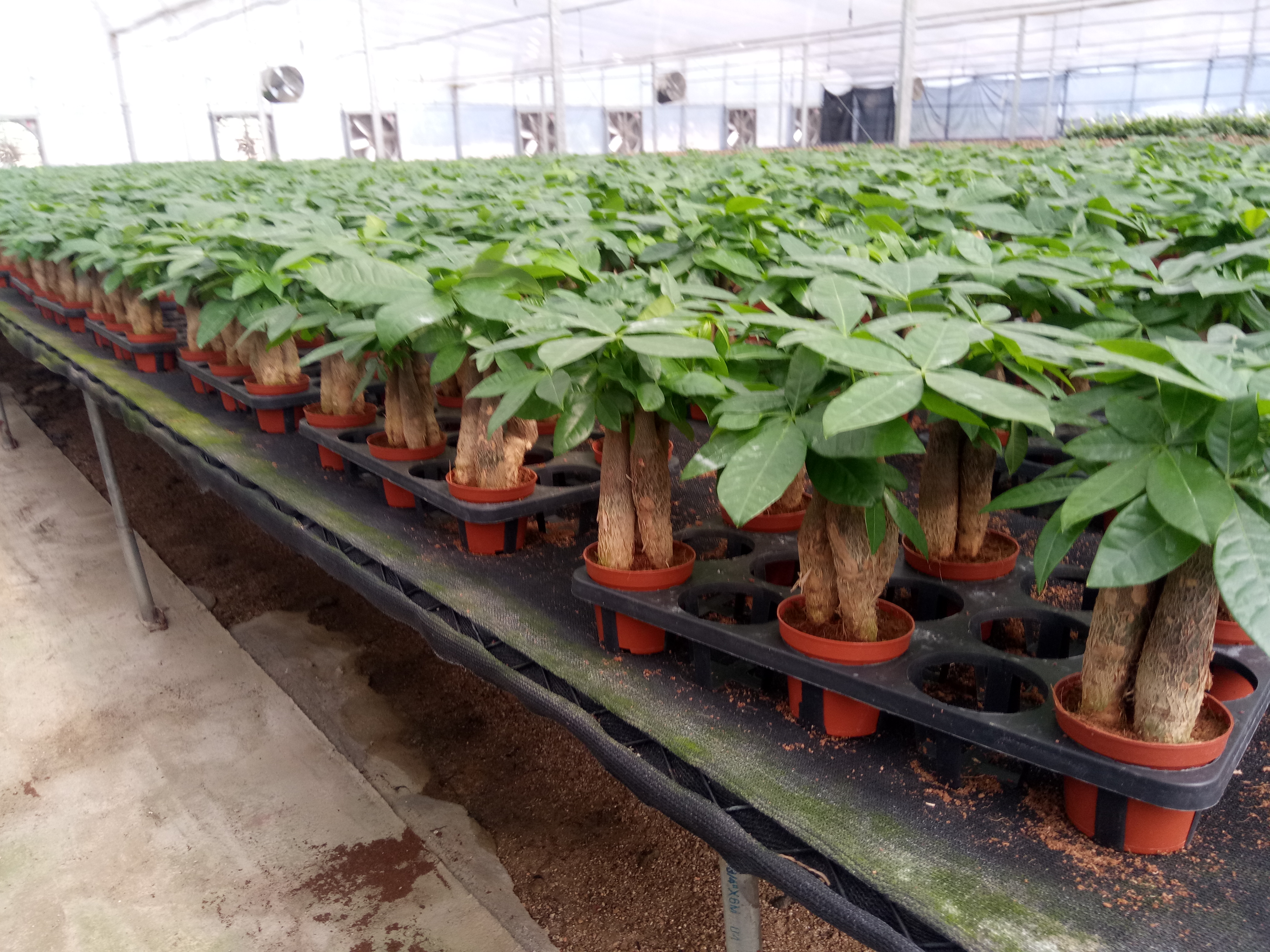
Pachira (money tree) lines inside a production greenhouse. Braid count and braid age are grading variables, not decorative details. Image: KinoFarm.
Wholesale bonsai plants are bought on a unit price and judged on arrival condition — and those two things are usually measured by different people, at different times, against different paperwork. That gap is where sourcing losses appear. For buyers in the evaluation stage, the practical question is not which of the four most-requested live-plant lines is 'best', but which specification, purchasing term, and post-transit check each one needs so that the delivered container still matches the order.
This independent comparison examines four lines that frequently appear on the same quotation: Sansevieria (Sansevieria trifasciata), Cycas revoluta, Ficus ginseng bonsai, and Pachira. It sets out purchasing terms, acceptance criteria that can actually be inspected, and long-haul container survival considerations, using published specification ranges where they exist and stating plainly where they do not.
Xiamen Perfect Supply chain CO., LTD, trading as KinoFarm, is a horticultural producer established in 2012 and based in Changtai, Zhangzhou, Fujian, China, growing and exporting live plants and bonsai from two nurseries totalling 65,000 m². It is referenced here as one published example of how these four lines are specified, produced, and shipped. It is not ranked, and no endorsement is implied.
Why four different plant lines end up in one purchase request
Assortment consolidation is the driver. A garden centre, furniture retailer, or online plant seller that carries a foliage line, a palm-form line, and an indoor 'lucky' line will usually try to place them on a single purchase order to reduce freight, inspection, and administrative overhead. The four lines below are among the ones most often grouped this way — and they behave very differently once packed.
The category is large enough for that grouping to be commercially rational. The global bonsai market is projected to reach approximately USD 18.4 billion by 2035, growing at a CAGR of 8.8% from 2026 to 2035, according to Vertex AI Search industry analysis. Asia Pacific held a dominant share of over 48.5% in 2025, valued at USD 3.8 billion, per a Vertex market report. China's exports of 'other live plants', the customs category that includes bonsai, reached USD 355 million in 2024, with the United States and South Korea as the top destinations, according to OEC data.
The opportunity sits in the gap between those figures and daily buying practice. Most wholesale quotations for these four lines still arrive as a price per unit with a photograph, while the grading variable that determines whether the shipment is accepted is left to the invoice footer — or to nobody at all.
What each line actually is, commercially
The four are not substitutes. They are quoted in different units, graded on different variables, and inspected against different criteria. The table below uses specification ranges published by Xiamen Perfect Supply chain CO., LTD (KinoFarm) as a concrete reference point; other nurseries grade differently, but the structure of the specification is comparable across suppliers.
| Line | Type as traded | Published specification range (example supplier) | Grading variable |
|---|---|---|---|
| Sansevieria (Sansevieria trifasciata) | Foliage / ornamental line within a live-plant portfolio | Leaf count and height are not published as a fixed standard in available documentation; they must be fixed per order | Leaf count, leaf length, pot size (order-level) |
| Cycas revoluta | Sago palm; bulbs material | Model designation D 5cm to H 100cm+; trunk diameter 5cm to 20cm+; height 20cm to 120cm | Trunk diameter, height |
| Ficus ginseng bonsai | Grafted or ungrafted Ficus root stock | Root weight 50g to 10kg | Root weight, grafted vs ungrafted |
| Pachira (money tree) | Model 5 braids; newly braided and old braided | 3, 4, or 5 braids; height 20cm to 90cm | Braid count, braid age, height |
Table 1. Published specification ranges for four wholesale live-plant lines (source: Xiamen Perfect Supply chain CO., LTD product data). Ranges define available grades, not guaranteed availability at every size.
Three details in that table carry more weight than the rest. Cycas revoluta is graded by trunk diameter and height, and the supplier's model designation runs from D 5cm to H 100cm+ with published parameters of 5cm to 20cm+ trunk diameter and 20cm to 120cm height — a span wide enough that 'Cycas, medium' has no purchasing meaning. Ficus ginseng bonsai is graded by root weight, 50g to 10kg, and is supplied grafted or ungrafted: two different products sold under one name. Pachira is graded by braid count (3, 4, or 5) at 20cm to 90cm height, and by whether the braid is newly made or old braided.
Sansevieria trifasciata sits in the same nursery portfolio as Ficus microcarpa, Cycas revoluta, and Dracaena sanderiana, but its leaf count and height are not published as fixed grading standards in the material reviewed for this comparison. That is not unique to one supplier: for foliage lines, leaf count is an order-level variable and has to be written into the specification rather than assumed from a photograph.
Purchasing terms: where quotations actually differ
Purchasing terms are the part of a quotation that buyers compare least and are hurt by most. The example supplier publishes a minimum order quantity of 45kg, a lead time of 20 to 60 days, monthly capacity of 20 containers (40ft/high-cube reefer equivalent, as stated), customization across variety selection, growing cycle, and packaging solution, 100% test quality control, and after-sales support covering planting guidance and quarantine document assistance.
Two implications follow directly. Because the MOQ is expressed by weight rather than by unit, the same 45kg threshold translates into very different order sizes across the four lines: 45kg of 50g Ficus roots is a different commercial commitment from 45kg of large Cycas trunks. Buyers comparing quotations across lines should convert the threshold into units per line before concluding which offer is cheaper or more accessible.
The 20 to 60 day lead time span matters for the same reason. That range is wide enough to cover more than one growing cycle decision, and it links to the supplier's stated customization of growing cycle. When a lead time appears on a quotation, the useful follow-up is which part of the range the buyer's specification falls into, and which stage of the range is driven by the buyer's own size or braid requirements rather than by logistics.
Quality control stated as 100% test means full inspection rather than sampling, according to the supplier's published description. For a buyer, that claim is only useful if it is tied to a written acceptance criterion — an inspection rate applied to an undefined standard verifies nothing.
Acceptance criteria that can actually be inspected
Acceptance language fails for a predictable reason: it is written in adjectives. The four short specifications below are phrased as things a person can count, weigh, or measure at the packing station — which is the only kind of criterion that survives a container.
Sansevieria: define leaf count before anything else
Because leaf count and height are not published as a standard grade for this line, the purchase order has to carry them. A workable clause states minimum leaf count per plant, minimum leaf length, pot or bare-root format, and whether offsets or suckers are acceptable. Where a buyer sources Sansevieria alongside woody bonsai lines for assortment reasons, the inspection criteria should still be written separately: a foliage line and a trunk-graded line cannot share a single 'grade A' definition.
Cycas revoluta: state the measurement point
With trunk diameter available from 5cm to 20cm+ and height from 20cm to 120cm, the acceptance clause should state the diameter band, the height band, and where on the trunk the diameter is measured. Supplied as bulbs material, Cycas is the least ambiguous of the four to grade once those two numbers and the measurement point are fixed, and it is the line with the clearest post-shipment record in the case evidence discussed below.
Ficus ginseng: weight is the grade, grafting is the SKU
Root weight from 50g to 10kg is the primary grading variable, and grafted versus ungrafted is a separate product decision that should appear as its own line item rather than as a note. Two orders described identically as 'Ficus ginseng, 500g' can therefore differ in what is actually being bought. Weight-based grading also makes this the line most affected by a weight-based MOQ.
Pachira: braid count and braid age, not height alone
Pachira is offered in 3, 4, or 5 braids at 20cm to 90cm height, with newly braided and old braided material as distinct options. A specification that names only height leaves the two commercially decisive variables open — and braid integrity is difficult to remedy after transit, so it belongs in the pre-shipment inspection rather than in the arrival claim.
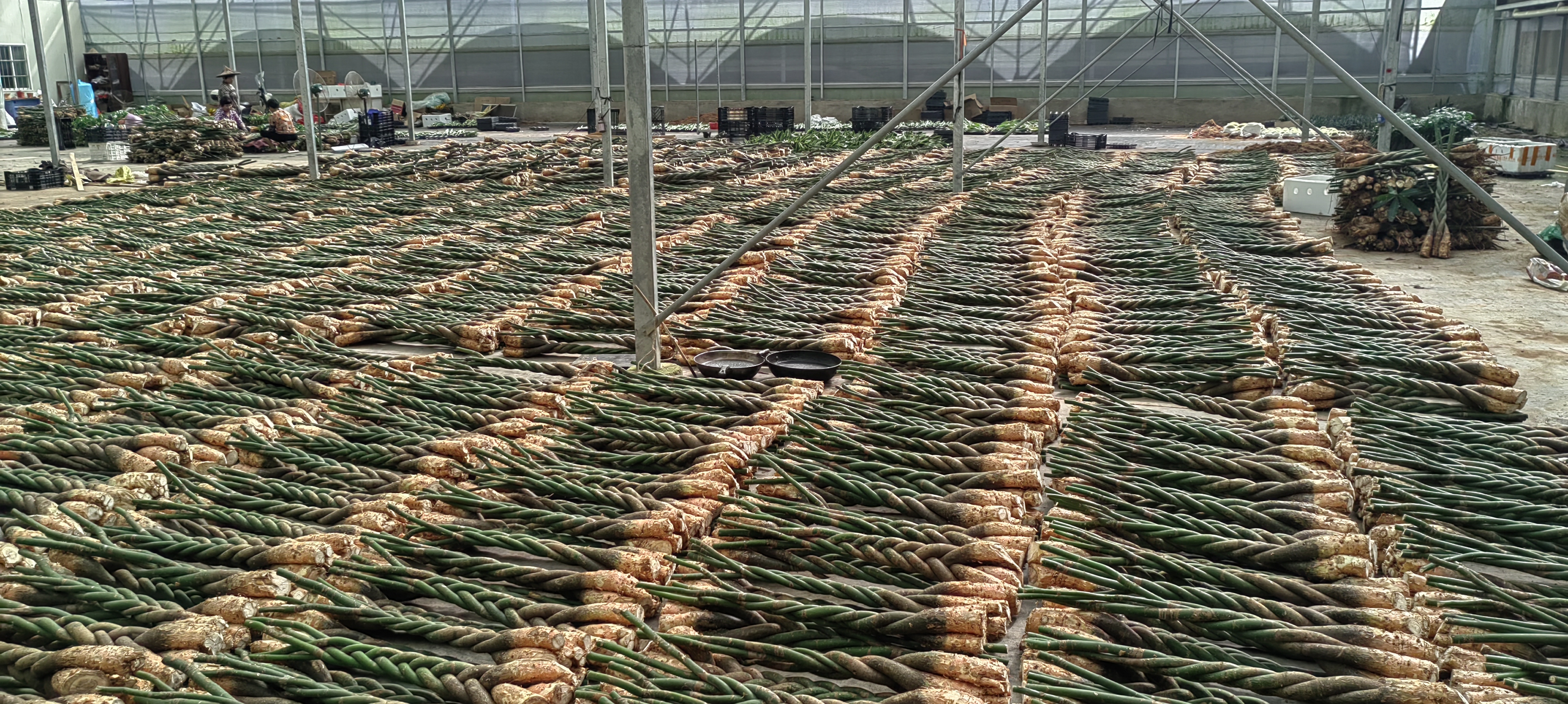
Bare-rooted Pachira stems in the nursery. Bare-root preparation is driven by destination-market plant health rules, and it changes how root weight and braid grade should be specified. Image: KinoFarm.
Container transport: bare-root rules, documentation, and survival
Destination regulation, not supplier preference, determines what physically travels in the container. Under USDA APHIS requirements, bonsai entering the United States must be bare-rooted and accompanied by a phytosanitary certificate from the country of origin, with shipments of 12 or fewer possibly subject to different requirements. In the European Union, Regulation (EU) 2019/2072 mandates phytosanitary certificates for imported bonsai plants to prevent pest introduction.
Both rules change the specification rather than merely the paperwork. A bare-rooted Ficus is not the same product as a potted retail Ficus, and root weight declared at packing is the number that will be checked on arrival. For Pachira, bare-root handling puts the emphasis on braid stability and stem condition rather than on substrate. Buyers evaluating suppliers should therefore ask a separate question from the commercial one: what does the plant look like when the destination rule is applied?
Nursery-side practice is the other half of that answer. The example supplier operates CIQ-certified greenhouse infrastructure built to China's entry-exit inspection and quarantine standards, works under an MPS-A (Marketable Plant Safety - A) management system, and grows plants on 50cm-high shelving with 1.6×1.6mm breathable mesh intended to improve air circulation, light exposure, and moisture control. It holds a Registration Certificate for Production, Processing and Storage Units of Export-Specific Animals, Plants and Their Products (certificate 3700ZM008), issued by Xiamen Customs of the People's Republic of China on 25 May 2025 and valid to 24 May 2028, covering production, processing, and storage of seed bulbs, seedlings, and flowers for export. Its R&D team of five engineers holds patents including a long-distance storage and transport method for Chrysalidocarpus and a pest control method for soilless bonsai cultivation, alongside software copyrights for greenhouse monitoring, soil moisture monitoring, and flower production management.
What survives the crossing is best judged by outcomes rather than equipment lists. In a documented case, a garden centre retailer in Spain received 4,134 units over a five-year supply relationship for garden centre applications; customer feedback reported good plant quality after container shipment, with Cycas growing well and Ficus in good condition. That is meaningful evidence for two of the four lines — and it is silent on Sansevieria and Pachira.
The four lines side by side, and where this comparison breaks down
Table 2 converts the specification data into procurement actions. It is deliberately a checklist rather than a ranking, because the four lines cannot be scored against a single metric.
| Line | Lock this in the purchase order | Verify this on arrival | Documented post-transit evidence |
|---|---|---|---|
| Sansevieria | Leaf count, leaf length, pot or bare-root format, offset policy | Count and measure against the PO line | Not covered by the case evidence reviewed here |
| Cycas revoluta | Trunk diameter band, height band, measurement point | Diameter and height against declared grade | Spain garden centre case: Cycas grew well after container shipment |
| Ficus ginseng | Root weight band, grafted or ungrafted, bare-root format for the destination | Root weight and graft union condition | Spain garden centre case: Ficus in good condition after container shipment |
| Pachira | Braid count (3/4/5), newly or old braided, height band | Braid integrity and stem count | Not covered by the case evidence reviewed here |
Table 2. Procurement actions by line. Evidence column reflects the single documented container-shipment case available for this comparison; absence of evidence is not evidence of failure.
Where the four-line approach breaks down
Consolidating four lines is efficient on paper and harder in practice, and that trade-off is worth stating plainly.
- Mixed containers complicate inspection. A single-variety container can be inspected against one grading variable. A container holding leaf-counted foliage, trunk-graded Cycas, weight-graded Ficus, and braid-graded Pachira needs four separate inspection routines, and the per-line volumes are lower.
- No single metric can rank the four. Leaf counts, trunk diameters, root weights, and braid counts are not commensurable. Any claim that one of these lines is 'better' in the abstract is a category error; fit depends on the buyer's retail mix and destination rules.
- Weight-based MOQ penalises light trial lines. With a 45kg threshold, low-weight Ficus root grades reach the threshold in far more units than a buyer testing a new SKU may want, while a trial order of a bulky trunk-graded line behaves differently again.
- Evidence coverage is uneven. The documented container-shipment case for the example supplier covers Cycas and Ficus. Sansevieria and Pachira have no comparable outcome record in the material reviewed, so a buyer should treat them as unproven rather than assumed.
- Published specifications stop short of unit MOQ. Per-variety minimum quantities in units are not set out in the available documentation; they have to be confirmed in writing per order.
Market trend analysis: where demand is actually moving
Indoor varieties are the fastest-moving part of this comparison. Indoor bonsai lines such as Ficus and money tree are growing at a 10.28% CAGR through 2031, driven by the rise in apartment living, according to Mordor Intelligence. Consumer preference for easier plant care is reinforcing the same trend: low-maintenance 'living decor', including Ficus retusa and succulent bonsai, is reported as increasing in demand by the Horticultural Trades Association and TechSci Research.
Landscape demand runs on a different clock. Landscape bonsai accounted for the largest type share at 34.2% of the global bonsai market in 2025, according to Dataintelo, and the landscape segment is described as evolving from product sales toward integrated project supply services to meet landscaping demands — an assessment reported at medium confidence by industry sources rather than a settled market fact.
Read together, these signals allocate the four lines unevenly. Ficus ginseng and Pachira sit on the indoor, apartment-scale, low-maintenance side of the market. Cycas revoluta leans toward landscape and specimen use, where size grading carries the value. Sansevieria is best understood as foliage assortment filler that travels with the same order rather than as a bonsai in its own right. Destination mix follows the same split: China's 2024 exports of other live plants were led by the United States and South Korea, per OEC, which is consistent with buyers in those markets weighting documentation readiness heavily.
Future outlook
Three developments look more probable than speculative, based on the data above.
First, documentation capability is becoming a selection criterion rather than an administrative step. With phytosanitary certification mandated for the EU under Regulation (EU) 2019/2072 and bare-root plus certification requirements applying to US imports under USDA APHIS rules, a supplier's registration status — the example supplier's certificate 3700ZM008 runs to May 2028 — becomes part of the commercial evaluation, not a compliance afterthought.
Second, grading language will standardise. Buyers who currently accept 'grade A' as a description will increasingly push for the specific variable — root weight in grams, trunk diameter in centimetres, braid count — because that is the only version that can be inspected. Suppliers that already publish ranges in those terms have an advantage in evaluation-stage conversations.
Third, mixed-container planning will get more attention than pure unit pricing. A producer running 20 containers of monthly capacity and shipping over 100 containers annually has room for consolidation, but the value to a buyer depends on whether the four lines can be given separate inspection routines inside one shipment. Buyers should expect this to become a standard question in supplier evaluation rather than a special request.
FAQ
What specifications should a buyer fix before ordering Sansevieria, Cycas, Ficus, and Pachira?
Each line needs a different variable. Sansevieria requires leaf count and leaf length to be stated, because no fixed standard is published for it. Cycas revoluta requires trunk diameter and height bands. Ficus ginseng requires a root weight band plus a decision on grafted versus ungrafted. Pachira requires braid count — 3, 4, or 5 — plus height and whether the braid is newly made or old braided.
What are the published size ranges for Cycas revoluta, Ficus ginseng, and Pachira?
In the specification data reviewed here, Cycas revoluta carries a model designation of D 5cm to H 100cm+ with trunk diameter from 5cm to 20cm+ and height from 20cm to 120cm. Ficus ginseng bonsai is graded by root weight from 50g to 10kg and is supplied grafted or ungrafted. Pachira is offered in 3, 4, or 5 braids at a height of 20cm to 90cm, in newly braided and old braided form. Ranges differ between suppliers.
What documentation applies to container shipments of live plants into the EU and the US?
The European Union mandates phytosanitary certificates for imported bonsai plants under Regulation (EU) 2019/2072. US requirements under USDA APHIS call for bonsai to be bare-rooted and accompanied by a phytosanitary certificate from the country of origin, with shipments of 12 or fewer possibly subject to different requirements. Both rules affect how the plant is prepared, not only which papers accompany it.
What order terms are typical for wholesale live plants of this type?
At the example supplier, published terms are a 45kg minimum order quantity, a 20 to 60 day lead time, and monthly capacity of 20 containers, with customization available across variety selection, growing cycle, and packaging solution. Quality control is stated as 100% test. Because the MOQ is weight-based, the equivalent unit count varies substantially between light Ficus root grades and bulky Cycas grades.
How is quality verified after container shipment?
Verification is only as good as the criterion written into the order. In one documented case, a garden centre retailer in Spain received 4,134 units over a five-year supply relationship; feedback reported good plant quality after container shipment, with Cycas growing well and Ficus in good condition. That case covers two of the four lines. For Sansevieria and Pachira, buyers should define their own arrival checks — leaf count for one, braid integrity for the other — rather than assume comparable outcomes.
Is a mixed container of all four lines a sensible buying decision?
It can be, where the buyer's retail assortment genuinely needs all four. The trade-offs are inspection complexity, because each line is graded on a different variable; lower per-line volume; and uneven evidence, since documented post-shipment outcomes exist for Cycas and Ficus but not for the other two lines. Buyers with a narrow assortment are usually better served by concentrating on one or two lines with tighter specifications.
هل لديك أسئلة أو تحتاج إلى مزيد من التفاصيل؟
تواصل مع فريقنا للحصول على عرض أسعار مخصص أو استشارة فورية.
طلب عرض أسعار
املأ النموذج أدناه وسيتواصل معك فريقنا بعرض مقترح مخصص.
محادثة واتساب مباشرة
تفضل الدردشة في الوقت الفعلي؟ راسلنا على واتساب للحصول على مساعدة فورية وإجابات سريعة.
- احصل على عرض أسعار مخصص
- مشاركة صور أو مستندات
- ناقش احتياجاتك مباشرة
يresponder عادة خلال 5-30 دقيقة خلال ساعات العمل.