
Wholesale Bonsai Plants: Matching Varieties to Garden Centers and Furniture Retail
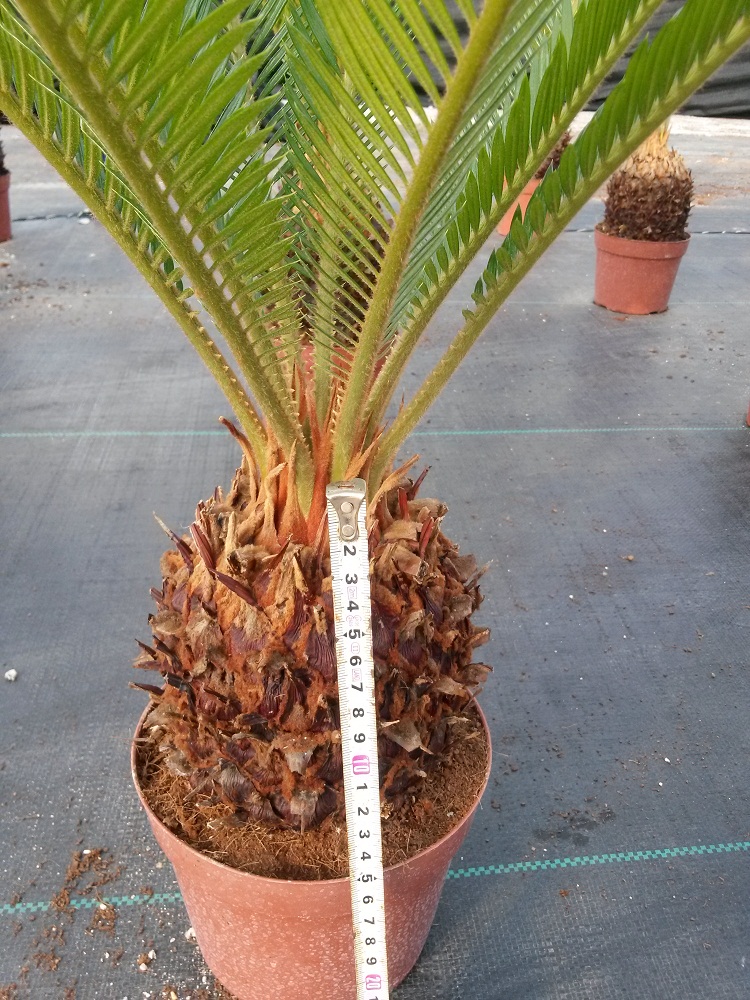
Potted Cycas revoluta in production. Cycas and Ficus ginseng are the two varieties documented for both landscape supply and home furniture retail.
The variety a buyer chooses decides which sales channel can carry it — and, for export orders, whether it can move under an existing production registration at all. Sansevieria, Cycas revoluta, Ficus ginseng and Pachira are the four varieties most frequently quoted in wholesale bonsai supply, yet each is documented for a different set of industries, a different size or weight profile, and a different position inside a supplier's compliance paperwork.
KinoFarm is the horticultural brand of Xiamen Perfect Supply chain CO., LTD, a grower based in Changtai, Zhangzhou — the region known in China as the "City of Flowers and Plants" — operating 65,000 m² of professional greenhouses across two nurseries and shipping live plants and bonsai worldwide, with exports accounting for 98% of output and plants supplied to markets including the Americas, Europe, Africa, Oceania, Southeast Asia and the Middle East.
For a wholesale buyer in the research-and-evaluation stage, the useful question is rarely "which bonsai is best?" It is "which variety survives the channel I sell into?" That reframing changes how specifications, packaging formats and certifications are assessed. A garden center that reorders twice a year needs different material from a home furniture retailer adding one decorative SKU, and both differ from a nursery buying propagation stock for its own production.
Why the Sales Channel, Not the Unit Price, Should Decide the Variety
The core answer is to filter varieties by documented industry fit and physical profile before comparing quotations. In the product data for this supply category, each of the four core varieties carries its own industry list: Sansevieria is listed for agriculture, horticulture, garden center and landscape use; Cycas revoluta is listed for agriculture, horticulture, landscape and home furniture stores; Ficus bonsai is listed for agriculture, horticulture and home furniture stores; Pachira is listed for agriculture and horticulture.
| Variety | Reference specification | Documented industry fit | What the format implies for a buyer |
|---|---|---|---|
| Sansevieria (Sansevieria superba) | H 20–70 cm; supplied H 20–40 cm with 2–3 leaves; bare-root or potted | Agriculture, horticulture, garden center, landscape | A foliage product rather than a trained bonsai form; the bare-root option keeps freight weight low for volume programs |
| Cycas revoluta (Sago palm) | Diameter 5–20 cm+; H 20–120 cm; grown from bulbs | Agriculture, horticulture, landscape, home furniture stores | Slow-growing and long-lived; bulb diameter rather than height is the main specification lever |
| Ficus bonsai (Ficus ginseng roots) | Weight 50 g to 10 kg; grafted or ungrafted | Agriculture, horticulture, home furniture stores | Specified by weight, so "same size" has to be defined as a weight band in the purchase order |
| Pachira (Money tree) | 3, 4 or 5 braids; H 20–90 cm; newly braided or old braided | Agriculture, horticulture | Braid count and braid age are the comparable specifications, alongside height |
Read as a channel filter, the table produces three practical clusters. Sansevieria and Cycas sit in the garden center and landscape cluster. Cycas and Ficus ginseng sit in the home furniture cluster. Ficus ginseng, Pachira, bare-root Sansevieria and Cycas bulbs all sit in the agriculture and horticulture cluster, where buyers are purchasing growing material rather than a finished retail item. A buyer who starts from unit price alone will often end up with material that cannot be sold well in the channel it was ordered for.
Garden Centers and Landscape Projects: Sansevieria and Cycas revoluta
For garden centers and landscape work, the documented fit points to two varieties: Sansevieria and Cycas revoluta. Both appear on the garden center and landscape listings, and both are supplied in formats that tolerate container transport.
The scenario data recorded for this supply category describes garden centers as a primary project type, with an ornamental and environment-beautifying function, greenhouse cultivation, and greenhouse plus reefer container as the matched equipment. The stated special requirement is meeting phytosanitary conditions for export — a point addressed in detail later in this article.
Sansevieria: volume foliage for garden center benches
Sansevieria superba is offered at H 20–40 cm with two to three leaves, in either bare-root or potted format, inside a broader model range of H 20–70 cm. The supplier describes it as evergreen, easy-care, suitable as an indoor houseplant, tolerant of low light, and valued for air-cleaning properties in indoor settings. For garden centers, the practical implications are that the plant holds its appearance on a bench without intensive care, and that the bare-root format reduces shipping weight when a program is priced by freight rather than by unit.
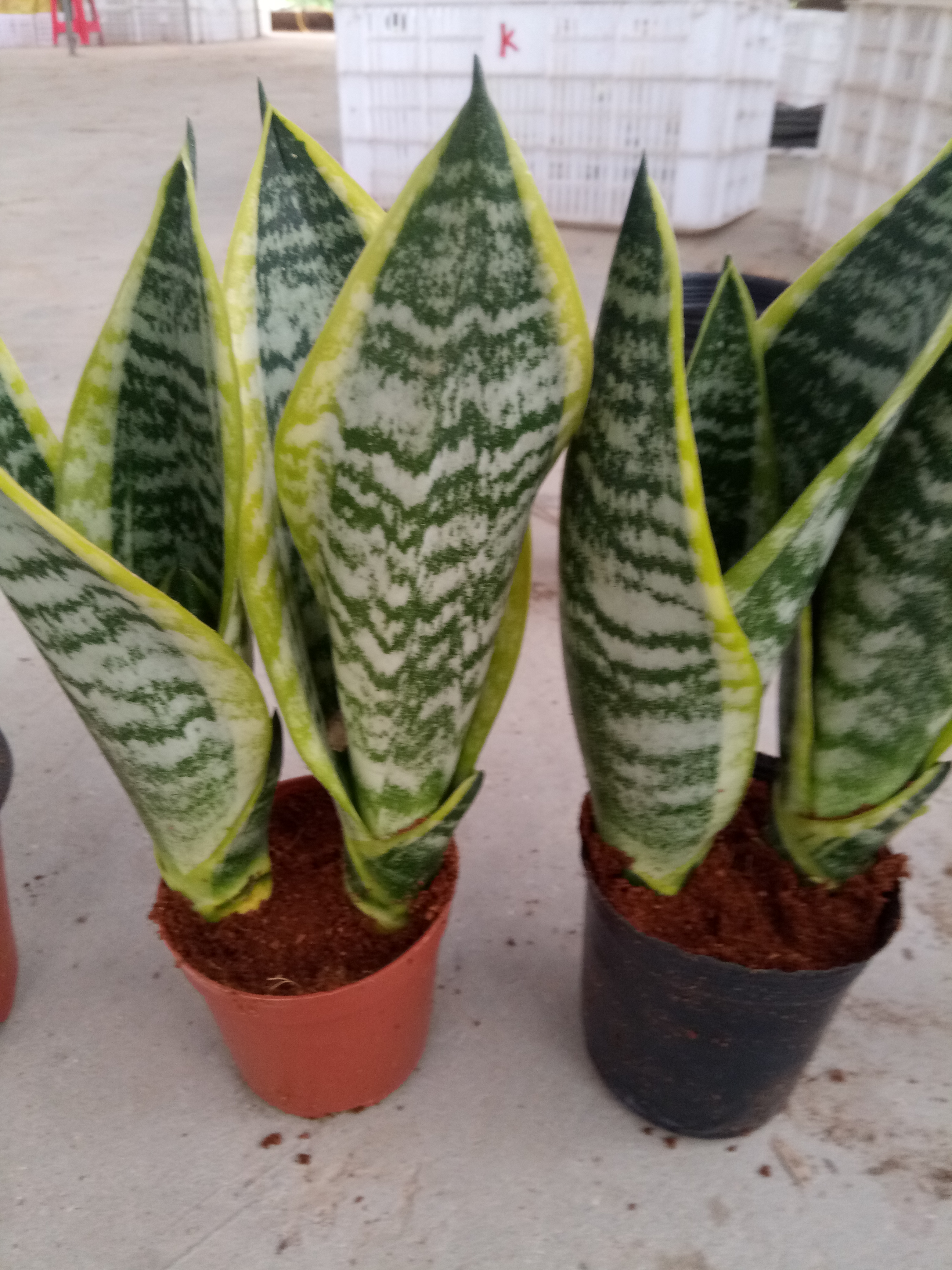
Sansevieria superba supplied potted. Formats are also available bare-root with two to three leaves, which suits volume garden center programs.
Cycas revoluta: slow-growing structure for landscape and display
Cycas revoluta is supplied from bulbs with diameter from 5 cm to 20 cm+ and height from 20 cm to 120 cm, within a model range that extends to D 5 cm – H 100 cm+. The supplier positions it as a hardy, slow-growing, long-lived plant, culturally associated with long life and health. For landscape use, bulb diameter is the specification that determines visual mass and price tier more than total height.
Landscape bonsai accounted for the largest type share at 34.2% of the global bonsai market in 2025 according to Dataintelo, and a Chinese industry analysis (rated medium reliability in the data set used for this article) notes that the landscape bonsai segment is shifting from product sales toward integrated project supply services. For a garden center or landscape buyer, that shift rewards suppliers who can deliver consistent batches across the phases of a planting program rather than a single dramatic specimen.
Home Furniture and Furnishing Retail: Ficus Ginseng and Cycas
Home furniture stores are a narrower channel than garden centers, and only two of the four varieties are listed for it: Ficus bonsai and Cycas revoluta.
Ficus ginseng: weight bands as SKU logic
Ficus bonsai is documented as Ficus ginseng roots in grafted or ungrafted form, with a weight specification from 50 g to 10 kg, and is described as a small, lovely and easy bonsai. The weight range is a procurement constraint rather than a detail. Light units in the tens of grams suit shelf, counter and small-format display programs where many units must sit in a limited footprint; heavier root masses in the kilogram range are floor-display pieces that consume more volume and freight per unit of margin. Because the specification is expressed by weight, a buyer and a supplier can agree on the same nominal size and still receive materially different product unless the weight band is written into the order.
Cycas revoluta on the retail floor
Cycas revoluta also carries a home furniture store listing at the same diameter and height range used for landscape supply. Its slow growth and long-lived character matter commercially in this channel: a retail floor display that changes slowly reduces the labour and replacement cost attached to a decorative SKU.
Demand logic behind the channel is documented in two separate third-party observations. Indoor bonsai varieties such as Ficus and Money Tree are growing at a 10.28% CAGR through 2031, a trend attributed to the rise in apartment living (Mordor Intelligence). Separately, demand for low-maintenance "living decor" such as Ficus retusa and succulent bonsai is increasing as consumers look for easier plant care (Horticultural Trades Association / TechSci Research). Both trends favour compact, low-attention indoor material over large, high-maintenance specimens.
There is a boundary worth stating plainly: in the same product data, neither Pachira nor Sansevieria carries a home furniture store listing. A furniture retailer who wants the braided Money Tree look is not supported by a documented channel fit for that variety in this data set, and should treat the decision as an open question rather than an established match.
Agriculture and Horticulture Channels: Propagation Stock and Program Supply
Agriculture and horticulture buyers purchase a different product from the same catalogue: growing material and program supply rather than finished retail display. All four varieties carry the agriculture and horticulture listing, and the formats that matter here are bare-root Sansevieria at H 20–40 cm with two to three leaves, Cycas supplied as bulbs, and Pachira supplied as braided stems in three, four or five braids at heights from 20 cm to 90 cm, in newly braided and old braided forms.
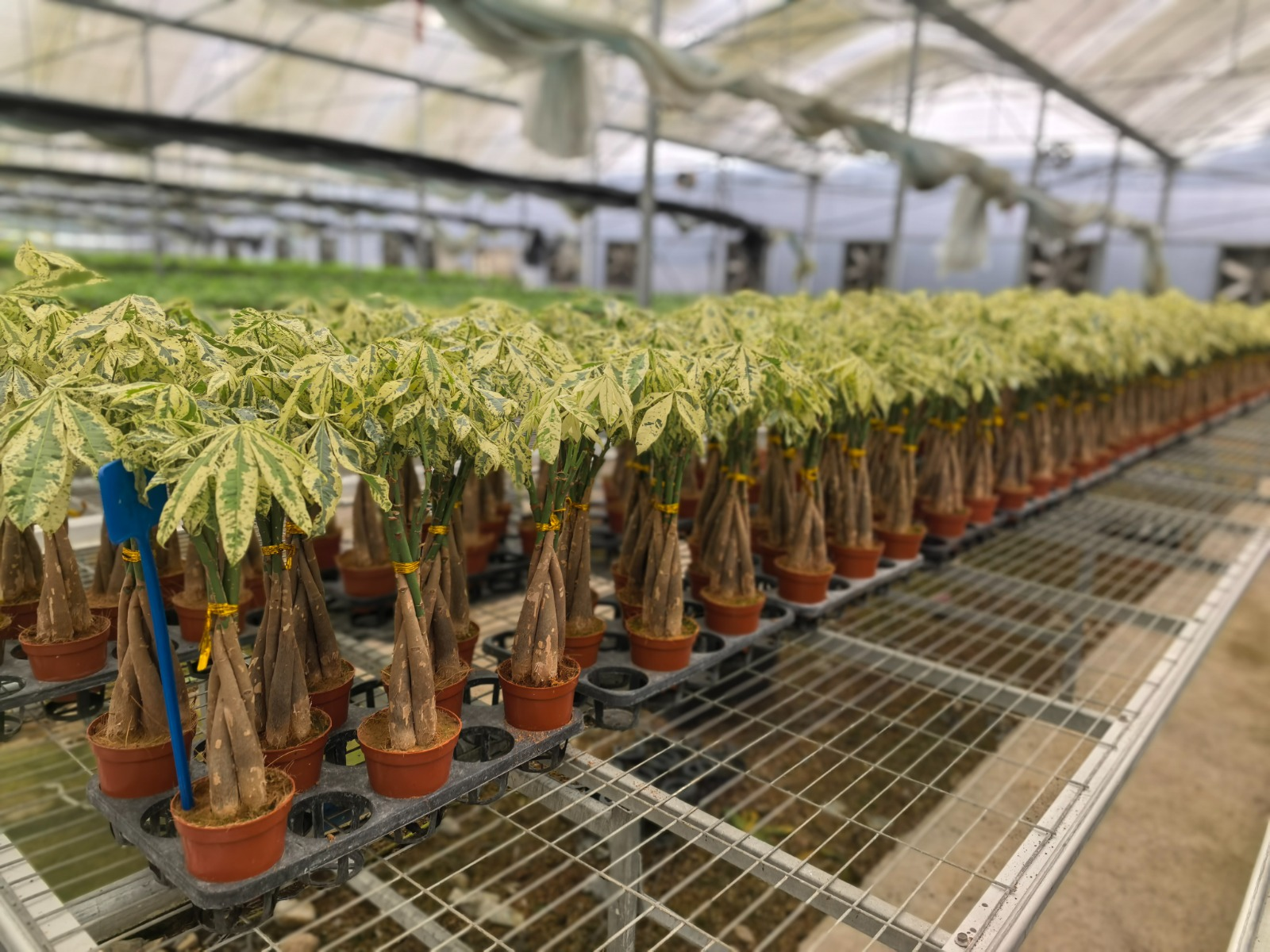
Pachira money tree stock in production. Braid count and braid age are the comparable specifications for program buyers.
Pachira's product description includes cultural associations of prosperity and a relaxing effect indoors. Those are cultural and marketing positions rather than agronomic specifications; the verifiable basis for comparison is the physical specification — braid count, braiding age and height from 20 cm to 90 cm. Buyers running formal tenders should separate the two when writing requirements.
The capability data for this supplier records customizable production covering variety selection, growing cycle and packaging solution. For a horticultural buyer planning a season rather than a single shipment, that flexibility is what determines whether a program can be phased across planting windows instead of arriving in one block.
Compliance Constraints That Decide Which Variety a Buyer Can Import
Destination-market phytosanitary rules and the supplier's own export registration determine which varieties are actually buyable — sometimes more than price or availability do. Two market requirements are relevant to wholesale bonsai buyers.
- European Union: Regulation (EU) 2019/2072 mandates phytosanitary certificates for imported bonsai plants in order to prevent pest introduction.
- United States: USDA regulations require bonsai to be bare-rooted and accompanied by a phytosanitary certificate from the country of origin; the same guidance notes that shipments of 12 or fewer may have different requirements (USDA APHIS PPQ 587).
On the supply side, KinoFarm's export production is covered by a Registration Certificate for Production, Processing and Storage Units of Export-Specific Animals, Plants and Their Products & Other Quarantine Articles, issued by Xiamen Customs of the People's Republic of China. The registration number is 3700ZM008, issued on 25 May 2025 and valid through 24 May 2028, covering production, processing and storage of seed bulbs, seedlings and flowers for export. Within the same product data, this registration applies to Cycas revoluta (product 7666), Ficus bonsai (product 7664) and Pachira (product 7662).
Verification point: Sansevieria does not appear in the applicable product list of that registration. A buyer ordering Sansevieria should confirm the documentation route for that specific variety with the supplier rather than assume it travels under the same registration. This is a documentation question, not a quality judgement.
Second boundary: the registration is a Chinese export-production registration. It supports the production and export readiness of the nursery; it does not replace import permits, destination inspection, or post-entry requirements, which remain the importing buyer's responsibility under EU and US rules.
Format availability interacts with these rules. Bare-root supply is available for Sansevieria at two to three leaves, and Cycas is supplied from bulbs — formats that are relevant when a destination market requires bare-rooted plant material. Buyers should still confirm the specific rule for their commodity and market rather than relying on a general format match.
Order Constraints: MOQ, Lead Time, Capacity and Quality Control
Commercial constraints shape variety selection as directly as compliance does. The capability data for this supply program records a minimum order quantity of 45 kg, a lead time of 20 to 60 days, monthly capacity of 20 reefer containers, 100% test quality control, and after-sales support covering planting guidance and quarantine document assistance, with export markets described as worldwide.
The 45 kg minimum is a weight threshold rather than a unit threshold, which has a different consequence for each variety. For small Ficus ginseng pieces in the tens of grams, a 45 kg order can represent a large number of shelf units; for heavier root masses or for Cycas by bulb diameter, the same threshold can represent a comparatively small number of display pieces. Buyers comparing quotations across varieties should convert the minimum order into expected retail units per channel before deciding, rather than comparing a per-kilogram figure with a per-piece figure.
Nursery context matters for lead-time planning. KinoFarm operates 65,000 m² of greenhouses across two nurseries with 120 employees, an annual output of 5,000,000 units and a five-engineer R&D team. Plants are grown on 50 cm-high shelving with 1.6 × 1.6 mm breathable mesh to manage air circulation, light exposure and moisture. The operation follows an MPS-A (Marketable Plant Safety – A) management system, and the company reports shipping more than 100 containers annually. For a buyer, the relevant translation is that lead time is a growing and preparation window rather than only a logistics window — which is why the customization options of variety selection, growing cycle and packaging solution matter for seasonal programs.
Operating Evidence: A Five-Year Garden Center Program in Spain
One documented case in the supply data describes a garden center retailer in Spain receiving 4,134 units over five years for garden center application, involving Cycas revoluta and Ficus bonsai. The recorded outcome is that Cycas grew well and Ficus performed well, with the highlight that quality held after container shipping.
What this demonstrates is limited but specific: the two varieties that carry both the landscape and the furniture retail listings have been supplied repeatedly into a garden center channel across a five-year period, and the reported result concerns post-shipping condition rather than sales performance. It is a single case. It does not establish expectations for other varieties, other channels, or other import markets, and it should not be read as a performance guarantee.
Market Signals Worth Weighing Before Committing a Channel
Market data on bonsai is directional rather than precise, and the divergence between sources is itself a useful signal for buyers building a channel plan.
- The global bonsai market is projected to reach approximately USD 18.4 billion by 2035, growing at a CAGR of 8.8% from 2026 to 2035 (Vertex AI Search / Industry Analysis).
- Estimates for the 2025 market value diverge widely: USD 1.8 billion (Dataintelo), USD 7.9 billion (Vertex Research) and USD 10.39 billion (Global Market Statistics). Buyers should treat sizing figures as directional.
- Asia Pacific held a dominant share of over 48.5% of the bonsai industry in 2025, valued at USD 3.8 billion (Vertex Market Report).
- China's exports of "Other live plants", a category that includes bonsai, reached USD 355 million in 2024, with the United States and South Korea among the top destinations (OEC).
- A third-party 2026 industry ranking lists Jiangsu Womei Horticulture, Zhangzhou Jiaying Horticulture and Chunqiu Horticultural Center among Chinese bonsai manufacturers. The source is rated medium reliability in the data set used here, so it is an indicative landscape rather than a procurement shortlist.
Read together, these signals support channel-specific planning rather than a single-format approach: an Asia-Pacific-weighted supply base, sustained export volume from China, and demand growth concentrated in indoor and low-maintenance categories on the consumer side.
Where These Four Varieties Do Not Fit
Stating boundaries is part of evaluating any supply program, and several apply directly to these four varieties.
- Sansevieria is not a trained bonsai form. It is supplied as foliage at H 20–40 cm with two to three leaves, bare-root or potted. A channel that depends on classical bonsai silhouettes will not be served by it, even though it carries garden center and landscape listings.
- Cycas cannot be scaled quickly. Slow growth and long life are the plant's commercial strengths in display and landscape use, but they also limit how fast volumes can be increased within a single season, and they require longer planning horizons.
- Sansevieria is not on the registration's product list. As noted above, the export production registration covering Cycas revoluta, Ficus bonsai and Pachira does not list Sansevieria, so documentation for that variety must be confirmed separately.
- The registration has an end date. It is valid through 24 May 2028. Multi-year supply agreements should include a renewal checkpoint rather than assuming continuous coverage.
- Ficus is specified by weight, not height. With a 50 g to 10 kg range, buyers and suppliers can describe the same product differently; the weight band has to be agreed in writing.
- Pachira and Sansevieria lack a home furniture listing in the current product data, restricting their documented fit to agriculture, horticulture, garden center and landscape channels.
- Market sizing is inconsistent across sources, so capital commitments should not be sized from a single market value estimate.
Channel-Matching Checklist for Wholesale Bonsai Buyers
- Confirm which varieties are documented for your channel: Sansevieria and Cycas for garden center and landscape; Cycas and Ficus ginseng for home furniture stores; all four for agriculture and horticulture.
- Convert the 45 kg minimum order into expected retail units for the specific variety and format you are considering.
- Write the specification in the unit the supplier uses: weight band for Ficus ginseng, bulb diameter for Cycas, braid count and braid age for Pachira, height and leaf count for Sansevieria.
- Check the destination market rule first: EU Regulation (EU) 2019/2072 for phytosanitary certification, USDA bare-root and certificate requirements for the United States.
- Verify that the supplier's export registration covers each variety ordered, and note the registration's validity window.
- Separate supplier documentation from destination import obligations; the two are not interchangeable.
- Plan the 20–60 day lead time against your selling season, and use variety selection, growing cycle and packaging customization to phase deliveries.
- Ask what post-shipping condition evidence exists for your channel and market before committing to a reorder cycle.
Future Outlook
Three directions are visible in the available evidence. First, indoor and low-maintenance varieties continue to gain share of demand, driven by apartment living and by consumers preferring easier plant care, which favours compact Ficus and braided Money Tree formats over large specimens in retail channels. Second, landscape supply is moving from one-off product sales toward integrated project supply, which shifts the evaluation criteria toward batch consistency, phased delivery and documentation reliability rather than a single standout plant. Third, compliance is becoming a selection filter rather than a formality: destination-market phytosanitary requirements in the EU and the US, combined with supplier-side production registrations, increasingly determine which varieties a buyer can plan around at all. For buyers, the practical consequence is to treat variety selection and documentation verification as one decision rather than two separate steps.
FAQ
Which of the four core wholesale bonsai varieties fits a garden center first?
Sansevieria and Cycas revoluta are the two varieties documented for garden center and landscape use. Sansevieria superba is supplied at H 20–40 cm with two to three leaves in bare-root or potted format within a model range of H 20–70 cm. Cycas revoluta is supplied from bulbs at diameter 5–20 cm+ and height 20–120 cm. Ficus ginseng and Pachira are not listed for garden centers in the same product data.
What documentation does a wholesale bonsai shipment need for the EU and the United States?
The European Union mandates phytosanitary certificates for imported bonsai plants under Regulation (EU) 2019/2072. US regulations require bonsai to be bare-rooted and accompanied by a phytosanitary certificate from the country of origin, with the guidance noting that shipments of 12 or fewer may have different requirements. Both are destination-market requirements that remain the importer's responsibility to confirm.
How can a buyer verify a supplier's export registration?
The relevant document for this supply program is a Registration Certificate for Production, Processing and Storage Units of Export-Specific Animals, Plants and Their Products & Other Quarantine Articles issued by Xiamen Customs of the People's Republic of China, registration number 3700ZM008, issued 25 May 2025 and valid through 24 May 2028, covering production, processing and storage of seed bulbs, seedlings and flowers for export. Buyers should check that the applicable product list matches the varieties ordered. Within that certificate, Cycas revoluta, Ficus bonsai and Pachira are listed; Sansevieria is not.
What are the order constraints — minimum quantity, lead time and monthly capacity?
The capability data records a minimum order quantity of 45 kg, a lead time of 20 to 60 days, and monthly capacity of 20 reefer containers, with 100% test quality control. Customization is available across variety selection, growing cycle and packaging solution, and after-sales support covers planting guidance and quarantine document assistance.
Do Ficus ginseng and Pachira both suit home furniture retail?
No. Ficus bonsai is listed for agriculture, horticulture and home furniture stores, with a weight specification of 50 g to 10 kg in grafted or ungrafted form. Pachira is listed for agriculture and horticulture only. Cycas revoluta also carries a home furniture store listing at diameter 5–20 cm+ and height 20–120 cm.
What limitations should a buyer plan around when selecting among these varieties?
Four are worth noting. Cycas revoluta is slow-growing and long-lived, which limits how quickly volumes can be scaled in a single season. The export production registration covering Cycas revoluta, Ficus bonsai and Pachira expires on 24 May 2028. Ficus ginseng is specified by weight rather than height, so sizing must be agreed in weight terms. Market size estimates for bonsai diverge substantially between research sources, so planning should rely on directional trends rather than a single market value.
For buyers who need the underlying variety specifications, packaging formats and product imagery in one document, the KinoFarm product catalogue is available for download: KinoFarm Catalogue.