
Wholesale Bonsai Plants Shortlist: Four Varieties, Four Buyer Markets
Wholesale Bonsai Plants Shortlist: Four Varieties, Four Buyer Markets
Wholesale bonsai plants are increasingly bought as a format decision rather than a species decision. A crate of two-to-three-leaf Sansevieria and a load of Cycas bulbs can leave the same nursery in the same week, yet they require different container settings, different port handling and different retail placement. For importers, garden center chains, landscape contractors and home furniture retailers, the practical question in 2026 is therefore narrower than 'who sells bonsai': it is which plant format will still be saleable after a long voyage, and which one will move on the buyer's own shelf.
This shortlist examines four live-plant options from Xiamen Perfect Supply chain CO., LTD, a grower and exporter established in 2012 in Changtai, Zhangzhou, Fujian, China, which supplies the trade under the Kinofarm Bonsai brand. The four are Sansevieria superba, Cycas revoluta (Sago palm), Ficus ginseng bonsai and Pachira (Money tree). Each entry below is limited to the formats, size bands and application areas the supplier documents, followed by the buyer-side reading of that specification: which market the format fits, what the transport constraints are, and where the shortlist stops being adequate.
Why a shortlist beats a price list in live-plant purchasing
Live plants are frequently compared on unit price, but two cost drivers sit outside the quotation. The first is format mismatch. A 20–40 cm Sansevieria with two to three leaves and a multi-kilogram Ficus ginseng bonsai are not interchangeable products; they serve different buyers, different shelf widths and different price points. Ordering the wrong size band produces markdowns rather than sales, and markdowns are rarely visible in the purchase order.
The second driver is post-harvest handling. Live plants are perishable cargo, and the question of whether plants can survive long-time transportation in containers is the most common reason a wholesale plant order underperforms its own quotation. A shortlist helps because it forces the buyer to state a format precisely — braid count, root format, weight class, diameter grade and height band. Those fields, rather than the species name, determine whether a container load arrives sellable.
The four-variety shortlist at a glance
| Variety | Supply format | Documented size / weight band | Where buyers typically place it |
|---|---|---|---|
| Sansevieria superba | Potted or bare roots | 2–3 leaves; 20–40 cm | Garden center assortments, indoor decor retail, low-maintenance shelf programs |
| Cycas revoluta (Sago palm) | Cycas bulbs | Diameter 5–20 cm+; height 20–120 cm | Landscape work, garden centers, home furniture stores, horticulture |
| Ficus ginseng bonsai | Grafted or ungrafted | Weight 50 g – 10 kg | Indoor bonsai retail, mini bonsai programs, home furniture stores |
| Pachira (Money tree) | 3, 4 or 5 braids; newly braided or old braided | Height 20–90 cm | Gift and lucky-plant retail, indoor decor, garden center |
Variety profiles and what each format means for a buyer
Sansevieria superba: a light, low-maintenance shelf format
Sansevieria superba is offered as potted material or as bare roots, in a two-to-three-leaf grade measuring 20–40 cm. For a buyer, the bare-root option is primarily a freight decision: removing growing medium cuts weight and volume, which raises the number of units that fit in a container. The two-to-three-leaf grade targets entry price points and multi-pack retail rather than specimen display, so it suits garden centers and indoor decor assortments that need volume at a low ticket.
The boundary is straightforward. A 20–40 cm band is not an ornamental specimen product, and buyers looking for statement pieces or instant landscape impact should not source them from this grade. The variety's fit is with the low-maintenance segment of the market, where retail demand has been shifting toward plants that are forgiving of imperfect care at home.
Cycas revoluta: one species covering both pot retail and landscape
Cycas revoluta is supplied as Cycas bulbs in a diameter range of 5–20 cm and above, with heights from 20 cm to 120 cm. The breadth of that band is the most important commercial fact about the variety: a single species can serve small pot retail at the low end and landscape-scale specification at the high end, which reduces the number of suppliers a buyer has to qualify.
The trade-off is weight planning. Cycas bulbs are dense relative to their volume, so a mixed-grade order consumes container payload faster than a foliage order of similar unit count. Buyers should specify the diameter grade in the purchase order rather than accepting a general '5–20 cm+' description, because the grade mix inside a shipment directly changes the landed cost per sellable unit.
Ficus ginseng bonsai: the weight band is the segmentation tool
Ficus ginseng bonsai is supplied grafted or ungrafted, with a weight range from 50 g to 10 kg. In practice the weight band does the market segmentation. The 50 g class behaves as mini bonsai and small potted indoor material; multi-kilogram pieces behave as large indoor bonsai and ornamental specimens. Buyers planning a tiered retail display can build it from one species with two clearly separated weight classes.
Grafting is a manual step, so grafted and ungrafted material carry different consistency profiles and different cost structures. Ungrafted plants vary more in appearance; grafted material is chosen when a buyer needs a more uniform look across a batch. Either way, weight should be specified per size class rather than as an open range.
Pachira Money tree: braid count is the specification
Pachira, commonly sold as Money tree, is supplied in three, four or five braids, newly braided or old braided, at heights of 20–90 cm. Braid count and braid age are the visible quality signals a retail customer reads first, which makes them the fields that should be written explicitly into a purchase order. A three-braid and a five-braid plant are different products at the shelf, even though both are recorded as Pachira.
Because braiding is a labour-intensive step in the growing cycle, order timing matters more for this variety than for unshaped foliage. The supplier's published lead time of 20–60 days should be planned against the retail season rather than against available warehouse space.
Can plants survive long-time transportation in containers?
Yes — but only when the container is treated as a controlled environment rather than as dry cargo space. Plant transportation of this kind relies on the dormancy and low-metabolism features of plants under low-temperature conditions. With well-adjusted temperature and ventilation, plants can maintain good freshness and survival rate across a long voyage.
The failure mode is well defined. Standard dry containers lack temperature adjustment and ventilation functions, and that causes relatively high plant loss during transportation. The correct equipment for a live-plant program is therefore a refrigerated or fresh-keeping container, with temperature and ventilation set according to the characteristics of each species being shipped. The four varieties in this shortlist do not share one setting, which is why the shortlist and the shipping plan have to be built together.
| Handling factor | Standard dry container | Refrigerated / fresh-keeping container |
|---|---|---|
| Temperature control | None | Adjustable and set per species |
| Ventilation | Not adjustable | Adjustable alongside temperature |
| Plant metabolism during transit | Not managed | Dormancy and low metabolism utilised under low-temperature conditions |
| Reported outcome for live plants | Relatively high plant loss | Good freshness and survival rate maintained |
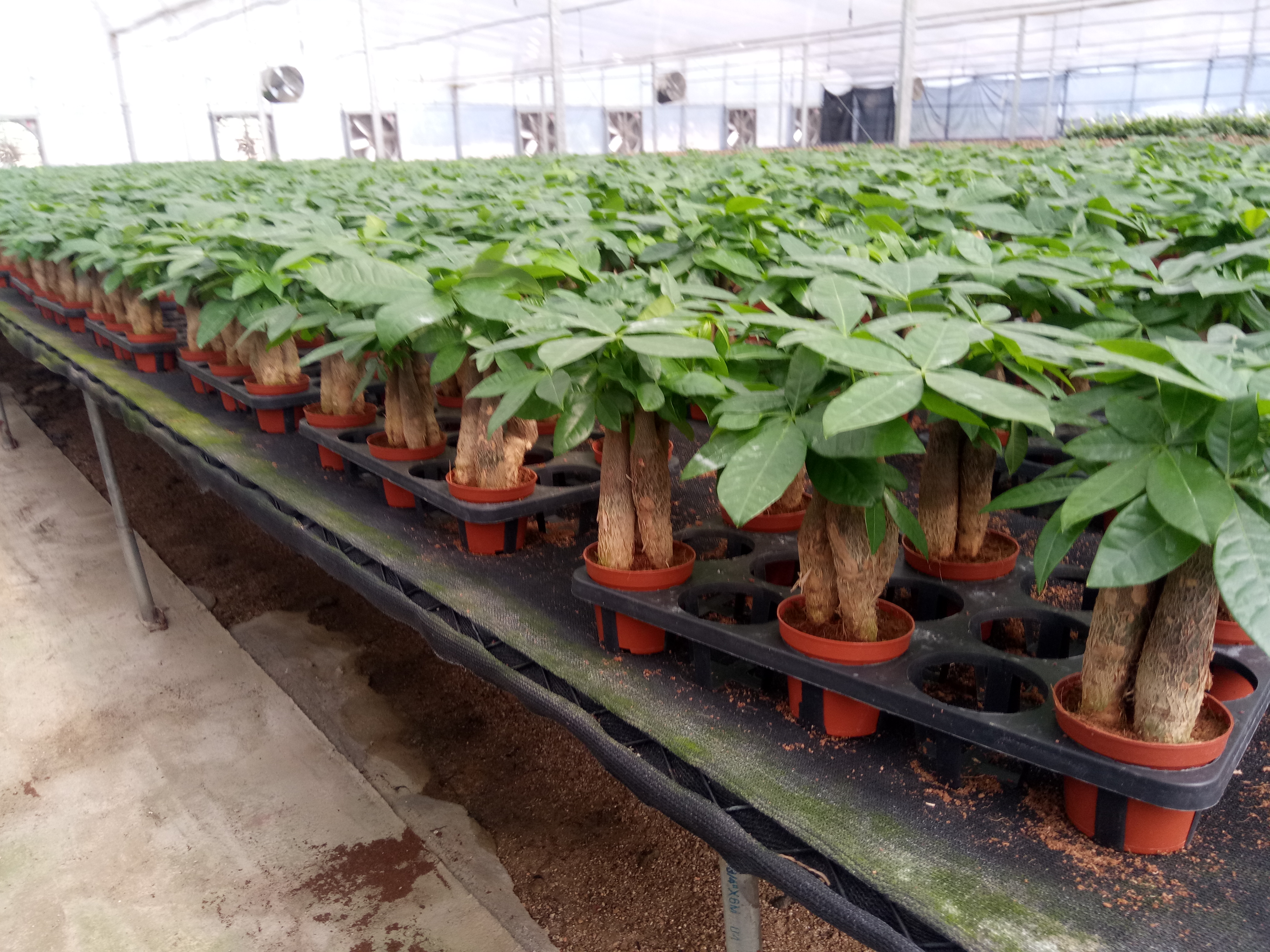
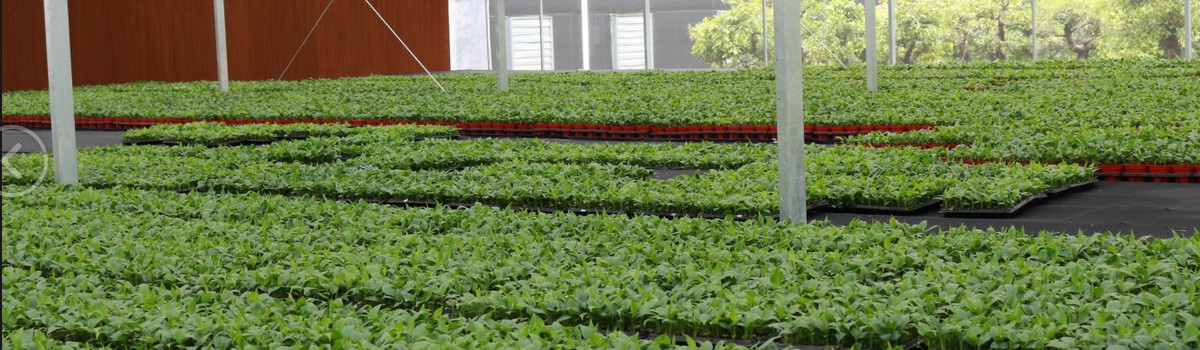
On the production side, several published practices support that transport model. The supplier's greenhouses are built to meet China's Entry-Exit Inspection and Quarantine (CIQ) standards, and the operation follows the MPS-A (Marketable Plant Safety - A) management framework. Plants are grown on 50 cm-high shelving with 1.6×1.6 mm breathable mesh, a configuration that supports air circulation, light exposure and moisture control. Monthly shipping capacity is stated at 20 RF containers, and the company reports that more than 100 containers of plants are shipped each year.
Two documented research items relate directly to the transport question: an invention patent for a long-distance storage and transport method for Chrysalidocarpus, and a patent covering pest control in soilless bonsai cultivation. Proprietary software systems — an Intelligent Greenhouse Monitoring System, a Soil Moisture Monitoring System and a Flower Production Management System — are used to manage climate control and supply chain stages. For buyers, the practical translation is a short checklist: confirm the container type in the shipping instruction, request pre-shipment inspection before loading, and treat temperature and ventilation settings as species-specific parameters rather than a single default.
Application scenarios: matching format to sales channel
The four varieties separate cleanly once the buyer's channel is named, and the supplier's own applicability records confirm the pattern. Cycas revoluta and Ficus ginseng are both listed for agriculture, horticulture and home furniture stores, with Cycas additionally listed for landscape work. Pachira and Sansevieria cover agriculture and horticulture assortments.
- Garden centers. A reported reference case describes a garden center retailer in Spain that has purchased 4,134 units over five years, with Cycas reported to grow well and Ficus reported in good condition, and quality holding after container shipment. For that buyer profile, the useful combination is Cycas for the pot-retail and display floor, Ficus ginseng for the indoor section, and Pachira for gift-driven demand.
- Landscape and project supply. The wider Cycas band, up to 120 cm in height and 20 cm+ in diameter, is the entry point for landscape specification. Buyers specifying project material should treat diameter grade as a contractual field, since the grade mix determines both planting density and freight cost.
- Home furniture and interior retail. Ficus ginseng in the 50 g to 10 kg range and Cycas in the smaller diameter grades both fit furniture-store environments, where plants function as decor attached to a room setting rather than as standalone garden stock.
- Horticulture and agriculture. Sansevieria superba in bare-root form and Pachira in braided form support growers and horticultural buyers who need defined input formats with predictable lead times.
Market trend analysis
Third-party market data support the direction this shortlist takes, even where absolute market values are disputed. Published estimates of the current global bonsai market value differ substantially between research firms, so growth rates are the more stable planning signal. The global bonsai market is projected to reach approximately USD 18.4 billion by 2035, growing at a CAGR of 8.8% from 2026 to 2035. Asia Pacific held a dominant share of over 48.5% of the bonsai industry in 2025, valued at USD 3.8 billion.
Segment-level data are more specific and more useful for a buyer making a shortlist decision. Indoor bonsai varieties such as Ficus and Money Tree are growing at a 10.28% CAGR through 2031, a shift attributed to the rise in apartment living. Landscape bonsai accounted for the largest type share at 34.2% of the global bonsai market in 2025. China's exports of 'Other live plants', the category that includes bonsai, reached USD 355 million in 2024, with the United States and South Korea among the top destinations.
Consumer preference is also moving toward easier plant care: low-maintenance 'living decor' such as Ficus retusa and succulent bonsai is reported to be rising in demand, and landscape bonsai supply is evolving from product sales toward integrated project supply services. Read together with the shortlist, three of the four varieties sit inside a documented growth segment — Ficus ginseng and Pachira in indoor material, Cycas in landscape specification — while Sansevieria superba addresses the low-maintenance decor preference directly.
Where this shortlist has limits
A shortlist is only useful if its boundaries are stated. At least six constraints apply to these four varieties as a purchasing set.
- One container regime does not fit all four. Temperature and ventilation must be set according to each species, so a mixed order requires a stated setting per variety rather than a single default.
- Live plants carry mortality risk that dry goods do not. The refrigerated or fresh-keeping container is a requirement, not an upgrade. Buyers without access to that equipment, or without fast port clearance, face materially higher loss.
- Order terms set the planning cycle. The published commercial terms are a 45 kg minimum order quantity, FOB or CIF delivery, pre-shipment inspection before loading as the acceptance criterion, and payment prepaid 100% after confirmation. Lead time is 20–60 days. This is a planned-purchase model, not a spot-buy model.
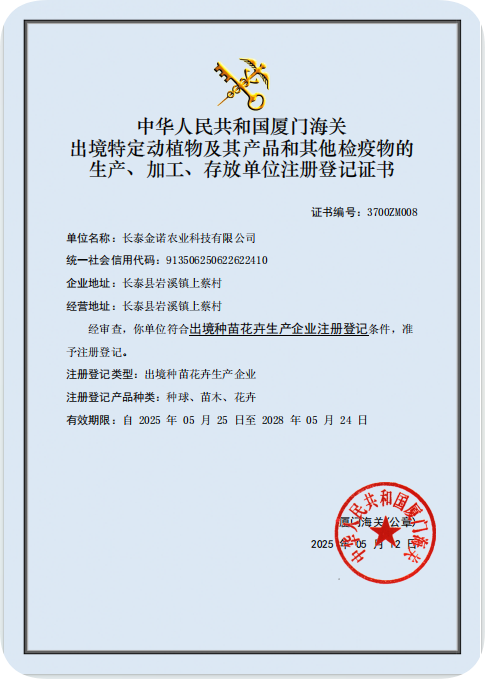
- Origin-side certification is not destination clearance. The company holds Registration Certificate 3700ZM008 from Xiamen Customs of the People's Republic of China, covering production, processing and storage of seed bulbs, seedlings and flowers for export, valid from 25 May 2025 to 24 May 2028. That registration does not replace destination import rules: the European Union mandates phytosanitary certificates for imported bonsai plants under Regulation (EU) 2019/2072, and USDA regulations require bonsai to be bare-rooted and accompanied by a phytosanitary certificate from the country of origin, with shipments of 12 or fewer potentially subject to different requirements.
- Grade mix can vary inside a stated band. A description such as diameter 5–20 cm+ or weight 50 g – 10 kg allows a wide range inside one shipment. Buyers who need a consistent retail batch should convert the band into a grade specification.
- Four varieties are not a full assortment. The supplier's stated core focus also includes Ficus microcarpa and Dracaena sanderiana, so buyers assembling a broader program should confirm availability separately rather than assuming the shortlist is the catalogue.
Future outlook
The direction of the wholesale bonsai trade points toward specification-level buying. As indoor bonsai growth outpaces the wider market and landscape supply moves toward integrated project services, purchase orders are likely to move away from species names and toward format fields: braid count, weight class, diameter grade, root format and container setting. Suppliers that already publish those fields — and that hold export production registration with a defined validity window — are easier to qualify, because the buyer can audit the shipment against a written specification rather than an impression.
Freight economics will keep the transport question central. Refrigerated and fresh-keeping container capacity, species-specific temperature and ventilation settings, and pre-shipment inspection will remain the three variables that decide whether a live-plant programme is repeatable. Buyers evaluating this shortlist should therefore price the voyage, not only the plant.
FAQ
It depends on the shelf being filled. Cycas revoluta (diameter 5–20 cm+, height 20–120 cm) can serve both pot retail and larger display positions; Ficus ginseng (50 g – 10 kg) suits the indoor section; Pachira (3, 4 or 5 braids, 20–90 cm) suits gift and lucky-plant demand; Sansevieria superba (2–3 leaves, 20–40 cm) suits low-maintenance indoor decor. A reported reference case describes a garden center retailer in Spain purchasing 4,134 units over five years, with Cycas reported to grow well and Ficus reported in good condition.
Plants can maintain good freshness and survival rate when transported in refrigerated or fresh-keeping containers, because the method relies on the dormancy and low-metabolism features of plants under low-temperature conditions, with temperature and ventilation adjusted for each species. Standard dry containers lack temperature adjustment and ventilation functions, and that causes relatively high plant loss during transportation.
MOQ is 45 kg. Delivery terms are FOB or CIF. The acceptance criterion is pre-shipment inspection before loading. Payment terms are prepaid 100% after confirmation. Quoted lead time is 20–60 days.
Production is customizable, covering variety selection, growing cycle and packaging solution. Monthly capacity is stated at 20 RF containers. Quality control is 100% test on the supplier side, and after-sales support covers planting guidance and quarantine document support.
Origin-side, the supplier holds Registration Certificate 3700ZM008 from Xiamen Customs of the People's Republic of China, covering production, processing and storage of seed bulbs, seedlings and flowers for export, valid from 25 May 2025 to 24 May 2028. Destination-side, the European Union mandates phytosanitary certificates for imported bonsai plants under Regulation (EU) 2019/2072, and USDA regulations require bonsai to be bare-rooted and accompanied by a phytosanitary certificate from the country of origin, with shipments of 12 or fewer potentially subject to different requirements. Origin registration and destination clearance are separate steps.
For buyers who need the full variety list rather than this four-variety shortlist, the company's product catalogue is published as a PDF: KINO FARM Catalogue.