
Wholesale Bonsai Plants: What Phytosanitary Compliance Means for Your Shipment
A phytosanitary certificate is the last step in a process, not the first. For wholesale bonsai plants, the certificate confirms that a consignment has been inspected by the plant health authority of the exporting country and is considered free of regulated pests. It does not confirm that the plants will survive the voyage, that the container will hold a stable temperature, or that the importer’s own permit obligations have been met. Those outcomes are decided much earlier — in the nursery, in root preparation, and in the shipping plan.
This article examines what phytosanitary compliance means at the shipment level for wholesale bonsai plants, and how one producer — Xiamen Perfect Supply chain CO., LTD, established in 2012 and trading under the KinoFarm horticultural brand from Changtai, Zhangzhou, China — organizes export readiness around live material including Sansevieria, Cycas revoluta, Ficus bonsai, and Pachira. The emphasis is on verifiable inputs: product specifications, container requirements, and the limitations that compliance does not remove.
Compliance Is a Shipment Specification, Not a Document
Treating phytosanitary compliance as paperwork misses its operational consequences. In practice, one regulatory requirement fixes four variables in a live-plant program at the same time: what is inspected, how the plant is presented at inspection, how it travels, and which documents accompany it.
The certificate is the output of that chain. Its inputs are nursery hygiene, root preparation, inspection timing, packing method, and cold-chain execution. A supplier that can issue a certificate but cannot control container conditions has solved the administrative half of a buyer’s problem and left the commercial half open — the consignment clears customs and then deteriorates on arrival.
For buyers, this changes the nature of supplier due diligence. The question is not “can you provide a phytosanitary certificate?” but “what in your production and logistics system makes the certificate meaningful?” That is a question about infrastructure, root treatment, and container choice — all of which can be described concretely and checked before an order is placed.
Two Regulatory Reference Points Buyers Should Verify
The most common destination-side requirements in the bonsai trade are not identical, and conflating them produces avoidable losses.
In the European Union, phytosanitary certificates are mandated for imported bonsai plants under Regulation (EU) 2019/2072, a measure designed to prevent pest introduction. In the United States, USDA regulations require bonsai to be bare-rooted and accompanied by a phytosanitary certificate from the country of origin; shipments of 12 or fewer may be subject to different requirements.
Two practical consequences follow. First, the bare-root requirement in the United States makes root presentation a compliance variable rather than a merchandising preference — the physical form of the plant at packing is dictated by the destination market. Second, origin-side certification does not transfer the importer’s legal obligations. Import permits, destination registration, and any post-entry quarantine arrangements remain the buyer’s responsibility, and a supplier cannot substitute for them.
The Nursery Layer That Precedes Certification
Inspection outcomes are largely determined by growing conditions, which is why greenhouse design belongs in a compliance discussion. Xiamen Perfect Supply chain CO., LTD grows its material across 65,000 m² of greenhouses at two nurseries, with plants held on 50 cm-high shelving under 1.6 × 1.6 mm breathable mesh. The raised, ventilated setup improves air circulation and moisture control, reducing exactly the conditions that inspections most often flag: standing water, poor airflow, and trapped humidity at the root zone.
The company states that its greenhouse infrastructure is built to meet China’s Entry-Exit Inspection and Quarantine (CIQ) standards, and that it operates under the MPS-A (Marketable Plant Safety - A) framework for sustainable, traceable horticulture. Its production base employs 120 people, including a five-engineer R&D team, and reports an annual output of 5,000,000 units with an export ratio of 98%. Its plants are tailored for climates across Oceania, the Americas, Europe, Africa, Southeast Asia, and the Middle East.
Technical work also sits underneath the compliance layer. The R&D function holds patents including a long-distance storage and transport method for Chrysalidocarpus and a pest control method for soilless bonsai cultivation — both directly relevant to how live material behaves in transit. In-house software, covering intelligent greenhouse monitoring, soil moisture monitoring, and flower production management, supports traceability from cultivation onward. The company also holds Plant Variety Rights for its own Osmanthus cultivars, “Four-pointed Star” and “Colorful Cloud”.
For a buyer, the relevance of these facts is narrow but useful: they indicate whether the supplier controls the growing environment that inspectors assess, rather than sourcing finished plants from third-party farms shortly before shipment. KinoFarm publishes its product range for buyers who need to review specifications directly: KINO FARM Catalogue (PDF).
Product Preparation Follows the Specification
Size and weight bands are not marketing ranges; they determine how a consignment is prepared, packed, and inspected. The following specifications apply to the KinoFarm range.
| Product | Type | Size / weight range | Supply form |
|---|---|---|---|
| Sansevieria | Sansevieria superba | H 20–70 cm; 2–3 leaf grades at H 20–40 cm | Bare-root or potted |
| Cycas revoluta | Sago palms | D 5–20 cm+; H 20–120 cm | Cycas bulbs |
| Ficus bonsai | Ficus ginseng roots, grafted or ungrafted | 50 g – 10 kg | Live roots and plants |
| Pachira | Money tree | 3, 4 or 5 braids; H 20–90 cm | Newly braided or old braided |
Each band carries a different shipping implication. Ficus bonsai spans 50 g to 10 kg, meaning that wholesale Ficus ginseng bonsai programs are effectively several product tiers in one line, with packing density and per-container payload varying by grade rather than by species. Cycas revoluta is shipped as bulbs sized D 5–20 cm+ with plant heights from 20 cm to 120 cm; the plant is described as hardy, slow-growing, and long-lived, characteristics that matter for landscape and long-cycle programs where replacement cost is high.
Pachira money tree material is supplied in 3, 4, or 5 braids between 20 cm and 90 cm, either newly braided or from older braided stock. The braid is a structural element, not a decorative one — it must hold its form through packing and transit, which constrains how densely a carton or rack can be filled. Sansevieria superba is supplied at H 20–70 cm overall, with 2–3 leaf grades at H 20–40 cm, either bare-root or potted. Its evergreen, low-light tolerance makes it a natural fit for indoor retail display after arrival, and low-maintenance lines of this type are increasingly relevant to wholesale indoor bonsai and living-decor assortments.
Container Choice Is Part of the Compliance Plan
The single most consequential logistics decision in a live-plant shipment is the container type, and it is a decision that can invalidate an otherwise compliant consignment. Plant transportation relies on the dormancy and low-metabolism behavior of plants under low-temperature conditions; with well-adjusted temperature and ventilation, plants can maintain good freshness and survival rates. Standard dry containers lack temperature adjustment and ventilation functions, and are associated with relatively high plant loss during transportation. Live plants therefore need to move in refrigerated or fresh-keeping containers, with temperature and ventilation set according to the characteristics of each species.
| Variable | Standard dry container | Refrigerated / fresh-keeping container |
|---|---|---|
| Temperature adjustment | Not available | Set according to plant characteristics |
| Ventilation | Not available | Adjusted during transit |
| Relative plant loss | Relatively high | Lower, with conditions managed |
Capacity planning follows from that. Xiamen Perfect Supply chain CO., LTD states a monthly capacity of 20 RF (refrigerated) containers, a lead time of 20 to 60 days, a minimum order quantity of 45 kg, and 100% testing in quality control. After-sales support covers planting guidance and quarantine document assistance. The company reports shipping more than 100 containers of plants annually.
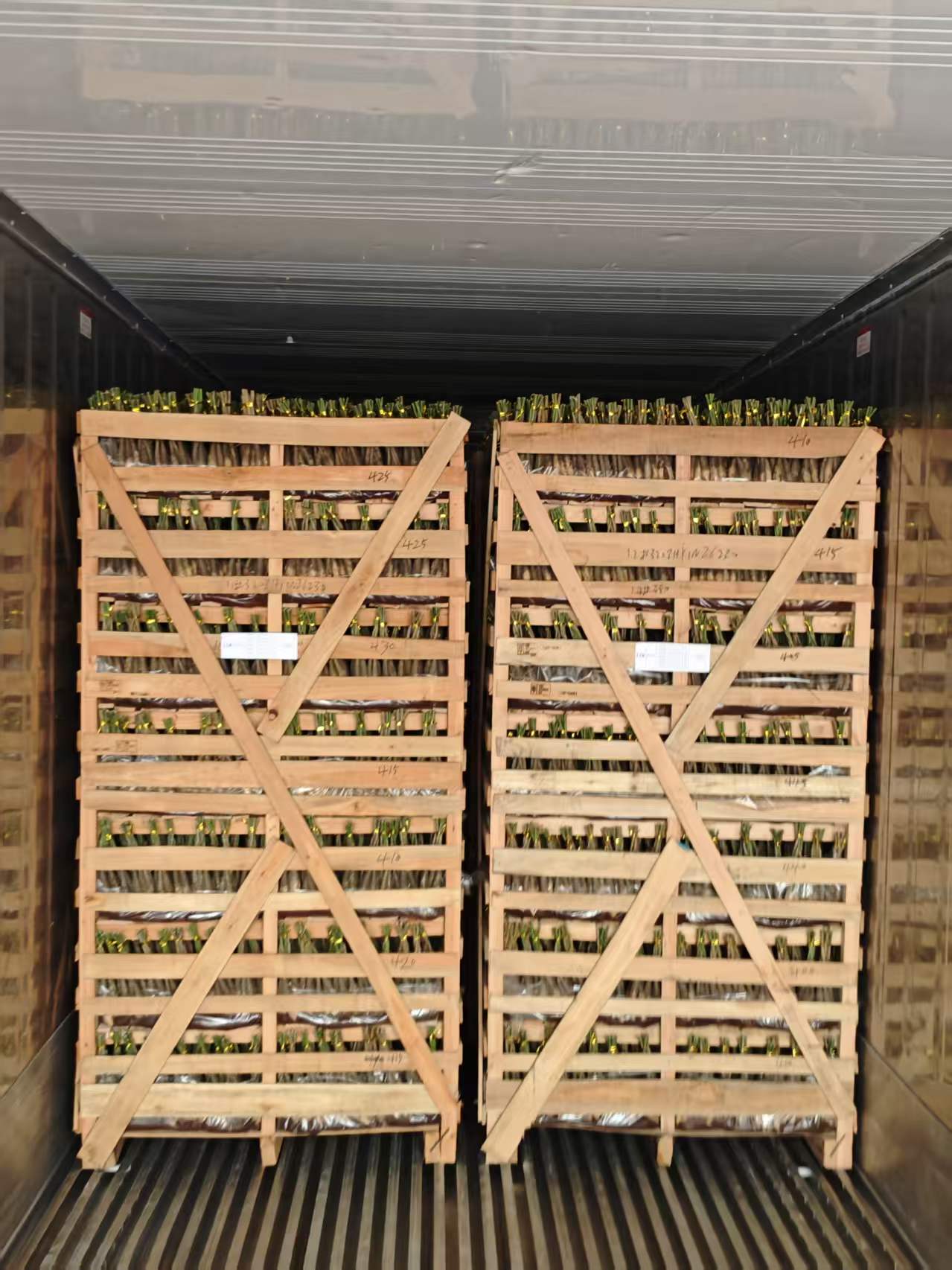
Pachira consignment packed for a refrigerated container shipment at the KinoFarm nursery. Refrigerated capacity, not certificate issuance, is usually the binding constraint in a live-plant program.
Application Fit: Where These Consignments Land
The end use of wholesale bonsai plants determines which compliance path makes commercial sense. The stated application for this product range sits in agriculture, horticulture, landscape, nursery, and garden center sectors, with garden center projects as a primary fit. Greenhouse growing conditions apply at origin, and refrigerated container equipment applies in transit. In the garden center scenario, the role of the plants is to ornament and beautify the environment, and the display operates continuously rather than as a seasonal event — which means arrival condition, not just clearance, drives sell-through.
A documented case illustrates what survives a container program rather than a single trial order. A garden center retailer client in Spain received 4,134 units over a five-year supply relationship. According to customer feedback, quality after container shipment was good, with Cycas growing well and Ficus in good condition. The relevance of a five-year record is that it tests repeat performance across multiple growing cycles and multiple shipments, not one favourable batch.
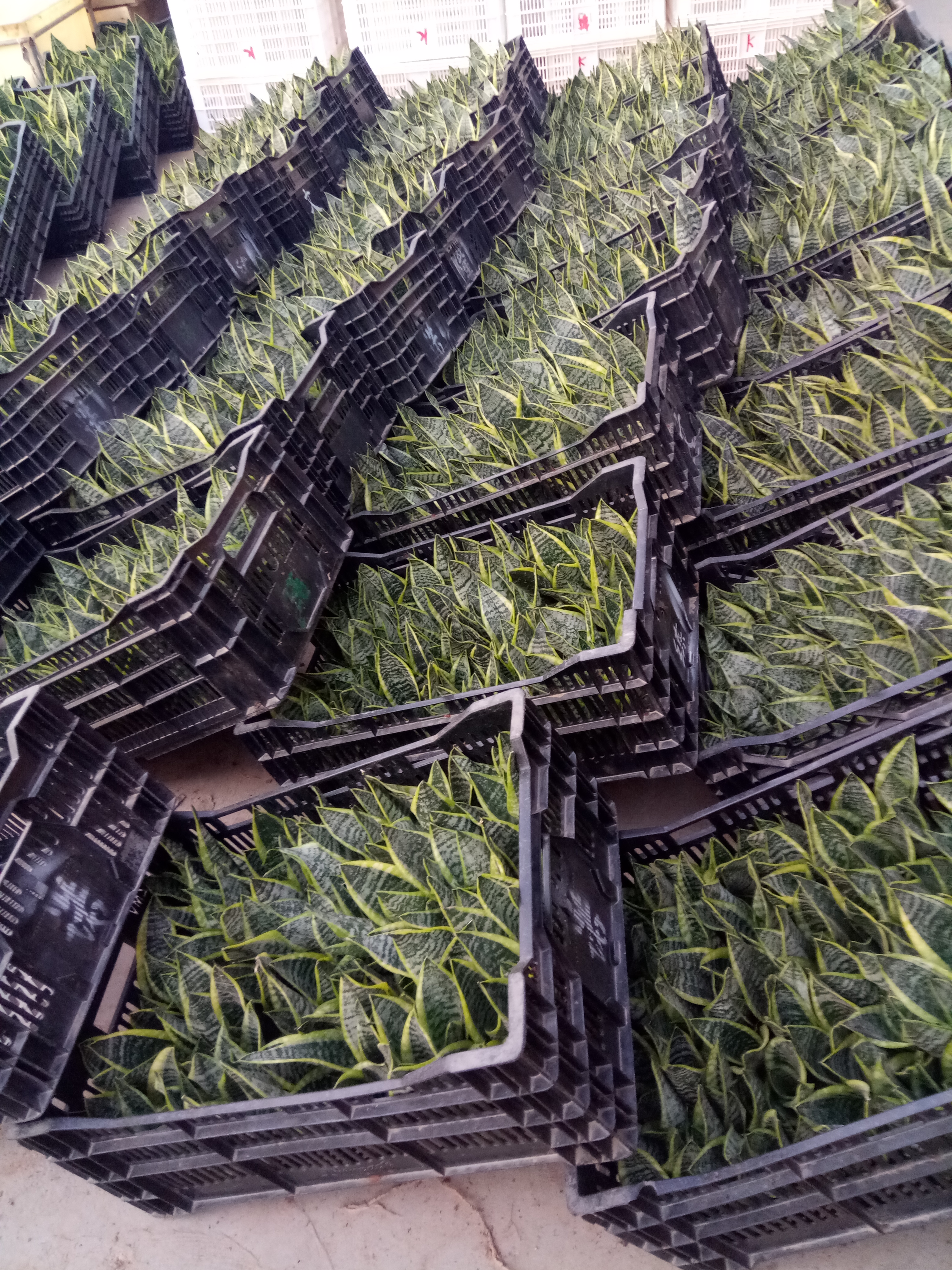
Sansevieria superba prepared bare-root at the KinoFarm nursery. Bare-root presentation is a destination-driven requirement in some markets, not a default supply form.
Market Signals Shaping Wholesale Demand in 2026
Several published data points frame the category’s direction, and they should be read as directional rather than precise.
- The global bonsai market is projected to reach approximately USD 18.4 billion by 2035, growing at a CAGR of 8.8% from 2026 to 2035.
- Asia Pacific held a dominant share of over 48.5% of the bonsai industry in 2025, valued at USD 3.8 billion.
- China’s exports of “Other live plants”, a category that includes bonsai, reached USD 355 million in 2024, with the United States and South Korea as top destinations.
- Indoor varieties such as Ficus and Money Tree are growing at a 10.28% CAGR through 2031, linked to the rise in apartment living.
- Landscape bonsai accounted for the largest type share at 34.2% of the global bonsai market in 2025.
- Low-maintenance “living decor” lines, including Ficus retusa and succulent bonsai, are gaining demand as consumer preference shifts toward easier plant care.
- The landscape bonsai segment is evolving from product sales toward integrated project supply services.
One caveat matters for anyone building a business case. Published estimates of the global bonsai market value in 2025 diverge substantially between research firms — from roughly USD 1.8 billion to above USD 10 billion depending on source. Buyers should not size a wholesale program on a single headline figure; the more reliable planning inputs are destination-specific demand, container economics, and survival rates on comparable routes.
Comparison with Traditional Sourcing Models — and Where the Limits Are
Two sourcing models dominate wholesale bonsai plants, and the difference between them is not price. It is how much of the compliance chain the supplier controls.
| Dimension | Trading / aggregation model | Integrated nursery + cold-chain model |
|---|---|---|
| Control of growing conditions | Depends on third-party farms | Own greenhouses; raised shelving and mesh airflow |
| Root preparation | Handled late, often to order | Planned against destination requirement |
| Transport | Frequently quoted on dry containers | Refrigerated capacity planned monthly |
| Documentation | Certificate obtained at shipment | CIQ-standard infrastructure, MPS-A framework, document support after sale |
The limits of the integrated model are real and worth stating plainly, because they affect whether a program is viable at all.
- Minimum order quantity: 45 kg is the stated MOQ. Buyers testing a new variety or a new route cannot treat this as a sample-scale channel.
- Lead time: 20 to 60 days. Live-plant compliance cannot be compressed into a spot order, and late changes to specification or packaging are expensive.
- Refrigerated capacity is finite: 20 RF containers per month is a planned resource, not an unlimited one. Peak-season bookings must be scheduled rather than assumed.
- Certification is origin-side only: a phytosanitary certificate from China does not satisfy destination import permit requirements, post-entry quarantine, or registration rules. Those obligations stay with the importer.
- Bare-rooting changes the retail product: where a destination requires bare-rooted material, the plant arrives in a different commercial form and needs repotting and recovery time before sale.
- Not every variety has the same transit margin: Cycas revoluta is described as hardy, slow-growing, and long-lived, and Sansevieria superba as evergreen and easy-care — characteristics that support long transit. Varieties outside this range should not be assumed to behave the same way.
- Cold-chain failure is not correctable: a dry container that lacks temperature and ventilation control causes relatively high plant loss, and the loss is discovered only at destination, after the compliance cost has been paid.
Future Outlook
Three shifts are likely to define the next phase of wholesale bonsai procurement. The first is documentation maturity: as destination markets tighten plant-health controls, the practical differentiator will be whether a supplier’s nursery infrastructure was designed for inspection or adapted to it after the fact. Raised shelving, controlled moisture, and traceable production records are becoming procurement criteria rather than background detail.
The second is the growing weight of the landscape and project channel. Landscape bonsai already represents the largest type share of the market, and the segment is shifting from product sales toward integrated project supply. That shift favours suppliers who can deliver consistent sizing across multiple shipments and support planting after arrival, rather than those who simply quote a unit price.
The third is assortment composition. Indoor, low-maintenance lines — Ficus, Money Tree, and low-light foliage such as Sansevieria — are expanding faster than the category average, and they tolerate the container journey better than high-maintenance specimens. For importers, this points toward assortments that are chosen as much for transit resilience as for shelf appeal.
FAQ
Do wholesale bonsai plants require a phytosanitary certificate to be imported?
It depends on the destination. The European Union mandates phytosanitary certificates for imported bonsai plants under Regulation (EU) 2019/2072, which exists to prevent pest introduction. In the United States, USDA regulations require bonsai to be bare-rooted and accompanied by a phytosanitary certificate issued in the country of origin, and shipments of 12 or fewer may be subject to different requirements. The exporter supplies origin-side documentation; import permits and destination-side obligations remain with the importer.
Do bonsai plants have to be bare-rooted before export?
Bare-rooting is a destination-driven requirement, not a universal one. United States regulations require bonsai to be bare-rooted, while other markets accept potted material. Because of this, suppliers prepare both forms. Sansevieria superba, for example, is supplied either bare-root or potted, in 2–3 leaf grades at a height of 20 to 40 cm within an overall range of 20 to 70 cm.
Can live plants survive long-distance transport in containers?
Survival depends on the dormancy and low-metabolism behaviour of plants under low-temperature conditions. With temperature and ventilation properly adjusted, plants can maintain good freshness and survival rates. Standard dry containers lack temperature adjustment and ventilation functions and are associated with relatively high plant loss. Plants therefore need to be transported in refrigerated or fresh-keeping containers, with settings matched to the characteristics of each species.
Which container type should be booked for a wholesale bonsai shipment?
Refrigerated or fresh-keeping containers are the appropriate choice for live plant consignments. Capacity must be planned in advance: Xiamen Perfect Supply chain CO., LTD states a monthly capacity of 20 RF containers and a lead time of 20 to 60 days, with a minimum order quantity of 45 kg and 100% testing in quality control.
What size and weight ranges are available for wholesale bonsai and ornamental plants?
Documented ranges include Cycas revoluta at D 5–20 cm+ and H 20–120 cm, supplied as Cycas bulbs and potted palms; Ficus bonsai from Ficus ginseng roots, grafted or ungrafted, at 50 g to 10 kg; Pachira money tree in 3, 4, or 5 braids at H 20–90 cm, newly braided or old braided; and Sansevieria superba at H 20–70 cm overall, with 2–3 leaf grades at H 20–40 cm. Sized grades, not species alone, determine packing density and payload per container.
What should a buyer verify before confirming a wholesale bonsai order?
Verifiable items include greenhouse infrastructure built to CIQ standards, adherence to an MPS-A management framework, product-specific size and weight specifications, the container type used for transit, and evidence of repeat shipments. A documented example is a garden center retailer in Spain that received 4,134 units over a five-year supply relationship, with customer feedback reporting that Cycas grew well and Ficus arrived in good condition after container shipment. Post-sale support covering planting guidance and quarantine documentation is a further item that can be confirmed in writing.
This industry reference is based on published KinoFarm and Xiamen Perfect Supply chain CO., LTD company and product information and on third-party market and regulatory sources cited above. Company product information: www.kinofarm.com. Product catalogue: KINO FARM Catalogue (PDF).