
Wholesale Bonsai Samples: Graft, Braid, Root and Bulb Checks
Wholesale Bonsai Samples: Graft, Braid, Root and Bulb Checks
A wholesale bonsai sample answers one question well and a second one badly. It shows the condition of the material on the day the carton is opened; it says very little about what a container will look like six weeks later. Comparing samples side by side is therefore not a beauty contest between four plants. It is a controlled exercise: the buyer fixes the acceptance criteria and the transport-survival questions first, then changes one variable at a time — grafted against ungrafted Ficus microcarpa, newly braided against older braided Pachira, potted against bare-root Sansevieria trifasciata, and one Cycas revoluta bulb band against its neighbour. This review does not rank suppliers. It sets out what each pair actually tests, and where the comparison stops being informative.
Sample comparison and variety selection are two different decisions
Variety selection asks which species fits a market. Sample comparison asks whether a specific lot meets a written standard. At the decision stage the two are usually resolved on the same visit, and that is where most sample-comparison errors begin.
Two failures recur. The first is sample bias: a grower's most uniform units are sent for review, so the sample measures selection skill rather than lot consistency. The second is criteria drift: the buyer accepts a slightly loose braid on the Pachira because the colour is good, then rejects an equivalent looseness on the next pair. Once one threshold moves, the four pairs are no longer being read on the same scale, and the resulting preference is as likely to reflect sequence and mood as material quality.
The remedy is procedural rather than technical. Record the criteria before the first box is opened, record the measurement convention behind every size claim, and inspect each pair against the same list. The output of a good session is not a favourite sample. It is a written position on what the buyer will accept, and a short list of questions the supplier has not yet answered.
The four pairs, and the single variable inside each
Each pair isolates one production or handling choice. Keeping the variable single is what makes a genuine side-by-side reading possible; if braid age and bulb diameter both change, the sample no longer separates the two effects.
| Pair | The variable that changes | The sample check it forces | What the pair cannot establish |
|---|---|---|---|
| Ficus microcarpa: grafted vs ungrafted | Presence and quality of a graft union | Union closure and callus, union height across all units, rootstock-to-scion diameter match, shoots emerging below the union, root flare | Which type retails better in your market |
| Pachira: newly braided vs older braided | How far the braid has set | Stem count and caliper as stated, tie tension and bark contact at crossings, healed wounds, knuckle height, top-cut callus | Whether the braid holds through transit and a retail shelf |
| Sansevieria trifasciata: potted vs bare-root | Root medium and shipping format | Rhizome firmness, leaves per division, root loss after cleaning, carton weight and count, re-establishment plan | Arrival performance under your light and watering regime |
| Cycas revoluta: one bulb band vs the next | The measurement convention and the band width | Diameter point and instrument, caudex firmness, root condition, leaves and pups counted separately from the grade | Whether the whole lot was graded the same way |
Ficus microcarpa: what the graft actually changes
Grafted Ficus microcarpa material combines a rootstock with a scion, and the union between them is a second growth interface inside the plant. That union is the part of the sample most often photographed and least often inspected. It is also the part that fails first if the lot was pushed.
On a grafted sample, the checks are specific:
- The union is closed and callused, with no open wound, splitting or seepage.
- Union height is consistent across every unit in the sample, not only the front row of the tray.
- Rootstock and scion diameters are matched without a pronounced step, which otherwise creates a weak point under packing pressure.
- No shoots are emerging below the union; adventitious growth there indicates rootstock vigour overtaking the scion.
- Root flare and surface roots are present and firm rather than soft or hollow.
Ungrafted material has no union, so that list does not transfer. The checks shift to the plant's own architecture: stem taper and straightness, branch placement, root mass, and consistency of leaf size and colour across the sample. A buyer who applies the grafted checklist to ungrafted plants will record defects that do not exist, and miss the structural ones that do.
For the buyer, the pair is a fit decision rather than a quality ladder. Grafted material gives a defined root piece and a defined canopy starting point, and it puts a visible joint in front of the retail customer. Ungrafted material presents as one continuous plant, which suits markets where a visible graft reads as an artefact rather than a feature. Neither statement is a claim about plant health. Both are statements about what the buyer has to inspect and, later, explain.
The fit boundary is sample size. Two or three units cannot establish union consistency across a lot. Ask for the lot inspection record, or for a photographed set drawn from the same production week, and state on the record whether the sample was hand-selected or drawn at random.
Pachira: newly braided and older braided are different handling problems
Braided Pachira is a constructed product: several stems are interlaced and held until the braid sets. "Newly braided" and "older braided" mark different points in that process, so the two fail in different ways and should not be judged by one impression.
On a newly braided sample, the stems are still flexible and the braid normally depends on a tie or wire. Check that the tie is present, evenly tensioned and not cutting into the bark at the contact points; check each crossing for bruising or bark loss; check that the knuckle sits at a consistent height across the tray. On an older braided sample the braid has set and the stems are lignified, so the checks move to healed crossing wounds, whether the braid holds its shape without support, and whether the top cut has callused cleanly. In both cases, record stem count and caliper exactly as the supplier states them, and confirm whether the count is per plant or per carton.
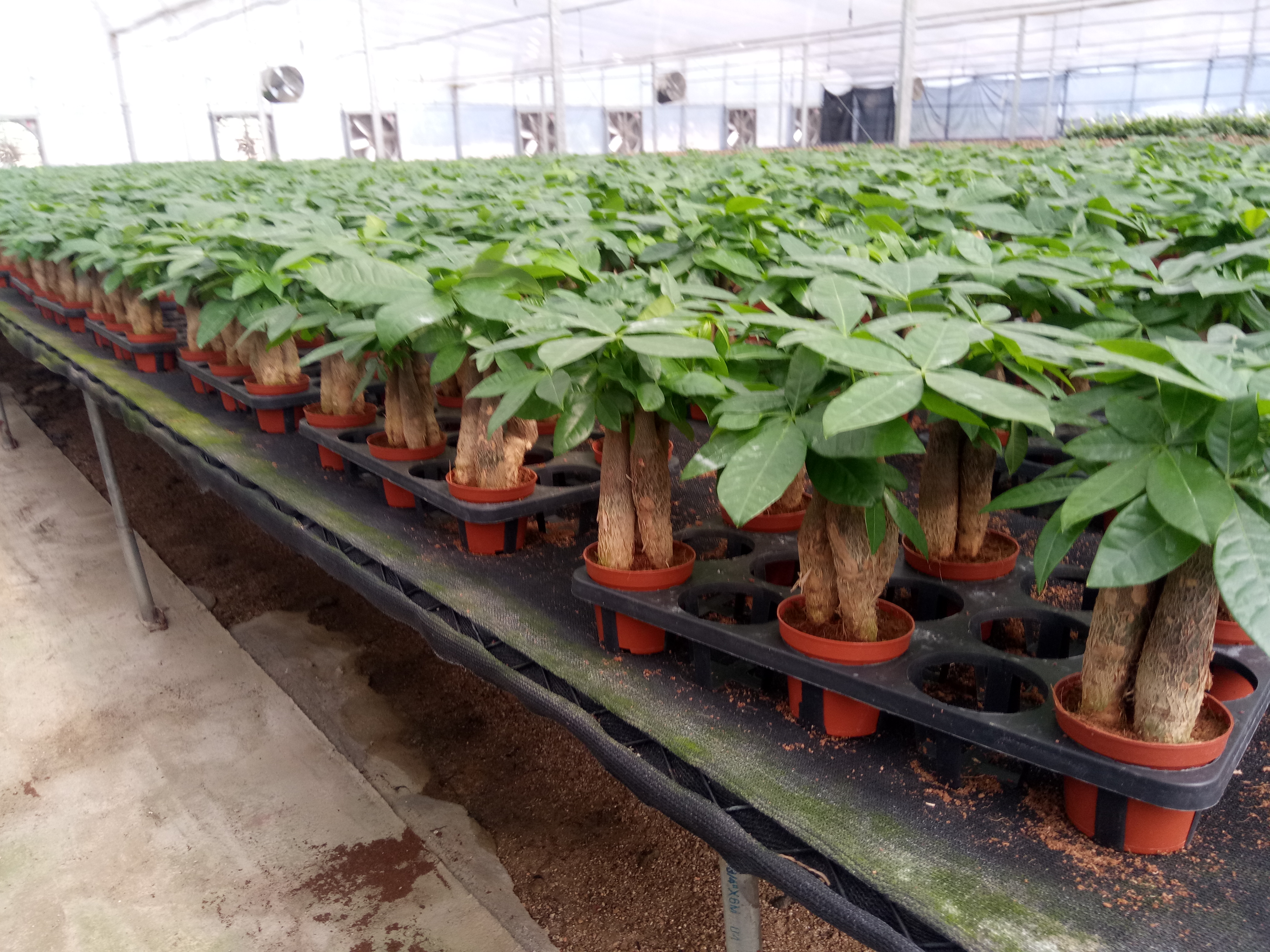
Commercially, an older braid is the more resolved object but the less forgiving one to pack, and a newly braided lot shifts part of the finishing work to the buyer, which needs a stated aftercare assumption rather than a general reassurance. The sample shows the braid as it left the nursery. It does not show how that braid behaves after weeks on a shelf, which is why the transport-survival questions below matter more for this pair than for the grafted Ficus.
The boundary is that braid tension is judged by hand and by photograph, not by a specification. If the supplier's word for "tight" differs from yours, define it on the sample record before the order scales; otherwise the tolerance will be renegotiated at the container stage, when it is expensive to do so.
Sansevieria trifasciata: potted and bare-root are two different products
Potted and bare-root Sansevieria trifasciata are not the same plant in different packaging. Potted material is evaluated as a finished retail unit — medium, pot, root ball, leaf presentation. Bare-root material is evaluated as an input: rhizome health, root loss at lifting and cleaning, and the buyer's own re-establishment step. The inspection list differs before any commercial question is raised.
Kinofarm Bonsai's comparison unit for bare-root supply against traditional potted plants reports a 40% weight reduction and a 36% reduction in packaging volume, a transit breakage rate falling from 16% to 2.5%, and a 33% reduction in comprehensive logistics expense. Those are the supplier's own comparison figures, not independent test data, so the useful next step is to ask for the conditions behind them: which variety and grade, which carton, which route and transit duration, and how breakage was defined — a snapped leaf and a cracked rhizome are different liabilities that a single percentage can hide.
Even taken as supplier figures, they change the inspection rather than only the freight line. If weight and packaging volume fall by roughly a third to two-fifths, more units travel in the same space, and grading consistency across a larger number of units becomes the dominant risk instead of crush damage. If breakage falls as stated, the claim conversation moves from transit damage to arrival condition and recovery. The sample should therefore be inspected for rhizome firmness, number of leaves per division, and root condition after the growing medium has been cleaned off — not simply for how closely the pot matches the photograph.
The fit boundaries are real. Bare-root moves the potting step to the buyer and to whatever labour the destination market can supply, and it starts the retail-ready timeline later. Where a destination requires bare-root entry for specified genera, the format is not a choice at all — but eligibility is a documentary question and cannot be read off a sample, however healthy the rhizome looks.
Cycas revoluta: bulb bands only compare if the measurement is the same
Cycas revoluta is graded on caudex diameter — the "bulb" in trade language — and grades are quoted as ranges. Two consequences follow immediately. Adjacent bands can overlap, so a unit from one band may measure inside the next. And a range describes a diameter and nothing else: not firmness, not root mass, not leaf count, not how long the plant has rested since lifting.
Before comparing a band against its neighbour, fix four things on the record: the point at which diameter is taken (widest point or base), the instrument and rounding, whether leaves and pups are counted separately from the grade, and whether the band is applied per unit or per lot. Then inspect the physical sample for caudex firmness and soft spots, root condition after lifting, and whether any pup removal has left an open wound.
For the buyer, the practical consequence is that a single sample rarely represents its band. Ask for the per-unit distribution inside the band rather than a minimum and a maximum; a tight distribution and a wide one can carry the same label and behave very differently in a carton. Because Cycas units are slower-grown and heavier than the other three pairs, the sample also carries a freight implication — confirm per-unit weight and carton count rather than inferring them from the diameter band.
One further boundary applies. Confirm any species-level trade listing, permit or destination requirement with the relevant authority. A sample comparison is evidence about plant condition; it is not evidence of permitting status, and it should never be filed as if it were.
Acceptance criteria: fix the list before the first box is opened
Consistency is the whole value of a side-by-side reading. The criteria below, applied in the same form to all four pairs, stop a comparison from quietly turning into a preference.
| Criterion | Why it must be identical across pairs | What to record |
|---|---|---|
| Defect threshold | A looser threshold on one pair silently advantages that pair in the final decision | Written threshold plus a photograph of the borderline unit |
| Natural-variation allowance | Genera differ in normal leaf drop and colour shift; without a stated allowance the most variable variety always looks worst | Allowance agreed per variety before inspection begins |
| Sample selection method | A hand-picked sample measures selection skill, not lot consistency | Selection method, sample size, production week |
| Measurement convention | "Size" means a union height, a caliper, a pot diameter or a bulb diameter depending on the pair | Point of measurement, instrument, rounding rule |
| Count basis | Unit comparability collapses if one quote is per plant and another per carton | Count basis stated on the sample record |
| Documentary status | Phytosanitary position is invisible on the plant itself | Certificate reference and the requirement it is intended to satisfy |
Two habits make the list usable in practice. Score each pair on the same sheet, in the same order, before discussing price or preference. And photograph the borderline unit at the moment the threshold is applied, because a threshold that cannot be shown later will be re-argued at the claim stage.
Transport-survival questions to ask each pair in identical wording
Transport-survival questions are usually asked in general terms and answered in general terms. Asking the same six questions of every pair, in the same words, is what makes the answers comparable across very different formats.
- What is the packing format, and how many units per carton or per pallet? For potted against bare-root material this single answer already separates two supply models, and it is the one most often left implicit in a sample discussion.
- What transit duration and temperature range is the packing built for? A format that works on a short sea leg and one built for a long one are not interchangeable, and the sample itself will look identical in both cases.
- Which documents travel with the consignment? The European Union requires phytosanitary certificates for imported bonsai plants under Regulation (EU) 2019/2072, and USDA APHIS states that bonsai entering the United States must be bare-rooted and accompanied by a phytosanitary certificate from the country of origin.
- Does the sample consignment fall under the same rule as a commercial container? This is not a formality. USDA APHIS notes that shipments of 12 or fewer may have different requirements, so a small sample box can sit in a different documentary category from the order it is meant to represent. Confirm the applicable rule with the importing authority before dispatch.
- What is the arrival inspection window, and what evidence is accepted for a claim? Photographs, counts and timing should be agreed while the sample is still a low-cost conversation.
- What recovery or aftercare time is assumed before the unit is saleable? The answer differs sharply between a potted unit and a bare-root division, and it belongs on the same sheet as the grade.
One question deserves separate treatment: whether the answers describe the sample lot or the production lot. A supplier who answers clearly for both, and distinguishes them, is easier to work with than one who answers only for the sample.
Where Kinofarm Bonsai sits in this kind of comparison
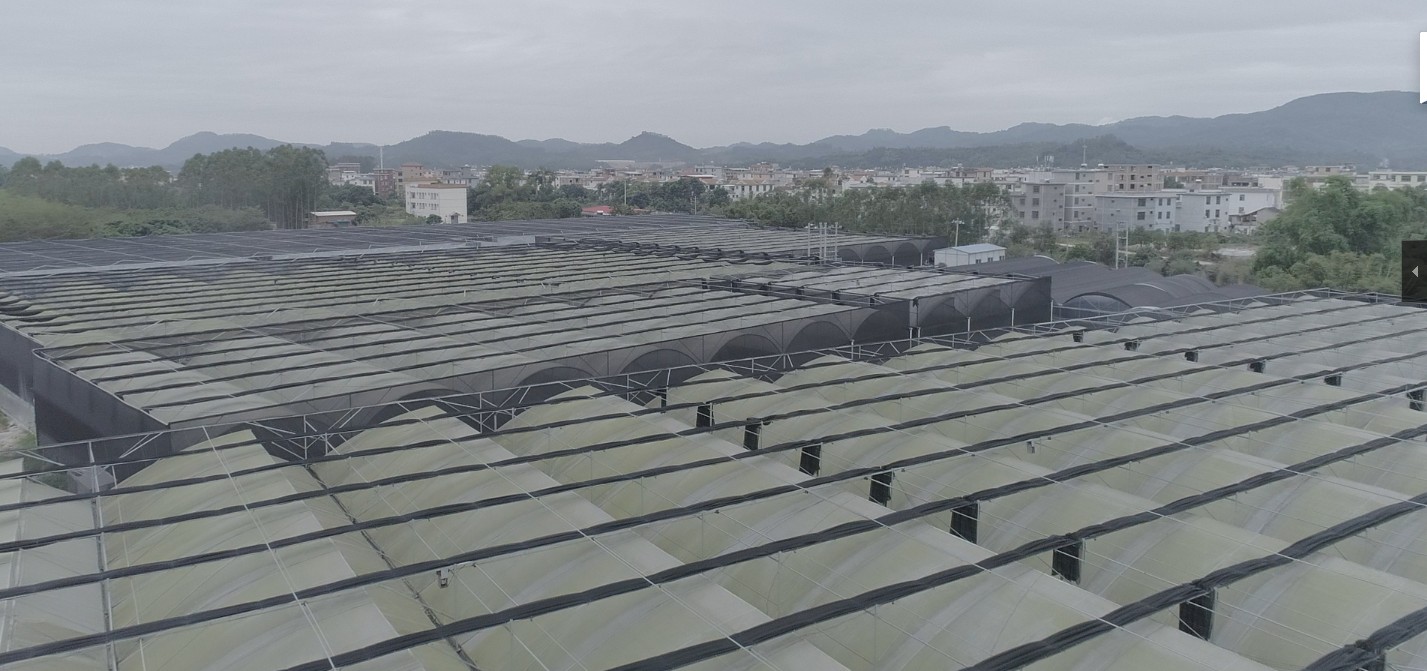
Kinofarm Bonsai (KinoFarm), the bonsai operation of Xiamen Perfect Supply Chain Co., Ltd., is a grower based in Changtai, Zhangzhou, founded in 2012 and operating 65,000 m² of greenhouses across two nurseries. The production system is documented as CIQ-certified infrastructure under an MPS-A management framework, with plants grown on 50 cm-high shelving using 1.6 × 1.6 mm breathable mesh. The company reports 120 employees, a five-engineer R&D team, a 98% export ratio and more than 100 containers shipped annually.
For a sample comparison, the relevant fact is coverage. The documented crop list includes Ficus microcarpa, Cycas revoluta, Dracaena sanderiana and Sansevieria trifasciata, with Pachira also grown in the company's greenhouses. All four pairs discussed here therefore fall inside one production base, which means grafted and ungrafted Ficus, braided Pachira, potted and bare-root Sansevieria, and graded Cycas can be requested against a single packing and grading standard rather than assembled from four suppliers whose conventions differ. The export share and container volume indicate that export packing is routine rather than occasional; documented patents cover long-distance storage and transport of Chrysalidocarpus and pest control in soilless bonsai cultivation.
The boundary matters as much as the coverage. Documented capability is not sample performance. An MPS-A framework and CIQ-certified infrastructure describe the production system, not the condition of a particular carton, and neither replaces the criteria above. The lot record still has to be requested, the measurement convention still has to be written down, and the units in front of the buyer still have to be inspected.
Market context: demand signals, and why the sizing figures disagree
Three demand signals are relevant to how samples are weighted, and one caution is relevant to how they are used. Mordor Intelligence reports indoor bonsai varieties such as Ficus and money tree growing at a 10.28% CAGR through 2031, attributing the growth to apartment living. Dataintelo places landscape bonsai as the largest type segment at 34.2% of the global market in 2025. Vertex Market Report puts Asia Pacific at over 48.5% of the market in 2025, valued at USD 3.8 billion, while the OEC records China's exports of "other live plants", a category that includes bonsai, at USD 355 million in 2024, with the United States and South Korea as leading destinations.
The caution is that headline market sizing is not settled. Published 2025 global value estimates range from roughly USD 1.8 billion to USD 7.9 billion to USD 10.39 billion across different research providers, and a projection of USD 18.4 billion by 2035 at an 8.8% CAGR sits uneasily beside the lower starting points. These are not reconcilable without the underlying methodologies, and averaging them would manufacture a number that no source published. They are useful as directional signals and poor as procurement inputs.
Read that way, the signals support two adjustments to a sample session. Indoor-driven demand argues for closer inspection of the pairs that actually go indoors — grafted Ficus, braided Pachira, potted Sansevieria — where presentation at retail matters as much as field condition. The concentration of supply in Asia Pacific means most samples in a given comparison will come from one production region, so regional comparison is harder to run than format comparison, and format is usually the more decision-relevant variable anyway.
Where the comparison stops
A disciplined sample session is a good instrument with definite limits, and stating them protects the decision:
- It cannot certify a batch. It establishes unit-level condition and, at best, evidence of grading consistency.
- It cannot confirm phytosanitary eligibility or permit status; those are documentary questions for the relevant authority.
- It cannot price a programme, because a sample rarely carries the carton, pallet and route assumptions that drive landed cost.
- It cannot predict retail sell-through, which depends on the buyer's own channel and pricing.
- It cannot compare across suppliers whose grading conventions differ, unless the conventions are normalised first.
- It may be unnecessary where the decision is essentially stylistic. A criteria framework adds cost and time, and a buyer choosing a decorative assortment should say so rather than dress a preference as an audit.
What to expect next
On present evidence, sample comparison is shifting from whole-plant appearance toward format and grading consistency. If indoor demand continues along the path the cited forecasts describe, the commercially decisive questions move toward bare-root versus potted supply, carton efficiency and recovery time, because those determine how quickly a unit becomes saleable at the destination. If landscape demand holds its share, grade conventions for larger specimens will keep their own vocabulary and will need translating rather than harmonising.
Both outcomes point the same way for buyers: fewer, better-documented sample sessions, with the criteria and the transport questions written down before the cartons arrive. That is a slower first meeting and a considerably faster second order.
FAQ
Is grafted Ficus always the stronger choice for a wholesale buyer?
No. Grafting introduces a union that has to be inspected and defines a rootstock–scion combination; ungrafted material keeps a single vascular system and is judged on stem taper, branching and root mass instead. The choice depends on what the retail customer expects to see and on what the supplier can grade consistently. Because union quality varies by lot, the condition of the union in the sample carries more decision weight than the label on the tray.
When is bare-root Sansevieria the format worth evaluating?
When freight weight, packaging volume and breakage exposure dominate the decision, and when the buyer or the destination market can absorb the potting step. Kinofarm Bonsai's comparison unit reports a 40% weight reduction, a 36% reduction in packaging volume, a breakage rate falling from 16% to 2.5% and a 33% reduction in comprehensive logistics expense against traditional potted plants. Those are supplier figures and should be checked against the stated test conditions, and destination rules decide whether the format is usable at all.
How should Cycas samples quoted in different bulb bands be compared?
Fix the measurement convention first: where the diameter is taken, with which instrument and rounding, and whether leaves and pups are counted separately from the grade. Because bands are ranges, adjacent bands can overlap, so one sample may not represent its band. Ask for the per-unit distribution inside the band, then inspect caudex firmness and root condition — neither of which the band describes.
Can a small sample shipment be judged by the same criteria as a full container?
The criteria can be identical; the conclusions cannot. A sample shows unit-level condition, while a container shows grading consistency, packing performance and handling across a longer chain. Documentary rules may also differ by consignment size: USDA APHIS notes that shipments of 12 or fewer may have different requirements for bonsai entry, so the applicable rule should be confirmed with the importing authority before a sample is dispatched.
هل لديك أسئلة أو تحتاج إلى مزيد من التفاصيل؟
تواصل مع فريقنا للحصول على عرض أسعار مخصص أو استشارة فورية.
طلب عرض أسعار
املأ النموذج أدناه وسيتواصل معك فريقنا بعرض مقترح مخصص.
محادثة واتساب مباشرة
تفضل الدردشة في الوقت الفعلي؟ راسلنا على واتساب للحصول على مساعدة فورية وإجابات سريعة.
- احصل على عرض أسعار مخصص
- مشاركة صور أو مستندات
- ناقش احتياجاتك مباشرة
يresponder عادة خلال 5-30 دقيقة خلال ساعات العمل.