
Wholesale Bonsai Supplier Checklist for Long-Term Distributors
Wholesale bonsai plants are not a commodity the way many other potted ornamentals are. Two orders can look identical on paper — same species, same pot size — but perform very differently after a 20-day ocean voyage. For distributors and garden retailers, the gap between a successful trial order and a dependable multi-year supply relationship is determined by the things that are hardest to inspect from a price list: cultivation method, root state, pest-control history, transport preparation, and the consistency of quality across seasons.
This guide is written for buyers in the decision and execution stage of sourcing. It explains what to verify when selecting a wholesale bonsai nursery for long-term distribution, with KinoFarm — the export brand of Xiamen Perfect Supply chain CO., LTD — used as a reference example of how an export nursery in China is structured.
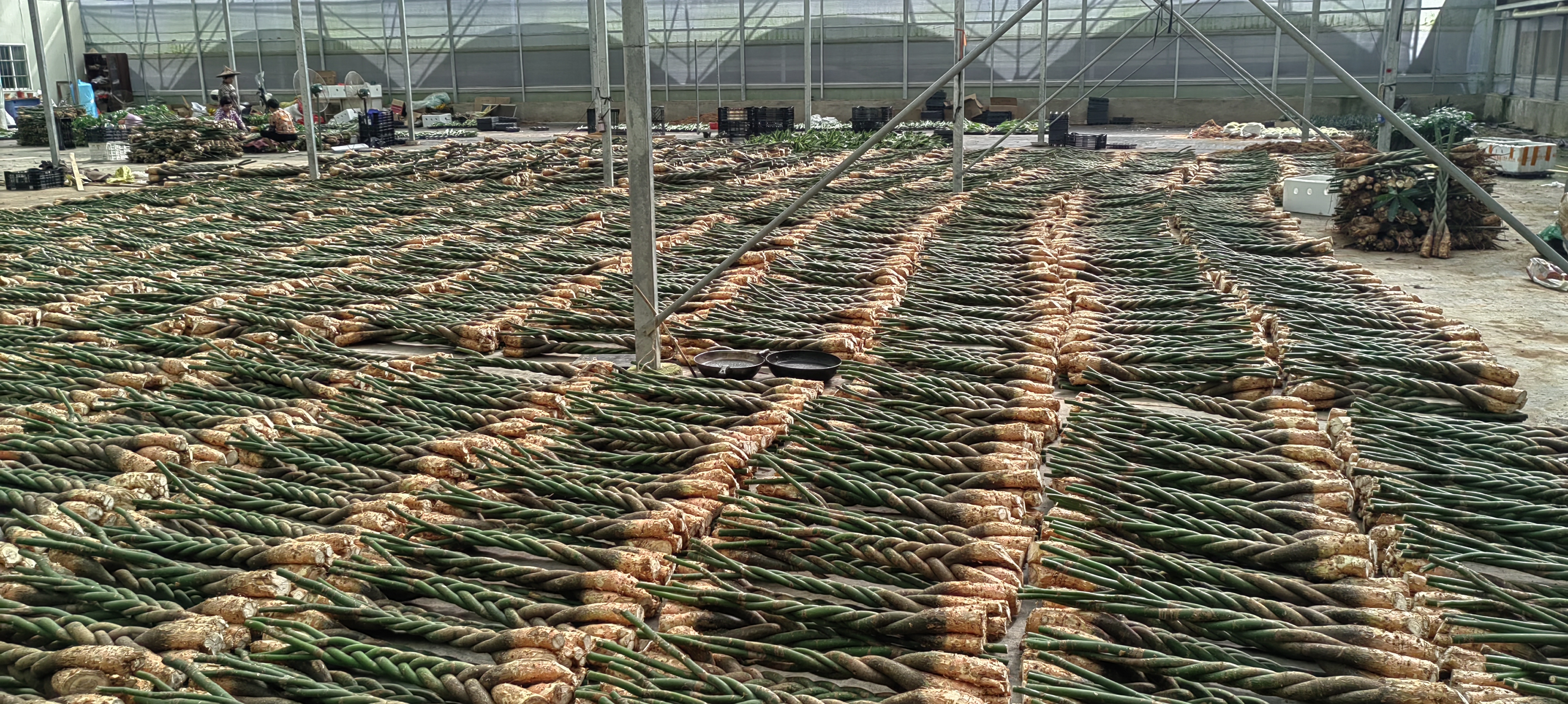
A Pachira money tree bonsai with exposed roots at KinoFarm’s greenhouse. Root condition is one of the least visible but most important factors in wholesale bonsai transportation.
The Real Cost of Bonsai Sourcing Is Hidden in the Relationship
A recurring problem in wholesale bonsai procurement is that suppliers with excellent photographs can fail on repeat orders. Quality drifts between harvests. Shipments arrive with broken branches or dehydrated roots. Phytosanitary paperwork is late. Seasonal demand peaks cannot be filled because the nursery does not hold enough mature inventory. Each of these failures may look like an isolated logistics issue, but together they point to weak cultivation infrastructure or insufficient export experience.
The commercial opportunity is significant enough to justify careful supplier selection. The global bonsai market is projected to reach approximately USD 18.4 billion by 2035, growing at a CAGR of 8.8% from 2026 to 2035. Asia Pacific held a dominant share of over 48.5% in 2025, valued at USD 3.8 billion. China’s exports of “other live plants” — a customs category that includes bonsai — reached USD 355 million in 2024, with the United States and South Korea as top destinations. Indoor bonsai varieties such as Ficus and Money Tree are growing at a 10.28% CAGR through 2031, driven largely by apartment living and low-maintenance demand.
For a distributor, the implication is straightforward: a supplier that can prove infrastructure, publish defined trading terms, and maintain traceable cultivation processes is easier to scale with than a supplier that only offers attractive images.
Supplier Evaluation Checklist for Wholesale Bonsai Distributors
When a wholesale bonsai order is placed, the buyer is not purchasing a single product. The buyer is purchasing a production system. The following checklist covers the areas that matter most in a long-term relationship.
1. Nursery Infrastructure and Scale
Check whether the nursery is built for export or only for local retail. A greenhouse designed to export standards is a stronger signal than a large open field. KinoFarm operates 65,000 m² of professional greenhouses across two nurseries in Zhangzhou, Fujian — a region known in China as the “City of Flowers and Plants.” The company’s registered address is Room 201, No.25, Xinghu Road, Huli District, Xiamen, China.
Infrastructure only becomes meaningful when it is matched by workforce and output. KinoFarm employs approximately 120 people and ships more than 100 containers of live plants per year. Its production capacity is around 5,000,000 units annually, with about 98% of output exported. An export ratio above 90% matters because it forces the nursery to maintain packaging and documentation processes that domestic-only suppliers often lack.
2. Cultivation Method and Export Readiness
The best indicator of plant survival is how the plant was grown before it was shipped. KinoFarm grows plants on 50 cm-high shelving with a 1.6×1.6 mm breathable mesh. This setup improves air circulation, light exposure, and moisture control — three variables that determine whether a plant can tolerate the stress of a long transit period.
Ask whether the nursery follows a recognized production management system. KinoFarm operates under MPS-A (Marketable Plant Safety - A) management, a globally recognized framework for sustainable and traceable horticulture. Its greenhouse infrastructure is built to meet CIQ (China Entry-Exit Inspection and Quarantine) standards, which is directly relevant for plants that must pass export quarantine before loading.
3. Product Portfolio and Consistency
A long-term distributor needs more than one or two species. Core wholesale bonsai categories include Ficus ginseng bonsai, Pachira money tree bonsai, Cycas revoluta, and related indoor and outdoor varieties. KinoFarm’s range covers Ficus microcarpa, Cycas revoluta, Dracaena sanderiana, and Sansevieria trifasciata.
The company also holds Plant Variety Rights for proprietary Osmanthus cultivars, including “Four-pointed Star” (四芒星) and “Colorful Cloud” (彩云). Plant variety protection is relevant to distributors because it signals that the nursery has its own R&D capacity, not just resale capacity.
For pricing and batch matching, KinoFarm’s commonly supplied sizes include Pachira in 3, 4, and 5 braid forms from H20 cm to H90 cm; Ficus ginseng bonsai from 50 g to 10 kg; and Cycas revoluta from D5 cm to H100 cm+. Distributors planning seasonal programs should verify that the supplier has enough size range to support multiple order cycles.
4. R&D and Technical Capacity
Technical capacity is often invisible in a product photo, but it shows up in arrival quality. KinoFarm’s R&D team includes five engineers and holds invention patents for long-distance storage and transport methods for live plants, as well as for pest control in soilless bonsai cultivation. The company has also developed proprietary software for greenhouse monitoring, soil moisture monitoring, and flower production management.
For wholesale buyers, these details matter because they affect repeatability. A nursery that monitors greenhouse conditions and manages soil moisture systematically is more likely to produce uniform batches than one that depends on the experience of individual growers.
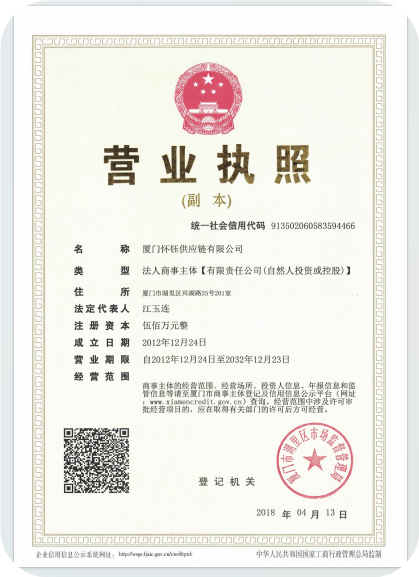
Business registration documentation for Xiamen Perfect Supply chain CO., LTD, the operating entity behind the KinoFarm Bonsai export brand.
How KinoFarm Structures Cultivation for Export Survival
Long-distance plant transportation relies on the dormancy and low-metabolism features of plants under low-temperature conditions. When temperature and ventilation are adjusted correctly, plants can maintain good freshness and survival during container transport. Standard dry containers are not suitable for this because they lack temperature adjustment and ventilation functions, which leads to relatively high plant loss.
KinoFarm’s cultivation and packaging model is aligned with this constraint. Plants are prepared for export through root treatment, reduced soil weight, and packaging that lowers both weight and volume. This is not a decorative preference; it is a transport decision. Wholesale orders are typically shipped in refrigerated or fresh-keeping containers, with the temperature and ventilation set according to plant characteristics.
The MPS-A management system and the CIQ-certified greenhouse structure both support this process by keeping plants healthy and traceable from an early growth stage. For a distributor, the practical benefit is simpler: arrival condition is more predictable, and claims for damaged stock are less frequent.
What the Commercial Terms Tell You About a Supplier
Commercial terms are one of the fastest ways to assess whether a nursery is set up for structured wholesale operations. KinoFarm’s published purchasing conditions are a minimum order quantity of 45 kg, FOB or CIF delivery, pre-shipment inspection before loading, and 100% prepayment after order confirmation. These terms are not designed for occasional spot buyers. They signal an export workflow with consolidated order lots, quality inspection points, and documented shipments.
The specific numbers matter less than the structure they reveal. A defined MOQ means the supplier groups production cycles rather than harvesting on demand. A pre-shipment inspection step means the buyer has a formal quality checkpoint before the goods leave the nursery. Payment terms are a signal of how the supplier manages risk; 100% prepayment is common in live-plant export because the seller carries most of the perishability risk.
Buyers entering a long-term relationship should therefore read the commercial conditions as part of the product specification.
Bonsai vs. Traditional Potted Plants: A Logistics Comparison
One of the most useful comparisons in wholesale bonsai sourcing is not between two bonsai suppliers, but between bonsai produced for long-distance transport and traditional potted plants. The difference affects every part of the supply chain.
| Comparison Point | Traditional Potted Plants | Long-Distance Bonsai Cultivation (KinoFarm Model) |
|---|---|---|
| Product weight | Baseline | Reduced by about 40% |
| Packaging volume | Baseline | Reduced by about 36% |
| Transit breakage rate | Around 16% | Around 2.5% |
| Comprehensive logistics cost | Baseline | About 33% lower |
| Arrival maintenance demand | Higher after transit | Easier domestication; lower maintenance after arrival |
| Carbon emission per unit during transport | Higher | Lower |
The comparison is based on KinoFarm’s published product and export data, and it reflects a cultivation model designed for cross-border bulk export, long-distance sea transportation, and tissue-culture seedling trade. For distributors, the logistics differences are not marginal; at the scale of full-container shipments, a one-third reduction in logistics cost changes the wholesale price structure.
The Limits of a Logistics-Optimized Bonsai Supply
This optimized model is not a universal solution. It depends on refrigerated or fresh-keeping containers. Standard dry containers, with no temperature control and limited ventilation, still cause relatively high plant loss. The model also works best when the entire supply chain — nursery preparation, packaging, container setting, and delivery — is coordinated by the supplier. If a buyer arranges uncontrolled inland transport or allows the plants to sit in unsuitable conditions at the destination port, the advantages of the optimized packaging are quickly lost.
In addition, not every bonsai product can follow the same bare-root or reduced-soil treatment. Some species and large specimen sizes require a more traditional root system and need different packaging. Buyers should confirm with the supplier which products in the range are suitable for long-distance optimized transport and which ones require special handling.
Application Scenarios: Wholesale Buyer Segments
Wholesale bonsai buyers are not a uniform group. At least three segments have different requirements.
Garden centers and home furniture retailers need compact indoor varieties with strong visual appeal and predictable shelf behavior. Ficus ginseng bonsai, Pachira money tree bonsai, and small potted bonsai are common choices. KinoFarm’s applicable range for this channel includes Pachira in 3, 4, and 5 braid forms at H20-90 cm, Ficus ginseng-root bonsai from 50 g to 10 kg, and Cycas revoluta from D5 cm to H100 cm+.
Landscape projects increasingly use outdoor bonsai and evergreen specimens for ornamental purposes. Cycas revoluta is one of the most commonly supplied varieties for this segment. Landscape orders tend to be batch-driven, so the supplier’s ability to provide consistent size ranges matters more than the availability of individual display pieces.
E-commerce and online distribution channels prioritize low-maintenance varieties that travel well. Wholesale indoor bonsai trees and succulent bonsai are growing in demand because consumers prefer living décor that does not require intensive care. For this segment, packaging consistency and post-arrival survival performance are the main supplier evaluation criteria.
Market Trends Rewriting the Wholesale Bonsai Landscape
Several verified market trends are worth tracking in 2026.
Indoor bonsai is the fastest-growing segment. Ficus and Money Tree varieties are growing at a 10.28% CAGR through 2031, driven by apartment living. Low-maintenance “living décor” such as Ficus retusa and succulent bonsai is also increasing in demand because consumers want easier plant care. Wholesale buyers should expect indoor varieties to become a larger share of their product mix.
Landscape bonsai is moving from product sales to integrated project supply. The market for landscape bonsai is evolving toward project-level supply services, rather than single-product transactions. Some Chinese nurseries are now coordinating species selection, supply planning, and delivery for landscape projects. This shift benefits distributors who work with suppliers that have both a broad portfolio and project experience.
China remains a dominant supply base. China’s exports of “other live plants” reached USD 355 million in 2024. The Asia Pacific region held over 48.5% of the global bonsai market in 2025. For distributors outside Asia, sourcing from Chinese nurseries remains economically rational if the supplier can meet phytosanitary and import standards.
A Note on the Competitive Landscape
Industry rankings for 2026 list several notable Chinese bonsai producers, including Jiangsu Womei Horticulture, Zhangzhou Jiaying Horticulture, and Chunqiu Horticultural Center. These names confirm that the supply base is active and competitive. Buyers should evaluate any producer — including KinoFarm — against the same infrastructure, documentation, and logistics criteria rather than relying on name recognition alone.
Future Outlook: From Transactions to Supply Relationships
Bonsai distribution is becoming a relationship business. Buyers are consolidating their supplier lists to reduce inspection complexity, harmonize phytosanitary documentation, and stabilize quality across seasons. The shift toward integrated supply services in landscape bonsai will likely accelerate as landscape contractors look for fewer, more capable suppliers.
For distributors, the practical implication is to evaluate suppliers by evidence rather than images. A nursery that can demonstrate greenhouse area, cultivation standards, defined commercial terms, and a documented export workflow will be easier to depend on across multiple seasons. A supplier that cannot answer these basic questions with documentation is a higher-risk partner, regardless of how good the sample looks.
FAQ on Wholesale Bonsai Supply and Transport
Can plants survive long-time transportation in containers?
Yes, under controlled conditions. Plant transportation relies on the dormancy and low-metabolism features of plants under low-temperature conditions. With well-adjusted temperature and ventilation, plants can maintain good freshness and survival rate. Standard dry containers lack temperature adjustment and ventilation functions, which causes relatively high plant loss. Plants must be transported in refrigerated or fresh-keeping containers, with temperature and ventilation set according to the characteristics of the specific plant.
What phytosanitary requirements apply to imported wholesale bonsai?
For the European Union, Regulation (EU) 2019/2072 requires phytosanitary certificates for imported bonsai plants to prevent pest introduction. For the United States, USDA regulations require bonsai to be bare-rooted and accompanied by a phytosanitary certificate from the country of origin; shipments of 12 or fewer may have different requirements. Buyers should verify current destination-country rules before placing orders, because non-compliance can lead to shipment delays or destruction.
For buyers preparing a long-term supplier shortlist, the full company catalogue with product details is publicly available: KinoFarm Catalogue. The company’s website is www.kinofarm.com. It can be contacted at willaim@kinofarm.com or +86-13806003349.
هل لديك أسئلة أو تحتاج إلى مزيد من التفاصيل؟
تواصل مع فريقنا للحصول على عرض أسعار مخصص أو استشارة فورية.
طلب عرض أسعار
املأ النموذج أدناه وسيتواصل معك فريقنا بعرض مقترح مخصص.
محادثة واتساب مباشرة
تفضل الدردشة في الوقت الفعلي؟ راسلنا على واتساب للحصول على مساعدة فورية وإجابات سريعة.
- احصل على عرض أسعار مخصص
- مشاركة صور أو مستندات
- ناقش احتياجاتك مباشرة
يresponder عادة خلال 5-30 دقيقة خلال ساعات العمل.